Table of Contents9 sections
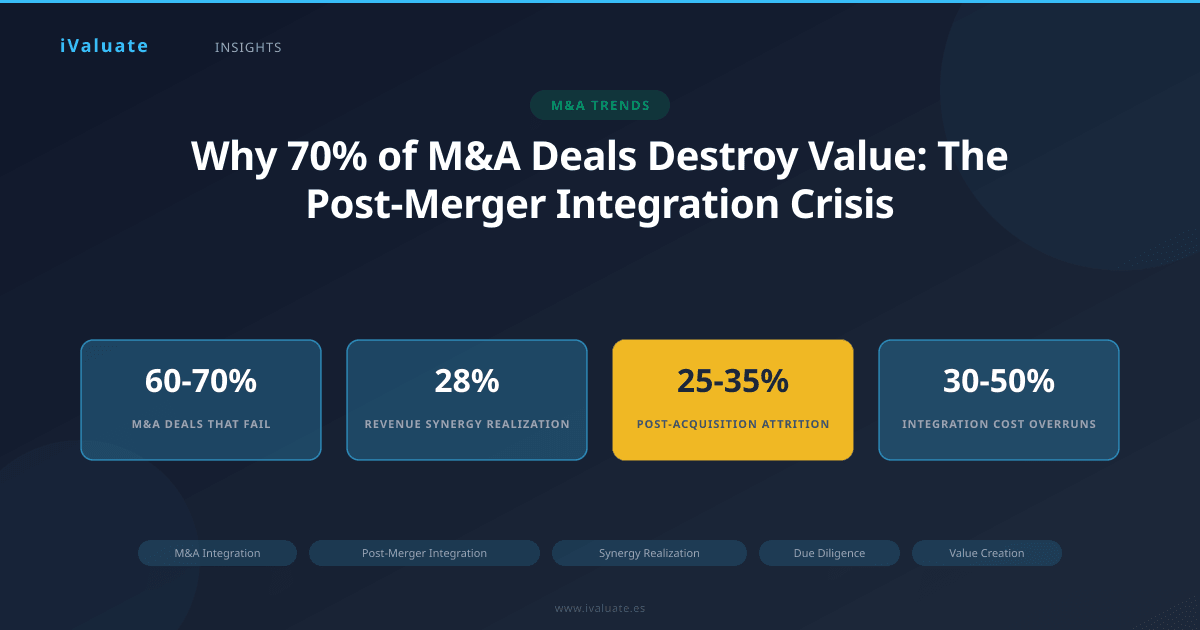
In 2024, global M&A activity rebounded to $3.2 trillion, marking a 15% increase from the prior year as dealmakers emerged from the interest rate shock that characterized 2022-2023. Yet beneath these impressive headlines lies a sobering reality: between 60% and 70% of these transactions will fail to create the shareholder value their architects promised. This isn't a new phenomenon—it's a persistent pattern that has plagued corporate development for decades, costing shareholders hundreds of billions annually.
The culprit isn't typically the deal thesis itself. Most acquisitions are grounded in sound strategic logic: market consolidation, capability acquisition, geographic expansion, or digital transformation. The value destruction occurs in the critical 12-24 months following deal close—during post-merger integration (PMI). Understanding why integration fails so consistently, and how sophisticated due diligence can mitigate these risks, has become essential knowledge for corporate development professionals, private equity investors, and business owners navigating today's complex M&A landscape.
01 The Anatomy of Post-Merger Integration Failure
Post-merger integration represents the operational phase where deal thesis meets organizational reality. It encompasses everything from IT systems consolidation and workforce rationalization to customer retention and culture alignment. The statistics paint a stark picture of how frequently this process derails value creation:
- Only 30% of acquisitions achieve their stated synergy targets within the projected timeframe
- 47% of acquired companies experience significant customer attrition in the first 18 months post-close
- Employee turnover at target companies averages 25-35% higher than baseline in the two years following acquisition
- Integration costs typically exceed initial estimates by 30-50%, directly eroding deal economics
These failures manifest across multiple dimensions simultaneously. A technology company acquiring a competitor might successfully consolidate data centers and eliminate duplicate overhead, yet lose the engineering talent that made the target valuable in the first place. A consumer goods manufacturer might achieve procurement synergies while watching brand equity erode due to misaligned marketing strategies.
The Four Primary Failure Modes
Analysis of failed integrations reveals four recurring patterns that account for the majority of value destruction:
1. Cultural Incompatibility and Organizational Rejection
Culture isn't a soft issue—it's the operating system that determines how decisions get made, how information flows, and how employees respond to change. When a hierarchical, process-driven acquirer purchases an entrepreneurial, innovation-focused target, the resulting friction can paralyze both organizations. A 2024 study by McKinsey found that cultural misalignment was cited as the primary failure factor in 42% of unsuccessful integrations, up from 33% a decade ago.
Consider the cautionary tale of a Fortune 500 financial services firm that acquired a fintech startup in 2023 for $850 million. The acquirer's 18-month approval cycles and risk-averse culture clashed violently with the target's rapid iteration model. Within 14 months, 60% of the startup's product team had departed, the innovation pipeline stalled, and the strategic rationale for the acquisition evaporated. The acquirer ultimately wrote down $520 million of goodwill.
2. Synergy Overestimation and Realization Failure
Deal models routinely project synergies that prove elusive in practice. Revenue synergies are particularly problematic—research indicates that only 28% of projected revenue synergies materialize as modeled. Cost synergies fare better but still underperform, with actual realization averaging 65-70% of projections.
The gap stems from several factors: underestimating integration complexity, overlooking interdependencies between cost centers, and failing to account for business disruption during transition. When a pharmaceutical company eliminates "redundant" sales positions post-acquisition, it may discover those roles served distinct customer segments or therapeutic areas. The cost savings appear on paper, but revenue erosion follows six months later.
3. Operational Disruption and Customer Defection
Integration activities inevitably divert management attention from day-to-day operations. Sales teams focus on internal reorganization rather than customer relationships. Product development slows as teams navigate new approval processes. Service quality deteriorates as support systems are consolidated.
The customer impact can be devastating. A 2025 analysis of B2B acquisitions found that targets experienced an average 12% revenue decline in the first full year post-close, driven primarily by customer attrition and reduced wallet share. In competitive markets with low switching costs, this disruption creates opportunities for rivals to permanently capture market share.
4. Key Talent Exodus
Human capital represents the primary value driver in knowledge-intensive acquisitions—technology, professional services, healthcare, and creative industries. Yet integration processes often treat people as interchangeable resources rather than irreplaceable assets.
Retention challenges intensify when acquirers impose rigid compensation structures, eliminate autonomy, or signal that target company employees are second-class citizens. The departure of 10-15 key individuals can destroy more value than any operational synergy might create. This is particularly acute in technology acquisitions, where a handful of engineers or product managers may represent the core intellectual property being acquired.
02 The Due Diligence Gap: Where Deals Go Wrong Before They Close
The foundation for integration success—or failure—is laid during due diligence. Yet traditional due diligence processes remain heavily weighted toward financial and legal analysis, with insufficient rigor applied to operational, cultural, and integration planning dimensions.
A comprehensive review of 200 middle-market transactions completed between 2022-2024 revealed that buyers spent an average of 65% of due diligence time and resources on financial and legal workstreams, 25% on commercial and operational assessment, and only 10% on integration planning and cultural evaluation. This allocation is precisely inverted from what drives post-close success.
Financial Due Diligence: Necessary but Insufficient
Financial due diligence excels at identifying historical performance issues, working capital requirements, and quality of earnings adjustments. These insights directly impact valuation and deal structure. However, financial DD rarely illuminates the operational interdependencies, customer concentration risks, or organizational capabilities that determine integration feasibility.
For example, financial analysis might confirm that a target achieved 18% EBITDA margins. What it typically won't reveal is that those margins depend on a single procurement manager's relationships with key suppliers, or that the customer service organization is held together by informal networks that will dissolve under new ownership.
Operational Due Diligence: The Missing Link
Sophisticated buyers have increasingly recognized that operational due diligence—deep assessment of business processes, systems architecture, organizational capabilities, and customer relationships—provides the insights that actually predict integration success.
Effective operational DD examines:
- Process maturity and documentation: Can key processes be understood, replicated, and improved? Or do they exist only in the heads of long-tenured employees?
- Systems architecture and technical debt: What's the true cost and timeline for IT integration? Where are the hidden dependencies?
- Organizational capability gaps: Does the target possess the functional expertise to operate independently or within the acquirer's model?
- Customer relationship mapping: Which relationships are institutional versus personal? What's the risk of defection under new ownership?
- Supplier and partner dependencies: Are there single points of failure in the value chain? Will key relationships survive ownership change?
A private equity firm's 2024 acquisition of a specialty distribution business illustrates the value of rigorous operational DD. Initial financial analysis suggested straightforward margin expansion through procurement leverage and overhead reduction. However, detailed operational assessment revealed that the target's superior service levels—which commanded premium pricing—depended on a decentralized inventory model that would be destroyed by the planned consolidation. Armed with this insight, the buyer restructured the integration approach, preserved the service model, and achieved 94% of projected synergies versus the 60% typical in the sector.
Cultural Due Diligence: From Soft Issue to Strategic Imperative
Cultural assessment has evolved from optional to essential, particularly for deals where human capital drives value. Leading acquirers now deploy structured cultural due diligence frameworks that assess:
- Decision-making processes and speed
- Risk tolerance and innovation orientation
- Communication styles and information flow
- Performance management and accountability systems
- Leadership approaches and management philosophy
These assessments identify potential friction points and inform integration planning. A collaborative, consensus-driven culture won't seamlessly adopt a command-and-control model. A startup accustomed to rapid experimentation will struggle under enterprise governance frameworks. Identifying these gaps during diligence allows buyers to either adjust the integration approach or, in extreme cases, reconsider the transaction entirely.
The most successful acquirers view cultural due diligence not as a veto mechanism, but as an integration planning tool. The goal isn't cultural identity—it's understanding differences well enough to bridge them effectively.
03 Integration Planning: The Bridge Between Diligence and Execution
The highest-performing acquirers begin integration planning during due diligence, not after deal close. This parallel-path approach ensures that integration strategies are grounded in deep operational understanding and that Day 1 readiness is achieved.
The Integration Management Office (IMO)
Sophisticated buyers establish a dedicated Integration Management Office staffed with experienced program managers, functional leads, and change management specialists. The IMO serves as the central coordination point for integration activities, tracking synergy realization, managing interdependencies, and escalating issues.
Effective IMOs operate with several key principles:
- Clear governance and decision rights: Integration decisions require speed. Ambiguous authority structures create bottlenecks that delay synergy realization and frustrate both organizations.
- Detailed synergy tracking: Each synergy initiative requires an owner, timeline, dependencies, and monthly progress reporting. Vague commitments to "optimize procurement" or "rationalize facilities" never materialize.
- Risk monitoring and mitigation: The IMO maintains a dynamic risk register, tracking customer defection signals, key employee flight risks, operational disruptions, and synergy realization delays.
- Communication cadence: Integration creates uncertainty. Regular, transparent communication—even when the message is "we're still deciding"—reduces anxiety and speculation.
The First 100 Days: Critical Actions and Common Pitfalls
The initial post-close period establishes momentum and signals priorities. Research consistently shows that deals with strong first-100-day execution achieve 1.5-2.0x higher synergy realization rates than those with slow starts.
Critical early actions include:
Day 1 Operational Readiness: Basic blocking and tackling—legal entity structure, banking relationships, payroll continuity, customer communication—must execute flawlessly. Operational stumbles in the first week create lasting credibility damage.
Leadership Alignment and Role Clarity: The combined organization's leadership team should be announced by Day 1, with clear reporting relationships and decision rights. Prolonged ambiguity about "who's in charge" paralyzes decision-making and accelerates talent attrition.
Customer and Stakeholder Communication: Key customers, suppliers, and partners should hear about the transaction from the company, not from media reports. The message should emphasize continuity, commitment, and enhanced capabilities.
Quick Wins and Visible Progress: Early synergy realization—even small wins—builds credibility for the integration program and demonstrates that the combination creates value. These might include consolidated purchasing agreements, eliminated duplicate subscriptions, or cross-selling pilot programs.
04 Synergy Realization: From Spreadsheet to Reality
The gap between modeled synergies and realized value represents one of the most significant sources of M&A disappointment. Deal models routinely project synergies that prove elusive, not because they're theoretically impossible, but because execution proves far more complex than anticipated.
Cost Synergies: The More Achievable Target
Cost synergies—eliminating redundant functions, consolidating facilities, leveraging procurement scale—are more predictable than revenue synergies, yet still underperform. Analysis of 150 transactions completed between 2021-2024 found that actual cost synergy realization averaged 68% of initial projections, with a median timeline 1.4x longer than modeled.
Common cost synergy pitfalls include:
- Underestimating one-time costs: Severance, lease terminations, system migrations, and facility closures often cost 30-50% more than initial estimates
- Overlooking interdependencies: Eliminating a "redundant" finance function may work on paper, but if that team also managed customer billing, the downstream disruption erodes the savings
- Regulatory and contractual constraints: Union agreements, customer contracts, and regulatory requirements may prevent or delay planned consolidations
- Hidden costs of complexity: Operating two ERP systems costs more than one, but migration projects routinely exceed budgets and timelines by 2-3x
Revenue Synergies: High Potential, Low Probability
Revenue synergies—cross-selling, geographic expansion, product bundling—offer compelling upside but prove notoriously difficult to capture. Only 28% of projected revenue synergies materialize as modeled, and the timeline typically extends 2-3 years beyond initial projections.
The challenge stems from multiple factors. Sales teams resist selling unfamiliar products. Customers view bundled offerings skeptically. Integration activities distract from core selling efforts. And the assumed complementarity of product lines or customer bases often proves weaker than anticipated.
A 2024 case illustrates the challenge: A software company acquired a complementary platform with the thesis that cross-selling would drive 25% revenue growth in the combined customer base. Eighteen months post-close, cross-sell penetration reached only 8%. The barrier wasn't product fit—it was that the target's sales team operated on relationship-based selling while the acquirer used a transactional model. The cultural and process gap prevented the revenue synergy from materializing.
Experienced acquirers heavily discount revenue synergies in valuation models, treating them as upside rather than base case. Cost synergies drive deal economics; revenue synergies provide option value.
05 The Technology Integration Challenge
In an era where every company is a technology company, IT integration has evolved from back-office concern to strategic imperative. Yet technology integration remains one of the most underestimated aspects of PMI, both in terms of cost and timeline.
The 2025 landscape presents unique challenges. Legacy on-premise systems coexist with cloud platforms. Data privacy regulations (GDPR, CCPA, emerging frameworks) complicate data consolidation. Cybersecurity risks multiply during transition periods when systems are interconnected but not fully integrated.
The Integration Spectrum: From Coexistence to Full Consolidation
Not every acquisition requires complete technology integration. The appropriate approach depends on strategic rationale, operational interdependencies, and risk tolerance:
Standalone Operation: The target maintains separate systems indefinitely. This approach suits financial acquisitions where operational independence is desired, or where integration risk outweighs synergy potential. Integration is limited to financial reporting consolidation.
Selective Integration: Core systems (ERP, HRIS) are consolidated, but customer-facing or specialized systems remain separate. This balances synergy capture with operational risk and preserves unique capabilities.
Full Integration: All systems are consolidated onto the acquirer's platforms. This maximizes synergies but requires significant investment, extended timelines, and carries substantial execution risk.
A 2024 analysis of technology integrations found that full consolidation projects averaged 18-24 months and cost 2.1x initial estimates. Selective integration approaches achieved 70-75% of potential synergies at 40% of the cost and half the timeline.
06 Measuring Integration Success: Beyond Financial Metrics
Traditional integration scorecards focus heavily on synergy realization and cost savings. While these metrics matter, they provide an incomplete picture of integration health. Leading acquirers have developed more comprehensive measurement frameworks that include:
- Customer metrics: Retention rates, Net Promoter Score, wallet share, and win rates versus pre-acquisition baseline
- Employee metrics: Voluntary attrition (overall and for key talent segments), engagement scores, and time-to-productivity for new hires
- Operational metrics: On-time delivery, quality metrics, system uptime, and other KPIs that indicate operational health
- Innovation metrics: New product velocity, R&D productivity, and patent filings—particularly critical for acquisitions motivated by innovation or capability
These broader metrics often reveal problems before they impact financial results. Rising customer complaints or declining employee engagement are leading indicators of value erosion, providing opportunity for corrective action.
07 The Role of Professional Advisors and Tools
Given the complexity and high failure rates of M&A integration, sophisticated buyers increasingly leverage specialized advisors and analytical tools throughout the deal lifecycle.
Integration consultants bring pattern recognition from dozens of prior deals, helping buyers avoid common pitfalls and accelerate synergy realization. Their value is highest in complex situations: cross-border deals, large-scale integrations, or transactions in unfamiliar sectors.
Technology platforms have also evolved to support the M&A lifecycle. Modern valuation and due diligence tools enable more rigorous analysis during the pre-close phase, helping buyers understand integration complexity and risk before committing capital. Platforms like iValuate allow professionals to model various integration scenarios, stress-test synergy assumptions, and quantify the value impact of different integration approaches—analysis that was previously feasible only for the largest transactions.
Project management platforms designed specifically for M&A integration provide structure for tracking hundreds of integration tasks, managing interdependencies, and reporting progress to stakeholders. These tools don't guarantee success, but they significantly reduce the risk of execution failures driven by poor coordination or lost visibility.
08 Looking Forward: Integration in an Evolving M&A Landscape
As we move through 2025 and into 2026, several trends are reshaping the M&A integration landscape:
Increased Regulatory Scrutiny: Antitrust authorities globally are taking harder looks at acquisitions, particularly in technology and healthcare. This scrutiny extends into the integration phase, with regulators monitoring compliance with behavioral remedies and market commitments. Integration plans must account for these constraints.
Remote and Hybrid Work Models: The post-pandemic shift to distributed work models complicates cultural integration and relationship building. The informal interactions that traditionally facilitated integration—hallway conversations, after-work gatherings—no longer occur organically. Successful integrators are developing new approaches to culture building in hybrid environments.
ESG Integration: Environmental, social, and governance considerations increasingly influence M&A strategy and integration planning. Buyers must integrate sustainability reporting, assess climate risk across the combined portfolio, and align social impact initiatives—adding complexity to already challenging integrations.
AI and Automation: Artificial intelligence and automation technologies are creating new opportunities for post-merger value creation, particularly in back-office consolidation and process optimization. However, they also introduce new integration challenges around data governance, algorithm bias, and workforce transition.
09 Conclusion: Integration as Competitive Advantage
The persistent 60-70% failure rate in M&A value creation isn't inevitable—it's a reflection of inadequate preparation, insufficient rigor in due diligence, and poor execution during the critical post-close period. The acquirers who consistently create value through M&A share common characteristics: they invest heavily in operational and cultural due diligence, they begin integration planning during the diligence phase, they establish strong governance and program management, and they measure success through comprehensive metrics beyond financial synergies.
For corporate development professionals, private equity investors, and business owners navigating today's complex M&A environment, the message is clear: integration capability represents a sustainable competitive advantage. Organizations that build institutional expertise in post-merger integration—through dedicated resources, structured methodologies, and sophisticated analytical tools—will capture the value that eludes their less-prepared competitors.
The stakes are substantial. In a $3+ trillion annual M&A market, the difference between 30% and 70% success rates represents hundreds of billions in shareholder value. As deal activity continues to accelerate in 2025-2026, driven by digital transformation imperatives, industry consolidation, and generational ownership transitions, the ability to execute successful integrations will increasingly separate winning acquirers from those who destroy value.
Professional tools and platforms, including iValuate, have made sophisticated integration analysis accessible to a broader range of market participants, democratizing capabilities that were previously available only to the largest strategic buyers and top-tier private equity firms. This evolution enables more rigorous pre-deal analysis, better-informed integration planning, and ultimately, higher success rates across the M&A landscape.
The question for dealmakers isn't whether integration is difficult—it demonstrably is. The question is whether they'll invest in the capabilities, processes, and tools required to beat the odds and join the 30% who consistently create value through acquisition.