Table of Contents9 sections
In the increasingly competitive M&A landscape of 2025-2026, vendor due diligence (VDD) reports have evolved from a tactical advantage to a near-universal expectation in mid-market and large-cap transactions. As sellers seek to accelerate deal timelines and maximize valuations in a market characterized by elevated interest rates and selective buyer appetite, the strategic deployment of sell-side due diligence has become a defining feature of sophisticated transaction processes.
For buyers, however, the presence of a professionally prepared VDD report presents both opportunities and challenges. While these documents can significantly compress transaction timelines and reduce information asymmetry, they also require careful interpretation, independent verification, and a nuanced understanding of their inherent limitations. This article examines the mechanics, benefits, and pitfalls of vendor due diligence from the buyer's perspective, providing a framework for effectively leveraging these reports while protecting against their potential blind spots.
01 The Evolution and Current State of Vendor Due Diligence
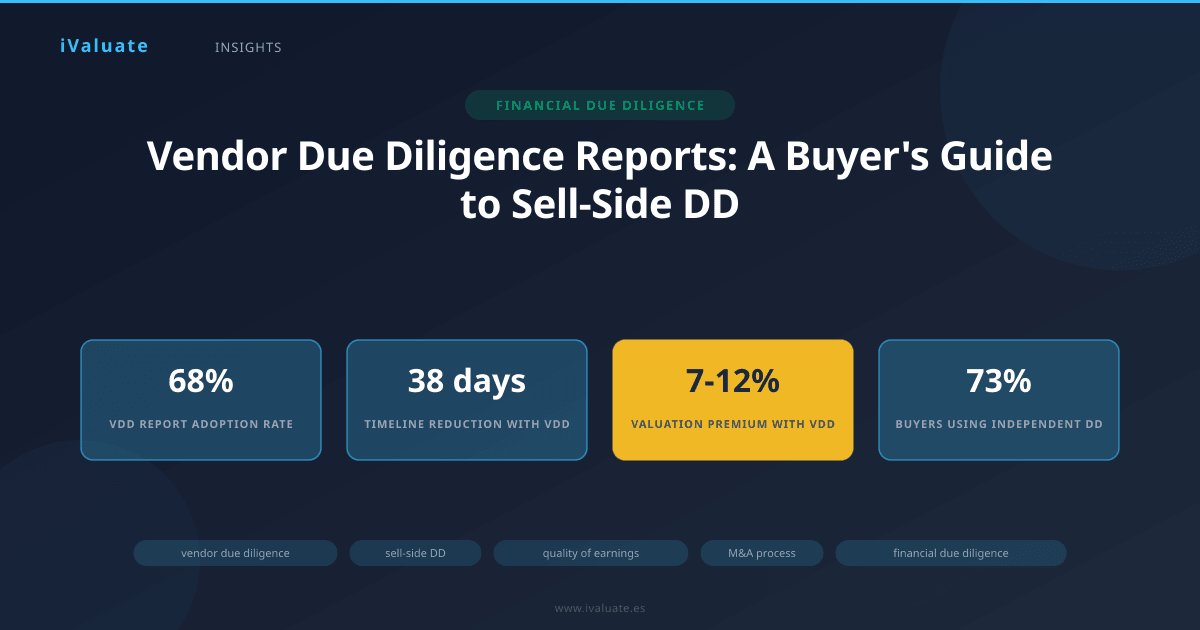
Vendor due diligence emerged in the late 1990s as an innovation in auction processes, but its adoption has accelerated dramatically over the past decade. Recent market data indicates that approximately 68% of private equity-backed sales processes in 2024-2025 included some form of sell-side financial or commercial due diligence, compared to just 42% in 2018. This shift reflects several converging market dynamics:
- Compressed transaction timelines: Average time from LOI to close has decreased from 127 days in 2019 to 89 days in 2025 for transactions with VDD reports
- Increased competition: With dry powder in private equity exceeding $2.8 trillion globally, sellers leverage VDD to manage multiple bidders efficiently
- Quality of earnings standardization: The professionalization of quality of earnings (QoE) methodologies has made sell-side financial due diligence more credible and actionable
- Remote diligence normalization: Post-pandemic acceptance of virtual data rooms and remote diligence has made centralized sell-side reports more practical
The typical VDD package in 2025 includes a financial due diligence report (often called a quality of earnings report), a commercial due diligence report, and increasingly, operational, IT, or ESG due diligence components. The financial VDD alone typically ranges from 80 to 200 pages and represents an investment of $150,000 to $500,000 by the seller, depending on target complexity and revenue scale.
02 The Strategic Advantages of Vendor Due Diligence
Accelerated Transaction Timelines
The most tangible benefit of VDD reports is timeline compression. In a traditional buyer-led diligence process, the buyer typically requires 60-90 days post-LOI to complete financial, commercial, and operational due diligence. With a comprehensive VDD package, this timeline can compress to 30-45 days, as buyers can focus their limited diligence window on validation and specific areas of concern rather than foundational analysis.
This acceleration matters significantly in competitive processes. Data from mid-market transactions in 2024 shows that deals with VDD reports closed an average of 38 days faster than those without, and sellers achieved valuations averaging 7-12% higher, controlling for other factors. The speed advantage allows sellers to maintain deal momentum and reduces the risk of material adverse changes or market disruptions derailing transactions.
Enhanced Information Quality and Consistency
A well-executed VDD report provides several information advantages that benefit both parties. The sell-side advisor works directly with management over several weeks to understand the business model, normalize earnings, and identify adjustments. This process often surfaces issues early—allowing sellers to address them proactively—and creates a single, consistent narrative that all bidders evaluate simultaneously.
For buyers, this consistency is valuable. Rather than each bidder developing different EBITDA normalizations based on varying interpretations of management presentations, the VDD report establishes a common analytical foundation. In my experience advising on transactions, I've observed that deal processes with quality VDD reports experience 40-50% fewer post-LOI EBITDA disputes compared to traditional processes.
Risk Identification and Management
Counterintuitively, a thorough VDD report often identifies risks and issues that might otherwise remain hidden until late-stage buyer diligence. Professional sell-side advisors understand that undisclosed issues discovered during buyer diligence create far more valuation damage than issues transparently addressed upfront. A comprehensive VDD report that candidly discusses customer concentration, working capital requirements, or revenue recognition complexities actually builds buyer confidence and reduces the risk of late-stage repricing.
A 2024 study of 340 middle-market transactions found that deals with comprehensive VDD reports experienced post-close purchase price adjustments 31% less frequently than those without, suggesting that sell-side diligence improves earnings quality and reduces post-close disputes.
03 The Limitations and Risks of Relying on Vendor Due Diligence
Inherent Conflicts of Interest
The fundamental limitation of any VDD report is the conflict of interest embedded in its creation. The sell-side advisor is hired, compensated, and directed by the seller, creating an inherent bias toward presenting the target in the most favorable light possible. While reputable advisors maintain professional standards and risk their reputation by producing misleading reports, the scope, emphasis, and framing of analysis inevitably reflect the seller's interests.
This conflict manifests in several ways. Sell-side reports typically emphasize positive trends and growth opportunities while minimizing or contextualizing negative developments. EBITDA adjustments tend toward the aggressive end of the acceptable range. Revenue quality analysis may focus on overall growth while deemphasizing customer concentration or churn metrics. The report will address required topics but may not proactively explore areas the seller prefers to minimize.
Scope Limitations and Strategic Omissions
VDD reports are prepared under tight timelines—typically 4-6 weeks—and with limited scope compared to comprehensive buyer diligence. The sell-side advisor works from information the seller provides and has limited ability to independently verify data or conduct extensive third-party research. Areas commonly receiving insufficient attention in VDD reports include:
- Working capital analysis: Sell-side reports often provide historical working capital data but may not deeply analyze seasonality, structural changes, or normalized requirements
- Capex and maintenance requirements: Growth capex receives attention, but maintenance capex and deferred investments may be understated
- Customer and vendor diligence: VDD rarely includes extensive primary research with customers or suppliers
- Management depth and organizational capability: Operational due diligence may be absent or superficial
- Synergy validation: Sell-side reports describe the business but don't validate buyer-specific synergies or integration risks
In one transaction I advised on in 2024, the VDD report presented a compelling growth narrative supported by a 24% revenue CAGR over three years. However, buyer diligence revealed that 60% of growth came from a single customer relationship dependent on a personal relationship with the founder, who was exiting. The VDD report disclosed the customer concentration but didn't emphasize the relationship dependency or succession risk—a framing choice that significantly impacted valuation.
The Reliance Letter Paradox
Most VDD reports are accompanied by a reliance letter that allows buyers to rely on the report's contents and, critically, provides recourse against the advisor if the report contains material misstatements. However, these letters contain significant limitations that buyers must understand:
Liability caps: Reliance letters typically cap the advisor's liability at a multiple of their fees—commonly 3-5x. For a $300,000 VDD engagement, maximum recovery might be $900,000 to $1.5 million, a fraction of potential losses on a $50-100 million transaction.
Exclusions and qualifications: Reliance letters exclude liability for information provided by management, projections, and matters outside the explicit scope of work. They also typically require that buyers conduct their own diligence and not rely solely on the VDD report.
Practical recovery challenges: Pursuing claims against advisors is time-consuming, expensive, and requires proving that misstatements were material and that the advisor failed to meet professional standards—a high bar given the judgment involved in due diligence.
The reliance letter therefore provides limited practical protection. Its primary value is ensuring the sell-side advisor has professional liability insurance and creating reputational incentives for quality work, rather than providing meaningful financial recourse for buyers.
04 Best Practices for Buyers Evaluating VDD Reports
Critical Reading and Gap Analysis
Sophisticated buyers approach VDD reports as a starting point rather than a conclusion. The first step is critical reading focused on identifying what the report emphasizes, what it minimizes, and what it omits entirely. Key questions include:
- What EBITDA adjustments are included, and are they recurring or non-recurring? How do they compare to industry norms?
- How is revenue quality assessed? What metrics on customer retention, churn, or concentration are absent?
- What trends are emphasized in the executive summary versus buried in appendices?
- What qualifications or limitations does the advisor note in their scope or assumptions?
- What areas does the report explicitly state require further buyer diligence?
Following this critical reading, buyers should prepare a gap analysis identifying areas requiring focused buyer diligence. This typically includes deep dives on working capital, customer concentration, key person dependencies, and any areas where the VDD analysis seems superficial or overly optimistic.
Focused Confirmatory Diligence
Rather than duplicating the entire VDD analysis, sophisticated buyers conduct focused confirmatory diligence in three categories:
Validation: Testing key VDD conclusions through independent analysis. This might include recalculating EBITDA adjustments, analyzing revenue quality through different lenses, or stress-testing growth assumptions.
Deep dives: Conducting extensive analysis in areas the VDD addressed superficially or identified as risks. Customer diligence, working capital modeling, and management assessment typically fall into this category.
Buyer-specific analysis: Evaluating integration risks, synergy validation, and strategic fit—areas outside VDD scope but critical to buyer decision-making.
This focused approach allows buyers to leverage VDD efficiency while protecting against its limitations. In practice, buyers typically spend 40-60% of the time and cost they would have invested in full buy-side diligence, while achieving comparable risk mitigation.
Engaging Independent Advisors Strategically
The decision of whether to engage independent buy-side advisors when a VDD report exists depends on deal size, complexity, and buyer sophistication. For transactions above $50 million enterprise value, most sophisticated buyers engage independent financial and commercial due diligence advisors even when comprehensive VDD exists. For smaller transactions or highly experienced buyers with strong internal capabilities, focused independent work on specific risk areas may suffice.
When engaging buy-side advisors in a VDD context, the scope should be explicitly designed to complement rather than duplicate the sell-side work. The buy-side advisor should focus on validating key VDD conclusions, exploring gaps and risks, and providing independent perspective on areas where seller bias is most likely to influence the VDD analysis.
In a 2025 survey of private equity deal professionals, 73% reported engaging some form of independent buy-side diligence even when comprehensive VDD reports were provided, with average buy-side diligence costs running 45-60% of what they would have been without VDD.
05 The Information Memorandum and VDD Package Integration
The information memorandum (IM) and VDD package serve complementary but distinct purposes in the sale process. The IM is a marketing document that presents the investment thesis, growth opportunities, and strategic positioning of the target. It's prepared by the investment bank or M&A advisor and is explicitly promotional in nature.
The VDD report, by contrast, is an analytical document prepared by an independent accounting or advisory firm that examines historical financial performance, normalizes earnings, and identifies risks. While both documents are seller-controlled, the VDD report carries more analytical credibility due to the advisor's professional standards and liability exposure.
Sophisticated buyers analyze the relationship between these documents carefully. Areas where the IM's growth narrative isn't fully supported by VDD analysis warrant particular scrutiny. For example, if the IM emphasizes recurring revenue and customer retention but the VDD report provides limited churn analysis or customer cohort data, buyers should conduct independent customer diligence to validate the revenue quality claims.
Similarly, if the IM projects aggressive growth but the VDD report shows historical growth driven by non-recurring factors or identifies significant customer concentration, buyers should adjust their valuation assumptions accordingly and conduct focused diligence on growth sustainability.
06 Sector-Specific Considerations in VDD Interpretation
The value and limitations of VDD reports vary significantly by sector and business model. In software and technology businesses, VDD reports in 2025 increasingly focus on revenue quality metrics including net revenue retention, customer acquisition costs, lifetime value analysis, and cohort performance. However, these reports often provide limited insight into technology architecture, technical debt, or product roadmap viability—areas requiring specialized technical diligence.
In healthcare services, VDD reports typically provide strong analysis of reimbursement trends, payer mix, and regulatory compliance, but may offer limited insight into clinical quality metrics, physician relationships, or operational efficiency compared to benchmarks. Buyers in this sector typically supplement VDD with operational and clinical diligence.
For manufacturing and distribution businesses, VDD reports generally provide solid financial analysis but may inadequately address operational efficiency, supply chain resilience, or capital intensity. The 2023-2024 supply chain disruptions and the subsequent reshoring trends have made operational diligence particularly critical in these sectors, often requiring independent assessment even when comprehensive financial VDD exists.
07 Emerging Trends in Vendor Due Diligence
Several trends are reshaping VDD practices in 2025-2026:
ESG and Sustainability Diligence
Environmental, social, and governance due diligence has rapidly evolved from a nice-to-have to a standard component of VDD packages for transactions above $100 million enterprise value. Approximately 45% of VDD packages in 2024-2025 included some form of ESG assessment, up from 18% in 2021. This reflects both regulatory pressures—particularly in Europe—and buyer demand for understanding climate risks, social impacts, and governance structures.
Technology and Cybersecurity Assessment
As digital transformation accelerates and cyber risks intensify, technology and cybersecurity due diligence has become increasingly common in VDD packages. For technology-enabled businesses, approximately 35% of sell-side packages now include IT infrastructure assessment and cybersecurity reviews, addressing system architecture, technical debt, data security practices, and cyber risk exposure.
AI-Enhanced Analysis
Due diligence providers are increasingly leveraging artificial intelligence and machine learning tools to analyze large data sets, identify anomalies, and benchmark performance. These tools enable more comprehensive analysis of transaction-level data, customer behavior patterns, and operational metrics within compressed VDD timelines. However, buyers should understand the limitations of AI-driven analysis and ensure that key conclusions reflect human judgment and business context, not just algorithmic outputs.
08 Case Study: VDD in a Competitive Software Acquisition
To illustrate these principles in practice, consider a 2024 transaction involving the sale of a vertical software business serving the construction industry. The seller engaged a Big Four accounting firm to prepare a comprehensive financial and commercial VDD package, investing approximately $425,000 in the process. The VDD report presented normalized EBITDA of $18.2 million (versus reported EBITDA of $15.8 million) and highlighted strong revenue growth of 28% CAGR over three years.
The winning bidder, a software-focused private equity firm, approached the VDD report strategically. Rather than accepting the normalized EBITDA at face value, they conducted focused analysis on the $2.4 million in adjustments, determining that approximately $800,000 represented truly non-recurring items while $1.6 million consisted of aggressive but defensible normalizations for founder compensation, public company costs, and other items that required careful evaluation.
More significantly, the buyer's focused commercial diligence revealed that the impressive revenue growth was driven substantially by price increases averaging 12% annually—well above inflation and customer contract terms. Customer interviews indicated growing dissatisfaction and identified two competitors developing competing solutions. While the VDD report disclosed the pricing strategy, it framed it as evidence of pricing power rather than a potential risk to retention and growth.
The buyer adjusted their valuation model to reflect more conservative growth assumptions and structured earnouts tied to customer retention metrics. The transaction closed at 9.2x normalized EBITDA versus the seller's initial 11.5x expectation, with the buyer attributing their disciplined valuation to the insights gained from critical VDD analysis combined with focused independent diligence.
09 Conclusion: Leveraging VDD While Managing Its Limitations
Vendor due diligence reports have become an integral feature of the M&A landscape, offering genuine benefits in transaction efficiency and information quality when properly prepared and interpreted. For buyers, these reports provide a valuable analytical foundation that can significantly compress diligence timelines and reduce costs while maintaining appropriate risk management.
However, the inherent conflicts of interest, scope limitations, and strategic framing embedded in sell-side reports require that buyers approach them with appropriate skepticism and analytical rigor. The most successful buyers treat VDD reports as a starting point rather than a conclusion, conducting focused confirmatory and gap-filling diligence that validates key assumptions, explores identified risks, and addresses areas outside the VDD scope.
The reliance letter provides limited practical protection, making independent validation essential for material transactions. Buyers should budget 40-60% of traditional diligence costs even when comprehensive VDD exists, focusing these resources on validation, deep dives in critical risk areas, and buyer-specific analysis that VDD reports don't address.
As M&A markets continue to evolve in 2025-2026, with persistent competition for quality assets and ongoing pressure for transaction efficiency, VDD reports will remain a standard feature of professional sale processes. Buyers who develop sophisticated capabilities in interpreting these reports, identifying their gaps and biases, and conducting focused confirmatory diligence will maintain competitive advantage while protecting against the risks of over-reliance on seller-controlled analysis.
For M&A professionals navigating these complex analyses, platforms like iValuate provide valuable tools for conducting independent valuation assessments and benchmarking VDD conclusions against market data and comparable transactions. In an environment where information quality and analytical rigor directly impact deal outcomes, leveraging both professional VDD reports and independent analytical capabilities represents best practice for sophisticated buyers.