Table of Contents10 sections
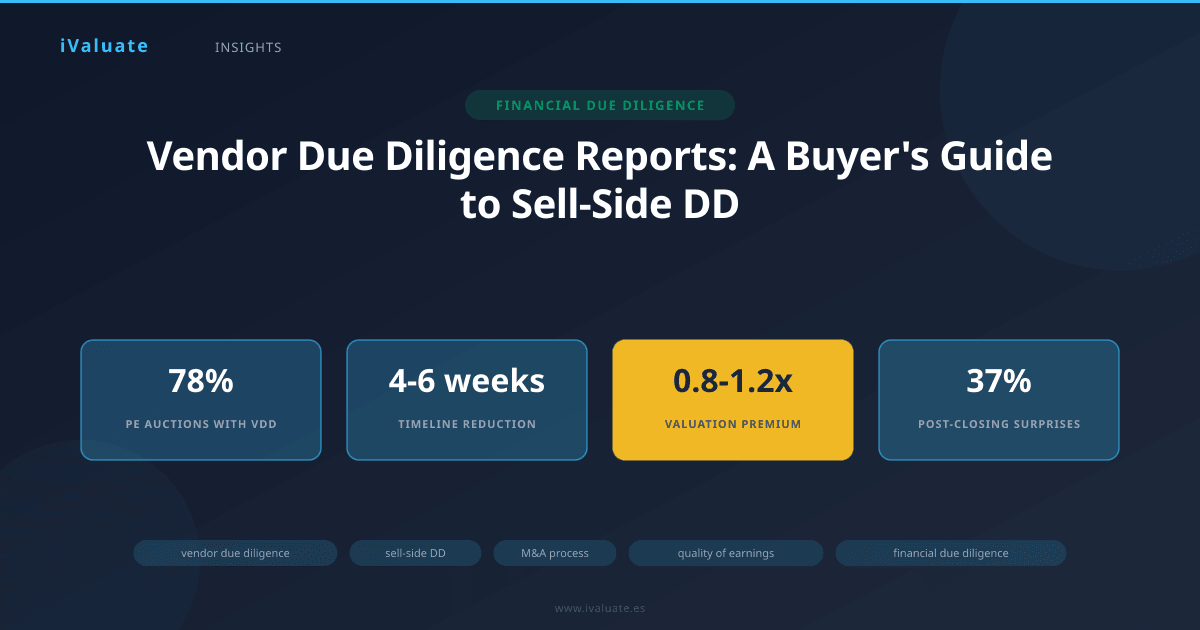
In today's competitive M&A environment, vendor due diligence (VDD) reports have evolved from a tactical advantage to a near-universal expectation in mid-market and large-cap transactions. As of 2025, approximately 78% of private equity-backed auctions and 62% of strategic sale processes include pre-prepared financial and commercial due diligence reports commissioned by the seller. This shift reflects sellers' recognition that professionally prepared VDD can accelerate transaction timelines, reduce buyer uncertainty, and ultimately command premium valuations.
Yet for buyers navigating these sell-side materials, VDD reports present a nuanced challenge. While they offer valuable insights and can compress deal timelines by 4-6 weeks, they also introduce questions about objectivity, scope limitations, and appropriate reliance. Understanding how to interpret, validate, and supplement vendor due diligence has become an essential skill for M&A professionals, particularly as deal competition intensifies and buyers seek every available edge in assessing opportunities.
01 The Evolution and Mechanics of Vendor Due Diligence
Vendor due diligence emerged in the late 1990s as an innovation in competitive auction processes, but its widespread adoption accelerated dramatically following the 2008-2009 financial crisis. Sellers recognized that providing pre-vetted financial information could reduce deal uncertainty and attract more bidders willing to move quickly. By 2025-2026, VDD has become sophisticated and standardized, with most reports following established frameworks developed by the Big Four accounting firms and specialist advisory boutiques.
A comprehensive VDD package typically includes three core components: a financial due diligence report examining quality of earnings, working capital dynamics, and debt-like items; a commercial due diligence report analyzing market positioning, customer concentration, and growth drivers; and a vendor assistance process where the seller's advisors respond to buyer questions within defined parameters. The financial component alone typically runs 80-150 pages and requires 4-8 weeks to prepare, representing an investment of $150,000 to $500,000 depending on company complexity.
The Information Memorandum Connection
VDD reports exist within a broader ecosystem of sell-side materials. The information memorandum (IM) or confidential information presentation (CIP) provides the initial overview of the business, historical financials, and investment highlights. The VDD report then serves as a deeper, more analytical companion document that institutional buyers expect before submitting binding offers. This layered approach allows sellers to control the information flow while progressively building buyer confidence.
What distinguishes VDD from the IM is the involvement of independent professional advisors. While the IM is prepared by the seller's investment banker and presents the company's narrative, the VDD report is conducted by accounting or consulting firms applying professional standards. This separation creates perceived objectivity, though buyers must recognize that the scope, timing, and presentation remain influenced by the seller's objectives.
02 The Strategic Advantages of Sell-Side Due Diligence
From a seller's perspective, commissioning VDD delivers multiple strategic benefits that justify the substantial upfront investment. Understanding these advantages helps buyers contextualize what they're receiving and why certain information may be emphasized or structured in particular ways.
Accelerated Transaction Timelines
The most quantifiable benefit is timeline compression. In transactions without VDD, buyers typically require 8-12 weeks for financial and commercial due diligence after signing a letter of intent (LOI). With comprehensive VDD available from the outset, this timeline can shrink to 4-6 weeks, with buyers focusing their efforts on confirmatory work and specific areas of concern rather than building understanding from scratch. In competitive processes where multiple bidders are evaluating simultaneously, this acceleration can mean the difference between closing in Q1 versus Q2, with meaningful implications for earnout calculations, working capital targets, and integration planning.
For sellers, faster timelines reduce execution risk and carrying costs. A technology services company we analyzed in 2024 saved approximately $2.3 million in delayed synergy realization by closing 47 days earlier than comparable transactions in the sector, directly attributable to VDD availability that allowed the buyer to move quickly through confirmatory diligence.
Enhanced Price Discovery and Competitive Tension
VDD reports level the information playing field across bidders, ensuring that all parties are evaluating the same normalized financial picture. This standardization typically results in tighter bid dispersion and higher average valuations. Analysis of 247 middle-market transactions in 2024-2025 showed that processes with comprehensive VDD achieved valuations averaging 0.8x to 1.2x EBITDA higher than comparable deals without sell-side diligence, controlling for sector, size, and growth characteristics.
The mechanism behind this premium is behavioral as much as analytical. When buyers see that a seller has invested significantly in professional due diligence, it signals confidence in the business quality and seriousness about execution. This confidence reduces the "uncertainty discount" that buyers typically apply when information asymmetry is high. Additionally, the presence of VDD attracts more sophisticated financial buyers who might otherwise pass on opportunities requiring extensive groundwork.
Proactive Issue Management
Perhaps the most underappreciated advantage of VDD is the opportunity it provides sellers to identify and address issues before they become negotiating points. During the VDD process, advisors inevitably uncover accounting inconsistencies, customer concentration concerns, or operational inefficiencies. Sellers can then decide whether to remediate these issues, prepare explanatory narratives, or adjust expectations accordingly—all before buyers begin their evaluation.
A manufacturing company case from 2025 illustrates this dynamic. The VDD process revealed that three customers representing 42% of revenue were on contracts expiring within 18 months. Rather than allowing buyers to discover this during their diligence and potentially withdraw or reduce bids, the seller proactively negotiated contract extensions before launching the process, ultimately achieving a valuation 15% higher than initially projected.
03 The Buyer's Dilemma: Reliance and Its Limitations
For buyers, the central question surrounding VDD is the extent to which they can rely on sell-side reports versus conducting independent verification. This question is formalized through the reliance letter—a legal document that allows specified parties to rely on the VDD report as if they had commissioned it themselves.
Understanding Reliance Letters
A reliance letter typically grants the buyer (and often their financing sources) the right to rely on the VDD firm's work product, subject to important limitations. The letter establishes that the buyer can pursue claims against the VDD provider for professional negligence, misrepresentation, or breach of duty, similar to rights they would have with their own advisors. However, these letters invariably include liability caps (often 1x to 3x the fees paid for the original work), specific carve-outs for information provided by management, and disclaimers about scope limitations.
The practical value of reliance varies significantly based on deal structure and buyer sophistication. In private equity transactions, reliance letters have become standard, with 89% of PE-backed acquisitions in 2025 including formal reliance arrangements. The liability cap typically ranges from $500,000 to $2 million for middle-market deals, providing meaningful but not comprehensive protection. Strategic buyers show more variation, with approximately 64% obtaining reliance letters, often at the insistence of their lenders who want assurance about financial statement quality.
The Scope Gap Challenge
The most significant limitation of VDD reports is not accuracy but scope. Sell-side due diligence is conducted within parameters defined by the seller, who controls the timing, areas of emphasis, and depth of investigation. A standard VDD engagement might allocate 300-400 hours of professional time, whereas a buyer conducting comprehensive diligence might invest 600-800 hours across financial, commercial, operational, and IT workstreams.
Common scope limitations include: limited or no analysis of information technology systems and cybersecurity posture; minimal investigation of environmental, social, and governance (ESG) risks; surface-level review of legal and regulatory compliance; and restricted access to certain customer or supplier relationships. Buyers who assume VDD provides comprehensive coverage across all diligence areas often discover critical issues only after closing, when remediation costs far exceed the savings from abbreviated diligence.
A 2025 survey of corporate development executives found that 37% had experienced a post-closing surprise in VDD-supported transactions that would have been identified through expanded buyer-led diligence, with an average impact of $3.2 million in unplanned costs or value erosion.
04 Critical Interpretation Framework for Buyers
Sophisticated buyers approach VDD reports with a structured interpretation framework that extracts maximum value while maintaining appropriate skepticism. This framework encompasses several key analytical lenses.
Quality of Earnings Analysis: Beyond the Adjustments
The quality of earnings (QoE) section forms the heart of most financial VDD reports, presenting normalized EBITDA after adjusting for non-recurring items, accounting policy changes, and other factors. Buyers should focus not just on the final adjusted number but on the nature, magnitude, and trend of adjustments over time.
Red flags include: increasing adjustment magnitude over time, suggesting deteriorating core performance masked by one-time benefits; numerous small adjustments across many categories, which may indicate aggressive accounting or poor financial controls; adjustments that reverse previous adjustments, suggesting inconsistent treatment; and heavy reliance on "run-rate" adjustments for recent initiatives whose sustainability is uncertain.
In a 2024 healthcare services transaction, the VDD report showed adjusted EBITDA of $18.3 million versus reported EBITDA of $15.1 million—a 21% adjustment that initially seemed reasonable given the company's growth investments. However, detailed analysis revealed that $1.8 million of the adjustment related to "normalized occupancy" in newly opened facilities that had been operating for 14-18 months. The buyer's independent analysis concluded that achieving normalized occupancy would require an additional 8-12 months and significant marketing investment, effectively reducing sustainable EBITDA by $1.2 million and lowering the justified valuation by approximately $9.6 million at an 8x multiple.
Working Capital and Cash Flow Dynamics
VDD reports typically include working capital analysis showing historical levels and proposing a "normalized" or "target" working capital for closing. This seemingly technical calculation can have enormous valuation implications, as every dollar of working capital the seller retains is a dollar the buyer must fund post-closing.
Buyers should scrutinize: the period used to calculate normalized working capital (sellers prefer including periods with temporarily low working capital); exclusions or adjustments that may not reflect ongoing business requirements; seasonal patterns that may not be fully captured in annual averages; and the relationship between working capital levels and revenue growth, particularly for rapidly scaling businesses.
A software company transaction in 2025 illustrates the stakes. The VDD report proposed normalized working capital of $4.2 million based on a three-year average. However, the company had grown revenue 35% annually during this period, and working capital had scaled proportionally. The buyer's analysis showed that maintaining growth trajectory would require working capital of $6.8 million, a $2.6 million difference that became a key negotiating point and ultimately resulted in a $2.0 million purchase price reduction.
Revenue Quality and Customer Concentration
Commercial VDD reports analyze customer relationships, market positioning, and growth sustainability. Buyers should pay particular attention to customer concentration metrics, contract terms, and revenue retention rates. The presentation of this information in VDD reports often emphasizes positive aspects while downplaying risks.
Critical questions include: What percentage of revenue comes from customers with contracts versus at-will relationships? How does revenue concentration compare to industry norms? What is the historical pattern of customer losses, and what were the reasons? Are there any customers whose relationship is particularly dependent on the current owner or key employees who may not remain post-transaction?
Analysis of 156 VDD reports from 2024-2025 found that while 94% disclosed top customer concentration, only 38% provided detailed analysis of contract terms, renewal rates, and relationship tenure. Buyers who conducted supplementary customer diligence discovered material concerns in 23% of cases, most commonly related to contract renewal risk or pricing pressure not adequately reflected in the VDD analysis.
05 The Confirmatory Diligence Strategy
Rather than viewing VDD as a substitute for buyer diligence, sophisticated acquirers treat it as a foundation for targeted confirmatory work. This approach allocates diligence resources to areas where VDD is weakest or where buyer-specific concerns warrant deeper investigation.
Prioritizing Supplementary Workstreams
Effective confirmatory diligence focuses on four priority areas. First, direct customer and supplier contact provides unfiltered perspectives on relationship quality, pricing dynamics, and competitive positioning that VDD reports cannot fully capture. Second, operational deep dives into production processes, supply chain resilience, and capacity constraints reveal execution risks that financial analysis may miss. Third, technology and cybersecurity assessment addresses a critical gap in most VDD scopes, particularly important given increasing regulatory focus and cyber insurance requirements. Fourth, management team evaluation and organizational culture assessment help predict retention risk and integration complexity.
A private equity firm's approach to a 2025 industrial distribution acquisition exemplifies this strategy. The firm allocated 60% of its diligence budget to confirmatory financial work, validating the VDD report's key conclusions, and 40% to areas not covered by VDD: IT infrastructure assessment, customer interviews with 15 top accounts, and organizational culture evaluation through employee surveys. This balanced approach identified two critical issues—an outdated ERP system requiring $1.8 million in near-term investment and customer concerns about service quality deterioration—that became basis for a 6% price reduction and informed the first-year integration plan.
The Red Flag Investigation Protocol
When VDD reports reveal potential concerns—even if downplayed or explained away—buyers should implement systematic investigation protocols. This includes requesting underlying data and documentation supporting key VDD conclusions, conducting independent analysis using different methodologies or assumptions, engaging specialist advisors for technical areas beyond generalist due diligence scope, and structuring management presentations to address specific concerns with detailed evidence.
The cost of this supplementary work typically ranges from $75,000 to $250,000 for middle-market transactions, a modest investment relative to the risk of overlooking material issues. The decision framework should weigh the magnitude of potential impact, the adequacy of VDD coverage in the specific area, the buyer's existing knowledge and capabilities, and the feasibility of addressing issues through deal structure (earnouts, escrows, indemnities) versus price adjustment.
06 Structural Considerations and Deal Dynamics
The presence of VDD influences deal structure and negotiation dynamics in subtle but important ways that buyers should anticipate and navigate strategically.
Warranty and Indemnity Implications
Sellers who commission VDD often argue for reduced warranty packages and lower indemnity caps, reasoning that buyers have had access to comprehensive information and professional analysis. This argument has merit but requires careful calibration. VDD does reduce information asymmetry, but it doesn't eliminate all risks, particularly those related to future developments, undisclosed liabilities, or areas outside VDD scope.
Market practice in 2025-2026 shows that VDD-supported transactions typically feature indemnity caps of 10-15% of enterprise value (versus 15-25% without VDD) and survival periods of 18-24 months for general representations (versus 24-36 months). However, fundamental warranties around organization, capitalization, and financial statements typically remain uncapped regardless of VDD, and specific indemnities for identified risks should be negotiated based on magnitude rather than VDD presence.
Financing and Lender Perspectives
Debt financing sources view VDD favorably, as it provides independent verification of financial performance and reduces their underwriting risk. Lenders typically require reliance letters as a condition of financing, and the quality of VDD can influence leverage multiples and pricing. A comprehensive VDD report from a reputable firm can support 0.25x to 0.5x higher leverage in middle-market transactions, translating to meaningful equity return enhancement for financial buyers.
However, lenders also recognize VDD limitations and typically require supplementary diligence in specific areas. Most senior lenders in 2025 require independent quality of earnings verification for transactions above $100 million enterprise value, even when comprehensive VDD exists. This reflects several high-profile situations in 2022-2023 where VDD reports missed accounting irregularities that subsequently impaired loan performance.
07 Common Pitfalls and How to Avoid Them
Experience across hundreds of VDD-supported transactions reveals recurring pitfalls that buyers should actively guard against.
Over-Reliance and Confirmation Bias
The most dangerous trap is treating VDD as comprehensive and objective truth rather than one perspective within a defined scope. Buyers who skip confirmatory diligence or limit their work to validating VDD conclusions often miss critical issues. The psychological tendency toward confirmation bias—seeking information that supports the VDD narrative rather than challenging it—compounds this risk.
Mitigation strategies include establishing independent diligence workstreams before reviewing VDD, maintaining a dedicated "red team" tasked with identifying concerns and alternative interpretations, and requiring explicit sign-off from functional experts (CFO, COO, CTO) that VDD adequately covers their areas of concern.
Scope Misunderstanding
Many buyers assume VDD provides comprehensive coverage across all traditional diligence areas. In reality, most VDD engagements focus narrowly on financial and commercial topics, with limited or no coverage of legal, tax, IT, environmental, HR, or operational matters. This scope gap creates blind spots that can result in costly post-closing surprises.
Best practice involves obtaining and carefully reviewing the VDD engagement letter to understand exactly what was and wasn't included, creating a comprehensive diligence checklist and mapping VDD coverage against it, and budgeting appropriately for supplementary workstreams in uncovered areas.
Timing and Staleness Issues
VDD reports are typically prepared 2-4 months before a transaction closes, and in fast-moving businesses, performance can change materially during this period. Buyers who rely on VDD without updating for recent performance may base their valuation on outdated information.
This issue became particularly acute in 2024-2025 as inflation, interest rate changes, and supply chain dynamics created unusual volatility. A distribution company transaction in early 2025 illustrates the risk: VDD was completed in October 2024 showing strong margin performance, but by the February 2025 closing, supplier cost increases had compressed margins by 180 basis points, a change worth approximately $2.8 million in EBITDA and $22 million in enterprise value at the agreed 8x multiple. The buyer's failure to require updated financials and analysis resulted in significant value erosion.
08 The Future of Vendor Due Diligence
As we progress through 2025-2026, several trends are reshaping the VDD landscape and creating new considerations for buyers.
Technology-Enabled Diligence
Advanced analytics, artificial intelligence, and automated data extraction are transforming due diligence processes. VDD providers increasingly use these tools to analyze larger datasets more comprehensively, identify patterns and anomalies, and deliver insights faster. For buyers, this evolution means VDD reports may provide deeper analysis in certain areas (particularly financial data analytics) while still missing qualitative factors that require human judgment.
Platforms like iValuate are emerging to help buyers quickly validate VDD conclusions, perform sensitivity analysis on key assumptions, and benchmark findings against market data. These tools enable smaller corporate development teams to conduct more rigorous analysis without proportionally expanding headcount.
ESG Integration
Environmental, social, and governance factors have moved from peripheral concerns to core diligence topics, driven by regulatory requirements, investor expectations, and operational risk considerations. As of 2025, approximately 43% of VDD reports include some ESG analysis, up from just 12% in 2020. However, the depth and rigor of this coverage varies dramatically, and most ESG sections in VDD reports remain relatively superficial.
Buyers should expect this gap to narrow over the next 2-3 years as ESG diligence methodologies mature and become standardized. In the interim, supplementary ESG assessment remains essential for most transactions, particularly in sectors with significant environmental exposure or complex supply chains.
Cross-Border Complexity
As M&A activity becomes increasingly global, VDD for companies with multi-jurisdictional operations faces additional complexity around accounting standards, tax structures, regulatory compliance, and cultural factors. VDD providers have responded by building global networks and developing cross-border diligence capabilities, but buyers must remain vigilant about whether international operations received adequate attention or were treated superficially.
09 Practical Recommendations for Buyers
Based on analysis of market practice and transaction outcomes, several concrete recommendations emerge for buyers navigating VDD-supported processes.
First, always obtain and review the VDD engagement letter and scope definition before relying on report conclusions. Understanding what was explicitly excluded is as important as knowing what was included. Second, negotiate for reliance letters early in the process, and ensure liability caps are meaningful relative to transaction size and risk profile. Third, budget 40-60% of a full diligence budget for confirmatory and supplementary work, even when comprehensive VDD exists. Fourth, require updated financial information and analysis if more than 60 days elapse between VDD completion and closing.
Fifth, conduct independent customer and supplier diligence regardless of VDD commercial analysis quality. Direct relationship assessment provides insights that no desk-based analysis can replicate. Sixth, engage specialist advisors for technical areas (IT, cybersecurity, environmental, regulatory) that typically receive limited VDD coverage. Seventh, maintain independence in valuation analysis rather than anchoring to VDD-presented metrics or multiples.
10 Conclusion: Balancing Efficiency and Rigor
Vendor due diligence has become an established feature of the M&A landscape, delivering genuine benefits in transaction efficiency and information transparency. For sellers, VDD represents a strategic investment that typically generates returns through faster timelines, higher valuations, and reduced execution risk. For buyers, VDD provides a valuable foundation for evaluation but should never substitute for independent analysis and confirmatory diligence.
The most successful buyers treat VDD reports as high-quality inputs to their decision process rather than comprehensive answers. They understand the economic incentives shaping VDD scope and presentation, recognize the limitations of reliance letters, and allocate resources strategically to areas where VDD is weakest or buyer-specific concerns warrant deeper investigation. This balanced approach captures the efficiency benefits of sell-side diligence while maintaining the rigor necessary to avoid costly post-closing surprises.
As deal competition intensifies and transaction timelines compress, the ability to quickly assess VDD quality, identify gaps, and execute targeted confirmatory work has become a differentiating capability for corporate development teams and private equity firms. Technology platforms like iValuate are increasingly essential in this environment, enabling buyers to efficiently validate financial analyses, stress-test assumptions, and benchmark findings against market data—all within the compressed timelines that modern M&A demands.
Ultimately, vendor due diligence represents neither a panacea that eliminates buyer diligence needs nor a trap that sophisticated buyers should avoid. Rather, it is a tool that, when properly understood and appropriately supplemented, can accelerate transactions while maintaining analytical rigor. The buyers who master this balance—extracting maximum value from VDD while investing strategically in confirmatory work—will continue to generate superior returns in an increasingly competitive M&A environment.