Table of Contents10 sections
The financial services sector presents some of the most complex valuation challenges in M&A. Unlike industrial or technology companies where EBITDA multiples and discounted cash flow models dominate, banks, insurers, and fintechs require fundamentally different analytical frameworks. The combination of regulatory capital requirements, intangible balance sheet assets, and evolving competitive dynamics from digital disruptors has created a valuation landscape that demands specialized expertise.
In 2025-2026, financial services M&A activity has rebounded significantly following the regional banking turmoil of 2023. Global deal volume in the sector reached $287 billion in 2024, up 22% from the prior year, with particularly strong activity in insurance consolidation and fintech acquisitions by traditional institutions. Yet the valuation methodologies applied across these subsectors differ dramatically, reflecting their distinct business models, regulatory frameworks, and risk profiles.
01 The Fundamental Difference: Why EBITDA Multiples Don't Work
The first principle any M&A advisor must internalize when valuing financial institutions is that traditional industrial valuation metrics are largely inapplicable. EBITDA—the workhorse multiple for most corporate transactions—is essentially meaningless for banks and insurers. Financial institutions are fundamentally balance sheet businesses where leverage is intrinsic to the operating model, not a capital structure choice.
For banks, interest expense is a cost of goods sold, not a financing cost. A bank's ability to generate net interest margin by borrowing at lower rates and lending at higher rates is its core value creation mechanism. Similarly, depreciation and amortization are trivial compared to loan loss provisions and reserve adjustments. Insurance companies face analogous issues, with their economic value tied to underwriting profits, investment returns on float, and the long-tail nature of claims liabilities.
This fundamental difference drives financial services M&A toward equity-based valuation frameworks rather than enterprise value approaches. The two dominant methodologies are Price-to-Book Value (P/BV) multiples for banks and Embedded Value approaches for life insurers, supplemented by Price-to-Earnings (P/E) multiples and dividend discount models across both sectors.
02 Price-to-Book Value: The Banking Sector Standard
Price-to-Book Value remains the primary valuation metric in banking M&A, despite its limitations. The P/BV multiple compares a bank's market capitalization (or transaction price) to its book value of equity, essentially measuring how much acquirers will pay above accounting net worth. In the first quarter of 2025, publicly traded U.S. regional banks traded at a median P/BV of 1.18x, while larger money center banks commanded multiples ranging from 1.35x to 1.65x.
The appeal of P/BV multiples stems from the nature of banking assets. Unlike manufacturing companies where book values may bear little relation to economic values, bank balance sheets consist primarily of financial instruments with reasonably transparent fair values. Loans, securities, deposits, and borrowings can be marked to market or modeled with relative precision. Book value thus provides a more economically meaningful baseline than for other industries.
Adjusting Book Value for Regulatory Capital
Sophisticated banking valuations don't simply apply market P/BV multiples to reported book value. Regulatory capital considerations require substantial adjustments. Under Basel III frameworks (which continue to evolve through Basel IV implementation in 2025-2026), banks must maintain Common Equity Tier 1 (CET1) capital ratios above regulatory minimums—typically 7-8% for well-capitalized institutions, with additional buffers for systemically important banks.
When valuing a target bank, acquirers must assess whether current book value represents excess capital that could be extracted or whether capital injections will be required. A bank trading at 0.95x book value might appear cheap, but if it's operating at minimum regulatory capital levels with a deteriorating loan portfolio, the true economic value could be substantially lower. Conversely, a bank at 1.4x book with a CET1 ratio of 12% may justify its premium through the optionality of that excess capital for growth or shareholder returns.
In a recent 2024 transaction, a regional bank holding company with $8.3 billion in assets was acquired at 1.32x tangible book value. The target maintained a CET1 ratio of 11.2%, well above the 8.5% regulatory requirement. The acquirer's valuation analysis attributed approximately 0.15x of the multiple premium specifically to the value of deployable excess capital, which could be redeployed into higher-yielding assets or returned to shareholders post-acquisition.
Tangible Book Value vs. GAAP Book Value
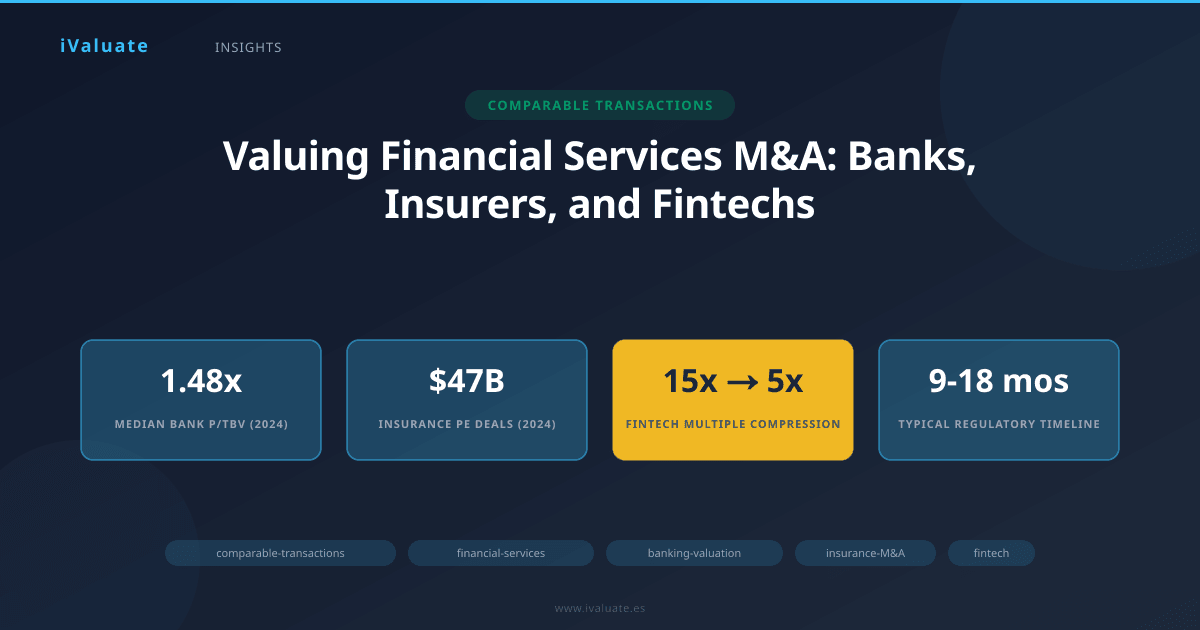
Most banking M&A transactions reference tangible book value (TBV) rather than GAAP book value, excluding goodwill and other intangible assets. This adjustment is critical because acquisition-related intangibles don't represent deployable capital or loss-absorbing capacity. The median P/TBV multiple for U.S. bank acquisitions in 2024 was 1.48x, compared to P/BV multiples averaging 1.32x for the same transactions.
The spread between these multiples reflects the intangible asset burden on bank balance sheets. For banks with significant M&A history, goodwill can represent 15-25% of total equity, creating substantial divergence between book and tangible book metrics. Acquirers focus on tangible book because it represents the actual equity capital available to support lending and absorb losses.
03 Embedded Value: The Insurance Sector Framework
Life insurance valuation departs entirely from banking approaches, centering on Embedded Value (EV) methodologies. Embedded Value represents the present value of future profits from in-force policies plus adjusted net worth. This approach recognizes that an insurer's true economic value lies not in its current balance sheet but in the stream of profits that will emerge as existing policies run off.
The European insurance market has standardized around Market Consistent Embedded Value (MCEV), which uses risk-neutral valuation techniques and market-observable discount rates. Under MCEV frameworks, the value of in-force business is calculated by projecting future distributable earnings from existing policies, discounting at risk-free rates plus appropriate risk margins, and adjusting for the cost of holding required capital.
Components of Embedded Value
A typical MCEV calculation comprises three elements. First, the adjusted net worth represents shareholders' equity with adjustments for market value of assets and elimination of certain regulatory reserves. Second, the value of in-force business (VIF) captures the present value of future profits from existing policies. Third, the cost of required capital reflects the opportunity cost of holding regulatory capital that could otherwise be distributed to shareholders.
In a 2025 cross-border insurance transaction, a European life insurer with €42 billion in assets was acquired at 1.35x MCEV. The target's embedded value breakdown showed adjusted net worth of €3.8 billion, VIF of €2.1 billion, and a cost of required capital of €0.4 billion, yielding total MCEV of €5.5 billion. The transaction price of €7.4 billion implied the acquirer was paying €1.9 billion for future new business value beyond the in-force book.
Sensitivity to Interest Rates and Mortality Assumptions
Embedded value calculations are extraordinarily sensitive to actuarial assumptions. Interest rate environments directly impact both discount rates and the projected returns on invested assets backing policy liabilities. The 2022-2024 interest rate hiking cycle significantly enhanced life insurer embedded values, as higher rates improved investment yields on fixed-income portfolios and reduced the present value of long-tail liabilities.
Mortality and longevity assumptions create additional complexity. For life insurance products, improving mortality (people living longer) reduces claim costs and enhances profitability. For annuity products, the opposite holds—longevity risk means insurers must pay benefits for extended periods. A 1% improvement in mortality assumptions might increase VIF by 8-12% for a life-heavy insurer, while the same change could reduce VIF by 6-9% for an annuity-focused company.
Property and casualty insurers typically aren't valued on embedded value frameworks, as their policies have shorter durations and less predictable long-tail liabilities. P&C transactions more commonly use P/BV multiples (ranging from 1.2x to 2.1x for well-performing carriers in 2025) combined with underwriting profit analyses and combined ratio assessments.
04 The Fintech Disruption: Valuation at the Intersection
The emergence of fintech companies has created a valuation frontier where traditional financial services metrics collide with technology sector approaches. Fintechs occupy a spectrum from pure technology platforms to companies that are functionally banks or insurers operating under different regulatory frameworks. This ambiguity creates significant valuation challenges and opportunities for multiple arbitrage.
In 2024-2025, we've witnessed a recalibration of fintech valuations following the 2021-2022 bubble. Digital banking platforms that commanded 15-25x revenue multiples at peak now trade at 3-6x revenue, while embedded finance companies have seen multiples compress from 20-30x to 5-10x. This normalization reflects market recognition that many fintechs face similar unit economics, regulatory burdens, and competitive dynamics as traditional financial institutions, despite their technological veneer.
Hybrid Valuation Approaches for Fintechs
Valuing fintech M&A targets requires blending financial services and technology methodologies. For revenue-generating fintechs with established business models, acquirers typically employ multiple approaches: revenue multiples (comparing to both fintech peers and relevant financial services segments), P/E multiples (for profitable entities), and DCF models incorporating both growth trajectories and terminal value assumptions.
The key analytical challenge is determining which comparable set is most relevant. A digital lending platform might be compared to both traditional consumer finance companies (trading at 1.2-1.8x book value and 8-12x earnings) and fintech lenders (trading at 2-5x revenue for high-growth entities). The appropriate framework depends on growth rates, profitability, regulatory status, and funding model.
In a notable 2024 transaction, a major regional bank acquired a digital small business lending platform for $840 million, representing 4.2x revenue and 18x EBITDA. The acquirer's valuation justified the premium multiple by modeling customer acquisition cost savings (the bank's existing SMB relationships provided distribution), regulatory capital efficiency (the bank could fund loans on-balance-sheet at lower cost than the fintech's warehouse facilities), and technology platform value (the acquired system would replace legacy origination infrastructure). The blended approach yielded an IRR projection of 16.3%, well above the bank's cost of capital.
Regulatory Capital Arbitrage in Fintech Acquisitions
One of the most significant value drivers in bank acquisitions of fintechs is regulatory capital arbitrage. Fintechs operating outside traditional banking charters often fund lending activities through expensive warehouse lines, securitizations, or balance sheet partnerships. When acquired by a regulated bank, these assets can be funded with insured deposits at dramatically lower costs, while the bank's existing capital base absorbs the regulatory requirements.
This dynamic creates substantial synergy value. A fintech originating $2 billion annually in personal loans at a weighted average rate of 12.5% might generate net interest margin of 4.2% after funding costs of 8.3% (warehouse lines and securitization expenses). The same portfolio funded by a bank with deposit costs of 2.8% would generate NIM of 9.7%—a 550 basis point improvement. At scale, this funding arbitrage can justify acquisition premiums that appear excessive on standalone fintech metrics.
The convergence of traditional financial institutions and fintechs is fundamentally reshaping valuation paradigms. Acquirers must assess not just current economics but the regulatory and capital structure transformations that occur when a fintech is integrated into a chartered institution.
05 Regulatory Capital: The Hidden Value Driver
Regulatory capital considerations permeate every aspect of financial services M&A valuation, yet they're often underappreciated by generalist advisors. The capital treatment of acquired assets, the regulatory approval process, and post-merger capital requirements can swing deal economics by 20-30% or more.
Risk-Weighted Assets and Capital Consumption
Under Basel III frameworks, different asset classes consume different amounts of regulatory capital based on their risk weights. Cash and government securities carry 0% risk weights, residential mortgages typically carry 35-50% weights, while commercial loans might carry 100% weights and certain trading assets can exceed 100%. When a bank acquires another institution, the acquirer must assess the risk-weighted asset (RWA) profile of the target's balance sheet.
A target bank with $5 billion in total assets might have RWAs of only $3 billion if heavily weighted toward government securities and residential mortgages, or $4.5 billion if concentrated in commercial and industrial loans. At an 8% CET1 requirement, the first scenario requires $240 million in regulatory capital while the second demands $360 million—a $120 million difference that directly impacts valuation.
Sophisticated acquirers model the post-acquisition capital optimization opportunities. Can the target's securities portfolio be repositioned? Will loan portfolios be retained or sold? Can off-balance-sheet structures reduce RWA density? These questions drive material value creation or destruction.
Regulatory Approval Risk and Timing
Financial services M&A transactions face substantially longer regulatory approval timelines than other sectors—typically 9-18 months from announcement to close, compared to 3-6 months for industrial deals. This extended timeline creates valuation implications through deal risk, opportunity cost, and potential for adverse changes in the target's business during the interim period.
Deal structures must account for regulatory risk through appropriate termination fees, reverse break fees, and material adverse change provisions. In 2024, the median termination fee in U.S. bank M&A was 3.8% of deal value, compared to 2.5-3.0% in other sectors. This premium reflects the heightened regulatory uncertainty and the potential for deals to be blocked on competitive grounds, capital adequacy concerns, or Community Reinvestment Act considerations.
The discount rate applied in DCF valuations should incorporate regulatory approval risk. A transaction with 85% probability of approval might warrant a 50-100 basis point increase in discount rate compared to a certainty scenario, materially impacting present values on long-duration cash flows typical in financial services.
06 Cross-Border Considerations and Currency Risk
International financial services M&A introduces additional complexity through divergent regulatory regimes, accounting standards, and currency exposures. A U.S. bank acquiring a Latin American subsidiary must navigate local capital requirements, potential restrictions on dividend repatriation, and currency devaluation risks that can erode returns.
European insurance transactions increasingly involve Solvency II capital calculations, which differ materially from U.S. risk-based capital frameworks. These differences affect both the valuation of targets and the capital efficiency of cross-border structures. In several 2024-2025 transactions, acquirers established intermediate holding companies in specific jurisdictions to optimize regulatory capital treatment and minimize trapped capital at subsidiary levels.
Currency hedging strategies must be incorporated into valuation models for cross-border deals. A €5 billion acquisition of a European insurer by a U.S. buyer faces potential FX volatility that could swing dollar-equivalent purchase price by hundreds of millions. Forward contracts, currency swaps, and natural hedges through offsetting exposures all factor into the economic analysis.
07 Earnouts, Contingent Consideration, and Deal Structure
Financial services M&A increasingly incorporates earnout provisions and contingent consideration, particularly in fintech acquisitions where future growth is uncertain. These structures bridge valuation gaps between buyers and sellers while aligning incentives for post-acquisition performance.
A typical fintech earnout might provide additional consideration based on revenue growth, customer acquisition metrics, or technology platform adoption by the acquirer's customer base. In a 2025 transaction, a major insurer acquired a digital distribution platform for $320 million upfront plus earnouts of up to $180 million based on policy sales generated through the platform over three years. The earnout structure effectively shifted risk to the seller while providing upside participation if the integration succeeded.
Valuing contingent consideration requires probability-weighting scenarios and discounting at risk-adjusted rates. The $180 million maximum earnout referenced above might have an expected value of only $95 million when adjusted for execution risk and time value of money. This gap between maximum and expected value creates negotiating dynamics and affects how deals are marketed to stakeholders.
08 Current Market Dynamics: 2025-2026 Outlook
The financial services M&A landscape in 2025-2026 is characterized by several converging trends. First, regional bank consolidation continues as institutions seek scale to compete with national players and invest in technology infrastructure. Median P/TBV multiples for in-market regional bank mergers have stabilized at 1.45-1.55x, down from peaks of 1.8-2.0x in 2021 but well above the distressed levels of 2023.
Second, insurance sector M&A remains robust, driven by private equity appetite for specialty carriers and life insurers. PE firms acquired $47 billion of insurance assets globally in 2024, often at premiums to publicly traded comparables due to their ability to optimize capital structures and pursue aggressive investment strategies not available to public companies. These transactions typically occur at 1.3-1.5x MCEV for life insurers and 1.4-1.9x book value for P&C carriers.
Third, traditional financial institutions are selectively acquiring fintech capabilities to accelerate digital transformation. Rather than paying peak multiples for standalone fintechs, banks and insurers are targeting specific technology platforms, customer acquisition engines, or data analytics capabilities at 3-7x revenue multiples. The focus has shifted from growth at any cost to profitable, scalable technologies that integrate cleanly with legacy systems.
Interest rate expectations for 2025-2026 suggest a gradual easing cycle, with the Federal Reserve projected to reduce rates by 75-100 basis points over the period. This environment creates mixed implications for financial services valuations. Banks may face net interest margin compression, potentially pressuring P/BV multiples, while insurers could see embedded values decline as discount rates fall and fixed-income reinvestment yields decrease.
09 Practical Implications for M&A Professionals
For CFOs, M&A advisors, and private equity professionals navigating financial services transactions, several practical principles emerge from this complex landscape. First, assemble teams with genuine sector expertise—generalist advisors applying industrial company frameworks will miss critical value drivers and risks. The difference between a competent and exceptional financial services valuation can easily represent 10-15% of deal value.
Second, invest heavily in due diligence around regulatory capital, asset quality, and reserve adequacy. In banking deals, loan portfolio reviews, allowance for credit losses analyses, and interest rate risk assessments are not optional extras—they're fundamental to determining whether the target's book value represents real economic equity. For insurers, actuarial reviews of reserve adequacy and reinsurance recoverability are equally critical.
Third, model multiple scenarios incorporating different regulatory outcomes, interest rate paths, and integration assumptions. Financial services deals are inherently more uncertain than industrial transactions due to regulatory approval risk and the sensitivity of financial institution economics to macroeconomic variables. Scenario analysis and Monte Carlo simulation provide much richer insight than single-point estimates.
Fourth, structure deals to align risk and reward appropriately. Earnouts, contingent capital injections, and representation and warranty insurance all serve valuable roles in managing the uncertainties inherent in financial services M&A. The optimal structure depends on the specific risk profile of each transaction.
10 Conclusion: Navigating Complexity with Sophisticated Tools
Financial services M&A valuation represents one of the most technically demanding areas of corporate finance. The interplay of regulatory capital requirements, sector-specific metrics like P/BV and embedded value, and the disruptive force of fintech innovation creates a landscape where traditional valuation frameworks must be substantially adapted or abandoned entirely.
Success in this environment requires deep sector knowledge, sophisticated analytical capabilities, and the judgment to know which methodologies apply in which contexts. A regional bank acquisition demands fundamentally different approaches than a life insurance transaction or a fintech platform purchase, yet all three may occur within a single financial institution's M&A program.
As the sector continues to evolve through 2025-2026, with ongoing regulatory changes, technological disruption, and macroeconomic uncertainty, the premium on analytical rigor will only increase. Financial institutions that master these valuation complexities—or partner with advisors who possess genuine expertise—will identify opportunities that others miss and avoid value-destroying transactions that appear attractive on surface metrics.
Modern valuation platforms like iValuate are increasingly essential for professionals navigating this complexity, providing the analytical infrastructure to model regulatory capital scenarios, compare transactions across subsectors, and stress-test assumptions under multiple economic environments. In a domain where precision matters and the stakes are measured in hundreds of millions of dollars, the combination of human expertise and sophisticated analytical tools separates successful dealmakers from those who struggle to create value in one of M&A's most challenging sectors.