Table of Contents6 sections
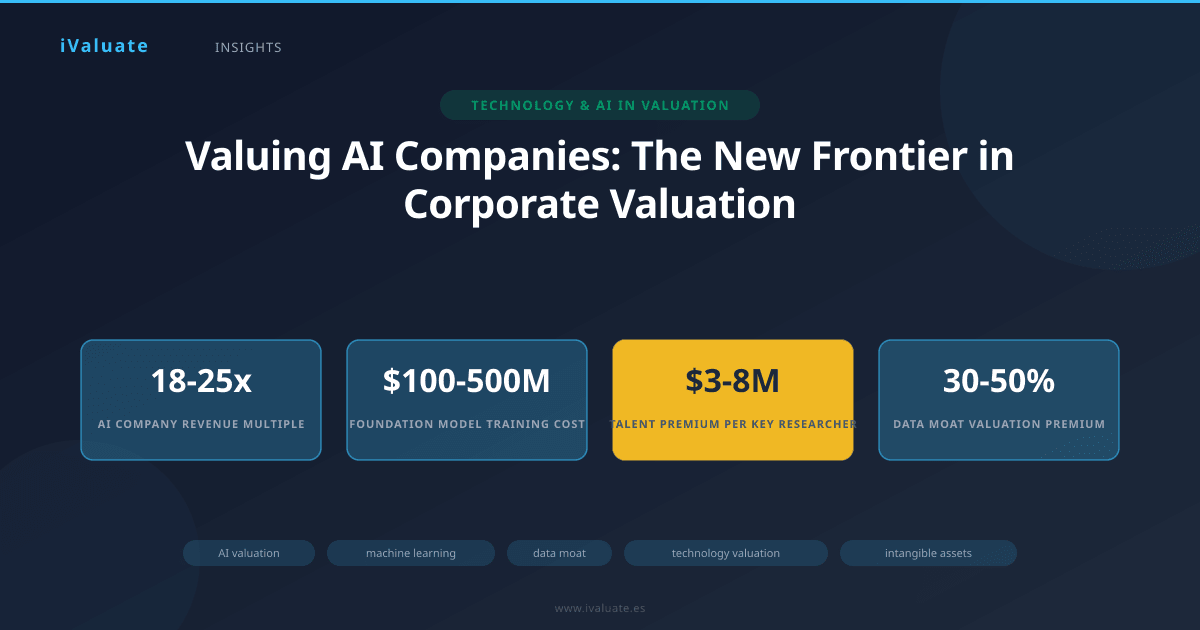
The valuation of artificial intelligence and machine learning companies represents one of the most challenging frontiers in corporate finance today. Unlike traditional software businesses with predictable SaaS metrics or manufacturing firms with tangible assets, AI companies derive their value from intangible, rapidly evolving intellectual property that defies conventional valuation frameworks. As we move through 2025, with AI companies commanding median revenue multiples of 18-25x compared to 8-12x for traditional enterprise software, understanding the unique value drivers of these businesses has become essential for M&A advisors, private equity professionals, and corporate development teams.
The fundamental challenge in AI company valuation stems from the nature of the assets themselves. Traditional valuation methodologies—discounted cash flow analysis, comparable company multiples, precedent transactions—were designed for businesses with established revenue models, physical assets, and predictable cash flows. AI companies, particularly those in early or growth stages, often possess none of these characteristics. Instead, their value resides in proprietary algorithms, curated datasets, specialized talent, and the potential to disrupt existing markets or create entirely new ones.
01 The Unique Asset Structure of AI Companies
To properly value an AI or machine learning company, we must first understand what constitutes its core assets. Unlike a manufacturing company where equipment, inventory, and real estate appear clearly on the balance sheet, or even a traditional software company where customer contracts and recurring revenue provide tangible value markers, AI companies' most valuable assets are largely invisible to conventional accounting.
Proprietary Models and Algorithms
The crown jewel of any AI company is typically its proprietary models and algorithms. These represent years of research, experimentation, and refinement. In 2025, we're seeing foundation models with training costs exceeding $100-500 million for frontier AI companies, while specialized vertical AI models might cost $2-15 million to develop. The valuation challenge lies in determining not just the replacement cost of these models, but their competitive advantage and durability.
When valuing AI models, practitioners must assess several dimensions: accuracy and performance metrics relative to alternatives, the difficulty of replication, the breadth of application, and the rate of model decay. A computer vision model achieving 98% accuracy in a specialized industrial application might command significant value if competitors are stuck at 92-94%, but only if that advantage can be sustained. In our experience, model advantages without supporting moats typically erode within 12-18 months as competitors catch up.
Data Assets and the Data Moat Concept
Perhaps the most critical and misunderstood component of AI company valuation is the data moat. The concept is straightforward: proprietary, high-quality training data that cannot be easily replicated creates a sustainable competitive advantage. In practice, assessing the strength and value of a data moat requires sophisticated analysis.
Not all data is created equal. A company with 10 million labeled images scraped from public sources has virtually no data moat—competitors can acquire similar data sets relatively easily. Conversely, a healthcare AI company with 500,000 annotated medical scans, complete with patient outcomes and physician notes, accumulated through exclusive partnerships with hospital systems, possesses a formidable moat. The latter dataset might be worth $50-200 million as a standalone asset, while the former has negligible independent value.
Key factors in data moat valuation include: exclusivity of data access, quality and depth of labeling, difficulty and cost of replication, regulatory barriers to data collection, and the data's relevance to high-value use cases.
We evaluate data moats across five dimensions: volume, velocity (rate of new data acquisition), variety, veracity (quality and accuracy), and most importantly, exclusivity. A company generating 1 million new proprietary data points monthly through its product usage has a strengthening moat; one relying on a static historical dataset has a deteriorating one. In 2025 valuations, we typically apply a 30-50% premium to companies with demonstrable, expanding data moats compared to those with replicable data assets.
Technical Talent as a Premium Asset
The talent premium in AI company valuations has reached unprecedented levels. A team of 10 world-class machine learning engineers and researchers can be worth $20-50 million in acquisition value, independent of the company's current revenue or technology. This reflects both the scarcity of top-tier AI talent and the reality that in many AI acquisitions, the team is the primary asset being acquired.
Quantifying the talent premium requires analyzing several factors: the team's publication record and academic credentials, their track record of shipping production AI systems, their expertise in specific high-demand areas (such as large language models, reinforcement learning, or computer vision), and critically, their retention risk post-acquisition. We've observed acquirers paying $3-8 million per key AI researcher in talent-focused acquisitions, with earnouts structured to ensure retention over 3-4 years.
02 Valuation Methodologies for AI Companies
Traditional valuation approaches require significant modification when applied to AI companies. The three primary methodologies—income approach (DCF), market approach (comparables), and asset approach—each present unique challenges and opportunities in the AI context.
Modified DCF Analysis for AI Businesses
Discounted cash flow analysis remains the theoretical gold standard for valuation, but applying it to AI companies requires careful adjustments. The standard DCF assumes relatively predictable revenue growth and margin expansion. AI companies, particularly those in emerging categories, face far greater uncertainty in both dimensions.
Our approach involves scenario-based DCF modeling with explicit assumptions about market penetration, competitive dynamics, and technology evolution. For a typical growth-stage AI company, we model three scenarios: a base case assuming moderate market adoption and sustained competitive advantage (40% probability), an upside case assuming rapid market expansion and winner-take-most dynamics (25% probability), and a downside case assuming commoditization or technology disruption (35% probability). The probability-weighted average provides a more realistic valuation than a single-point forecast.
Discount rates for AI companies typically range from 15-30%, depending on stage, market position, and technology risk. Early-stage companies with unproven product-market fit might warrant 25-30% discount rates, while established AI companies with recurring revenue and clear moats might justify 15-18% rates. The higher end of this range reflects not just financial risk but technology obsolescence risk—a factor largely absent in traditional business valuation.
Market Multiples and Comparable Company Analysis
The market approach to AI company valuation has evolved considerably as the sector has matured. In 2025, we can identify several distinct categories of AI companies, each with characteristic valuation multiples:
- Foundation Model Companies: Revenue multiples of 25-40x for companies developing large language models or multimodal foundation models, reflecting winner-take-most market dynamics and massive TAM
- Vertical AI Applications: Revenue multiples of 12-20x for companies applying AI to specific industry problems with clear ROI, similar to traditional vertical SaaS but with a premium for AI capabilities
- AI Infrastructure and Tools: Revenue multiples of 15-25x for companies providing MLOps, model monitoring, or other infrastructure tools, reflecting strong unit economics and expansion potential
- AI-Enabled Services: Revenue multiples of 3-8x for companies using AI to deliver services more efficiently, valued more like services businesses than technology companies
When selecting comparable companies, we look beyond superficial AI labeling to assess true comparability in business model, market position, and technology maturity. A common error is comparing an early-stage computer vision startup to established players like Palantir or DataRobot—the business models and risk profiles are fundamentally different.
Asset-Based Valuation and the Technology Stack
While rarely used as the primary valuation method, asset-based approaches provide a useful floor value for AI companies, particularly in distressed situations or early-stage valuations. The challenge lies in properly valuing intangible assets that don't appear on balance sheets.
We typically decompose an AI company's technology stack into discrete components: trained models, training data, proprietary algorithms and architectures, software infrastructure, and intellectual property (patents, trade secrets). Each component is valued using replacement cost methodology, adjusted for obsolescence and competitive advantage. For example, a proprietary dataset might have cost $5 million to collect and label, but if it provides a 2-year competitive advantage in a $500 million market, its value might be $30-50 million based on the cash flows it enables.
03 Special Considerations in AI Company Valuation
The Compute Cost Factor
One distinctive aspect of AI company economics is the significant and ongoing compute cost required for model training and inference. Unlike traditional software where development costs are largely fixed and marginal costs approach zero, AI companies face substantial variable costs that scale with usage. A large language model might cost $50,000-500,000 per month in inference costs at scale, directly impacting gross margins.
In our valuation work, we pay close attention to the unit economics of AI delivery. Companies with gross margins below 60% face significant valuation discounts compared to traditional software companies with 80-90% gross margins. The path to margin improvement—through model optimization, custom silicon, or pricing power—becomes a critical value driver. We've observed that each 10 percentage point improvement in gross margin can translate to a 15-25% increase in valuation for growth-stage AI companies.
Regulatory and Ethical Risk Factors
The regulatory landscape for AI has evolved dramatically, with the EU AI Act fully implemented in 2025 and similar frameworks emerging in the US and Asia. These regulations create both risks and opportunities in AI company valuation. Companies with robust governance frameworks, explainable AI capabilities, and proactive compliance programs command premiums of 10-20% compared to those facing regulatory uncertainty.
Ethical considerations have moved from theoretical concerns to material valuation factors. AI companies in sensitive domains—hiring, lending, healthcare, criminal justice—face heightened scrutiny around bias, fairness, and transparency. Due diligence now routinely includes algorithmic audits and bias testing. We've seen deals delayed or repriced by 15-30% following discovery of bias issues or inadequate governance frameworks.
Technology Obsolescence and Refresh Cycles
AI technology evolves at a pace that makes traditional technology obsolescence assumptions inadequate. Models that represented state-of-the-art 18 months ago may be superseded by new architectures or approaches. This rapid evolution creates significant valuation risk, particularly for companies whose value rests primarily on current model performance rather than data moats or market position.
We address this through explicit modeling of technology refresh cycles and R&D requirements. A company must continuously invest 20-35% of revenue in R&D to maintain competitive model performance—far higher than the 10-15% typical in traditional enterprise software. This ongoing investment requirement must be reflected in cash flow projections and terminal value assumptions.
04 Real-World Valuation Examples
Case Study: Vertical AI Application Company
Consider a computer vision company serving the manufacturing quality control market. The company has $15 million in ARR growing at 120% annually, with 95% gross margins and a net retention rate of 135%. Traditional SaaS metrics would suggest a valuation of $120-180 million (8-12x revenue). However, deeper analysis reveals:
- A proprietary dataset of 50 million labeled defect images from 200+ production lines, accumulated over 4 years and continuously expanding—estimated standalone value of $30-40 million
- Model accuracy of 99.2% versus 96-97% for competitors, translating to $500,000+ annual value per customer in reduced false positives
- A team including three former researchers from leading computer vision labs, with multiple CVPR publications
- Exclusive data partnerships with two Fortune 500 manufacturers, creating a strengthening data moat
These AI-specific factors justified a valuation of $280-320 million (18-21x revenue), with the premium attributed to the data moat (30% premium), model performance advantage (20% premium), and talent quality (15% premium). The company was ultimately acquired for $295 million in early 2025.
Case Study: Foundation Model Company
A more complex example involves a company developing domain-specific foundation models for legal document analysis. With only $8 million in revenue but $120 million in capital raised, traditional metrics provided little guidance. The valuation hinged on:
- Training data comprising 500 million legal documents, including proprietary case files and contracts—impossible to replicate without similar partnerships
- Model performance significantly exceeding GPT-4 on legal reasoning tasks, validated through independent benchmarks
- A team of 45 including 12 PhD-level researchers, with several pioneers in legal AI
- Early traction with 15 AmLaw 100 firms, suggesting strong product-market fit
The company was valued at $800 million in a Series C round (100x revenue), reflecting the winner-take-most dynamics in foundation models, the strength of the data moat in a high-value vertical, and the quality of the team. While this multiple appears extreme, it reflects rational assessment of the company's probability of capturing a significant share of a $50+ billion legal technology market.
05 Practical Frameworks for AI Company Valuation
Based on hundreds of AI company valuations, we've developed a practical framework that combines quantitative and qualitative factors:
The AI Value Score
We assess AI companies across six dimensions, each scored 0-10, with weights reflecting their importance:
- Data Moat Strength (25%): Exclusivity, quality, and growth rate of proprietary training data
- Model Performance (20%): Accuracy advantage versus alternatives, measured objectively
- Market Position (20%): Revenue growth, customer retention, and competitive dynamics
- Team Quality (15%): Depth of AI expertise, track record, and retention risk
- Technology Durability (10%): Architecture advantages, patent protection, and refresh cycle requirements
- Unit Economics (10%): Gross margins, CAC payback, and path to profitability
Companies scoring 7.5+ typically command top-quartile multiples within their category. Those below 5.0 face significant valuation discounts or may be uninvestable at any reasonable valuation. This framework provides structure to what might otherwise be subjective assessments of intangible assets.
Adjusting for Stage and Maturity
AI company valuation must account for stage-specific factors. Early-stage companies (pre-revenue or <$2M ARR) are valued primarily on team, technology, and total addressable market, with data moat potential as a key differentiator. Growth-stage companies ($2-20M ARR) are valued on a combination of traction metrics and AI-specific advantages. Mature AI companies (>$20M ARR) increasingly resemble traditional software businesses, though AI-specific factors still command 20-40% premiums for companies with strong moats.
06 The Future of AI Company Valuation
As we look toward 2026 and beyond, several trends will shape AI company valuation practices. First, the market is developing more sophisticated frameworks for assessing data moat strength, moving beyond simple volume metrics to evaluate data quality, exclusivity, and strategic value. Second, we're seeing increased focus on AI governance and ethics as material valuation factors, not just risk mitigation checkboxes. Third, the distinction between "AI companies" and "companies using AI" is blurring, requiring more nuanced valuation approaches.
The compute cost economics of AI will likely improve with continued advances in model efficiency and specialized hardware, potentially expanding gross margins and valuations for companies that successfully optimize their inference costs. Conversely, the democratization of foundation models through open source and API access may compress valuations for companies without strong differentiation beyond model performance alone.
The companies that will command premium valuations in the coming years are those that combine strong AI capabilities with defensible data moats, clear paths to profitability, and sustainable competitive advantages that extend beyond current model performance.
For valuation professionals, the imperative is clear: develop deep technical understanding of AI technologies, build frameworks that capture intangible value drivers, and maintain healthy skepticism about AI hype while recognizing genuine innovation. The companies creating real value through AI—solving important problems with sustainable advantages—will justify their valuations through cash flows and market impact. Those riding the AI wave without fundamental differentiation will face valuation compression as the market matures.
Professional valuation platforms like iValuate are evolving to incorporate these AI-specific factors, providing practitioners with tools to systematically assess data moats, model value, and talent premiums alongside traditional financial metrics. As the AI sector continues its rapid evolution, the ability to accurately value these complex businesses will remain a critical skill for M&A advisors, investors, and corporate development professionals navigating this transformative technology landscape.