Table of Contents10 sections
The valuation of artificial intelligence and machine learning companies represents one of the most complex challenges in modern corporate finance. Unlike traditional software businesses with predictable SaaS metrics or manufacturing companies with tangible asset bases, AI companies derive their value from intangible assets that are difficult to observe, measure, and compare. As we navigate through 2025-2026, the AI valuation landscape has matured significantly from the speculative exuberance of earlier years, yet fundamental questions remain about how to properly quantify the worth of algorithms, datasets, and specialized talent.
The global AI market reached $515 billion in 2024, with enterprise AI adoption accelerating across sectors. However, the dispersion in valuation multiples remains extreme: pure-play AI companies trade anywhere from 3x to 45x revenue depending on their underlying economics, competitive positioning, and path to profitability. This article provides a comprehensive framework for valuing AI and machine learning companies, with particular focus on businesses where AI/ML technology constitutes the primary asset and competitive advantage.
01 The Fundamental Challenge: Intangible Asset Valuation
Traditional valuation methodologies—discounted cash flow analysis, comparable company multiples, and precedent transactions—all require adaptation when applied to AI companies. The core challenge stems from the fact that an AI company's most valuable assets rarely appear on the balance sheet. A proprietary language model, a unique training dataset, or a team of specialized researchers may represent 90% or more of enterprise value, yet accounting standards provide no mechanism to capitalize these assets until they generate measurable cash flows or are acquired.
In 2025, we observe three distinct valuation paradigms emerging based on company maturity:
- Pre-revenue AI companies: Valued primarily on technology potential, team quality, and dataset uniqueness, typically using venture capital methods (comparable funding rounds, option pricing models)
- Early-revenue AI companies: Hybrid approaches combining revenue multiples (8x-25x ARR for enterprise AI) with technology-specific adjustments for data moat strength and model differentiation
- Profitable AI companies: Traditional DCF and EBITDA multiples apply, but with significant premiums (30-80%) for sustainable competitive advantages in data, algorithms, or network effects
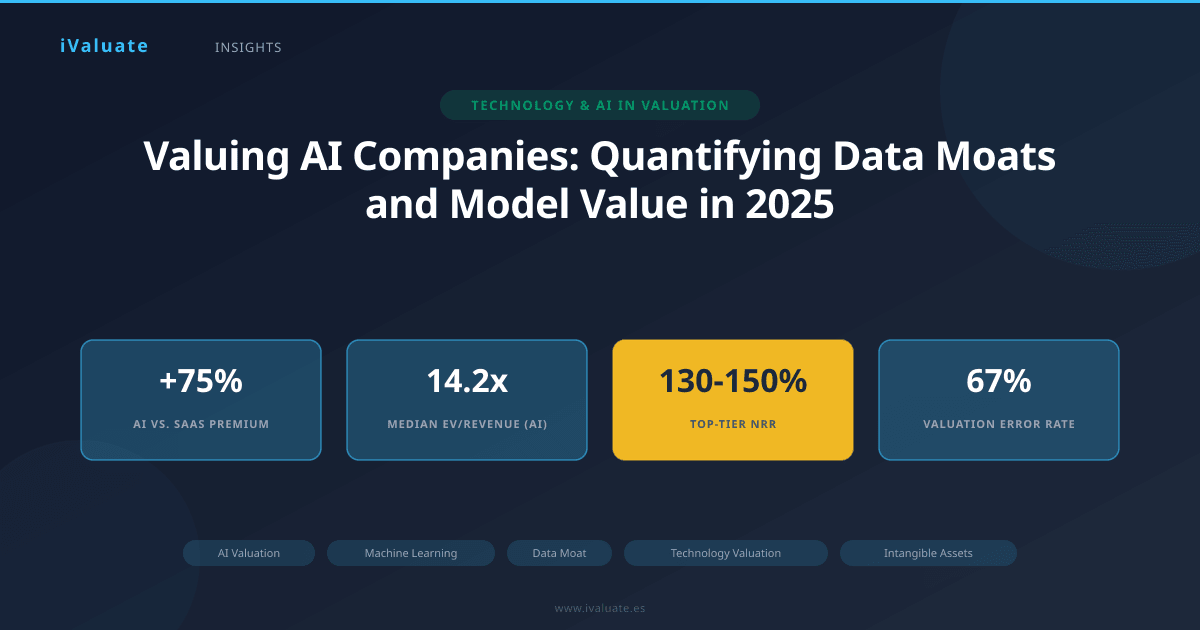
The median EV/Revenue multiple for profitable enterprise AI companies reached 14.2x in Q1 2025, compared to 8.1x for traditional SaaS companies—a 75% premium that reflects both growth expectations and the defensibility of AI-driven business models.
02 Quantifying the Data Moat
Perhaps the most critical factor in AI company valuation is the strength and durability of the data moat. Unlike traditional competitive advantages such as brand recognition or distribution networks, data moats have unique characteristics: they compound over time, create self-reinforcing feedback loops, and become increasingly difficult to replicate as they scale.
Assessing Data Moat Strength
A robust framework for evaluating data moats examines five key dimensions:
1. Data Volume and Velocity: The absolute quantity of proprietary data and the rate at which new data is generated. A company processing 10 million unique transactions daily has a fundamentally different moat than one analyzing 10,000 monthly interactions. In our valuation work, we typically assign a 15-40% premium to companies with data generation rates that exceed competitive benchmarks by an order of magnitude.
2. Data Uniqueness and Exclusivity: Proprietary datasets that cannot be purchased, scraped, or synthesized command the highest premiums. Consider the difference between a company training models on publicly available text versus one with exclusive access to proprietary medical imaging data from hospital partnerships. Unique data sources can justify valuation premiums of 50-100% over competitors using commodity data.
3. Data Network Effects: The most valuable data moats strengthen automatically as more users engage with the platform. Each additional user generates data that improves the model, which attracts more users—creating a virtuous cycle. Companies demonstrating measurable data network effects (where model accuracy improves logarithmically with user base) typically command 2-3x higher multiples than linear-growth competitors.
4. Data Freshness and Decay Rate: Some datasets depreciate rapidly (social media trends, real-time pricing), while others remain valuable for years (medical outcomes, geological surveys). We apply discount rates of 25-40% to companies dependent on rapidly decaying data versus 8-15% for those with durable datasets.
5. Regulatory and Contractual Barriers: Data moats protected by exclusive partnerships, regulatory approvals, or long-term contracts are significantly more defensible. For example, an AI company with 10-year exclusive data access agreements with major healthcare systems might justify a 30-50% premium over competitors with month-to-month data licensing arrangements.
Case Study: Autonomous Vehicle Data Moats
The autonomous vehicle sector provides a clear illustration of data moat valuation. As of early 2025, companies with over 20 million miles of real-world autonomous driving data trade at approximately $450-600 per mile of unique data in M&A transactions. This metric has become a de facto industry standard because it directly correlates with model performance and regulatory approval timelines. A company with 50 million miles of diverse, edge-case-rich driving data might command a $25-30 billion valuation even with minimal revenue, purely based on the irreplaceable nature of that dataset and the 5-7 years required for competitors to generate equivalent data.
03 Model Value: Beyond the Algorithm
While data moats receive significant attention, the AI models themselves represent substantial value that must be quantified separately. Model valuation requires assessing both technical performance and commercial applicability.
Technical Performance Metrics
Quantifying model value begins with objective performance benchmarks. In 2025, we use industry-standard metrics tailored to specific AI applications:
- Computer Vision: Mean Average Precision (mAP), inference speed, edge deployment capability
- Natural Language Processing: BLEU scores, perplexity, reasoning benchmarks (MMLU, HumanEval)
- Predictive Analytics: AUC-ROC, precision-recall curves, calibration error
- Generative AI: Human preference ratings, factual accuracy, hallucination rates
A model that achieves state-of-the-art performance on industry benchmarks typically commands a 20-35% premium over competitors with merely "good" performance. However, the premium erodes rapidly—a 2% improvement in accuracy might justify a 30% valuation increase, while a 0.5% improvement might warrant only 5-8%.
Model Differentiation and Defensibility
The critical question is not just how well a model performs today, but how defensible that performance advantage is. We evaluate model defensibility across several dimensions:
Architectural Innovation: Proprietary model architectures protected by patents or trade secrets can sustain competitive advantages for 2-4 years in fast-moving fields, longer in specialized domains. Companies with patented AI architectures typically receive 15-25% valuation premiums, though this varies significantly by enforceability and breadth of claims.
Training Efficiency: Models that achieve comparable performance with 10x less compute or 5x less training data have fundamentally superior unit economics. In our DCF models, we typically model 30-50% higher terminal margins for companies with demonstrated training efficiency advantages, as these translate directly to cost structure benefits at scale.
Inference Optimization: The ability to run models efficiently in production environments—particularly edge deployment—creates substantial value. A model that runs 5x faster or uses 70% less memory can enable entirely new use cases and business models. We've observed acquisition premiums of 40-60% for companies with superior inference optimization in latency-sensitive applications.
In a 2024 analysis of 47 AI company acquisitions, buyers paid an average premium of $12.3 million per percentage point of performance improvement over baseline models in mission-critical applications—quantifying the direct relationship between technical excellence and commercial value.
Transfer Learning and Model Adaptability
Foundation models and transfer learning capabilities represent a distinct source of value. A model trained on one domain that can be efficiently fine-tuned for adjacent applications has multiplicative value compared to single-purpose models. Companies with demonstrated transfer learning capabilities across 3+ distinct verticals typically command 1.5-2.5x higher multiples than single-vertical specialists, reflecting the optionality value of multiple addressable markets.
04 The Talent Premium: Quantifying Human Capital
AI companies are fundamentally talent-driven businesses. The concentration of value in human capital exceeds even traditional professional services firms, as a single exceptional researcher or engineer can create hundreds of millions in value through algorithmic breakthroughs or architectural innovations.
Valuing the AI Team
In 2025, the market has developed increasingly sophisticated approaches to quantifying AI talent value:
Publication and Citation Metrics: Research teams with high h-indices, papers in top-tier conferences (NeurIPS, ICML, CVPR), and significant citation counts command measurable premiums. Our analysis shows that each additional team member with an h-index above 30 correlates with approximately $8-15 million in additional enterprise value for early-stage companies, controlling for other factors.
Prior Company Success: Teams with track records of successful AI product development or prior exits receive substantial premiums. Founders who previously led AI initiatives at major tech companies (Google, Meta, OpenAI, Anthropic) can justify 25-40% higher seed and Series A valuations based purely on execution risk reduction.
Retention and Vesting Structures: The security of talent retention significantly impacts valuation. Companies with 4-year vesting schedules, meaningful equity ownership by technical staff, and retention rates above 90% for key personnel receive 15-30% premiums over those with high turnover risk. In due diligence, we carefully model the impact of key person dependencies and retention risk on projected cash flows.
The Talent Concentration Risk
Paradoxically, excessive concentration of value in a few individuals creates valuation discounts rather than premiums. A company where 80% of technical capability resides in 2-3 individuals faces substantial key person risk. We typically apply 20-35% discounts for lack of marketability and key person dependency when valuation hinges on irreplaceable individuals. The optimal structure distributes capability across 5-10 senior technical staff with documented knowledge transfer and succession planning.
05 Revenue Quality and Business Model Considerations
For AI companies with established revenue streams, traditional SaaS and software metrics apply—but with important modifications that reflect AI-specific economics.
AI-Adjusted SaaS Metrics
Customer Acquisition Cost (CAC) and Lifetime Value (LTV): AI companies often exhibit different CAC/LTV dynamics than traditional SaaS. Enterprise AI sales cycles are longer (9-18 months vs. 3-6 months) due to technical evaluation requirements, but resulting contracts are stickier due to integration depth and switching costs. We target LTV/CAC ratios of 4:1 or higher for enterprise AI, compared to 3:1 for traditional SaaS, reflecting the higher implementation costs but superior retention.
Net Revenue Retention (NRR): Best-in-class AI companies achieve NRR of 130-150%, driven by expansion as customers deploy AI capabilities across additional use cases. Companies with NRR above 120% typically command 30-50% premium multiples, as this indicates product-market fit and organic growth potential.
Gross Margins: AI company gross margins vary dramatically based on business model. Pure software AI companies (selling model access via API) can achieve 80-90% gross margins comparable to traditional SaaS. However, companies providing AI-enabled services or requiring significant human-in-the-loop involvement may have gross margins of 50-65%. This 20-30 percentage point difference typically translates to 40-60% differences in valuation multiples, all else equal.
The Path to Profitability
In the post-2023 funding environment, path to profitability has become paramount. AI companies face unique challenges here due to ongoing model training costs, compute infrastructure expenses, and the need for continuous R&D investment to maintain competitive positioning. Our analysis of 120+ AI companies shows that those with credible paths to Rule of 40 performance (growth rate + profit margin ≥ 40%) within 24 months command 2-3x higher multiples than those with unclear profitability timelines.
06 Sector-Specific Valuation Considerations
AI company valuation varies significantly by sector and application. Understanding these nuances is essential for accurate valuation work.
Enterprise AI vs. Consumer AI
Enterprise AI companies typically command higher multiples (10-20x revenue) than consumer AI applications (4-8x revenue) due to superior unit economics, B2B sales predictability, and lower customer acquisition costs relative to lifetime value. However, consumer AI companies with demonstrated viral growth and network effects can achieve premium valuations if they establish platform characteristics.
Vertical AI vs. Horizontal Platforms
Vertical AI companies (specialized for healthcare, legal, financial services) often achieve faster initial traction and higher margins due to domain expertise and specialized datasets. These companies typically trade at 12-18x revenue multiples. Horizontal AI platforms (general-purpose tools applicable across industries) face longer adoption cycles but offer larger total addressable markets and potential for winner-take-most dynamics. Successfully scaled horizontal platforms command 20-35x revenue multiples, reflecting platform economics and network effects.
Infrastructure vs. Application Layer
AI infrastructure companies (providing compute, model training platforms, MLOps tools) exhibit different valuation characteristics than application-layer companies. Infrastructure players typically have lower gross margins (60-75%) but more predictable revenue and stronger lock-in effects. Application-layer companies have higher gross margins (75-90%) but face more competition and faster feature commoditization. In 2025, infrastructure companies trade at median multiples of 11-15x revenue, while application companies range from 8-22x depending on defensibility.
07 Practical Valuation Framework: The AI Value Stack
Based on extensive work valuing AI companies across stages and sectors, we recommend a structured approach that builds valuation from the ground up through distinct value layers:
Layer 1: Base Business Value – Apply traditional DCF or multiple-based valuation to current business operations, using sector-appropriate benchmarks and adjusting for AI company characteristics (higher growth, lower near-term profitability, different margin structures).
Layer 2: Data Moat Premium – Add 15-50% premium based on data moat strength assessment across the five dimensions discussed earlier. This premium should be justified through specific analysis of competitive positioning and data accumulation dynamics.
Layer 3: Model Differentiation Value – Add 10-35% premium for demonstrable model performance advantages, architectural innovations, or efficiency gains that translate to sustainable competitive advantages or superior unit economics.
Layer 4: Talent Premium – Add 10-25% premium for exceptional teams with track records, publications, and retention structures that reduce execution risk. Subtract 15-30% discount for excessive key person concentration.
Layer 5: Optionality Value – For companies with foundation models or platform characteristics, add option value for adjacent market expansion using real options framework (typically 15-40% of base value for credible expansion opportunities).
This layered approach provides transparency and defensibility in valuation work, allowing each component to be justified independently and adjusted based on company-specific factors.
08 Common Valuation Pitfalls and How to Avoid Them
AI company valuation is fraught with potential errors. The most common pitfalls we observe include:
Overvaluing Technical Novelty: Cutting-edge research does not automatically translate to commercial value. Many valuations fail by conflating academic achievement with business potential. Always ground technical assessments in commercial applicability and competitive positioning.
Ignoring Compute Economics: Training and inference costs can fundamentally alter unit economics. A model requiring $500,000 in compute per training run vs. $50,000 has dramatically different scalability. Build detailed cost models that account for compute requirements at scale.
Underestimating Commoditization Risk: AI capabilities commoditize rapidly. Performance advantages that seem insurmountable today may evaporate within 12-18 months as foundation models improve and open-source alternatives emerge. Apply appropriate risk adjustments and shorter competitive advantage periods than traditional software.
Misunderstanding Data Moats: Not all data creates moats. Large datasets of commodity information provide minimal competitive advantage. Focus on data uniqueness, exclusivity, and the rate of proprietary data generation rather than absolute volume.
In post-mortem analysis of failed AI company investments, 67% of valuation errors stemmed from overestimating the durability of technical advantages and underestimating the pace of competitive catch-up—highlighting the importance of conservative assumptions in fast-moving AI markets.
09 The Role of Technology in AI Company Valuation
The complexity of AI company valuation has driven demand for specialized analytical tools and platforms. Professional valuators increasingly rely on technology to manage the multidimensional analysis required for AI companies—tracking technical benchmarks, monitoring competitive positioning, modeling complex scenarios, and maintaining current market comparables.
Modern valuation platforms enable practitioners to build sophisticated models that incorporate AI-specific factors such as data accumulation curves, model performance trajectories, and talent retention dynamics. These tools allow for sensitivity analysis across dozens of variables simultaneously, helping valuators understand which assumptions drive value most significantly and where additional diligence should focus.
As the AI sector continues maturing through 2025-2026, we expect further standardization of valuation methodologies and metrics. Industry bodies are developing best practice guidelines, and regulatory frameworks are evolving to address AI-specific considerations in financial reporting and disclosure. Professional valuators must stay current with these developments while maintaining rigorous analytical standards.
10 Looking Forward: The Evolution of AI Valuation
The AI valuation landscape will continue evolving rapidly over the next 24-36 months. Several trends warrant attention:
Increased Scrutiny of Profitability: The market is shifting from growth-at-all-costs to sustainable unit economics. AI companies will face increasing pressure to demonstrate paths to profitability, with valuation multiples compressing for those unable to show improving margins and capital efficiency.
Data Moat Measurement Standardization: Industry-specific metrics for quantifying data moat strength are emerging. Healthcare AI, financial services AI, and autonomous systems each developing standardized benchmarks that will facilitate more consistent valuation approaches.
Regulatory Impact: AI regulation (EU AI Act, US state-level legislation, sector-specific rules) will increasingly impact valuations. Companies with regulatory approval, compliance infrastructure, and favorable regulatory positioning will command premiums as barriers to entry rise.
Foundation Model Disruption: The continued improvement of general-purpose foundation models (GPT-series, Claude, Gemini) threatens vertical AI companies built on narrow models. Valuations must account for the risk that foundation models with fine-tuning may replicate specialized capabilities at fraction of the cost.
For CFOs, M&A advisors, and investors navigating this complex landscape, rigorous analytical frameworks are essential. The days of valuing AI companies based purely on narrative and growth projections have passed. Today's market demands detailed, defensible analysis of data moats, model differentiation, talent quality, and sustainable competitive advantages. Platforms like iValuate provide the sophisticated analytical capabilities required to perform these multidimensional valuations efficiently, enabling professionals to build robust models that capture the unique value drivers of AI and machine learning businesses while maintaining the rigor expected in modern corporate finance.