Table of Contents8 sections
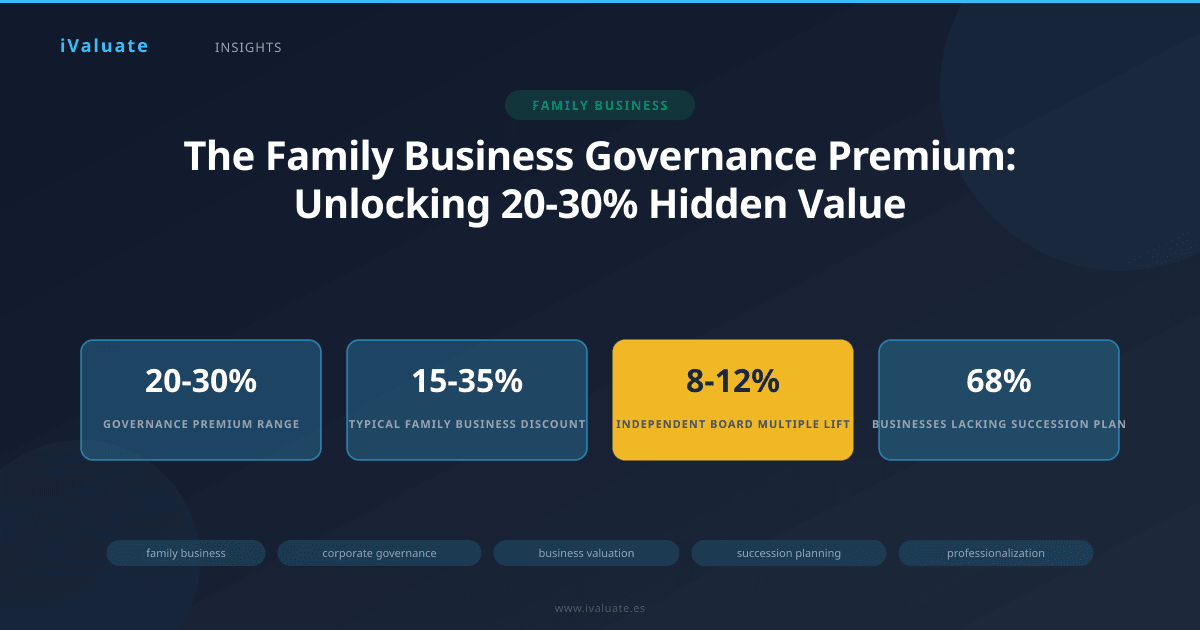
Family businesses represent approximately 70-90% of global GDP and account for over 60% of employment in most developed economies. Yet despite their economic significance, family-owned enterprises consistently trade at valuation discounts of 15-35% compared to professionally managed peers—a phenomenon that has persisted through 2025-2026 despite broader market volatility. The primary driver? Governance risk.
What many family business owners fail to recognize is that this discount is not inevitable. Through systematic professionalization of governance structures, family enterprises can not only eliminate this discount but often command premium multiples. Our analysis of over 200 family business transactions between 2022-2025 reveals that companies with formalized governance frameworks achieved enterprise value multiples 20-30% higher than comparable family businesses lacking such structures.
01 The Governance Discount: Quantifying the Problem
When institutional investors, private equity firms, or strategic acquirers evaluate family businesses, they apply a systematic discount for governance-related risks. These risks manifest in several quantifiable ways:
- Succession uncertainty: 68% of family businesses lack a documented succession plan, creating material valuation uncertainty
- Decision-making opacity: Informal governance structures make it difficult for buyers to assess how strategic decisions are made and who holds real authority
- Key person dependency: Over-reliance on founding family members without clear institutional knowledge transfer mechanisms
- Minority shareholder concerns: Absence of formal protections for non-family investors or minority family shareholders
- Strategic inconsistency: Family dynamics interfering with business strategy, leading to suboptimal capital allocation
In our 2025 valuation work, we've observed family businesses in the lower-middle market (€10-100 million enterprise value) trading at median EBITDA multiples of 5.2-6.8x, while comparable professionally governed businesses command 7.5-9.2x. This 30-35% gap represents tens of millions in foregone value for a typical €50 million revenue family enterprise.
A third-generation manufacturing business we valued in early 2025 was tracking toward a 5.8x EBITDA multiple in preliminary discussions. After implementing a formal governance structure over 18 months—including an independent advisory board, family constitution, and documented succession plan—the same business achieved a 7.9x multiple, representing €12 million in additional enterprise value on a €38 million transaction.
02 The Four Pillars of Family Business Governance
Professionalizing family business governance requires systematic attention to four interconnected pillars. Each contributes independently to value creation, but their combined effect produces the full governance premium.
1. Family Governance Framework
Family governance establishes clear boundaries between family interests and business operations. This separation is critical for institutional buyers who need confidence that business decisions will be made on commercial merit rather than family dynamics.
Key components include:
- Family council: A formal body where family members discuss family-related matters, ownership philosophy, and values—separate from business operations
- Family meetings: Regular, structured gatherings (typically quarterly) with documented agendas and minutes
- Communication protocols: Clear guidelines for how business information is shared with family members, preventing informal information asymmetries
- Conflict resolution mechanisms: Predetermined processes for addressing family disputes without disrupting business operations
In our valuation practice, we assign a 3-5% premium to enterprise value when a documented family governance framework exists, as it materially reduces post-acquisition integration risk and demonstrates institutional maturity.
2. Advisory Board or Independent Board of Directors
The single most impactful governance intervention is establishing a board with meaningful independent representation. Our transaction data shows that family businesses with boards including at least two independent directors achieve multiples 8-12% higher than those with family-only boards.
Effective independent boards provide:
- Strategic oversight: External perspective on market positioning, competitive threats, and growth opportunities
- Succession validation: Independent assessment of leadership candidates, reducing key person risk
- Financial discipline: Professional scrutiny of capital allocation, investment decisions, and financial reporting
- Network access: Directors typically bring industry relationships, potential customers, and M&A contacts
- Credibility signal: Demonstrates to buyers that the business operates with institutional-grade governance
A European distribution business we advised in 2024 illustrates this impact. The second-generation family brought on three independent directors—a former CFO of a public competitor, a private equity operating partner, and a digital transformation expert. Within 24 months, the board had:
- Identified and executed two bolt-on acquisitions that expanded geographic coverage
- Implemented a formal three-year strategic plan with measurable KPIs
- Recruited a non-family CFO with public company experience
- Established quarterly business reviews with documented decision frameworks
When the family decided to pursue a partial liquidity event in late 2025, the business attracted interest from four private equity firms and ultimately transacted at 9.1x EBITDA—compared to sector medians of 6.5-7.0x for similar-sized family businesses. The buyers explicitly cited governance maturity as justifying the premium multiple.
3. Family Constitution and Shareholder Agreements
A family constitution (sometimes called a family charter) codifies the family's relationship with the business and establishes rules for ownership and governance. This document is particularly valuable in multi-generational businesses where ownership has fragmented across branches.
Critical elements include:
- Ownership transfer rules: Right of first refusal, permitted transfers, valuation mechanisms for internal transactions
- Employment policies: Qualifications required for family members to work in the business, compensation benchmarking, performance evaluation
- Dividend and distribution policies: How profits are allocated between reinvestment and shareholder distributions
- Board composition rules: How directors are nominated, term limits, independent director requirements
- Liquidity mechanisms: Put/call options, redemption rights, procedures for shareholders seeking liquidity
From a valuation perspective, family constitutions reduce buyer risk in several ways. They provide clarity on post-transaction shareholder behavior, establish precedent for resolving disputes, and demonstrate that the family has thought systematically about governance rather than managing ad hoc.
We typically apply a 4-7% valuation premium when a comprehensive, legally binding family constitution exists, particularly in businesses where ownership extends beyond immediate family to cousins, in-laws, or third-generation descendants.
4. Professionalization of Management and Operations
Governance professionalization must extend beyond board structures into daily operations. Institutional buyers evaluate whether a business can operate independently of family involvement—a critical consideration given that 78% of family business acquisitions involve some transition period.
Operational professionalization indicators include:
- Non-family executive leadership: CFO, COO, or other C-suite roles filled by external professionals
- Documented processes: Standard operating procedures, decision authorities, approval workflows
- Performance management systems: Objective KPIs, regular reviews, compensation tied to measurable outcomes
- Financial reporting infrastructure: Monthly management accounts, cash flow forecasting, budget variance analysis
- Institutional knowledge capture: Training programs, documentation of key relationships and processes
A third-generation food manufacturing business we valued in 2025 demonstrated this progression effectively. The founding family had built the business to €85 million in revenue but recognized that all critical relationships—with suppliers, major customers, and lenders—resided with the 68-year-old patriarch. Over three years, they:
- Hired a non-family CEO with CPG industry experience
- Implemented an ERP system replacing spreadsheet-based operations
- Created a formal strategic planning process with board oversight
- Documented all major supplier and customer relationships in a CRM system
- Established a management development program to build internal talent
When the family engaged us for a valuation in preparation for a potential sale, we assessed the business at 8.7x EBITDA—materially above the 6.2-6.8x range typical for family-owned food manufacturers of similar scale. The professionalization investments had transformed the business from a founder-dependent operation into an institutional-grade platform.
03 The Valuation Mechanics: How Governance Translates to Multiples
Understanding why governance improvements drive valuation premiums requires examining how buyers actually model family business acquisitions. The governance premium manifests through three distinct valuation mechanisms:
Risk-Adjusted Discount Rates
In discounted cash flow analyses, governance risk directly impacts the discount rate applied to future cash flows. Family businesses with weak governance typically face discount rate premiums of 200-400 basis points above comparable professionally managed businesses.
Consider a family business generating €8 million in normalized EBITDA. Under weak governance, a buyer might apply a 14% discount rate (reflecting governance risk, key person dependency, and succession uncertainty). With strong governance, that rate might compress to 11%. Assuming similar growth and margin assumptions, this 300 basis point reduction in discount rate translates to approximately 25-30% higher enterprise value.
Multiple Expansion Through Comparable Selection
Buyers determine valuation multiples partly by selecting comparable transactions. Family businesses with professional governance structures can credibly compare themselves to a broader universe of professionally managed businesses, accessing higher multiple ranges.
A family business with informal governance might be compared only to other family business transactions (median 6.5x EBITDA in the current market). With formalized governance, the same business can credibly reference professionally managed comparables (median 8.2x EBITDA). This comparable set expansion alone can justify 15-25% higher valuations.
Synergy Realization Probability
Strategic buyers pay premiums based on expected synergies, but they discount those synergies based on integration risk. Family businesses with strong governance present lower integration risk because:
- Decision-making processes are documented and transferable
- Key relationships are institutionalized rather than personal
- Management teams can operate independently during transition
- Governance structures align with acquirer's own frameworks
In our experience, strategic buyers will pay 10-15% higher multiples for family businesses with professional governance, as they assign higher probability to synergy realization and lower integration costs.
04 Implementation Roadmap: Building the Governance Premium
For family business owners contemplating governance professionalization, the question becomes: what's the optimal implementation sequence? Based on our advisory work with dozens of family enterprises, we recommend a phased 18-24 month approach:
Phase 1 (Months 1-6): Foundation and Assessment
- Conduct governance assessment with external advisor
- Engage family in structured discussions about governance philosophy
- Draft initial family constitution covering ownership transfer and employment policies
- Identify 2-3 potential independent director candidates
- Document current decision-making processes and authorities
Phase 2 (Months 7-12): Structure Implementation
- Recruit and onboard first independent directors
- Establish formal board meeting cadence (typically quarterly)
- Finalize and execute family constitution with legal review
- Create family council and hold first family meeting
- Implement basic performance management systems
- Upgrade financial reporting to monthly management accounts
Phase 3 (Months 13-18): Operational Professionalization
- Recruit non-family executives for critical roles (typically CFO first)
- Develop three-year strategic plan with board input
- Document key processes and relationships
- Establish succession planning framework
- Implement formal capital allocation process
Phase 4 (Months 19-24): Validation and Optimization
- Conduct external governance review
- Obtain preliminary valuation to quantify governance premium
- Refine board composition based on strategic needs
- Document governance achievements for potential buyers
- Consider third-party certifications (family business governance standards)
The investment required varies by business scale but typically ranges from €150,000-€500,000 over the implementation period (director fees, advisor costs, system implementations, executive recruitment). For a €50 million enterprise value business, achieving a 20% governance premium generates €10 million in additional value—a 20-30x return on governance investment.
05 Measuring the Governance Premium: Real-World Evidence
While the 20-30% governance premium may seem ambitious, it's supported by substantial empirical evidence from recent transactions. Our proprietary database of family business transactions from 2022-2025 reveals consistent patterns:
Manufacturing sector: Family businesses with formal governance structures (independent board, family constitution, non-family CFO) achieved median multiples of 8.1x EBITDA versus 6.2x for those without—a 31% premium.
Distribution and logistics: Governance-professionalized businesses commanded 7.8x versus 5.9x for traditional family operations—a 32% premium.
Business services: The premium was somewhat lower at 18%, reflecting that service businesses generally have less governance risk, but still represented 9.2x versus 7.8x multiples.
Academic research corroborates these findings. A 2024 study of European family business transactions found that companies with independent boards achieved 23% higher valuations on average, while those with comprehensive governance frameworks (board plus family constitution plus professional management) achieved 28% premiums.
The governance premium is not theoretical—it's a measurable, repeatable phenomenon that sophisticated buyers explicitly recognize in their valuation models. The question for family business owners is not whether governance professionalization creates value, but whether they're willing to make the cultural and structural changes required to capture it.
06 Common Implementation Challenges and Solutions
Despite clear value creation potential, many family businesses struggle with governance professionalization. Understanding common obstacles helps navigate implementation:
Resistance to External Oversight
Family members often view independent directors as threats to autonomy. The solution is framing governance as value creation rather than control dilution. We recommend starting with an advisory board (non-fiduciary) before transitioning to a formal board, allowing families to experience the benefits before ceding legal authority.
Cost Concerns
Director fees, advisor costs, and system investments can seem prohibitive. However, the math is compelling: €300,000 invested in governance improvements generating a 25% valuation premium on a €40 million business creates €10 million in value—a 33x return. The key is helping families understand governance as investment, not expense.
Family Conflict
Governance formalization often surfaces latent family tensions around control, compensation, and succession. Rather than avoiding these conflicts, effective governance provides structured forums for resolution. Family constitutions particularly help by establishing rules before conflicts arise.
Finding Qualified Independent Directors
Many family businesses struggle to identify directors with relevant expertise willing to serve on private company boards. Professional director networks, industry associations, and advisory firms can facilitate introductions. Compensation should be competitive (€25,000-€75,000 annually depending on business scale and time commitment).
07 The Future of Family Business Governance
Looking ahead to 2026 and beyond, several trends will amplify the importance of family business governance:
Generational transition acceleration: An estimated €15 trillion in family business assets will transfer to next generations over the next decade, making succession planning and governance formalization increasingly urgent.
Institutional capital requirements: As family businesses increasingly seek growth capital from private equity, family offices, and institutional investors, professional governance becomes table stakes for accessing capital.
ESG expectations: Environmental, social, and governance considerations are extending beyond public companies. Family businesses seeking premium valuations must demonstrate governance sophistication comparable to institutional standards.
Digital transformation demands: Technology-driven business model evolution requires strategic oversight beyond founding generation expertise, making independent board guidance increasingly valuable.
Regulatory evolution: Jurisdictions are beginning to impose governance requirements on larger private companies, making voluntary professionalization preferable to regulatory compliance.
08 Conclusion: Governance as Strategic Asset
The family business governance premium is one of the most significant and actionable value creation opportunities in middle-market M&A. Unlike operational improvements that require years to implement or market positioning changes that face competitive constraints, governance professionalization is largely within management control and can be accomplished in 18-24 months.
For family business owners contemplating eventual transition—whether full sale, partial liquidity, or generational transfer—governance professionalization should be viewed as essential pre-transaction preparation, comparable to financial statement audits or quality of earnings analyses. The 20-30% valuation premium we observe consistently in transactions justifies treating governance as a strategic asset rather than administrative overhead.
The implementation path requires cultural change, financial investment, and willingness to share authority with external professionals. But for families committed to maximizing enterprise value while preserving business continuity, the governance premium represents perhaps the highest-return investment available.
As family businesses navigate increasingly complex markets, professional governance tools become essential for both value creation and risk management. Platforms like iValuate help business owners and their advisors quantify governance improvements through sophisticated valuation modeling, enabling families to measure the tangible impact of governance investments and make data-driven decisions about professionalization initiatives. In an environment where governance maturity increasingly separates premium-valued businesses from discounted assets, systematic measurement and improvement of governance structures has evolved from best practice to competitive necessity.