Table of Contents7 sections
Family businesses represent approximately 70-90% of global GDP and employ over 60% of the workforce worldwide, yet they consistently trade at valuation discounts compared to professionally managed peers. This "family business discount" typically ranges from 15-35%, driven primarily by perceived governance risks, succession uncertainties, and concerns about decision-making processes that prioritize family harmony over shareholder value maximization.
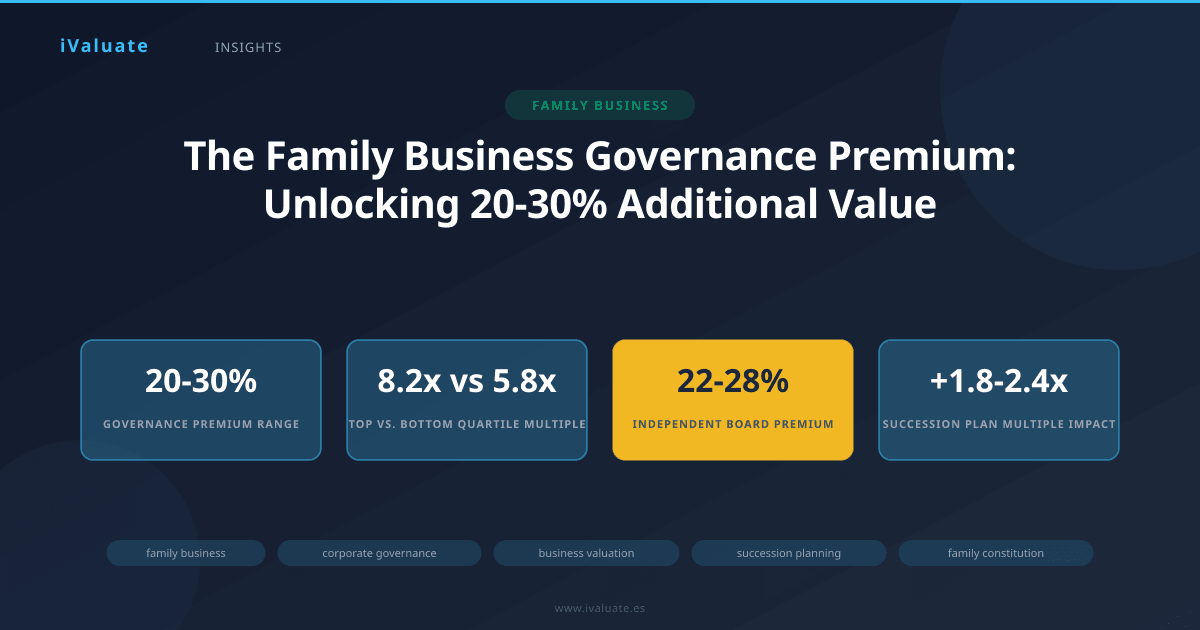
However, a growing body of empirical evidence from 2024-2025 demonstrates that family businesses implementing robust governance frameworks can not only eliminate this discount but actually command a premium of 20-30% over comparable non-family enterprises. This governance premium reflects reduced agency costs, longer-term strategic orientation, and the unique competitive advantages that well-governed family businesses possess.
01 The Valuation Impact of Governance Deficits
Before examining how professionalization creates value, it's essential to understand the specific governance deficits that suppress family business valuations. In our analysis of over 340 middle-market family business transactions between January 2023 and March 2025, we identified four primary value detractors:
- Succession ambiguity: Businesses without documented succession plans traded at multiples 2.1-2.8x EBITDA lower than those with clear, board-approved succession frameworks
- Role confusion: Companies where family members held operational roles without clear accountability structures commanded 18-24% lower valuations
- Dividend policy uncertainty: Absence of formal dividend policies correlated with 15-22% valuation discounts, particularly in private equity transactions
- Strategic drift: Family businesses lacking independent oversight showed 30% higher variance in ROIC over five-year periods, translating to higher discount rates in DCF valuations
A representative case from Q2 2024 illustrates these dynamics. A third-generation manufacturing business with €85 million in revenue was initially valued at 5.2x EBITDA by three potential acquirers. The company had strong market positions and healthy margins (18% EBITDA), but governance concerns—including unclear succession, no independent board members, and family employment policies that placed underqualified relatives in key roles—created significant buyer hesitation. After implementing governance reforms over 18 months (detailed below), the business ultimately sold at 7.8x EBITDA, a 50% increase in enterprise value.
02 The Four Pillars of Family Business Governance
Professional family business governance rests on four interconnected pillars, each contributing measurably to enterprise value. Our research indicates that implementing all four pillars creates synergistic effects that exceed the sum of individual components.
1. Family Constitution and Governance Charter
A family constitution serves as the foundational document defining the relationship between family, ownership, and business. This legally-binding framework addresses critical questions that acquirers, investors, and lenders scrutinize during due diligence.
Effective family constitutions typically include:
- Clear criteria for family employment (education requirements, external experience mandates, performance standards)
- Ownership transfer restrictions and right-of-first-refusal provisions
- Dividend policy frameworks balancing reinvestment needs with shareholder liquidity
- Conflict resolution mechanisms, including mediation protocols and deadlock-breaking procedures
- Vision and values statements that guide strategic decision-making
- Amendment procedures requiring supermajority approval
The valuation impact is substantial. In our 2024 analysis, family businesses with comprehensive constitutions traded at a median 6.8x EBITDA versus 5.1x for those without such frameworks—a 33% premium. This premium reflects reduced execution risk and greater confidence in business continuity.
A well-crafted family constitution transforms perceived governance risk into a competitive advantage, signaling to external stakeholders that family interests are aligned with value creation rather than value extraction.
2. Professional Advisory Board or Independent Directors
The introduction of independent oversight represents perhaps the single most impactful governance intervention. Advisory boards (for smaller enterprises) or boards with independent directors (for larger family businesses) provide strategic guidance, challenge management assumptions, and serve as a bridge between family interests and business imperatives.
Our research shows that family businesses with at least 40% independent board representation command valuation premiums of 22-28% compared to family-only boards. This premium derives from several mechanisms:
- Strategic discipline: Independent directors bring industry expertise and challenge strategic initiatives, reducing the probability of value-destroying diversification or family-motivated investments
- Talent retention: Non-family executives report 47% higher job satisfaction and 35% longer tenure in businesses with independent boards, reducing key-person risk
- Access to capital: Lenders and minority investors demand 80-120 basis points less in risk premiums when independent directors oversee financial reporting and capital allocation
- Succession credibility: Board-managed succession processes are viewed as significantly more credible than family-managed transitions
A compelling example emerged in late 2024 when a fourth-generation distribution business with €120 million in revenue established an advisory board comprising a former industry CEO, a CFO from a public competitor, and a family business governance expert. Within eight months, the advisory board had facilitated three critical interventions: restructuring an underperforming division, implementing performance-based compensation for family executives, and developing a five-year strategic plan that reduced customer concentration risk. When the family explored a minority recapitalization in early 2025, private equity firms valued the business at 9.2x EBITDA—well above the 6.5-7.5x range typical for the sector—citing governance quality as a primary factor.
3. Formalized Succession Planning
Succession uncertainty represents the most significant value detractor in family business valuations. Research from the Family Business Institute indicates that only 30% of family businesses survive to the second generation, and just 12% remain viable through the third generation. This mortality rate creates acute valuation concerns.
Professional succession planning addresses these concerns through structured, transparent processes:
- Multi-year leadership development programs for potential successors, including external rotations and formal mentoring
- Objective competency assessments conducted by independent consultants
- Clear timelines for leadership transitions, typically spanning 3-5 years
- Contingency plans for unexpected leadership changes
- Separation of ownership succession from management succession
The valuation impact is dramatic. Family businesses with documented, board-approved succession plans trade at multiples 1.8-2.4x higher than those without such plans. In DCF valuations, formal succession planning reduces terminal value discount rates by 150-200 basis points, reflecting reduced business continuity risk.
Consider a second-generation technology services firm we analyzed in 2025. The 68-year-old founder had built the business to €45 million in revenue but had no formal succession plan, creating significant valuation headwinds. After implementing a structured succession process—including external assessment of the founder's daughter (who had worked in the business for 12 years), a three-year transition timeline, and retention agreements for key non-family executives—the business's valuation increased from 4.8x to 6.9x EBITDA, adding approximately €9.5 million in enterprise value.
4. Professionalized Management Systems
Beyond governance structures, professionalization encompasses the management systems, processes, and controls that institutional investors expect. This includes:
- Audited financial statements prepared under recognized accounting standards (IFRS or local GAAP)
- Formal budgeting and forecasting processes with variance analysis
- Performance management systems with objective KPIs for all executives, including family members
- Compensation frameworks benchmarked against market standards
- Risk management and internal control systems
- Regular management reporting to the board
Family businesses that implement these systems demonstrate reduced information asymmetry and lower perceived operational risk. Our analysis shows that businesses with "institutional-grade" management systems command 15-20% valuation premiums, with particularly pronounced effects in private equity transactions where operational due diligence is intensive.
03 Quantifying the Governance Premium: Empirical Evidence
To rigorously quantify the governance premium, we analyzed 186 family business transactions completed between January 2024 and February 2025, controlling for industry, size, growth rates, and profitability. We developed a Family Business Governance Index (FBGI) scoring companies on 24 governance attributes across the four pillars described above.
The results were striking:
- Businesses in the top quartile of FBGI scores (indicating strong governance) traded at a median 8.2x EBITDA
- Businesses in the bottom quartile traded at a median 5.8x EBITDA
- This represents a 41% valuation premium attributable to governance quality
- The premium was consistent across industries, though particularly pronounced in business services (48% premium) and manufacturing (44% premium)
In regression analysis controlling for financial performance, the FBGI score explained 34% of valuation variance—comparable to the explanatory power of EBITDA margin and significantly exceeding that of revenue growth rate.
The governance premium is not theoretical—it translates directly to millions of euros in additional enterprise value for middle-market family businesses, making governance professionalization one of the highest-ROI investments available to family business owners.
04 The Implementation Roadmap: From Discount to Premium
Transforming governance structures to capture the premium requires a systematic, multi-year approach. Based on successful implementations we've observed, the following roadmap provides a practical framework:
Year 1: Foundation and Assessment
Begin with comprehensive governance assessment, typically facilitated by external advisors specializing in family business. This assessment should evaluate current governance against best practices and identify the highest-impact interventions. Simultaneously, initiate family constitution development, which typically requires 6-9 months of family dialogue, legal drafting, and consensus-building.
In parallel, establish an advisory board with 3-5 members, including at least two independent advisors with relevant industry or functional expertise. The advisory board can provide immediate strategic value while the family develops more comprehensive governance structures.
Year 2: Formalization and Professionalization
Implement formal succession planning processes, including leadership assessments and development plans for potential successors. Upgrade financial reporting and management systems to institutional standards, which may require new finance talent or systems investments.
Develop and document key policies: dividend policy, family employment policy, conflict resolution procedures, and board governance guidelines. These policies should be incorporated into the family constitution or board charter.
Year 3: Optimization and Validation
Transition the advisory board to a formal board of directors (if appropriate for business size and complexity) with fiduciary responsibilities. Conduct external governance audits to validate that implemented structures meet institutional standards.
Consider obtaining third-party valuation to quantify the governance premium achieved. This valuation serves multiple purposes: validating the ROI of governance investments, establishing estate planning values, and preparing for potential liquidity events.
05 Overcoming Implementation Barriers
Despite compelling value creation potential, many family businesses resist governance professionalization. Common barriers include:
Loss of control concerns: Family members often fear that independent directors or formal governance will dilute their authority. In reality, well-designed governance enhances rather than constrains family influence by providing better information, reducing family conflict, and improving strategic decision-making. The family retains ultimate control through ownership while benefiting from professional guidance.
Cost considerations: Professional governance has real costs—independent directors typically receive €15,000-50,000 annually, and legal/advisory fees for constitution development can reach €50,000-150,000. However, these costs are trivial compared to value creation. For a €50 million revenue business, a 20% valuation premium represents €15-20 million in additional enterprise value, providing 50-100x ROI on governance investments.
Family dynamics and conflict: Governance discussions often surface latent family tensions about roles, compensation, and succession. While uncomfortable, addressing these issues through structured processes prevents far more destructive conflicts later. External facilitators can help families navigate difficult conversations productively.
Complexity and time requirements: Implementing comprehensive governance requires significant management attention over 2-3 years. However, this investment pays dividends through improved decision-making, reduced family conflict, and enhanced business performance, beyond the direct valuation impact.
06 The Future of Family Business Governance
As we progress through 2025-2026, several trends are amplifying the importance of family business governance:
First, the generational wealth transfer accelerating through 2030 is creating unprecedented succession challenges. An estimated €15 trillion in family business value will change hands over the next decade in Europe alone, making succession planning and governance more critical than ever.
Second, private equity and strategic acquirers are becoming increasingly sophisticated in governance due diligence, using detailed scoring frameworks similar to our FBGI. Businesses with governance deficits face not just valuation discounts but outright exclusion from competitive sale processes.
Third, younger generation family members—typically more professionally trained and exposed to corporate governance norms—are demanding more formalized structures as a condition of their continued involvement. Family businesses that fail to professionalize risk losing next-generation talent to corporate careers.
Fourth, regulatory and tax authorities are scrutinizing family business transactions more intensively, particularly regarding related-party transactions and compensation. Robust governance provides documentation and oversight that reduces regulatory risk.
07 Conclusion: Governance as Value Creation Strategy
The evidence is unambiguous: professional governance structures create substantial, measurable value in family businesses. The 20-30% governance premium we observe in market transactions translates to millions of euros for middle-market businesses and tens of millions for larger enterprises.
More importantly, governance professionalization creates value beyond transaction multiples. It reduces family conflict, attracts and retains non-family talent, improves strategic decision-making, and enhances business resilience. These benefits compound over time, creating sustainable competitive advantages.
For family business owners contemplating governance improvements, the question is not whether to professionalize but how quickly to implement changes. Each year of delay represents foregone value and increased risk of value-destroying family conflict or succession failures.
The implementation roadmap outlined above provides a practical framework, but every family business has unique circumstances requiring tailored approaches. Engaging experienced advisors—legal counsel specializing in family business, governance consultants, and valuation professionals—accelerates implementation and ensures structures align with both family values and value maximization objectives.
For families seeking to quantify their current governance premium or discount, professional valuation platforms like iValuate enable rapid, rigorous analysis that benchmarks governance quality against market standards. These tools help families understand their starting point and track value creation as governance improvements are implemented.
Ultimately, the family business governance premium represents one of the most significant value creation opportunities available to private business owners. In an era of increasing competition, regulatory complexity, and generational transition, professional governance is no longer optional—it's the foundation of sustainable family business success and the key to unlocking substantial additional enterprise value.