Table of Contents9 sections
In the first quarter of 2025, a mid-market private equity firm walked away from a $180 million acquisition of a profitable SaaS company after technical due diligence revealed over $12 million in deferred infrastructure upgrades and critical security vulnerabilities. The target's EBITDA margins looked attractive at 28%, but the IT assessment uncovered technical debt that would require immediate capital investment and pose material operational risk. This scenario is no longer exceptional—it's becoming the norm.
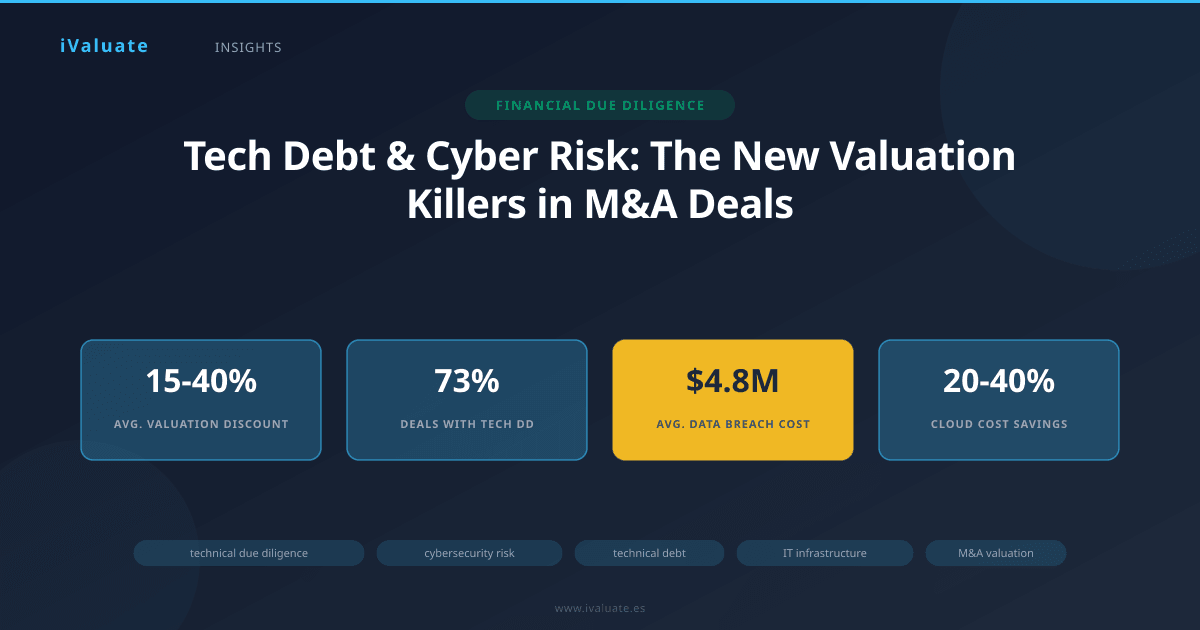
The landscape of M&A due diligence has fundamentally shifted. What was once a cursory IT review conducted in the final weeks before closing has evolved into a critical workstream that can make or break deal economics. Technical debt and cybersecurity risk have emerged as material valuation factors, with sophisticated buyers now applying systematic discounts ranging from 15% to 40% of enterprise value when significant technology liabilities are identified.
01 The Evolution of IT Due Diligence in Deal-Making
Traditional financial due diligence focused on validating historical performance, assessing working capital requirements, and identifying quality of earnings issues. IT considerations were typically limited to verifying that systems functioned and checking off basic compliance requirements. This approach made sense when technology was primarily a back-office function supporting core business operations.
Today's reality is starkly different. Technology infrastructure is the business for many companies, and even in traditional industries, digital capabilities drive competitive advantage and operational efficiency. According to 2025 data from the Association for Corporate Growth, 73% of middle-market M&A transactions now include comprehensive technical due diligence as a standard component of the diligence process, up from just 41% in 2020.
This evolution reflects several converging trends:
- Digital transformation acceleration: The pandemic permanently shifted business models toward digital channels, making technology infrastructure mission-critical rather than supportive
- Regulatory pressure: New cybersecurity disclosure requirements from the SEC (effective 2024) and evolving data privacy regulations globally have elevated cyber risk to board-level concern
- High-profile breaches: Major incidents affecting household names have demonstrated that cyber events create real, quantifiable financial impact measured in hundreds of millions of dollars
- Cloud migration complexity: The shift from on-premise to cloud infrastructure has created new technical debt categories and security considerations that require specialized assessment
02 Understanding Technical Debt as a Valuation Factor
Technical debt represents the implied cost of future rework required due to choosing expedient solutions over more robust approaches in software development and IT infrastructure. Like financial debt, it accumulates interest—the longer it remains unaddressed, the more expensive remediation becomes.
In M&A contexts, technical debt manifests in several forms:
Infrastructure Debt
Legacy systems running on outdated platforms, unsupported operating systems, or end-of-life hardware create operational risk and limit scalability. A 2025 manufacturing sector analysis revealed that 62% of middle-market industrial companies still operate critical production systems on Windows Server versions no longer receiving security updates. The cost to migrate these systems while maintaining operational continuity can range from $500,000 to $5 million depending on complexity.
Code Debt
For software companies and digital businesses, poorly documented code, lack of automated testing, and architectural shortcuts create maintenance burdens that slow development velocity and increase defect rates. Private equity firms acquiring software assets now routinely conduct code quality assessments using automated tools that measure technical debt ratios—the remediation cost versus the cost to rebuild from scratch. Ratios above 20% typically trigger valuation adjustments.
Integration Debt
Companies that have grown through acquisition often operate disparate systems that don't communicate effectively, requiring manual data reconciliation and creating data integrity issues. One healthcare services company acquired in late 2024 was operating 14 separate patient management systems across its locations, with no unified data architecture. The buyer applied a $7.3 million valuation reduction to account for the post-close integration costs.
Security Debt
Deferred security updates, unpatched vulnerabilities, and inadequate access controls create exposure that can be quantified through penetration testing and vulnerability assessments. The average cost to remediate critical and high-severity vulnerabilities identified during due diligence ranges from $1.2 million to $8.5 million for middle-market companies, according to 2025 cybersecurity consulting data.
Technical debt is not inherently a deal-breaker, but it must be accurately quantified and reflected in deal economics. Sophisticated buyers build detailed remediation roadmaps with associated costs and timelines, then negotiate appropriate purchase price adjustments or escrow holdbacks to protect against execution risk.
03 Cybersecurity Risk: From IT Issue to Enterprise Risk
The materiality of cybersecurity risk in deal valuations has increased exponentially. The SEC's 2024 cybersecurity disclosure rules require public companies to report material cyber incidents within four business days, fundamentally changing how cyber risk is perceived and priced in transactions. Private companies, while not subject to the same disclosure requirements, face similar scrutiny from sophisticated buyers who understand that cyber incidents can destroy enterprise value overnight.
Quantifying Cyber Risk in Deal Models
Modern technical due diligence includes comprehensive cybersecurity assessments that evaluate:
- Security posture: Firewall configurations, intrusion detection systems, endpoint protection, and security information and event management (SIEM) capabilities
- Access management: Identity and access management (IAM) protocols, privileged access controls, and multi-factor authentication implementation
- Data protection: Encryption standards, data loss prevention tools, backup and recovery capabilities, and data classification frameworks
- Compliance status: Adherence to relevant frameworks (SOC 2, ISO 27001, NIST, GDPR, CCPA) and industry-specific requirements (HIPAA, PCI-DSS)
- Incident response: Documented response plans, tabletop exercise history, cyber insurance coverage, and historical incident data
The financial impact of inadequate cybersecurity can be modeled with increasing precision. A 2025 study by a leading cyber insurance provider found that the total cost of a material data breach for middle-market companies averages $4.8 million, including incident response, legal fees, regulatory fines, customer notification, credit monitoring, business interruption, and reputational damage. For companies with revenues between $50 million and $500 million, this represents 1-10% of enterprise value.
Real-World Impact: Case Examples
In early 2025, a private equity buyer discovered during technical due diligence that a target healthcare technology company had experienced a ransomware incident 18 months prior that was never disclosed to the board or documented in the data room. While the company had paid the ransom and restored operations, the incident revealed fundamental security architecture weaknesses. The buyer reduced the purchase price by $22 million (15% of the original enterprise value) and required the sellers to fund a $5 million escrow for 24 months to cover potential regulatory actions or customer claims related to the undisclosed incident.
Another instructive example involved a financial services technology company with strong growth metrics and attractive unit economics. Technical due diligence revealed that the company's core platform was processing and storing customer financial data without proper encryption, in violation of multiple regulatory requirements. The remediation cost was estimated at $3.8 million, but more significantly, the regulatory exposure was deemed unquantifiable. The transaction was restructured with a 25% valuation reduction and a two-year earnout tied to successful remediation and regulatory clearance.
04 The Technical Due Diligence Process
Comprehensive IT and cybersecurity due diligence typically follows a structured methodology that begins early in the transaction process and continues through closing:
Phase 1: Initial Assessment (Weeks 1-2)
The process begins with a detailed questionnaire covering IT infrastructure, application portfolio, cybersecurity controls, and technology organization. This initial assessment identifies red flags that require deeper investigation and helps scope the detailed review phase. Key deliverables include:
- Technology stack inventory and architecture diagrams
- Cybersecurity framework assessment (typically mapped to NIST or ISO standards)
- Historical IT spending and capital expenditure analysis
- Organizational structure and key personnel evaluation
Phase 2: Deep Dive Technical Review (Weeks 3-5)
Subject matter experts conduct detailed assessments including:
- Infrastructure review: Data center tours (physical or virtual), cloud environment assessment, network architecture evaluation, and disaster recovery testing
- Application assessment: Code quality analysis for proprietary software, third-party vendor evaluation, integration architecture review, and technical debt quantification
- Cybersecurity testing: Vulnerability scanning, penetration testing (with appropriate authorization), security control validation, and compliance gap analysis
- Data management: Data architecture review, data quality assessment, privacy compliance evaluation, and data governance framework analysis
Phase 3: Risk Quantification and Reporting (Week 6)
The technical due diligence team synthesizes findings into a comprehensive report that categorizes issues by severity and provides specific remediation cost estimates. Leading practices include:
- Risk-rated findings (critical, high, medium, low) with clear business impact articulation
- Detailed remediation roadmap with timelines and resource requirements
- Quantified cost estimates for addressing each category of technical debt
- Post-close integration considerations and Day 1 priorities
- Ongoing operational cost implications (increased security spending, infrastructure upgrades, etc.)
The most sophisticated buyers integrate technical due diligence findings directly into their valuation models, adjusting EBITDA for normalized IT spending, applying working capital adjustments for required capital expenditures, and incorporating specific risk factors into discount rate calculations.
05 Valuation Impact: How Buyers Price Technology Risk
The translation of technical findings into valuation adjustments varies by industry, company size, and deal structure, but several approaches have become standard practice:
Direct Purchase Price Adjustments
When technical debt or cybersecurity remediation costs can be reliably estimated, buyers typically negotiate dollar-for-dollar purchase price reductions. For example, if technical due diligence identifies $4 million in required infrastructure upgrades that must be completed within 12 months of closing, the purchase price is reduced by $4 million. This approach is most common for discrete, well-scoped issues like system migrations or security control implementations.
EBITDA Normalization
Many target companies underinvest in IT and cybersecurity relative to industry benchmarks, artificially inflating EBITDA. Sophisticated buyers normalize EBITDA to reflect appropriate ongoing technology spending before applying valuation multiples. Industry data from 2025 shows that technology spending as a percentage of revenue varies significantly by sector:
- Financial services: 7-9% of revenue
- Healthcare: 4-6% of revenue
- Manufacturing: 3-5% of revenue
- Professional services: 5-7% of revenue
- Software/technology: 15-25% of revenue
If a target company is spending 3% of revenue on IT when the industry benchmark is 6%, buyers will normalize EBITDA downward by the difference, which flows through to enterprise value at the transaction multiple.
Multiple Compression
When technical issues create uncertainty about future performance or increase operational risk, buyers may apply lower valuation multiples. A software company with significant technical debt that limits product development velocity might trade at 4-5x revenue instead of 6-7x for comparable companies with modern, scalable architectures. This approach is common when technical issues affect the company's competitive position or growth trajectory.
Escrow and Earnout Structures
For risks that are difficult to quantify precisely—such as potential regulatory actions related to compliance gaps or customer churn resulting from security incidents—buyers often use escrow holdbacks or earnout structures to allocate risk. A typical structure might hold back 15-20% of the purchase price in escrow for 18-24 months to cover identified technology risks that may materialize post-close.
06 Industry-Specific Considerations
Software and Technology Companies
For software businesses, technical due diligence focuses heavily on code quality, architecture scalability, and intellectual property. Key concerns include:
- Technical debt ratios and code maintainability indices
- Open source license compliance and potential infringement issues
- Cloud infrastructure costs and unit economics at scale
- Development velocity metrics and release cadence sustainability
- API design and integration capabilities
A 2025 analysis of software M&A transactions found that companies with technical debt ratios above 25% traded at an average 32% discount to comparable companies with modern, well-architected codebases.
Healthcare and Life Sciences
Healthcare companies face unique challenges related to HIPAA compliance, interoperability requirements, and the complexity of integrating with electronic health record (EHR) systems. Technical due diligence in this sector emphasizes:
- Protected health information (PHI) security controls and audit trails
- Business associate agreement (BAA) compliance with vendors
- HL7/FHIR integration capabilities and interoperability
- Telehealth platform security and scalability
- Medical device cybersecurity for connected health companies
Financial Services
Financial services firms face intense regulatory scrutiny and sophisticated cyber threats, making technical due diligence particularly rigorous. Focus areas include:
- PCI-DSS compliance for payment processing
- SOC 2 Type II attestations and control effectiveness
- Fraud detection and anti-money laundering (AML) system capabilities
- API security for fintech platforms
- Third-party risk management programs
07 Emerging Trends Shaping Technical Due Diligence
AI and Machine Learning Systems
As companies increasingly deploy AI and ML capabilities, technical due diligence is evolving to assess these systems. Key considerations include data quality and bias in training datasets, model governance and monitoring, explainability and regulatory compliance (particularly in regulated industries), and intellectual property ownership of models and algorithms. The EU AI Act, which began phased implementation in 2025, has created new compliance requirements that affect valuations of companies deploying high-risk AI systems.
Cloud Architecture and FinOps
Cloud spending optimization has become a material value creation opportunity. Technical due diligence now includes detailed analysis of cloud architecture efficiency, with buyers identifying 20-40% cost reduction opportunities in poorly optimized environments. A retail company acquired in Q4 2024 was spending $2.3 million annually on cloud infrastructure; post-acquisition optimization reduced this to $1.4 million with no functionality loss, creating immediate EBITDA improvement.
Supply Chain and Third-Party Risk
The 2024 Change Healthcare breach, which affected over 100 million individuals and caused billions in downstream impact, has elevated third-party risk assessment in technical due diligence. Buyers now conduct detailed vendor risk assessments, evaluating:
- Critical vendor dependencies and concentration risk
- Vendor security posture and compliance certifications
- Contract terms and data processing agreements
- Business continuity plans for key vendors
- Vendor financial stability and viability
08 Building an Effective Technical Due Diligence Program
For private equity firms, strategic acquirers, and advisory firms, developing technical due diligence capabilities requires investment in specialized expertise and structured methodologies. Leading practices include:
Assembling the Right Team
Effective technical due diligence requires a multidisciplinary team including infrastructure architects, application developers, cybersecurity specialists, data engineers, and compliance experts. Many firms maintain relationships with specialized technical due diligence consultancies that can be engaged on a deal-by-deal basis, while larger firms build internal capabilities.
Leveraging Technology Tools
Modern technical due diligence increasingly relies on automated tools for code analysis, vulnerability scanning, cloud cost optimization assessment, and compliance gap analysis. These tools accelerate the diligence process and provide objective, quantifiable metrics that support valuation discussions. Platforms like iValuate are evolving to incorporate technical risk factors into valuation models, enabling more sophisticated integration of IT and cyber considerations into deal economics.
Standardizing Methodologies
Repeatable frameworks and assessment templates ensure consistency across transactions and enable benchmarking. Many firms develop proprietary scoring systems that translate technical findings into standardized risk ratings that can be compared across portfolio companies or deal opportunities.
09 The Path Forward: Technology Risk as Core Diligence
The integration of technical debt and cybersecurity risk into M&A valuations represents a permanent shift in how deals are evaluated and priced. As we move through 2025 and into 2026, several trends will accelerate:
Regulatory pressure will continue to increase, with more jurisdictions adopting mandatory cyber incident disclosure requirements and imposing material penalties for compliance failures. The financial impact of these regulations will be directly reflected in deal valuations through increased compliance costs and potential liability exposure.
Cyber insurance underwriting has become significantly more rigorous, with carriers requiring detailed security assessments before providing coverage. Companies with poor security postures face dramatically higher premiums or coverage exclusions, creating quantifiable ongoing costs that affect EBITDA and valuation multiples.
The talent market for cybersecurity and specialized technical roles remains extremely competitive, with compensation inflation running 15-20% annually in many markets. This creates ongoing cost pressure that must be reflected in normalized EBITDA calculations and post-close operating plans.
For sellers, the message is clear: proactive investment in IT infrastructure and cybersecurity is not just about operational excellence—it's about valuation protection. Companies that address technical debt before going to market, achieve relevant compliance certifications, and can demonstrate mature security programs command premium valuations and experience smoother transaction processes.
For buyers, technical due diligence has evolved from a risk mitigation exercise to a value creation opportunity. Sophisticated technical assessments identify not just problems to be remediated, but opportunities to drive operational improvement, cost optimization, and competitive advantage post-acquisition.
The most successful dealmakers recognize that technology is no longer a back-office function to be reviewed superficially—it's a core driver of enterprise value that requires rigorous assessment by qualified experts. As deal complexity increases and technology becomes ever more central to business models across all sectors, the firms that build robust technical due diligence capabilities will have a significant competitive advantage in identifying attractive opportunities, negotiating appropriate deal terms, and creating value post-close.
Professional valuation platforms like iValuate are responding to this evolution by incorporating technical risk assessment frameworks into their analytical tools, enabling dealmakers to model the valuation impact of IT and cybersecurity factors with greater precision. As the M&A market continues to mature in its treatment of technology risk, the integration of technical due diligence into core valuation methodologies will only deepen, making these capabilities essential for any serious participant in the deal market.