Table of Contents10 sections
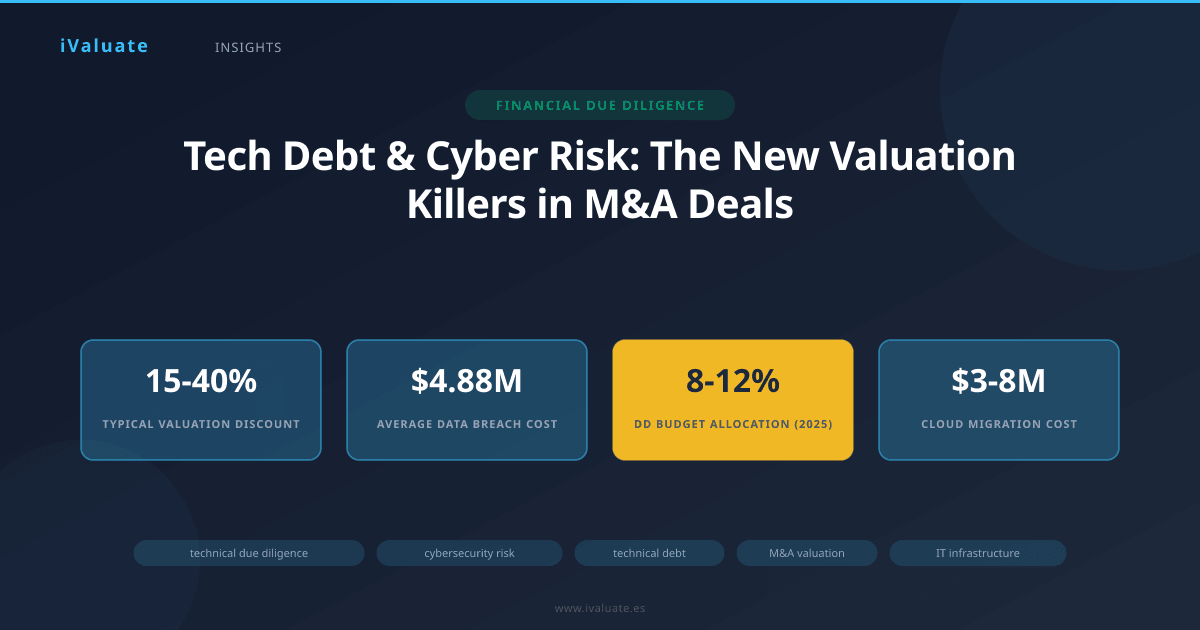
The M&A landscape has fundamentally shifted. What was once a cursory IT infrastructure review has evolved into a comprehensive technical due diligence process that can make or break billion-dollar transactions. In 2025-2026, technical debt and cybersecurity vulnerabilities have emerged as material valuation factors, with sophisticated buyers routinely applying 15-40% valuation discounts when significant IT risks are uncovered during due diligence.
This transformation reflects a sobering reality: technology is no longer just an operational consideration—it's a balance sheet issue. Private equity firms, strategic acquirers, and corporate development teams have learned expensive lessons from deals where hidden technical liabilities emerged post-close, eroding returns and requiring unbudgeted capital injections. The result is a new paradigm where IT and cybersecurity due diligence sits alongside financial and legal reviews as a critical value driver.
01 The Evolution of Technical Due Diligence in Deal-Making
Traditional M&A due diligence focused primarily on financial statements, customer contracts, and legal compliance. IT considerations were often relegated to a brief questionnaire or a superficial infrastructure review conducted days before closing. This approach proved catastrophically inadequate as businesses became increasingly technology-dependent.
The shift began accelerating around 2020-2021, driven by several high-profile incidents. One notable case involved a mid-market software acquisition where the buyer discovered post-close that 60% of the codebase was built on deprecated frameworks requiring immediate rewriting—a $40 million unbudgeted expense that effectively eliminated the first three years of projected returns. Another involved a healthcare services company where undisclosed cybersecurity vulnerabilities led to a breach six months after acquisition, resulting in $85 million in remediation costs, regulatory fines, and customer attrition.
By 2025, the market has matured significantly. Technical due diligence now typically begins during the Letter of Intent (LOI) phase and runs parallel to financial and legal workstreams. Leading acquirers allocate 8-12% of total due diligence budgets to technical assessments, compared to just 2-3% five years ago. This investment reflects the material impact these findings have on deal economics.
02 Quantifying Technical Debt: From Abstract Concept to Concrete Liability
Technical debt—the implied cost of future rework caused by choosing expedient solutions over sustainable architecture—has transitioned from engineering jargon to boardroom vocabulary. The challenge lies in translating this concept into financial terms that impact valuation models.
The Technical Debt Valuation Framework
Sophisticated buyers now employ structured frameworks to quantify technical debt across five dimensions:
- Code Quality and Architecture: Measuring code complexity, test coverage, documentation quality, and architectural patterns. Tools like SonarQube, CodeClimate, and custom static analysis platforms provide quantitative metrics. A codebase with less than 40% test coverage and high cyclomatic complexity typically signals 18-24 months of refactoring work.
- Infrastructure Modernization Gap: Assessing the delta between current infrastructure and industry standards. Companies running on-premises data centers with hardware approaching end-of-life, or using unsupported software versions, face significant migration costs. The average cloud migration for a mid-sized B2B SaaS company now runs $3-8 million.
- Scalability Constraints: Evaluating whether current systems can support projected growth without major re-architecture. Performance testing under load scenarios reveals bottlenecks that could throttle revenue growth post-acquisition.
- Integration Complexity: Analyzing how easily the target's systems can integrate with the acquirer's technology stack. API maturity, data architecture, and system interdependencies all factor into integration cost estimates.
- Talent and Knowledge Risk: Assessing concentration of critical knowledge, team skill gaps, and the availability of talent for legacy technologies. A system built on obscure frameworks with only two engineers who understand it represents extreme key-person risk.
The financial translation typically follows this model: Technical debt remediation costs are estimated, then a multiple is applied based on urgency and business impact. For revenue-critical systems, buyers often apply a 2-3x multiplier to account for opportunity cost and execution risk. A $5 million technical debt estimate on core revenue systems might therefore translate to a $10-15 million valuation adjustment.
Real-World Impact: The SaaS Acquisition Case
Consider a 2025 acquisition of a vertical SaaS company with $25 million ARR and strong unit economics. The initial valuation centered on an 8x revenue multiple, implying a $200 million enterprise value. Technical due diligence revealed:
- Monolithic architecture requiring 18-month decomposition into microservices to support enterprise customer requirements ($4.2 million estimated cost)
- Database architecture unable to support multi-tenancy at scale, limiting expansion into enterprise segment ($3.8 million re-architecture)
- Critical dependencies on deprecated libraries with known security vulnerabilities ($1.5 million remediation)
- Inadequate disaster recovery and business continuity capabilities below enterprise customer requirements ($2.1 million infrastructure investment)
Total identified technical debt: $11.6 million. However, the buyer's analysis went deeper. The architectural limitations directly constrained the company's ability to move upmarket—the core thesis of the acquisition. The buyer applied a 2.5x multiplier to reflect the strategic impact, resulting in a $29 million valuation reduction. The deal ultimately closed at $171 million, a 14.5% discount from the initial indication.
03 Cybersecurity Risk: The New Deal-Breaker
If technical debt represents future costs, cybersecurity vulnerabilities represent existential risk. The statistics are sobering: 43% of cyberattacks target small-to-medium businesses, and the average cost of a data breach reached $4.88 million in 2024, up 12% from the previous year. For M&A transactions, these risks have become material considerations that can derail deals entirely.
The Cybersecurity Due Diligence Framework
Modern cybersecurity due diligence extends far beyond penetration testing. Leading buyers now conduct comprehensive assessments across six domains:
- Security Posture Assessment: Evaluating controls across the NIST Cybersecurity Framework or ISO 27001 standards. This includes identity and access management, network security, endpoint protection, and security monitoring capabilities.
- Vulnerability Assessment: Conducting external and internal penetration testing, vulnerability scanning, and social engineering assessments. The discovery of critical unpatched vulnerabilities (CVSS score 9.0+) in production systems is increasingly common and highly material.
- Data Protection and Privacy: Assessing data classification, encryption practices, data retention policies, and compliance with regulations like GDPR, CCPA, and industry-specific requirements (HIPAA, PCI-DSS). Non-compliance can represent both immediate remediation costs and ongoing regulatory risk.
- Third-Party Risk: Evaluating vendor security practices, supply chain risks, and the security posture of integrated third-party services. The average company now relies on 130+ third-party vendors with system access.
- Incident Response Capability: Testing the target's ability to detect, respond to, and recover from security incidents. Companies without documented incident response plans or regular testing face significantly higher breach costs.
- Security Culture and Governance: Assessing security awareness training, governance structures, and the integration of security into development processes (DevSecOps maturity).
Valuation Impact of Cyber Risk
The financial impact of cybersecurity findings varies dramatically based on severity and industry. Buyers typically categorize findings into three tiers:
Critical Findings (deal-breakers or major valuation adjustments): Active breaches, evidence of prior unreported breaches, critical unpatched vulnerabilities in production systems, or fundamental absence of security controls. These findings can result in 25-40% valuation reductions or deal termination. In regulated industries like healthcare or financial services, critical findings often kill deals entirely due to regulatory risk.
Significant Findings (material valuation impact): Incomplete security programs, lack of encryption for sensitive data, inadequate access controls, missing security monitoring, or significant compliance gaps. These typically drive 10-20% valuation adjustments and require detailed remediation plans with escrowed funds or earnout adjustments.
Moderate Findings (operational concerns): Incomplete documentation, inconsistent policy enforcement, or gaps in security awareness training. These influence deal structure but rarely impact headline valuation significantly, though they often result in specific post-close remediation requirements.
The Healthcare Services Case Study
A 2024 acquisition in the healthcare services sector illustrates the material impact of cyber risk. A private equity firm was acquiring a behavioral health platform with $40 million in revenue for an initial $180 million valuation (4.5x revenue). Cybersecurity due diligence uncovered:
- Protected Health Information (PHI) stored in databases without encryption at rest
- Inadequate access controls allowing broad employee access to patient data
- No formal HIPAA compliance program or risk assessments
- Missing business associate agreements with multiple vendors processing PHI
- Inadequate logging and monitoring to detect unauthorized access
The findings represented both immediate remediation costs (estimated at $6.8 million) and substantial regulatory risk. The buyer's analysis included potential HIPAA violation penalties (up to $1.5 million per violation category per year), increased cyber insurance premiums, and reputational risk. More significantly, the deficiencies prevented the company from pursuing enterprise health system contracts—a key growth driver in the investment thesis.
The deal restructured significantly: the purchase price dropped to $145 million (19.4% reduction), with an additional $15 million held in escrow for 24 months pending completion of a comprehensive security remediation program. The seller also accepted a reduced earnout cap due to constrained near-term growth prospects while security improvements were implemented.
04 The Integration of Technical and Financial Due Diligence
The most sophisticated acquirers have moved beyond treating technical due diligence as a separate workstream. Instead, they integrate technical findings directly into financial models and valuation analyses. This integration manifests in several ways:
Adjusted EBITDA Calculations
Technical debt remediation costs are increasingly treated as normalized operating expenses when calculating adjusted EBITDA. If a target has been chronically underinvesting in technology—running systems with inadequate security, deferring necessary upgrades, or maintaining unsustainable technical debt levels—buyers now add back the annual investment required to maintain a sustainable technology posture. This might reduce adjusted EBITDA by 5-15% for technology-enabled businesses that have been harvesting rather than investing.
Growth Assumption Adjustments
Technical constraints that limit scalability directly impact revenue projections. If current infrastructure can only support 50% growth before requiring major re-architecture, aggressive growth assumptions in the base case become unrealistic. Similarly, cybersecurity deficiencies that prevent enterprise sales or expansion into regulated markets constrain addressable market assumptions. These adjustments flow through to terminal value calculations, often having more impact than the immediate remediation costs.
Working Capital and CapEx Requirements
Technical debt and cyber risk findings increase both working capital requirements (for ongoing remediation efforts) and capital expenditure needs (for infrastructure modernization). Buyers now model these as permanent step-ups in the capital intensity of the business, affecting free cash flow projections and return calculations.
Risk-Adjusted Discount Rates
Some acquirers apply risk premiums to discount rates when significant technical or cyber risks are identified. A company with critical unpatched vulnerabilities and inadequate security controls might see its discount rate increase by 200-300 basis points, reflecting the elevated risk profile. This approach is particularly common in private equity, where return hurdles are explicit.
05 Industry-Specific Considerations
The materiality of technical debt and cyber risk varies significantly across industries, requiring tailored due diligence approaches:
Software and Technology
For pure-play software companies, technical due diligence often represents 40-50% of total due diligence effort. Code quality, architecture, and scalability are fundamental value drivers. Buyers routinely bring in specialized technical due diligence firms to conduct multi-week code reviews, architecture assessments, and security audits. Valuation multiples in this sector are highly sensitive to technical findings—a well-architected, secure, scalable platform might command 12-15x ARR, while a technically troubled competitor trades at 6-8x.
Financial Services
Regulatory compliance dominates technical due diligence in financial services. SOC 2 Type II attestations, PCI-DSS compliance, and robust cybersecurity programs are table stakes. The absence of these controls can be deal-breaking, as they prevent the business from operating legally. Additionally, legacy core banking or payment processing systems represent enormous technical debt that can cost tens of millions to modernize.
Healthcare
HIPAA compliance and PHI protection are paramount. Healthcare deals increasingly include cyber insurance as a condition of closing, with buyers requiring minimum coverage levels (typically $10-25 million) and specific policy terms. Interoperability standards (FHIR, HL7) and EHR integration capabilities are also critical value drivers, as they determine the target's ability to participate in value-based care arrangements.
Manufacturing and Industrial
Operational technology (OT) security has emerged as a critical concern as manufacturing becomes more connected. The convergence of IT and OT creates new attack surfaces, and many industrial companies have inadequate OT security programs. Technical due diligence must assess both traditional IT infrastructure and industrial control systems, SCADA systems, and IoT devices on the factory floor.
06 Structuring Deals to Address Technical Risk
When material technical debt or cyber risk is identified, sophisticated buyers employ various deal structure mechanisms to allocate risk and ensure remediation:
Escrow Arrangements
Holding 10-20% of purchase price in escrow for 12-24 months pending completion of technical remediation milestones is increasingly common. The escrow agreement includes specific deliverables (e.g., "achieve SOC 2 Type II certification," "complete migration to cloud infrastructure," "remediate all critical and high-severity vulnerabilities") with objective success criteria.
Earnouts Tied to Technical Milestones
Earnout structures increasingly include technical performance metrics alongside financial targets. For example, an earnout might be contingent on maintaining system uptime above 99.9%, achieving specific security certifications, or successfully completing technology integration milestones. This aligns seller incentives with technical improvement.
Seller Financing with Technical Covenants
When sellers provide financing, loan agreements may include covenants related to technical performance and security posture. Breach of these covenants (e.g., a security incident resulting from failure to maintain adequate controls) can trigger acceleration or provide the buyer with offset rights.
Representations and Warranties Insurance
Reps and warranties insurance (RWI) policies increasingly include specific technical and cybersecurity representations. However, insurers have become more sophisticated, often excluding known issues identified during due diligence and requiring minimum security standards as a condition of coverage. Premiums for technology-enabled businesses have increased 30-40% since 2023, reflecting insurers' growing awareness of technical risk.
07 The Role of Specialized Technical Due Diligence Providers
The complexity and materiality of technical due diligence has spawned a specialized advisory ecosystem. Leading firms combine deep technical expertise with M&A experience, providing services that include:
- Comprehensive code reviews using automated tools and manual inspection
- Architecture assessments and scalability modeling
- Penetration testing and vulnerability assessments
- Technical debt quantification and remediation roadmaps
- Post-merger integration planning for technology systems
- Ongoing technical advisory during the hold period
These engagements typically cost $150,000-$500,000 for middle-market deals, with larger transactions commanding fees exceeding $1 million. While significant, this investment pales in comparison to the valuation adjustments and post-close surprises it helps avoid. The ROI is compelling: a $300,000 technical due diligence engagement that identifies $20 million in hidden technical debt delivers a 67x return.
08 Emerging Trends in Technical Due Diligence
As we move through 2025 and into 2026, several trends are reshaping technical due diligence:
AI and Machine Learning Risk Assessment
Companies deploying AI/ML systems face new categories of risk: model bias, data quality issues, explainability requirements, and regulatory compliance (particularly in the EU under the AI Act). Technical due diligence now includes AI risk assessments, examining training data provenance, model validation processes, and bias testing. These considerations are particularly material in healthcare, financial services, and HR technology sectors.
Cloud Architecture and FinOps
As businesses migrate to cloud infrastructure, due diligence increasingly focuses on cloud architecture efficiency and cost optimization. Poorly architected cloud deployments can result in costs 3-5x higher than necessary. FinOps assessments identify optimization opportunities that can improve EBITDA margins by 200-400 basis points in cloud-native businesses.
Open Source Risk Management
The average application now includes 528 open-source components, creating complex dependency chains and license compliance risks. Technical due diligence includes software composition analysis to identify vulnerable dependencies, license compliance issues, and supply chain risks. The 2024 XZ Utils backdoor incident heightened awareness of open-source supply chain security.
Quantum-Readiness
While still emerging, forward-looking technical due diligence is beginning to assess quantum computing risks, particularly for companies handling sensitive data with long-term value (financial records, healthcare data, government contracts). The question of whether current encryption will remain secure in a post-quantum world is becoming relevant for deals with 10+ year hold periods.
09 Building Internal Technical Due Diligence Capabilities
Leading private equity firms and serial acquirers are building internal technical due diligence capabilities rather than relying entirely on external advisors. This typically includes:
- Hiring CTOs or technical partners with operational experience
- Developing standardized technical due diligence playbooks and checklists
- Building relationships with specialized technical advisors for rapid deployment
- Creating technical value creation playbooks for portfolio companies
- Implementing portfolio-wide security standards and monitoring
This internal capability enables faster deal execution, more sophisticated technical risk assessment, and better post-acquisition value creation. Firms with strong internal technical capabilities report 15-20% higher returns on technology-enabled investments compared to peers relying solely on external advisors.
10 The Path Forward: Technical Due Diligence as Competitive Advantage
As technical debt and cybersecurity risk become increasingly material to deal valuations, the ability to rapidly and accurately assess these factors has become a competitive advantage in M&A markets. Buyers who can move quickly through technical due diligence while maintaining rigor can win competitive processes. Those who can accurately quantify technical risk can bid more aggressively when others see uncertainty.
The market is bifurcating. Sophisticated buyers with strong technical due diligence capabilities are paying full valuations for technically sound businesses while applying significant discounts to technically troubled targets. Meanwhile, less sophisticated buyers are either overpaying for technical risk they don't understand or passing on opportunities they can't properly assess. This creates both risk and opportunity.
For sellers, the message is clear: technical debt and cybersecurity deficiencies are no longer back-office concerns—they're material value detractors. Companies preparing for exit should invest in technical debt remediation, security program maturation, and infrastructure modernization 18-24 months before going to market. The ROI on these investments is substantial, often returning 3-5x in valuation improvement.
For buyers, technical due diligence has evolved from a checkbox exercise to a critical value protection mechanism. The cost of getting it wrong—in terms of valuation overpayment, post-close surprises, and remediation expenses—far exceeds the investment in rigorous upfront assessment. As one private equity partner recently noted, "We've never regretted spending too much on technical due diligence, but we've certainly regretted spending too little."
The integration of technical considerations into core valuation methodologies represents a permanent shift in M&A practice. As businesses become increasingly technology-dependent and cyber threats continue to evolve, the importance of technical due diligence will only grow. Firms that build robust capabilities in this domain—whether through internal expertise, trusted advisor relationships, or sophisticated analytical tools—will be better positioned to identify value, avoid pitfalls, and drive superior returns.
Professional valuation platforms like iValuate are evolving to help dealmakers incorporate these technical considerations into their valuation analyses, providing frameworks to quantify technical debt, model remediation costs, and adjust projections for technical constraints. As the market continues to mature, the integration of technical, financial, and strategic due diligence will become increasingly seamless, supported by tools and methodologies that translate technical findings into financial impact with precision and speed.