Table of Contents9 sections
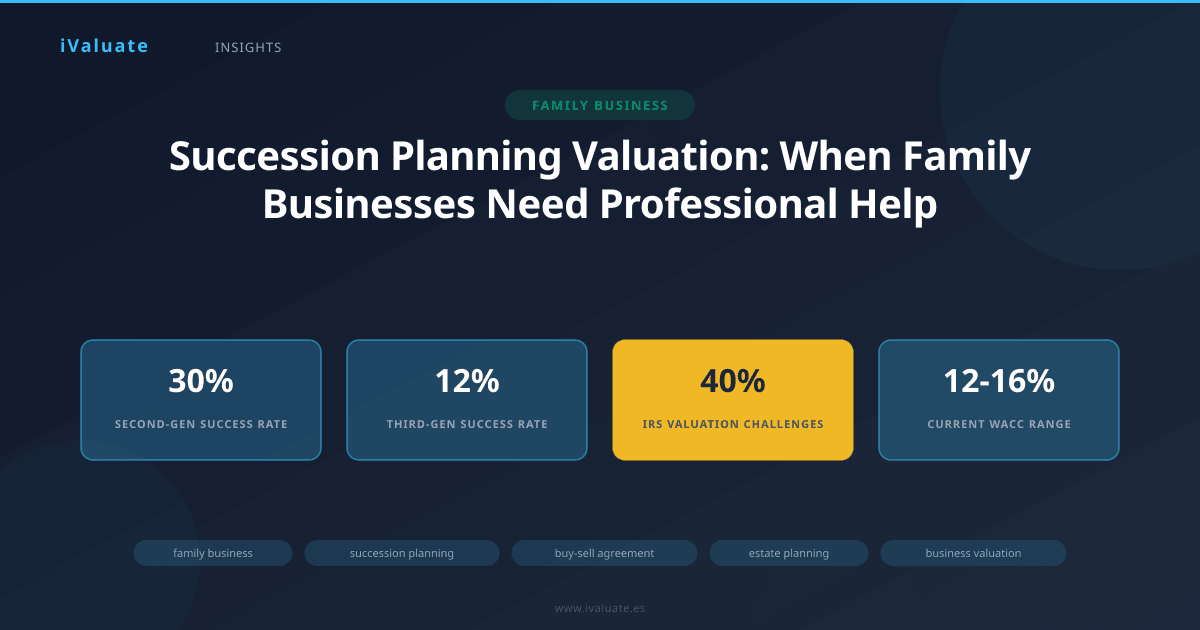
Family businesses represent the backbone of the global economy, accounting for approximately 70-90% of annual GDP worldwide and employing nearly 60% of the workforce in developed markets. Yet fewer than 30% successfully transition to the second generation, and only 12% make it to the third. While many factors contribute to this attrition, inadequate succession planning—particularly the failure to obtain timely, professional valuations—ranks among the most preventable causes of family business failure.
As we navigate 2025-2026, family businesses face unprecedented complexity in ownership transitions. Rising interest rates have compressed multiples across most sectors, geopolitical uncertainty affects cross-border family enterprises, and regulatory changes in estate and gift tax regimes create both risks and opportunities. Against this backdrop, understanding when and why professional valuations become necessary isn't merely good governance—it's essential to preserving generational wealth and business continuity.
01 The Valuation Imperative in Family Business Succession
Unlike publicly traded companies with transparent, market-determined values, private family businesses operate in an information vacuum. The absence of daily price discovery means that stakeholders—family members, advisors, lenders, and tax authorities—often hold dramatically different perceptions of what the business is worth. This perception gap becomes a critical fault line during succession events.
Professional valuations serve multiple essential functions in family business transitions. They establish objective benchmarks for negotiating ownership transfers between generations, provide defensible values for tax reporting and compliance, create fair mechanisms for buyouts when family members exit, and help families understand the true economic value they're stewarding across generations.
The stakes are considerable. A 2024 study by the Family Business Institute found that family businesses that obtained professional valuations at least every three years during succession planning periods experienced 43% fewer disputes among family members and achieved 28% higher post-transition enterprise values compared to those that relied on informal estimates or outdated appraisals.
02 Critical Valuation Triggers in Succession Planning
Buy-Sell Agreement Activation
Buy-sell agreements represent the constitutional framework for ownership transitions in family businesses. These contracts establish predetermined mechanisms for transferring ownership when triggering events occur—death, disability, divorce, bankruptcy, or voluntary exit. Yet the most meticulously drafted buy-sell agreement becomes a source of conflict if it lacks a robust valuation methodology.
In 2025, we're seeing a significant shift away from formula-based valuation approaches in buy-sell agreements. Traditional methods—such as book value multiples or revenue-based formulas—have proven inadequate in volatile markets. A manufacturing company valued at 4x EBITDA in 2021 might command only 6.5x in 2025 due to sector-specific tailwinds in reshoring and automation, while a retail business that traded at 0.8x revenue pre-pandemic might struggle to achieve 0.4x given structural headwinds in consumer spending.
Progressive family businesses now incorporate dynamic valuation triggers in their buy-sell agreements. Rather than relying on static formulas, these agreements mandate professional appraisals upon triggering events or at regular intervals (typically every 2-3 years). This approach ensures that valuations reflect current market conditions, industry dynamics, and company-specific performance.
Best practice: Buy-sell agreements should specify the valuation standard (fair market value vs. fair value), the qualifications of appraisers, the methodology framework (income, market, asset approaches), and dispute resolution mechanisms when parties disagree on value.
Estate Planning and Gift Tax Compliance
The intersection of succession planning and estate planning creates perhaps the most consequential valuation trigger for family businesses. In the United States, the estate and gift tax exemption stands at $13.61 million per individual in 2024, scheduled to sunset to approximately $7 million in 2026 unless Congress acts. This impending change has created urgency among family business owners to transfer wealth before the window closes.
Gifting ownership interests to the next generation offers powerful tax advantages, but the IRS scrutinizes these transfers intensely. The tax authority challenges approximately 40% of family business valuations submitted with estate tax returns, according to recent data from the American Society of Appraisers. Challenges typically focus on three areas: inappropriate valuation discounts for lack of marketability and control, failure to properly account for personal goodwill versus enterprise goodwill, and use of comparable companies that don't truly reflect the subject company's risk profile and growth prospects.
A professional valuation prepared by a credentialed appraiser (ASA, CFA, ABV, CVA) provides substantial protection in IRS disputes. Courts consistently afford greater weight to independent, contemporaneous appraisals that follow recognized standards (USPAP, IVS) than to valuations prepared by interested parties or those created retroactively to support a desired tax position.
Consider a recent case involving a third-generation food distribution business in the Midwest. The patriarch wished to gift 40% of the company to his three children in 2024, taking advantage of the current exemption levels. An initial internal estimate suggested the business was worth $35 million, implying a 40% gift value of $14 million—exceeding his remaining exemption and triggering immediate gift tax.
A professional valuation revealed a more nuanced picture. The appraiser identified that 30% of the company's earnings derived from the founder's personal relationships and reputation—personal goodwill that wouldn't transfer with the business. Additionally, the minority interests being gifted warranted a 25% discount for lack of control and a 20% discount for lack of marketability (applied sequentially, not additively). The final appraised value for the 40% interest came to $8.4 million, well within the exemption and saving the family approximately $2.1 million in immediate gift taxes.
Generational Transfer and Management Transition
The transition from one generation to the next represents the ultimate test of family business resilience. Unlike buy-sell agreement triggers or estate planning events, generational transfers often unfold over years, creating unique valuation challenges.
Many families structure generational transfers as gradual equity shifts, with the rising generation earning ownership through performance milestones, capital contributions, or time-based vesting. This approach requires periodic valuations to ensure fairness—both to the exiting generation (who wants to realize appropriate value for their life's work) and the entering generation (who shouldn't overpay for equity that may be encumbered by debt, deferred compensation, or operational challenges).
The valuation complexities multiply when multiple family members occupy different roles. Consider a third-generation commercial real estate firm where one sibling serves as CEO, another manages property operations, and a third works outside the business. How should ownership be allocated? Should the active siblings receive greater equity to reflect their contributions? Should the inactive sibling receive current income to offset the active siblings' sweat equity?
Professional valuations help answer these questions by disaggregating value components. An appraiser can estimate the value of management services separately from ownership returns, quantify the impact of key person dependencies, and model different capital structures to balance competing family interests.
03 Valuation Methodologies for Family Business Succession
Income Approach: Discounted Cash Flow Analysis
For most operating family businesses with predictable cash flows, the income approach—specifically discounted cash flow (DCF) analysis—provides the most defensible valuation foundation. This methodology projects future cash flows and discounts them to present value using a risk-adjusted discount rate that reflects the company's cost of capital.
In the current environment (2025-2026), DCF analysis requires particular attention to discount rate selection. The risk-free rate has stabilized around 4.2-4.5% for 10-year Treasuries, compared to near-zero rates in 2020-2021. Equity risk premiums have compressed slightly to 5.5-6.0% as market volatility has moderated from 2022-2023 peaks. For a typical middle-market family business, weighted average cost of capital (WACC) now ranges from 12-16%, depending on size, industry, and company-specific risk factors.
Size premiums remain significant for family businesses. Companies with market values below $100 million face liquidity constraints and concentration risks that warrant additional risk premiums of 2-5 percentage points. A family-owned industrial distributor with $50 million in enterprise value might carry a discount rate of 14.5%, while a similar business at $500 million might warrant only 11.5%.
Market Approach: Comparable Company and Transaction Analysis
The market approach benchmarks the subject company against comparable public companies or recent private transactions. In 2025, we're seeing robust M&A activity in certain family business sectors—particularly industrial services, healthcare services, and specialized manufacturing—providing rich comparable data.
Current market multiples vary dramatically by sector. Software and technology-enabled services companies trade at 8-15x EBITDA, reflecting strong recurring revenue models and scalability. Traditional manufacturing businesses command 5-8x EBITDA, with premiums for companies serving defensive end markets or possessing proprietary technology. Service businesses with high customer concentration or key person dependencies might trade at only 3-5x EBITDA.
The challenge in applying market multiples to family businesses lies in normalization adjustments. Family businesses often carry above-market compensation for family members, underutilized real estate on the balance sheet, discretionary expenses that benefit family members, and deferred maintenance or underinvestment that inflates current earnings. A thorough normalization process might adjust reported EBITDA by 15-30% in either direction.
Asset Approach: Net Asset Value
For asset-heavy family businesses—real estate holding companies, equipment lessors, or businesses in liquidation—the asset approach provides the valuation floor. This methodology values individual assets and liabilities at fair market value, then aggregates them to determine enterprise value.
The asset approach has gained relevance in 2025 as inflation has created significant gaps between book values and market values for long-held assets. A family business that purchased industrial real estate in 2010 might carry it at $5 million on the balance sheet while the current market value exceeds $15 million. Conversely, specialized equipment purchased at peak prices in 2021-2022 might have depreciated faster than accounting schedules suggest.
04 Valuation Discounts and Premiums in Family Transitions
One of the most contentious aspects of family business valuation involves discounts for lack of control and lack of marketability. These discounts recognize that minority interests in private companies are worth less than pro-rata shares of enterprise value because they lack control over business decisions and cannot be readily converted to cash.
Lack of control discounts typically range from 15-35%, depending on the rights attached to the minority interest. A 25% interest with no board representation, no access to financial information, and no ability to force distributions might warrant a 30% discount. Conversely, a 40% interest with board seats, information rights, and tag-along provisions might warrant only a 15% discount.
Lack of marketability discounts reflect the time and cost required to sell a private company interest. Academic studies and restricted stock analyses suggest discounts of 20-40% for minority interests in private companies. However, the emergence of secondary markets for private company shares and increased PE interest in minority investments has compressed these discounts somewhat in recent years.
Critical consideration: The IRS has intensified scrutiny of valuation discounts following several high-profile cases. Appraisers must provide robust empirical support for discount levels, including reference to restricted stock studies, pre-IPO studies, and partnership interest sales data.
05 Common Valuation Pitfalls in Family Succession
Even with professional guidance, family businesses frequently encounter valuation pitfalls that jeopardize succession plans. The most common include relying on outdated valuations in dynamic markets, using the same valuation for different purposes (estate planning vs. buy-sell vs. divorce), failing to account for personal goodwill in service businesses, and ignoring the impact of key person dependencies on value.
A particularly insidious pitfall involves circular reasoning in succession planning. A family might structure a generational transfer based on an initial valuation, but the transfer itself changes the business's risk profile and value. For example, if the founder's departure reduces projected revenue by 15% due to customer relationships, the post-transition value might be 25-30% lower than the pre-transition value. Professional appraisers model these scenarios to ensure all parties understand the value implications of different transition structures.
06 The Role of Independent Business Appraisers
While some families attempt to value their businesses internally or rely on accountants or attorneys for valuation guidance, complex succession scenarios demand specialized expertise. Credentialed business appraisers bring technical knowledge of valuation methodologies, current market data on multiples and transactions, understanding of tax and legal requirements, and independence that withstands regulatory and legal scrutiny.
The cost of professional valuation—typically $15,000 to $75,000 for middle-market family businesses, depending on complexity—represents a fraction of the value at stake. A $50 million family business that saves 5% in taxes or avoids a 10% value destruction through proper succession planning generates $2.5-5 million in benefit, yielding a 50-100x return on the valuation investment.
07 Emerging Trends in Family Business Valuation (2025-2026)
Several trends are reshaping how family businesses approach succession valuation. First, ESG considerations are increasingly affecting valuations, particularly for businesses in carbon-intensive industries or those with significant environmental liabilities. A family-owned manufacturing business with outdated environmental controls might face a 10-20% valuation discount reflecting remediation costs and regulatory risks.
Second, technology adoption is creating valuation premiums for family businesses that have successfully digitized operations. A third-generation distribution company that implemented advanced inventory management and customer analytics might command a 15-25% premium over peers still operating with legacy systems.
Third, the rise of search funds and family offices as acquirers has created new exit options for family businesses, affecting valuation benchmarks. These buyers often pay premiums for well-managed businesses with strong cultures and growth potential, particularly in the $10-50 million enterprise value range.
08 Practical Implementation: A Valuation Roadmap for Family Succession
Family businesses should implement a structured valuation cadence aligned with succession planning milestones. For businesses in active succession planning (within 5 years of transition), annual valuations provide current benchmarks and track value creation. For businesses in pre-succession mode (5-10 years out), biennial or triennial valuations balance cost and currency. For stable family businesses with no immediate succession plans, valuations every 3-5 years maintain awareness of value trends.
Each valuation should serve multiple purposes to maximize return on investment. A single comprehensive appraisal can support estate planning, update buy-sell agreements, inform strategic planning, provide benchmarks for management incentive plans, and establish baselines for family member buyouts.
Documentation is critical. Families should maintain a valuation file that includes all formal appraisals, supporting financial data, contemporaneous notes on business conditions, and documentation of how valuations were used in decision-making. This file becomes invaluable if the IRS or other parties challenge valuation conclusions years later.
09 Looking Forward: Valuation as Strategic Tool
The most sophisticated family businesses view valuation not as a compliance exercise but as a strategic tool for wealth preservation and growth. Regular valuations reveal value drivers and detractors, inform capital allocation decisions, benchmark performance against industry peers, and facilitate productive conversations about business strategy and family goals.
As family businesses navigate the complex succession landscape of 2025 and beyond, professional valuation expertise becomes increasingly indispensable. The convergence of generational wealth transfer, regulatory change, and market volatility creates both risks and opportunities. Families that invest in rigorous, independent valuations position themselves to capture opportunities while mitigating risks.
Modern valuation platforms like iValuate are democratizing access to sophisticated valuation analytics, enabling family business advisors and owners to perform preliminary analyses, track value trends, and identify when professional appraisals become necessary. While these tools don't replace credentialed appraisers for formal valuation opinions, they provide valuable insights between formal appraisals and help families make more informed decisions about succession timing and structure.
The successful family business succession requires careful orchestration of legal, tax, operational, and interpersonal elements. At the center of this complex process sits valuation—the objective measure of what has been built and what will be transferred. Families that recognize valuation triggers early, engage qualified professionals, and integrate valuation insights into succession planning dramatically improve their odds of joining the elite group that successfully transitions wealth and leadership across generations.