Table of Contents8 sections
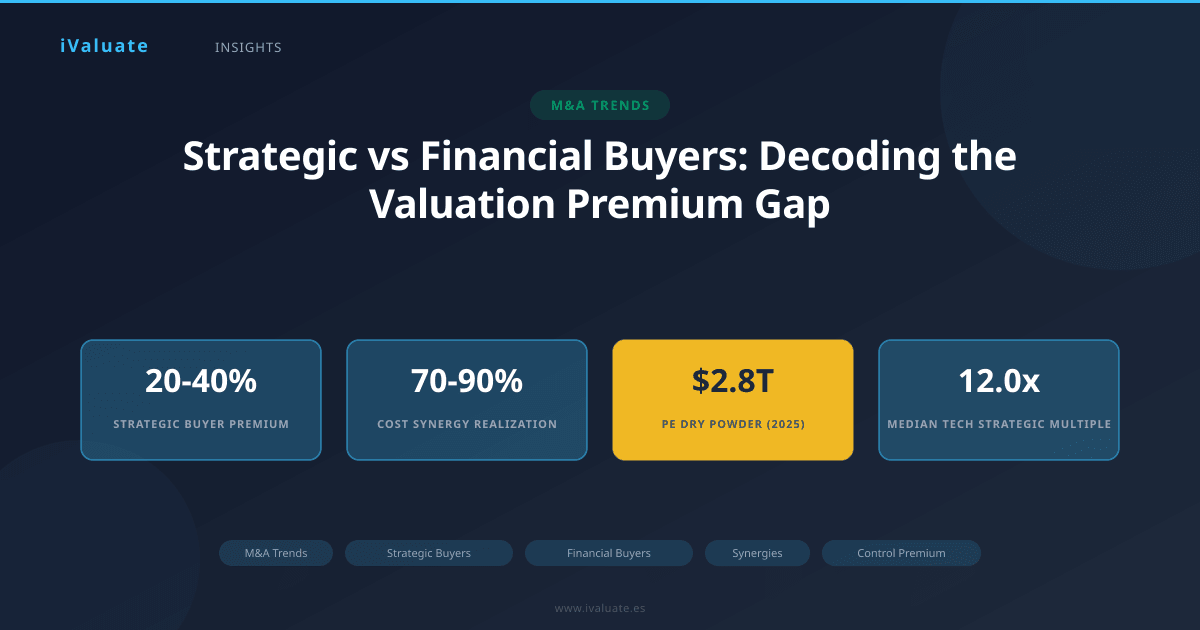
In the competitive M&A landscape of 2025-2026, a persistent valuation gap separates strategic and financial buyers, with strategic acquirers routinely paying premiums that leave financial sponsors unable to compete. This differential—typically ranging from 20% to 40% above what private equity firms will pay—reflects fundamental differences in value creation models, return requirements, and strategic imperatives. For business owners contemplating an exit and advisors structuring competitive processes, understanding these dynamics is essential to maximizing transaction value.
The valuation premium commanded by strategic buyers isn't merely a function of deeper pockets or irrational exuberance. Rather, it stems from quantifiable synergies, strategic positioning benefits, and different cost-of-capital structures that fundamentally alter the economics of acquisition. This article examines the structural drivers behind the strategic-financial buyer valuation gap, quantifies the premium components, and provides frameworks for understanding when and why this gap widens or narrows.
01 The Fundamental Economics: Why Strategic Buyers Can Pay More
Strategic acquirers operate under a fundamentally different value creation model than financial buyers. While private equity firms must generate returns primarily through operational improvements, multiple arbitrage, and financial engineering within a defined hold period (typically 3-7 years), strategic buyers can unlock value that simply doesn't exist for financial sponsors.
The mathematics are straightforward but powerful. Consider a middle-market software company generating $15 million in EBITDA. A financial buyer applying a 9.5x EBITDA multiple (reflecting current 2025 market conditions for quality software assets) arrives at an enterprise value of $142.5 million. After accounting for their target IRR of 20-25% and the need to exit at a comparable or higher multiple, their maximum sustainable bid rarely exceeds 10.0-10.5x, or roughly $150-158 million.
A strategic acquirer in the same sector, however, can justify significantly higher valuations by incorporating synergies into their analysis. If the buyer can realize $5 million in annual cost synergies (through elimination of redundant functions, procurement savings, and technology consolidation) and $3 million in revenue synergies (through cross-selling and market expansion), the effective EBITDA becomes $23 million. Even applying a conservative 50% probability-adjustment to these synergies and using the same 9.5x multiple, the strategic buyer's valuation reaches $189 million—a 26% premium over the financial buyer's ceiling.
Synergy Realization: The Primary Driver of Premium Valuations
Synergies represent the cornerstone of strategic buyer premiums, but not all synergies are created equal. The market has become increasingly sophisticated in distinguishing between realistic, achievable synergies and aspirational projections that rarely materialize.
Cost synergies typically offer the most reliable value creation, with realization rates of 70-90% when properly executed. These include:
- Elimination of duplicate corporate functions (finance, HR, legal, IT infrastructure)
- Procurement savings through combined purchasing power
- Facility consolidation and real estate optimization
- Technology platform rationalization
- Shared service center optimization
In the current market, acquirers are realizing cost synergies equivalent to 15-25% of the target's operating expenses within 18-24 months post-close. For a $100 million revenue target with 30% operating expenses, this translates to $4.5-7.5 million in annual savings—a meaningful increment to the combined entity's profitability.
Revenue synergies prove more elusive but potentially more valuable when achieved. These include cross-selling opportunities, geographic expansion, channel access, and product bundling. However, realization rates typically fall to 40-60%, and the timeline extends to 24-36 months. Sophisticated buyers now apply probability-weighted models to revenue synergies, often haircut ting projections by 50% or more in their valuation models.
A 2025 analysis of technology sector acquisitions revealed that strategic buyers who successfully realized revenue synergies achieved median growth acceleration of 8-12 percentage points above standalone projections. This growth premium, when capitalized over a 3-5 year period, justifies substantial acquisition premiums.
Strategic buyers in the software and technology sectors are currently paying median premiums of 35-42% over financial buyer valuations when significant revenue synergies are identifiable and credible, according to Q4 2024 and Q1 2025 transaction data.
02 Control Premium: The Value of Strategic Positioning
Beyond operational synergies, strategic acquirers pay premiums for control and strategic positioning that have no equivalent value to financial buyers. These intangible but economically significant factors include:
Market consolidation and competitive positioning: In fragmented industries, acquiring a competitor or complementary player can strengthen market position, increase pricing power, and create barriers to entry. The value of eliminating a competitor or preventing a rival from acquiring the target often justifies premiums of 10-20% above synergy-adjusted valuations.
Consider the industrial distribution sector, where a leading national distributor acquired a regional competitor in early 2025 for 12.8x EBITDA—nearly 40% above the 9.2x multiple that financial buyers offered. The strategic rationale centered on market share consolidation in key geographies where the two companies overlapped, effectively eliminating price competition and strengthening relationships with key suppliers. The acquirer's internal analysis valued this competitive positioning benefit at $8-12 million annually, separate from traditional cost synergies.
Technology and intellectual property acquisition: Strategic buyers frequently pay substantial premiums to acquire proprietary technology, patents, or technical talent that would take years and significant capital to develop internally. The "build vs. buy" analysis often favors acquisition even at premium valuations when time-to-market considerations are factored.
A notable 2025 example involved a healthcare technology company acquiring a smaller AI-driven diagnostics platform for 18.5x revenue—a multiple that appeared astronomical until analyzing the alternative. The acquirer's internal development program had already consumed $45 million over three years without achieving comparable functionality. The acquisition, at $140 million, effectively purchased 3-4 years of development time and immediate market credibility, justifying the premium despite the target's modest $7.5 million revenue base.
Customer relationships and channel access: In B2B sectors, acquiring established customer relationships and distribution channels can justify significant premiums. The value lies not just in the revenue these relationships generate, but in the cost and time required to develop equivalent market access organically.
Accretion/Dilution Analysis: Different Hurdles, Different Values
The accretion/dilution framework reveals another structural reason strategic buyers can outbid financial sponsors. Public company acquirers evaluate transactions through the lens of earnings per share (EPS) impact, while financial buyers focus on absolute IRR and cash-on-cash returns.
For a strategic buyer, an acquisition that is 5-10% dilutive in year one but becomes accretive by year two—particularly when synergies materialize—often passes investment committee scrutiny. The market typically looks through near-term dilution when the strategic rationale is compelling and management articulates a clear path to accretion.
Financial buyers lack this flexibility. Their model requires generating returns within a defined hold period, with limited ability to absorb near-term dilution. A private equity firm paying 11.0x EBITDA must exit at 11.5-12.0x or achieve substantial EBITDA growth to hit return targets. This mathematical constraint creates a natural ceiling on valuations that strategic buyers don't face.
The difference becomes stark in capital-intensive industries or businesses requiring significant integration investment. A strategic buyer can absorb $10-15 million in integration costs and near-term revenue disruption as part of a longer-term value creation plan. A financial buyer must factor these costs directly into their return calculation, effectively reducing the maximum supportable purchase price.
03 Cost of Capital Differentials and Return Requirements
The weighted average cost of capital (WACC) differential between strategic and financial buyers creates another layer of valuation advantage. Public company acquirers with investment-grade credit ratings access debt markets at 5.5-6.5% in the current 2025 environment, compared to 8.5-10.5% for private equity-backed leveraged buyouts.
This 250-350 basis point differential has meaningful valuation implications. Using a discounted cash flow framework, a 200 basis point reduction in WACC can increase enterprise value by 15-25%, depending on growth assumptions and terminal value calculations. For a $200 million transaction, this translates to $30-50 million in additional value that a strategic buyer can justify purely through cost of capital advantages.
Moreover, strategic buyers often employ lower return hurdles than financial sponsors. While private equity firms target 20-25% IRRs (and sometimes higher for smaller funds), corporate development teams typically use hurdle rates of 12-15%, aligned with their overall cost of capital plus a risk premium. This 500-1000 basis point differential in required returns dramatically expands the universe of acceptable valuations.
Real-World Case Study: Strategic Premium in Action
A compelling illustration of these dynamics emerged in a competitive 2024 process for a specialty chemicals manufacturer generating $28 million in EBITDA. The company operated in a niche market with strong customer relationships and proprietary formulations, attracting both strategic and financial bidders.
The financial buyer consortium, comprising two well-regarded middle-market funds, submitted a final offer of $252 million (9.0x EBITDA). Their analysis incorporated modest operational improvements and assumed a 5-year hold with exit at 9.5-10.0x, generating projected IRRs of 22-24%.
The winning strategic bidder, a larger chemicals company with complementary product lines, paid $336 million (12.0x EBITDA)—a 33% premium. Their investment thesis incorporated:
- $6.5 million in annual cost synergies through procurement optimization and elimination of duplicate functions (realization probability: 85%)
- $4.2 million in revenue synergies through cross-selling the target's products to existing customers (realization probability: 60%)
- Strategic value of $3-4 million annually from eliminating a competitor in key regional markets
- Technology and formulation IP that would require estimated $15-20 million and 3-4 years to develop internally
Applying a probability-weighted synergy value of $8.8 million to the standalone EBITDA and using a 10.5x multiple (reflecting the combined entity's scale and market position), the strategic buyer's internal valuation reached $385 million, providing comfortable headroom above their winning bid.
04 When the Gap Narrows: Market Conditions and Deal Dynamics
While strategic buyers generally command premium valuations, certain market conditions and deal characteristics narrow or even eliminate the gap. Understanding these scenarios is crucial for sellers and advisors optimizing process strategy.
Platform vs. add-on dynamics: When financial buyers pursue add-on acquisitions for existing portfolio companies, they can often match or exceed strategic buyer valuations. The platform company provides its own synergy base, and the financial sponsor can leverage operational expertise and existing infrastructure. In the current market, private equity add-on acquisitions are commanding premiums of 15-25% over standalone platform valuations, partially closing the gap with strategic buyers.
Sector-specific considerations: In highly fragmented, asset-light service industries, financial buyers have demonstrated ability to compete aggressively with strategic acquirers. The rollup playbook—acquiring multiple smaller companies and creating a larger, more valuable platform—allows financial sponsors to realize synergies comparable to strategic buyers. Healthcare services, business services, and specialized distribution sectors have seen particularly competitive financial buyer activity in 2025.
Market cycle positioning: During periods of compressed public market multiples, strategic buyers face greater scrutiny on acquisition premiums. When a public acquirer trades at 8.0x EBITDA but pays 12.0x for an acquisition, the dilution and strategic justification requirements intensify. Conversely, when public multiples expand (as seen in technology sectors through Q1 2025), strategic buyers gain greater latitude to pay premiums.
In sectors where public company acquirers trade at 15.0x+ EBITDA multiples, the strategic-financial buyer valuation gap has widened to 45-55% in recent transactions, reflecting both synergy potential and favorable stock currency for stock-based consideration.
05 Maximizing Value: Leveraging the Strategic-Financial Buyer Dynamic
For business owners and their advisors, understanding the strategic-financial buyer valuation gap creates opportunities to maximize transaction value through thoughtful process design and positioning.
Dual-track processes: Running parallel processes targeting both strategic and financial buyers creates competitive tension while providing optionality. The presence of credible strategic bidders often pushes financial buyers to sharpen pencils, while financial buyer interest establishes a valuation floor that strategic buyers must exceed.
In a well-executed dual-track process, the seller's advisor positions the company's strategic attributes—proprietary technology, customer relationships, market position, synergy potential—while simultaneously highlighting operational characteristics that appeal to financial buyers: recurring revenue, scalability, strong management team, and growth potential.
Synergy identification and quantification: Sophisticated sellers proactively identify and quantify potential synergies for strategic buyers, effectively doing the buyer's work and anchoring valuation discussions at higher levels. This requires research into potential acquirers' businesses, understanding their strategic priorities, and articulating specific, credible synergy opportunities.
A 2025 analysis of middle-market transactions found that sellers who provided detailed, buyer-specific synergy analyses achieved median premiums 12-18% higher than those relying on buyers to identify synergies independently. The key is credibility—overstated or unrealistic synergy projections damage credibility and can reduce final valuations.
Timing and market positioning: Strategic buyers are more active during periods of strong public market performance, when their stock currency is valuable and boards are receptive to growth-oriented M&A. Financial buyers, conversely, maintain more consistent acquisition activity across market cycles, as they deploy committed capital regardless of public market conditions.
Understanding these cyclical patterns allows sellers to time processes strategically. In the current 2025-2026 environment, with public technology and healthcare multiples near historical highs, strategic buyers in these sectors are particularly aggressive, creating favorable conditions for sellers with relevant assets.
06 The Role of Deal Structure in Bridging Valuation Gaps
When valuation gaps persist between buyer and seller expectations, creative deal structures can bridge the divide while managing risk for both parties.
Earnouts and contingent consideration: Earnouts allow buyers to pay premium valuations contingent on the business achieving specific performance targets. This structure is particularly effective when buyers and sellers have different views on growth potential or synergy realization. In the current market, 35-40% of transactions between $50-500 million include earnout provisions, with earnout periods typically ranging from 2-4 years.
Strategic buyers often structure earnouts around synergy realization or combined entity performance metrics, while financial buyers focus on standalone business performance. The key to successful earnouts is clear, objective metrics and alignment between buyer and seller on business strategy during the earnout period.
Equity rollovers: Both strategic and financial buyers increasingly offer sellers the opportunity to retain equity in the combined entity or acquiring company. This structure allows sellers to participate in value creation post-transaction while reducing the buyer's upfront cash requirement. For strategic buyers, equity rollovers align seller incentives with integration success and synergy realization. Financial buyers use rollovers to reduce leverage and maintain seller engagement during the value creation period.
In 2025, approximately 45% of private equity transactions include some form of management or seller equity rollover, typically ranging from 10-30% of total consideration. Strategic buyer rollovers are less common but increasing, particularly in technology and healthcare sectors where seller expertise and relationships are critical to integration success.
07 Looking Forward: The Evolving Strategic-Financial Buyer Landscape
As we progress through 2025 and into 2026, several trends are reshaping the strategic-financial buyer valuation dynamic.
Private equity dry powder and competition: With an estimated $2.8 trillion in private equity dry powder globally as of Q1 2025, financial buyers are increasingly competitive on valuation. Large-cap and upper-middle-market funds are paying multiples that historically were reserved for strategic buyers, particularly for high-quality assets with strong growth profiles. This trend is compressing the valuation gap in certain sectors and deal sizes.
Strategic buyer selectivity: After a period of aggressive M&A activity in 2021-2023, many strategic buyers are exercising greater discipline, focusing on acquisitions with clear, quantifiable synergies and strong strategic fit. This selectivity has created opportunities for financial buyers to win competitive processes, particularly for assets with strong standalone growth potential but limited synergy opportunities.
Technology and AI integration: The rapid advancement of artificial intelligence and automation technologies is creating new categories of strategic value. Companies with proprietary AI capabilities, unique data assets, or technology that accelerates digital transformation are commanding unprecedented premiums from strategic buyers. In Q4 2024 and Q1 2025, AI-related acquisitions averaged 16.5x revenue for companies with proven technology and customer traction—multiples that financial buyers simply cannot justify under traditional return frameworks.
Cross-border dynamics: International strategic buyers, particularly from Asia and the Middle East, are increasingly active in North American and European M&A markets. These buyers often have different return requirements, longer investment horizons, and unique strategic rationales that can justify premium valuations. The globalization of M&A markets is expanding the universe of potential strategic buyers and, in many cases, widening the strategic-financial buyer valuation gap.
For middle-market companies with international growth potential or technology that addresses global market needs, cultivating relationships with international strategic buyers can significantly enhance valuation outcomes. A 2025 study found that cross-border strategic acquisitions commanded median premiums of 8-12% above domestic strategic buyer valuations, reflecting the value of geographic expansion and market access.
08 Conclusion: Navigating the Valuation Premium Landscape
The persistent valuation gap between strategic and financial buyers reflects fundamental differences in value creation models, return requirements, and strategic imperatives. Strategic acquirers' ability to realize synergies, leverage lower costs of capital, and pursue longer-term strategic objectives enables them to justify premiums of 20-40% or more above financial buyer valuations in many transactions.
For business owners contemplating an exit, understanding these dynamics is essential to maximizing value. The optimal approach involves identifying and cultivating relationships with potential strategic buyers, quantifying synergy opportunities, and running competitive processes that create tension between strategic and financial bidders. At the same time, maintaining credible financial buyer interest establishes valuation floors and provides optionality if strategic processes don't yield expected premiums.
The landscape continues to evolve, with well-capitalized financial buyers increasingly competitive in certain sectors and deal sizes, while strategic buyers exercise greater selectivity and discipline. Success requires sophisticated analysis, market intelligence, and the ability to position assets to highlight strategic value while maintaining appeal to financial sponsors.
Professional valuation platforms like iValuate enable advisors and corporate development professionals to efficiently model different buyer scenarios, quantify synergy impacts, and analyze accretion/dilution dynamics across various deal structures. As the M&A market grows more complex and competitive, leveraging advanced analytical tools becomes increasingly critical to optimizing transaction outcomes and navigating the strategic-financial buyer valuation premium landscape effectively.