Table of Contents11 sections
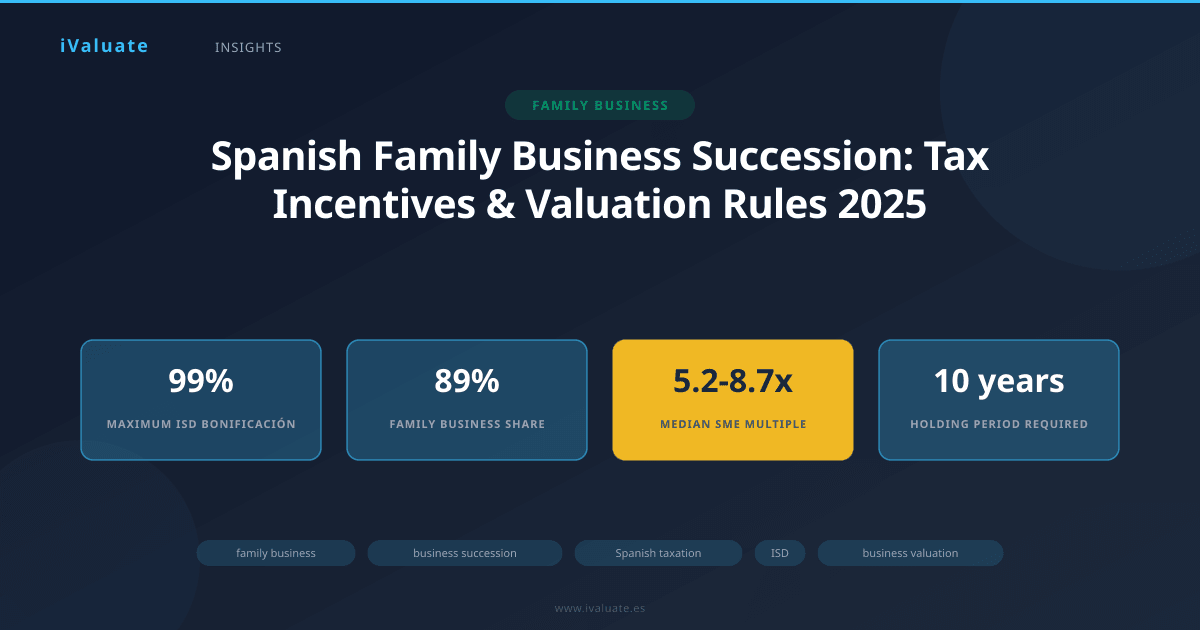
Spain's family business sector represents the backbone of the national economy, accounting for approximately 89% of all companies and generating nearly 67% of private sector employment. As the first generation of post-Franco entrepreneurs reaches retirement age, an estimated €2.1 trillion in business assets will transfer hands over the next decade. Understanding the tax implications—and substantial incentives—available under Spanish law has never been more critical for business owners, advisors, and family offices.
The Spanish inheritance and gift tax system (Impuesto sobre Sucesiones y Donaciones, or ISD) offers one of Europe's most generous incentive structures for qualifying family business transfers, with regional bonificaciones (tax reductions) reaching up to 99% in many autonomous communities. However, accessing these benefits requires meticulous compliance with technical valuation requirements, corporate governance protocols, and holding period commitments that can span a decade or more.
01 The ISD Framework and Regional Variations
Spain's inheritance and gift tax operates under a dual structure: national legislation establishes the base framework (Law 29/1987), while the 17 autonomous communities exercise significant regulatory autonomy to set rates and bonificaciones. This creates a complex patchwork where tax treatment can vary dramatically based on the deceased's or donor's region of residence.
The national ISD rates range from 7.65% to 34% on the taxable base, with multipliers applied based on pre-existing wealth and family relationship. Without regional incentives, effective rates can exceed 80% for large estates transferred to distant relatives. However, most regions have implemented substantial reductions specifically targeting empresa familiar (family business) transfers.
Regional Bonificación Landscape in 2025
As of 2025, the regional variations create significant planning opportunities:
- Madrid: 99% bonificación on both inheritance and gift tax for qualifying family businesses, effectively eliminating ISD liability for most transfers
- Andalusia: 99% reduction for direct descendants and spouses on qualifying business assets, with a €1 million threshold per beneficiary
- Catalonia: 95% reduction for empresa familiar transfers to Group I and II heirs (descendants, spouses, ascendants), with stricter governance requirements
- Basque Country: Each province (Bizkaia, Gipuzkoa, Álava) maintains separate regimes, with reductions ranging from 95-99% and unique valuation methodologies
- Galicia: 99% bonificación introduced in 2023, positioning the region competitively for family business succession
The disparity creates incentives for pre-succession residence planning, though anti-avoidance rules require genuine establishment in a region (typically five years of tax residence before death or donation).
02 Defining Empresa Familiar: Technical Requirements
Accessing the bonificación requires meeting the precise legal definition of empresa familiar under Article 4.8 of Law 29/1987 and subsequent regional adaptations. The requirements blend quantitative thresholds with qualitative governance criteria:
Participation Threshold
The deceased or donor, together with their spouse, ascendants, descendants, or collateral relatives up to the second degree, must hold at least 15% of the company's voting rights (or 20% if the company is listed on a regulated market). For individual holdings, the threshold rises to 5% when combined family ownership reaches the 15%/20% benchmark.
This participation must represent effective control or active involvement in management. In practice, tax authorities scrutinize whether family members hold board positions, executive roles, or demonstrate operational engagement beyond passive investment.
Activity Requirements
The business must conduct an economic activity that is not primarily passive asset management. Specifically, more than 50% of the company's assets must be devoted to operational business activities, excluding:
- Securities portfolios (unless managing third-party assets as a licensed entity)
- Real estate holdings (unless part of an active property development or management business)
- Cash and liquid investments beyond operational needs
- Loans to shareholders or related parties
This "50% rule" creates valuation complexity, as determining which assets qualify as operational versus passive requires detailed analysis of balance sheet composition, revenue attribution, and business model structure.
Remuneration Test
At least one family member from the ownership group must perform executive management functions and receive remuneration representing more than 50% of their total professional income. This requirement ensures genuine operational involvement rather than passive ownership structures.
The remuneration test has generated significant litigation, particularly regarding what constitutes "executive management" versus advisory or non-executive board roles. Recent Supreme Court rulings (2024) have clarified that the functions must be substantive and documented through employment contracts, board resolutions, and organizational charts.
03 Valuation Requirements and Methodologies
The valuation of transferred business interests represents perhaps the most technically demanding aspect of ISD compliance. Spanish tax law requires that transfers be valued at "real value" (valor real), which the tax authorities interpret as fair market value under arm's length conditions.
Regulatory Valuation Framework
The Spanish tax administration (AEAT) has issued detailed guidance on acceptable valuation methodologies, drawing heavily from International Valuation Standards (IVS) and European Valuation Standards (EVS). For operating businesses, the hierarchy of acceptable methods includes:
- Market approach: Comparable company multiples (EV/EBITDA, EV/Revenue) and precedent transactions, adjusted for size, liquidity, and control premiums
- Income approach: Discounted cash flow (DCF) analysis using weighted average cost of capital (WACC) appropriate to the business risk profile
- Asset approach: Net asset value (NAV) adjusted for market values, typically supplemented by income methods for going concerns
For small and medium enterprises (SMEs), which represent 99.8% of Spanish companies, the income approach using normalized EBITDA multiples has become the de facto standard. Market data from 2024-2025 shows median EV/EBITDA multiples for Spanish SMEs ranging from 5.2x to 8.7x depending on sector, with premium multiples of 10-12x for technology, healthcare, and specialized manufacturing businesses.
Discounts and Premiums
Minority interest discounts and lack of marketability discounts (DLOM) represent critical valuation adjustments that directly impact tax liability. Spanish tax practice generally accepts:
- Minority discounts: 15-30% for non-controlling interests in private companies, based on empirical studies of control premiums in Spanish M&A transactions
- Lack of marketability discounts: 20-35% for illiquid private company shares, calibrated to the restricted stock and pre-IPO studies adapted for Spanish market conditions
- Key person discounts: 10-25% when the business is heavily dependent on the founder or specific family members, though this requires robust documentation of succession planning efforts
However, aggressive discounting invites scrutiny. The tax authorities maintain the right to challenge valuations and impose their own assessments, which can trigger penalties of 50-150% of the underpaid tax if deemed fraudulent.
Documentation Standards
A defensible valuation requires comprehensive documentation including:
- Detailed financial projections with supporting assumptions tied to historical performance and market conditions
- WACC calculations with explicit beta, risk-free rate, equity risk premium, and size premium components
- Comparable company and transaction analysis with adjustment rationale
- Sensitivity analysis demonstrating valuation ranges under alternative scenarios
- Qualitative assessment of competitive position, management depth, customer concentration, and operational risks
Increasingly, tax authorities expect valuations to be prepared by qualified professionals—certified appraisers (RICS, IVSC), financial analysts (CFA), or specialized valuation firms. Self-prepared valuations, while legally permissible, face heightened scrutiny and challenge rates exceeding 40% in recent audits.
04 The Protocolo Familiar: Governance and Continuity
While not strictly required for ISD bonificación eligibility, the protocolo familiar (family protocol) has become a de facto best practice—and increasingly, a factor in tax authority assessments of genuine family business character. A well-structured family protocol serves multiple functions:
Governance Framework
The protocol establishes decision-making structures, board composition rules, family member employment policies, and conflict resolution mechanisms. This demonstrates to tax authorities that the business operates with professional governance rather than as a passive wealth vehicle.
Key provisions typically include:
- Board composition requirements (independent directors, family vs. non-family ratios)
- Voting rights and shareholder agreement terms
- Employment criteria for family members (qualifications, compensation benchmarks)
- Dividend and reinvestment policies
- Buy-sell provisions and valuation mechanisms for share transfers
Succession Planning
The protocol documents the long-term vision for business continuity, identifying next-generation leaders and development pathways. This addresses the tax authority's concern about whether transferred businesses will continue operating or be liquidated post-succession.
Statistics from the Spanish Family Business Institute (Instituto de la Empresa Familiar) show that only 33% of family businesses survive to the second generation, and just 15% to the third. A robust protocol with documented succession planning significantly strengthens the case for bonificación eligibility.
Holding Period Commitments
Most regional bonificación regimes require beneficiaries to maintain the acquired participation and continue the business activity for 10 years post-transfer. The family protocol can formalize these commitments and establish monitoring mechanisms, reducing the risk of inadvertent non-compliance.
Violations of holding period requirements trigger full retroactive tax liability plus interest and penalties, creating exposure that can reach 150-200% of the original tax benefit. In 2024, the Madrid tax authority initiated 127 clawback proceedings for premature disposals, recovering an average of €1.8 million per case.
05 Real-World Application: Three Case Studies
Case Study 1: Manufacturing Business in Catalonia
A third-generation precision manufacturing company with €45 million in revenue faced succession as the 72-year-old founder planned retirement. The business employed 180 people and generated €6.2 million in EBITDA. The ownership structure included the founder (60%), his two children (20% each), and a family holding company.
The succession strategy involved:
- Independent valuation using DCF and market multiples, arriving at an enterprise value of €52 million (8.4x EBITDA)
- Minority and marketability discounts totaling 35% applied to the children's existing stakes
- Gifting of the founder's shares to children over three years to utilize annual gift tax exemptions
- Formal family protocol establishing governance, employment policies, and 10-year holding commitments
The Catalonian 95% bonificación reduced the ISD liability from a calculated €8.7 million to €435,000—a tax efficiency of 95%. The phased gifting strategy further optimized wealth transfer taxes and facilitated gradual leadership transition.
Case Study 2: Technology Services Firm in Madrid
A software development and IT services company with €12 million in revenue and 40% EBITDA margins presented unique valuation challenges due to intangible assets and key person dependency. The founder (age 68) owned 85% directly, with key employees holding the remainder through an option plan.
The succession involved:
- Valuation at €28 million (5.8x revenue, 14.5x EBITDA) reflecting premium multiples for technology businesses
- 25% key person discount due to founder's client relationships and technical expertise
- Structured sale to a family trust with the founder's three children as beneficiaries
- Retention of founder as consultant for five years to mitigate key person risk
Madrid's 99% bonificación reduced the €4.2 million calculated tax to €42,000. The trust structure provided asset protection and facilitated equal distribution among children with varying involvement levels.
Case Study 3: Multi-Entity Retail Group in Andalusia
A regional retail chain operating through seven separate legal entities (holding company structure) with combined revenue of €78 million faced complex valuation and structuring issues. The second-generation owner (age 75) sought to transfer to his four children, two of whom were active in management.
Challenges included:
- Determining which entities qualified as empresa familiar (three were primarily real estate holdings)
- Consolidating valuations across operating and holding entities
- Addressing disparate involvement levels among beneficiaries
The solution restructured the group pre-succession:
- Real estate assets transferred to a separate family investment vehicle (not eligible for bonificación)
- Operating entities consolidated under a single holding company
- Valuation of operating business at €42 million using market multiples (6.2x EBITDA)
- Differential share classes providing active children with enhanced voting rights
The restructuring enabled 99% bonificación on the operating business (€42 million), while the real estate transfer (€18 million) received standard family tax treatment. Total tax savings exceeded €6 million compared to an unrestructured transfer.
06 Common Pitfalls and Risk Mitigation
Despite generous incentives, family business succession planning frequently encounters obstacles that can jeopardize bonificación eligibility or trigger disputes with tax authorities:
Premature Disposal
The 10-year holding requirement creates long-term exposure. Beneficiaries must resist temptation to sell, even partially, during this period. Exceptions exist for certain restructurings and mergers, but require advance ruling requests (consulta vinculante) from tax authorities.
Risk mitigation strategies include:
- Formal shareholder agreements with transfer restrictions
- Liquidity planning to ensure beneficiaries don't face forced sales for personal financial needs
- Insurance products to cover potential tax clawbacks in case of unavoidable early disposal
Activity Test Failures
The 50% operational asset requirement creates ongoing compliance obligations. Businesses that accumulate excess cash, make passive investments, or shift toward real estate holdings can inadvertently disqualify themselves.
Annual monitoring should track:
- Balance sheet composition and asset classification
- Revenue attribution between operational and passive sources
- Related-party transactions that might be recharacterized as passive holdings
Valuation Disputes
Tax authority challenges to declared values can trigger reassessments years after the transfer. The statute of limitations extends to four years (or 10 years if fraud is alleged), creating prolonged uncertainty.
Defensive strategies include:
- Engaging recognized valuation professionals with Spanish tax expertise
- Conservative valuation assumptions and moderate discount applications
- Contemporaneous documentation of all valuation inputs and methodologies
- Advance valuation agreements (acuerdo previo de valoración) with tax authorities for high-value transfers
07 Integration with Corporate and Personal Tax Planning
ISD optimization cannot occur in isolation—it must integrate with broader corporate tax (Impuesto sobre Sociedades) and personal income tax (IRPF) considerations:
Corporate Reorganizations
Pre-succession restructurings can optimize both ISD and ongoing corporate tax efficiency. Common strategies include:
- Mergers to consolidate group entities and simplify valuation
- Spin-offs to separate qualifying operational businesses from non-qualifying assets
- Holding company formations to centralize ownership and facilitate phased transfers
Spain's corporate reorganization regime (Law 27/2014, Chapter VII) provides tax-neutral treatment for qualifying restructurings, but requires careful sequencing to avoid triggering immediate tax events before the succession transfer.
IRPF Considerations for Donors
While gifts generally don't trigger capital gains tax for the donor under Spanish law, certain transfers can create IRPF exposure. Specifically, gifts to non-residents or transfers involving debt assumption may trigger deemed disposals at fair market value.
Additionally, donors must consider the opportunity cost of lifetime gifts versus testamentary transfers. While both can access bonificaciones, lifetime gifts enable:
- Phased transfers utilizing multiple years of exemptions
- Observation of beneficiary stewardship before full transfer
- Potential valuation discounts for minority interests that might not apply to controlling testamentary transfers
08 Cross-Border Dimensions
Approximately 23% of Spanish family businesses have international operations or ownership structures, creating additional complexity:
EU Succession Regulation
EU Regulation 650/2012 allows individuals to elect the law of their nationality to govern succession, rather than defaulting to residence-based rules. This creates planning opportunities for Spanish nationals residing abroad or foreign nationals with Spanish business interests.
However, the election affects only civil law succession (who inherits), not tax treatment. ISD remains governed by Spanish tax residence rules, creating potential mismatches.
Double Tax Treaties
Spain maintains inheritance and gift tax treaties with France, Greece, and Sweden. For businesses with cross-border ownership or operations in these jurisdictions, treaty provisions can provide relief from double taxation but may also limit bonificación availability.
The interaction between treaty provisions and regional bonificaciones requires careful analysis, as some treaties were negotiated before the current regional incentive landscape emerged.
09 The Role of Professional Valuation Platforms
The technical demands of ISD-compliant valuation have driven increased adoption of specialized valuation technology among advisors and family offices. Professional platforms enable:
- Standardized application of market multiples and discount rates calibrated to Spanish market conditions
- Automated sensitivity analysis and scenario modeling
- Audit trail documentation meeting tax authority standards
- Integration with financial planning and tax projection tools
The valuation process for a typical mid-market family business succession now involves 40-60 hours of professional time, including financial analysis, market research, report preparation, and quality review. Technology platforms can reduce this to 15-25 hours while improving consistency and defensibility.
10 Looking Ahead: Policy Trends and Planning Imperatives
The Spanish family business succession landscape continues to evolve, with several trends shaping planning strategies for 2025-2026:
Regional Competition for Family Businesses
Autonomous communities increasingly view generous ISD bonificaciones as economic development tools, attracting family business headquarters and high-net-worth residents. This "race to the bottom" in inheritance taxation shows no signs of abating, with Galicia, Murcia, and Extremadura all enhancing incentives in 2024-2025.
However, political pressure exists at the national level to harmonize regional treatment and prevent "tax haven" dynamics within Spain. Business owners should monitor potential federal reforms that could limit regional autonomy.
Enhanced Scrutiny and Compliance
As bonificación utilization has grown (up 34% from 2020 to 2024), tax authorities have increased audit activity and challenged aggressive planning structures. The AEAT has established specialized family business transfer units in major regions, staffed with valuation and corporate governance experts.
Expect continued focus on:
- Substance over form—whether businesses genuinely operate as family enterprises or serve primarily as tax-advantaged holding structures
- Valuation methodologies and discount applications
- Holding period compliance monitoring
- Related-party transactions and asset classification
Sustainability and ESG Integration
An emerging trend sees family protocols incorporating environmental, social, and governance (ESG) commitments as part of succession planning. While not currently a factor in bonificación eligibility, some regions are exploring preferential treatment for businesses demonstrating sustainability leadership.
The Basque Country introduced pilot provisions in 2024 allowing an additional 2% bonificación for certified B Corporations or businesses meeting specific ESG criteria. Whether this spreads to other regions remains to be seen, but it reflects broader policy alignment with EU sustainability objectives.
11 Conclusion: Strategic Imperatives for Family Business Succession
Spain's ISD bonificación regime represents one of Europe's most favorable environments for family business succession, but accessing these benefits requires sophisticated planning that integrates tax law, corporate governance, and professional valuation. The key imperatives for business owners and advisors include:
First, begin planning early—ideally 5-10 years before anticipated transfer. This allows time for corporate restructuring, protocol development, leadership transition, and residence planning if beneficial. Last-minute succession planning inevitably sacrifices optimization opportunities and increases execution risk.
Second, invest in professional valuation that meets tax authority standards. The cost of a comprehensive valuation (typically €15,000-€50,000 for mid-market businesses) represents a fraction of potential tax savings and provides crucial defensibility in case of challenge. Platforms like iValuate enable advisors to deliver institutional-quality valuations efficiently, ensuring compliance while managing professional costs.
Third, formalize governance through a family protocol that demonstrates genuine family business character and long-term commitment. The protocol serves dual purposes: optimizing family dynamics and business continuity while providing evidence of bonificación eligibility.
Fourth, maintain rigorous ongoing compliance monitoring. The 10-year holding period and activity requirements create extended exposure that demands annual review of asset composition, ownership structure, and operational metrics. A single compliance failure can trigger millions in retroactive tax liability.
Finally, integrate ISD planning with broader wealth transfer, corporate tax, and estate planning objectives. Succession represents a once-in-a-generation opportunity to optimize family wealth architecture—approaching it solely through an ISD lens risks suboptimal outcomes across other dimensions.
As Spain's great generational wealth transfer accelerates through 2025-2030, the families and advisors who master these technical requirements will preserve substantially more wealth for productive deployment in next-generation business growth. The regulatory framework rewards preparation, professional execution, and long-term commitment to family business continuity—values that align naturally with the multigenerational perspective that defines successful family enterprises.
For professionals navigating these complex requirements, specialized tools and platforms have become essential infrastructure. iValuate provides the valuation rigor and documentation standards that Spanish tax authorities increasingly expect, enabling advisors to deliver compliant, defensible analyses that protect clients' bonificación eligibility while managing professional liability exposure.