Table of Contents10 sections
Spain's family business landscape represents a cornerstone of the national economy, with approximately 1.1 million family-owned enterprises accounting for nearly 89% of all Spanish companies and contributing roughly 57% of private sector GDP. As the founding generation of post-Franco entrepreneurs reaches retirement age, an unprecedented wave of succession planning is underway—and the tax implications of these transfers have never been more critical.
The Spanish Inheritance and Gift Tax (Impuesto sobre Sucesiones y Donaciones, or ISD) framework offers substantial incentives for qualifying family business transfers, with bonificaciones (tax reductions) reaching up to 99% in most autonomous communities. However, accessing these benefits requires navigating complex valuation requirements, operational continuity obligations, and regional variations that can dramatically impact transaction structuring and family wealth preservation.
01 The ISD Framework for Family Business Transfers
Spain's inheritance and gift tax system operates at both the national and regional levels, creating a patchwork of regulations that sophisticated advisors must master. While the national law establishes the baseline framework through Law 29/1987, each of Spain's 17 autonomous communities has implemented its own bonificaciones and specific requirements, resulting in effective tax rates that can vary from near-zero to over 34% depending on location and structure.
For family business transfers specifically, the critical provision is Article 20.2.c of the national ISD law, which establishes a 95% reduction in the taxable base for transfers of qualifying business assets or participations. When combined with regional bonificaciones—which in communities like Madrid, Andalusia, and Galicia can reach 99% on the remaining 5%—the effective tax burden can approach zero for properly structured successions.
Defining Empresa Familiar Under Spanish Tax Law
The term "empresa familiar" (family business) carries specific legal meaning in the ISD context. To qualify for preferential treatment, the transferred business or participation must meet several stringent criteria:
- Active business requirement: The entity must engage in genuine economic activity, excluding passive asset management or simple real estate holding (unless the property is operationally necessary for the business)
- Management participation: The deceased or donor must have actively participated in management, either as director or through employment, receiving compensation representing at least 50% of their total income from economic activities and employment
- Minimum ownership threshold: For corporate participations, the family group must control at least 20% of voting rights (15% if shares are traded on organized markets, though this is rare for true family businesses)
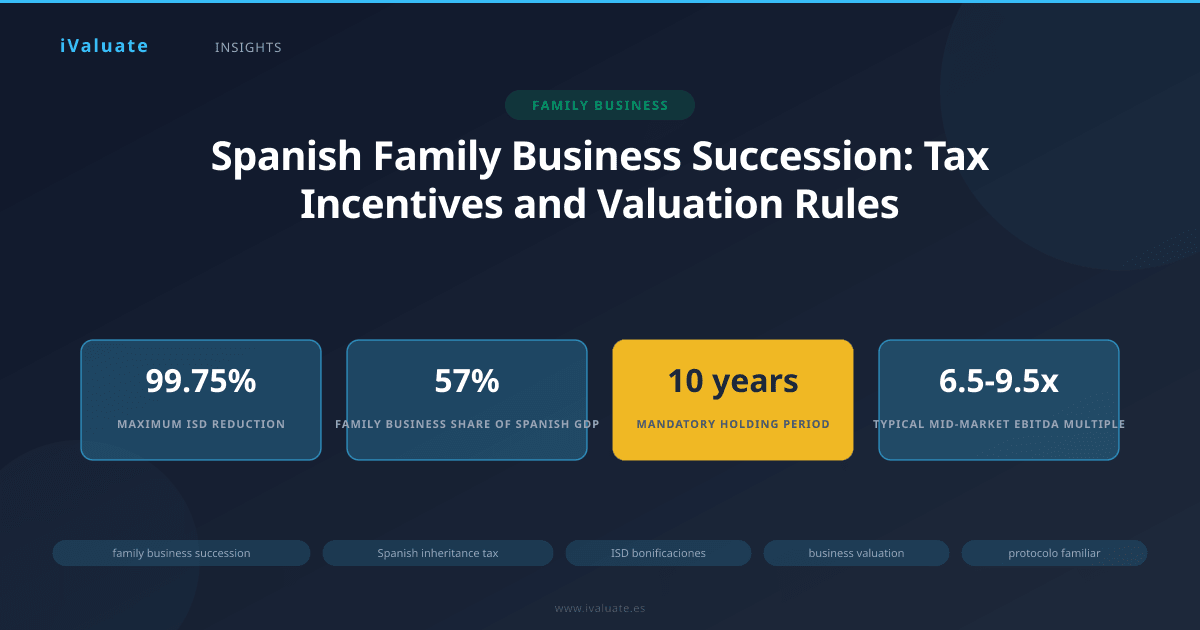
- Continuation requirements: Heirs must maintain both ownership and active management participation for a minimum of 10 years following the transfer
These requirements reflect the policy objective of preserving operating businesses and employment rather than simply facilitating wealth transfers. The 10-year holding period, in particular, represents a significant commitment that must be carefully considered in succession planning.
02 Valuation Requirements and Professional Standards
The valuation component of family business succession planning in Spain carries dual significance: it determines both the tax base for ISD purposes and serves as evidence of compliance with arm's-length transfer pricing requirements. Spanish tax authorities have become increasingly sophisticated in challenging valuations that appear aggressive, particularly following the 2020-2022 period when many businesses experienced volatile performance due to pandemic disruptions.
Mandatory Valuation Methods
Article 18 of the ISD regulation establishes a hierarchy of valuation approaches for different asset types. For operating businesses and corporate participations, the law generally requires using the higher of:
- Net book value (valor teórico) based on the most recent audited or tax-filed balance sheet
- Market value for publicly traded securities
- Capitalized earnings or discounted cash flow for operating businesses without readily ascertainable market values
In practice, the tax authorities maintain significant discretion in challenging valuations, particularly when the declared value falls substantially below what comparable market transactions would suggest. The Dirección General de Tributos (DGT) has issued numerous binding rulings clarifying that "market value" means the price that would be agreed between independent, informed parties in an arm's-length transaction.
The Role of Independent Valuation Reports
While not strictly mandatory in all cases, obtaining an independent valuation report from a qualified professional has become standard practice for family business transfers exceeding €1 million in value. These reports serve multiple purposes:
Defensive documentation: A professionally prepared valuation provides substantial protection against tax authority challenges. In administrative appeals and tax court proceedings, taxpayers who can demonstrate reliance on qualified expert opinions receive significant deference, even if the tax authorities might have reached a different conclusion.
Family governance: Independent valuations help depersonalize potentially contentious discussions among family members about relative ownership stakes and equalization payments. When siblings or cousins receive different assets or participation percentages, a credible third-party valuation reduces the risk of family conflict.
Compliance evidence: For businesses with international operations or related-party transactions, the succession valuation report can serve double duty as transfer pricing documentation, demonstrating that any cross-border aspects of the succession occurred at arm's length.
In a 2024 case involving a mid-sized Catalan manufacturing business, the tax authorities initially challenged a €8.5 million valuation, proposing instead a €14.2 million assessment based on industry multiples. The taxpayer's independent valuation report, which documented company-specific risk factors including customer concentration and aging equipment, ultimately prevailed in administrative appeal, saving the family approximately €850,000 in additional ISD liability.
03 Regional Variations and Strategic Considerations
One of the most complex aspects of Spanish family business succession planning involves navigating the substantial differences among autonomous communities. These variations create both planning opportunities and potential pitfalls.
Madrid and Andalusia: Maximum Generosity
Madrid and Andalusia currently offer the most favorable treatment, with 99% bonificaciones on the taxable base remaining after the national 95% reduction. This results in an effective tax rate of approximately 0.05% for qualifying transfers—essentially eliminating the ISD burden for family business successions.
These communities impose minimal additional requirements beyond the national law criteria. However, advisors must carefully document that the deceased or donor maintained genuine tax residence in these communities, as the tax authorities have aggressively challenged residence claims in high-value succession cases.
Catalonia: Favorable but Nuanced
Catalonia offers a 95% bonificación on top of the national reduction for direct descendants, resulting in effective rates around 0.25%. However, Catalan law imposes stricter requirements regarding the business activity test, explicitly excluding certain professional services and consulting businesses that might qualify elsewhere.
Additionally, Catalonia has been more aggressive in challenging the "active management" requirement, particularly for family businesses where the deceased held a board position but delegated day-to-day operations to professional managers. Recent administrative doctrine suggests that mere board membership may be insufficient without evidence of substantive decision-making authority.
Basque Country and Navarre: Separate Systems
The Basque Country provinces (Álava, Guipúzcoa, and Vizcaya) and Navarre maintain entirely separate tax systems under their historical foral rights. While generally favorable to family business succession, these systems operate under different legal frameworks and require specialized local expertise.
Vizcaya, for example, offers a 99% reduction but calculates it differently than other communities, applying it to the full value rather than the post-national-reduction base. Navarre's system includes unique provisions for agricultural and forestry businesses that can be particularly advantageous for certain family enterprises.
04 The Protocolo Familiar: Beyond Tax Compliance
While not strictly required for ISD benefits, the protocolo familiar (family protocol) has become increasingly important in Spanish family business succession planning. This formal governance document serves multiple functions that intersect with tax planning:
Demonstrating Business Continuity
Tax authorities evaluating whether a succession qualifies for ISD benefits look favorably on families that have documented governance structures and succession plans. A well-drafted protocolo familiar demonstrates that the transfer is part of a genuine business continuity strategy rather than a tax-motivated asset shuffle.
The protocol typically addresses:
- Criteria for family member employment and compensation
- Board composition and decision-making processes
- Dividend and reinvestment policies
- Procedures for voluntary or involuntary shareholder exits
- Dispute resolution mechanisms
Facilitating the 10-Year Holding Period
The mandatory 10-year holding and management participation requirement creates significant practical challenges. Family members may face liquidity needs, career changes, or interpersonal conflicts that make strict compliance difficult. A thoughtful protocolo familiar can establish mechanisms for addressing these situations while preserving ISD benefits.
For example, the protocol might establish a family holding company structure that allows individual family members to pledge or borrow against their indirect interests without technically transferring the underlying business participation. It might also create buy-sell provisions that allow exits in specific circumstances (death, disability, divorce) while ensuring replacement family members step into the management role.
A Valencia-based food distribution business with €45 million in annual revenue implemented a comprehensive protocolo familiar in 2023 as part of succession planning for its 72-year-old founder. The protocol established a family council, professional advisory board, and clear criteria for third-generation members to join the business. When the founder passed away unexpectedly in early 2025, the documented governance structure not only facilitated smooth operational continuity but also provided compelling evidence to tax authorities that the succession qualified for maximum ISD benefits, preserving approximately €3.8 million in family wealth.
05 Valuation Methodologies in Practice
For advisors and business owners navigating family business succession, understanding how valuation methodologies intersect with ISD requirements is essential. The choice of approach can significantly impact both tax liability and family dynamics.
Income-Based Approaches
Discounted cash flow (DCF) and capitalized earnings methods are generally preferred for established operating businesses with predictable cash flows. These approaches align well with how sophisticated buyers would actually value the business, providing strong support for the declared value.
However, income-based valuations require careful attention to normalization adjustments. Family businesses often include non-arm's-length compensation, personal expenses, or deferred maintenance that must be adjusted to reflect true economic earning power. Spanish tax authorities have become adept at identifying aggressive normalization adjustments that artificially inflate earnings and value.
Current market conditions in 2025 present particular challenges for DCF valuations. With the European Central Bank having reduced rates from their 2023 peaks but maintaining a cautious stance on inflation, determining appropriate discount rates requires careful analysis. For mid-market Spanish family businesses, we're seeing weighted average cost of capital (WACC) estimates in the 8.5% to 12.5% range, depending on industry, size, and company-specific risk factors.
Market-Based Approaches
Guideline public company and transaction multiples can provide valuable support for valuations, particularly for businesses in sectors with robust M&A activity. Spain's mid-market M&A environment has shown resilience in 2024-2025, with transaction multiples for quality businesses generally ranging from 6.5x to 9.5x EBITDA, depending on sector and growth profile.
However, applying public company or transaction multiples to family businesses requires substantial adjustments for:
- Size differences (marketability and liquidity discounts typically 20-35% for sub-€50 million businesses)
- Concentration risks (customer, supplier, or key person dependencies)
- Growth prospects and market position
- Quality of financial reporting and controls
The Spanish tax authorities generally accept reasonable marketability discounts supported by academic research and market data, but they scrutinize discounts exceeding 30% absent compelling company-specific justification.
Asset-Based Approaches
For businesses with substantial tangible assets—manufacturing, real estate development, or logistics companies—asset-based valuations may be appropriate. However, these approaches often understate the value of operating businesses with significant intangible assets or going-concern value.
Spanish tax law's reference to "net book value" as a valuation floor can create complications. While the law allows taxpayers to demonstrate that fair market value is lower than book value, doing so requires substantial evidence and often triggers additional scrutiny.
06 Structuring Considerations for Optimal Tax Efficiency
Sophisticated succession planning involves not just valuation but also transaction structuring to maximize ISD benefits while achieving family objectives.
Lifetime Gifts vs. Testamentary Transfers
While both lifetime gifts and inheritances can qualify for ISD bonificaciones, the choice between them involves multiple considerations:
Timing flexibility: Lifetime gifts allow the senior generation to transfer ownership while retaining management control through voting agreements or board positions. This can facilitate gradual transition and mentoring of successors.
Valuation control: With lifetime gifts, the parties have greater control over timing the valuation, potentially selecting a period when business value is temporarily depressed due to cyclical factors or one-time events.
Step-up basis: Inherited assets receive a step-up in tax basis to fair market value at death, potentially reducing future capital gains tax if the business is eventually sold. Gifted assets generally carry over the donor's historical basis.
Regional variations: Some autonomous communities offer more favorable treatment for inheritances than gifts, or vice versa. Madrid, for example, provides identical 99% bonificaciones for both, while other communities may differ.
Holding Company Structures
Many Spanish family businesses utilize holding company structures to facilitate succession planning and optimize tax treatment. A typical structure involves:
- Operating companies (OpCos) conducting actual business activities
- A family holding company (HoldCo) owning the OpCo shares
- Family members owning HoldCo shares, often through tiered structures separating voting and economic rights
This architecture offers several advantages for ISD planning:
Aggregation of the 20% threshold: Family members' indirect ownership through HoldCo can be aggregated to meet the minimum participation requirement, even if no individual family member would qualify independently.
Flexibility for non-business assets: The HoldCo can own both operating businesses (qualifying for ISD benefits) and passive investments (not qualifying), allowing clear separation for tax purposes.
Facilitated compliance with holding requirements: The 10-year holding period applies to the HoldCo shares, while the underlying OpCo structure can be reorganized without triggering ISD recapture, provided the HoldCo continues to meet the business activity test.
Partial Transfers and Staged Succession
Rather than transferring the entire business in a single transaction, many families implement staged succession plans involving:
- Initial minority stake transfers to test successors and begin the 10-year clock
- Gradual increase in successor ownership as they demonstrate capability
- Retention of control by the senior generation through super-voting shares or governance agreements
This approach reduces risk for both generations and can optimize tax treatment by spreading transfers across multiple years and potentially multiple tax regimes if autonomous community rules change.
07 Common Pitfalls and Risk Mitigation
Even with careful planning, family business successions can encounter challenges that jeopardize ISD benefits or create unintended consequences.
Premature Asset Sales
The 10-year holding requirement creates a trap for families who successfully transfer the business with minimal tax, only to receive an attractive acquisition offer shortly thereafter. Selling within the 10-year period triggers recapture of the ISD benefits, potentially creating a tax liability years after the succession when the family may have already deployed the inherited assets elsewhere.
Mitigation strategies include:
- Structuring acquisitions as mergers or share exchanges that may qualify as tax-deferred reorganizations
- Negotiating extended earnouts or deferred consideration to spread the economic benefit beyond the 10-year period
- In extremis, paying the recaptured ISD may still be economically rational if the acquisition premium is substantial
Management Participation Failures
The requirement that heirs maintain active management participation for 10 years can be challenging, particularly for third-generation family members who may pursue different careers or lack interest in the family business.
Recent tax authority guidance suggests that "active management" requires more than nominal board membership. Heirs should receive reasonable compensation for genuine services, attend board meetings regularly, and participate in substantive business decisions. Advisors should document this participation through board minutes, compensation records, and evidence of actual decision-making authority.
Valuation Challenges and Adjustments
Tax authorities have four years from the date of filing to challenge declared valuations (extended to 10 years in cases of fraud or gross negligence). Challenges typically arise when:
- Subsequent sales occur at substantially higher values within a short timeframe
- The declared value falls well below industry benchmarks or comparable transactions
- Normalization adjustments appear aggressive or poorly documented
- The business experiences rapid growth immediately post-succession, suggesting the value was artificially suppressed
Robust defense requires contemporaneous documentation of the valuation methodology, assumptions, and company-specific risk factors. Independent valuation reports should address potential challenges preemptively, explaining why the subject business might trade at a discount to industry medians or why certain adjustments are appropriate.
08 The Role of Technology in Modern Succession Planning
The complexity of Spanish family business succession planning—spanning valuation, tax optimization, legal compliance, and family governance—has driven increasing adoption of specialized technology platforms among advisors and business owners.
Professional-grade valuation tools enable advisors to efficiently model multiple scenarios, testing how different transaction structures, timing decisions, and valuation methodologies impact both ISD liability and family wealth preservation. These platforms incorporate current market data, regional tax variations, and regulatory requirements, reducing the risk of costly errors.
For businesses with operations across multiple autonomous communities or international footprints, integrated platforms that combine valuation analytics with tax modeling have become essential. They allow advisors to quickly assess whether restructuring operations or relocating tax residence might optimize succession outcomes, while maintaining full documentation for compliance purposes.
09 Looking Ahead: Policy Trends and Planning Implications
As Spain navigates the 2025-2026 period, several policy trends warrant attention from family business advisors and owners:
Potential Harmonization Efforts
There have been periodic discussions at the national level about harmonizing ISD treatment across autonomous communities to reduce tax competition and planning arbitrage. While comprehensive reform appears unlikely in the near term given regional political dynamics, advisors should monitor developments that could impact planning strategies premised on regional variations.
Enhanced Scrutiny of Valuations
Tax authorities across Europe, including Spain's Agencia Tributaria, have invested substantially in data analytics and valuation expertise. They increasingly use sophisticated benchmarking tools to identify outlier valuations for audit selection. This trend reinforces the importance of robust, well-documented valuations supported by independent professional opinions.
Evolving Definition of Business Activity
As the Spanish economy continues its transition toward services and digital businesses, questions arise about how traditional ISD requirements apply to modern business models. Recent administrative rulings suggest tax authorities are taking a substance-over-form approach, looking at whether businesses create genuine economic value rather than mechanically applying legacy definitions designed for manufacturing and retail enterprises.
10 Conclusion: Integrating Valuation Excellence with Tax Strategy
Spanish family business succession planning in 2025 requires integrating sophisticated valuation analysis with nuanced understanding of ISD requirements, regional variations, and family governance considerations. The potential tax savings—often €2-5 million or more for mid-sized businesses—justify substantial investment in professional planning and documentation.
Success requires early planning, typically beginning 3-5 years before anticipated transfer to allow time for business optimization, governance structure implementation, and careful transaction timing. Families that approach succession reactively, driven by health crises or immediate liquidity needs, inevitably face suboptimal outcomes and elevated tax costs.
The valuation component deserves particular attention, as it serves multiple critical functions: establishing the ISD tax base, providing evidence of arm's-length transfer pricing, facilitating family discussions about relative ownership stakes, and creating defensible documentation against potential tax authority challenges. Professional advisors increasingly rely on specialized platforms like iValuate to deliver the rigorous, well-documented valuations that Spanish family business succession planning demands, while efficiently modeling the complex scenarios that optimal tax structuring requires.
For the hundreds of thousands of Spanish family businesses facing generational transition in the coming decade, the intersection of valuation excellence and tax strategy will determine whether family wealth is preserved and businesses continue their legacy—or whether substantial value is unnecessarily lost to tax inefficiency and poor planning. The tools, incentives, and professional expertise exist to achieve optimal outcomes, but only for those who engage with the complexity early and comprehensively.