Table of Contents8 sections
In the evolving landscape of startup finance, secondary market transactions have emerged as a critical mechanism for price discovery and valuation benchmarking. Unlike public markets where prices update continuously, private companies face a fundamental challenge: how do you determine fair value when shares rarely trade? The answer increasingly lies in secondary transactions—private sales of existing equity that occur between funding rounds and provide invaluable market-based valuation signals.
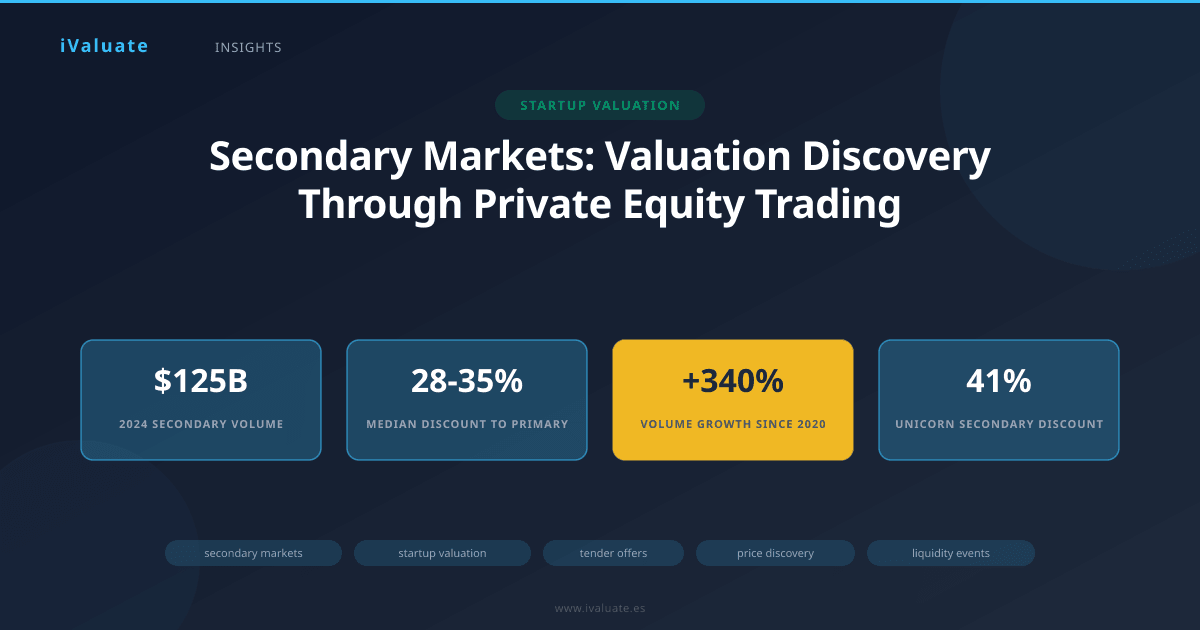
As of early 2025, secondary market activity for private company shares has reached unprecedented levels, with platforms facilitating over $125 billion in transaction volume annually. This represents a 340% increase from 2020 levels, reflecting both growing demand for liquidity among early employees and investors, and institutional recognition that secondary pricing offers more realistic valuation benchmarks than the often-inflated primary round valuations of the 2021-2022 vintage.
01 The Mechanics of Secondary Market Transactions
Secondary market transactions involve the sale of existing shares from current stakeholders—typically employees, early investors, or founders—to new buyers without the company issuing new equity. These transactions fundamentally differ from primary funding rounds in several critical ways that directly impact their valuation implications.
Types of Secondary Transactions
The secondary market encompasses several distinct transaction structures, each with unique characteristics affecting price discovery:
- Bilateral Private Sales: Direct negotiations between a seller (often an employee) and buyer (typically an institutional investor or high-net-worth individual). These transactions occur at negotiated prices that reflect information asymmetry, urgency of liquidity needs, and transfer restrictions.
- Tender Offers: Company-facilitated programs allowing multiple shareholders to sell shares at a uniform price to one or more buyers. Tender offers typically involve significant due diligence, board approval, and standardized pricing that provides the most reliable valuation benchmark.
- Structured Secondary Funds: Specialized investment vehicles that acquire portfolios of secondary positions across multiple companies, often at discounts reflecting illiquidity and concentration risk.
- Employee Share Programs: Company-sponsored liquidity programs designed to provide partial exits for employees while maintaining cap table control. These often occur at prices aligned with recent primary rounds or internal valuations.
The Price Discovery Process
Secondary transactions establish valuations through a market-clearing mechanism that differs markedly from primary fundraising. In a primary round, the company and lead investor negotiate a price that reflects growth projections, competitive positioning, and strategic value. The resulting valuation often incorporates significant forward-looking premium and may be influenced by investor FOMO (fear of missing out) dynamics.
Secondary pricing, by contrast, reflects what informed buyers will actually pay for existing equity with no accompanying governance rights, information access, or strategic relationship with the company. This creates a more conservative, market-tested valuation benchmark. Data from Forge Global and other secondary platforms indicates that secondary transactions in 2024-2025 occurred at a median discount of 28% to the most recent primary round valuation for late-stage companies, and 35-45% for earlier-stage ventures.
02 Why Secondary Pricing Matters for Valuation
The valuation implications of secondary market activity extend far beyond the specific shares traded. These transactions provide critical data points that inform broader valuation analyses and strategic decisions.
Addressing the Stale Valuation Problem
Private companies often experience significant gaps between funding rounds—18 to 24 months on average for growth-stage companies, and potentially much longer for mature private firms. During these periods, the last primary round valuation becomes increasingly stale, failing to reflect changing market conditions, operational performance, or competitive dynamics.
Secondary transactions fill this information void. When employees or early investors sell shares at specific prices, they create observable market data points that can be analyzed alongside financial performance to establish current fair market value. This proves particularly valuable for:
- 409A valuations for employee stock option grants
- Financial reporting under ASC 820 fair value standards
- Estate planning and tax compliance
- M&A negotiations and fairness opinions
- Internal decision-making regarding capital allocation
The Liquidity Premium Phenomenon
One of the most significant insights from secondary market analysis involves quantifying the illiquidity discount inherent in private equity. Academic research and market data consistently demonstrate that secondary buyers demand substantial discounts to compensate for lack of liquidity, information asymmetry, and concentration risk.
Analysis of over 3,400 secondary transactions completed in 2024 reveals that discounts vary systematically based on company characteristics. High-growth SaaS companies with clear paths to IPO or acquisition traded at median discounts of 18-22% to last primary round pricing. By contrast, companies in sectors facing headwinds (such as certain fintech and crypto-adjacent businesses) experienced discounts of 45-60%.
These discounts provide crucial calibration for valuation models. When a DCF analysis or comparable company approach yields a valuation, cross-referencing against secondary market discounts helps ensure the final valuation appropriately reflects marketability constraints.
03 Tender Offers as Valuation Benchmarks
Among secondary transaction types, tender offers deserve special attention as valuation benchmarks due to their structured nature and company involvement.
The Tender Offer Process
A typical tender offer follows a rigorous process that enhances its credibility as a valuation reference point. The company's board of directors approves the program, often after receiving a fairness opinion from an independent valuation firm. The offer price is established through negotiation between the company, existing investors, and the purchasing party—frequently a late-stage venture fund, private equity firm, or the company itself using balance sheet cash.
The process typically includes:
- Comprehensive due diligence by the purchaser, including access to financial statements, customer data, and operational metrics not available to bilateral secondary buyers
- Board-level review and approval, ensuring the price reflects informed judgment by fiduciaries
- Standardized offering documents that provide uniform pricing and terms to all participating sellers
- Minimum and maximum participation thresholds that ensure meaningful price discovery
This structured approach means tender offer pricing incorporates significantly more information and oversight than bilateral secondary sales, making it a more reliable valuation benchmark.
Case Study: Late-Stage SaaS Company Tender Offer
Consider a representative example from Q4 2024: a B2B SaaS company with $180 million in ARR growing at 45% year-over-year conducted a tender offer allowing employees and early investors to sell up to 20% of their vested holdings. The company had last raised capital in early 2022 at a $3.2 billion post-money valuation (approximately 18x ARR at the time).
The tender offer priced at $2.1 billion, representing a 34% discount to the 2022 valuation but only 11.7x current ARR—a multiple more aligned with public SaaS comparables trading at 8-14x ARR in late 2024. The tender price reflected several factors:
- Normalization of SaaS multiples from 2021-2022 peaks
- Strong operational performance (ARR growth from $100M to $180M)
- Improved path to profitability (EBITDA margin improved from -35% to -12%)
- Illiquidity discount for private shares
For valuation purposes, this tender offer provided a critical market-based reference point. Subsequent 409A valuations appropriately referenced the tender price, adjusted for the time value of money and any material operational changes. M&A discussions later that year used the tender offer as a floor valuation, recognizing that strategic buyers should pay a premium to financial buyers in a tender context.
04 Secondary Market Data and Valuation Methodologies
Sophisticated valuation practitioners integrate secondary market data across multiple methodologies to triangulate fair value estimates.
Market Approach Applications
In traditional market approach valuations, analysts compare the subject company to publicly traded peers or recent M&A transactions. Secondary market data enhances this analysis by providing direct pricing evidence for the specific company being valued.
When recent secondary transactions exist, they can be analyzed to derive implied valuation multiples. For instance, if secondary shares trade at $45 per share and the company has 50 million fully diluted shares outstanding, the implied equity value is $2.25 billion. Dividing by current-year revenue of $200 million yields an implied 11.25x revenue multiple that can be compared to public comparables and adjusted for differences in growth, profitability, and risk.
This approach proves particularly powerful when multiple secondary transactions occur over time, allowing analysts to observe valuation trends and assess whether the company is appreciating or depreciating relative to its last primary round.
Income Approach Calibration
Discounted cash flow models require numerous assumptions, including terminal value multiples and discount rates. Secondary market data provides empirical evidence to calibrate these assumptions.
The discount rate, in particular, benefits from secondary market analysis. By observing the returns that secondary buyers require—often 25-35% IRR for late-stage private companies—analysts can benchmark their weighted average cost of capital (WACC) calculations. If a DCF model uses a 15% discount rate but secondary buyers demand 30% returns, the disconnect suggests either the cash flow projections are too aggressive or the discount rate insufficiently accounts for private company risk.
Backsolving Techniques
A powerful analytical technique involves backsolving from secondary market prices to implied assumptions. If secondary shares trade at a known price, analysts can work backwards to determine what growth rates, margin assumptions, or exit multiples would justify that pricing.
This backsolving approach often reveals important insights. For example, if secondary pricing implies a 6x revenue exit multiple but the company's management projects a 12x multiple based on public comparable trading levels, the disconnect highlights either market skepticism about achieving comparable status or an appropriate illiquidity discount that must be maintained in the valuation.
05 Challenges and Limitations of Secondary Market Pricing
While secondary transactions provide valuable valuation insights, they come with important limitations that must be understood and addressed.
Information Asymmetry and Adverse Selection
Secondary sellers often have different information sets and motivations than the broader shareholder base. Employees selling shares may lack comprehensive financial information or may be motivated by personal liquidity needs unrelated to company prospects. Conversely, early investors selling large positions may have superior information suggesting deteriorating fundamentals.
This adverse selection problem means secondary prices may not represent equilibrium values for all shares. A sophisticated valuation analysis must consider whether observed secondary transactions reflect informed selling (potentially signaling overvaluation) or liquidity-driven selling (potentially creating buying opportunities at discounts to intrinsic value).
Limited Transaction Volume and Selection Bias
Many private companies have minimal secondary market activity, with perhaps one or two small transactions per year. These limited data points may not represent reliable price discovery, particularly if they involve unique circumstances such as estate settlements or divorce proceedings.
Additionally, companies that facilitate robust secondary markets may differ systematically from those that don't. High-growth companies with strong performance often embrace secondary liquidity to retain employees, while struggling companies may restrict transfers to avoid establishing low valuation benchmarks. This selection bias means secondary market data may skew toward higher-quality companies, limiting its applicability to the broader private company universe.
Transfer Restrictions and Right of First Refusal
Most private company shares are subject to transfer restrictions, rights of first refusal (ROFR), and co-sale agreements that affect secondary pricing. When a company or existing investors can match any third-party offer, secondary buyers may bid conservatively, knowing aggressive pricing will trigger the ROFR.
These restrictions create a wedge between observed secondary prices and true fair market value. A share that trades at $40 under ROFR constraints might command $50 in an unrestricted market. Valuation analysts must adjust for these contractual limitations when using secondary data as benchmarks.
06 The 2024-2025 Secondary Market Environment
The current secondary market landscape reflects broader shifts in private company valuations and liquidity dynamics.
Post-Bubble Repricing
The dramatic valuation reset of 2022-2023 created significant tension between stale primary round valuations and current market realities. Companies that raised capital at peak multiples in 2021-2022 found their valuations underwater relative to public comparables and realistic exit scenarios.
Secondary market activity in 2024-2025 has been characterized by price discovery at these lower, more sustainable levels. Data from secondary platforms shows that companies in the $1-5 billion valuation range experienced median secondary discounts of 32% to last primary round pricing, while companies valued above $5 billion (the so-called "unicorns") saw even steeper discounts averaging 41%.
This repricing provides crucial market-based evidence for 409A valuations, financial reporting, and strategic planning. Companies can no longer rely solely on stale primary round valuations; secondary market data forces a reckoning with current market conditions.
Institutional Adoption and Market Maturation
The secondary market has matured significantly, with major institutional investors now actively participating. Sovereign wealth funds, endowments, and family offices have allocated substantial capital to secondary opportunities, bringing greater price discipline and analytical rigor to the market.
This institutional participation has improved price discovery quality. When sophisticated buyers with extensive due diligence capabilities establish pricing, the resulting valuations carry greater weight as benchmarks. The involvement of firms like Coatue, Tiger Global, and Blackstone in secondary transactions has elevated market standards and reduced the information asymmetry that previously plagued bilateral sales.
Regulatory and Tax Considerations
Secondary market pricing has taken on heightened importance for tax and regulatory compliance. The IRS increasingly scrutinizes 409A valuations, particularly when employee option grants occur at strike prices significantly below recent secondary transaction prices. Companies must demonstrate that their common stock valuations appropriately consider all available market data, including secondary sales.
Similarly, financial reporting under ASC 820 requires companies to consider observable market transactions when determining fair value. Secondary market data often represents Level 2 inputs in the fair value hierarchy—observable inputs other than quoted prices—that should be weighted heavily in valuation determinations.
07 Best Practices for Using Secondary Data in Valuations
Professional valuators employ several best practices when incorporating secondary market data into their analyses.
Transaction Normalization and Adjustment
Not all secondary transactions deserve equal weight. Best practice involves normalizing transaction data by:
- Adjusting for time value of money to bring historical transactions to current value
- Considering transaction size and whether bulk discounts apply
- Evaluating seller motivations and information access
- Assessing whether transfer restrictions affected pricing
- Analyzing whether the transaction involved preferred or common shares
A rigorous analysis might weight a recent $5 million tender offer more heavily than a $50,000 bilateral sale from six months ago, recognizing the tender offer's superior price discovery characteristics.
Triangulation Across Multiple Data Sources
Secondary market data should complement, not replace, traditional valuation methodologies. The most defensible valuations triangulate across multiple approaches: DCF analysis, public comparable companies, precedent transactions, and secondary market data. When these methodologies converge on a similar value range, confidence in the valuation increases significantly.
Conversely, when secondary pricing diverges materially from other methodologies, it signals the need for deeper analysis. Perhaps the DCF assumptions are too aggressive, or perhaps the secondary transactions reflect temporary market dislocations that don't represent long-term value.
Documentation and Disclosure
When secondary market data influences a valuation conclusion, thorough documentation is essential. Valuation reports should disclose:
- The specific secondary transactions considered and their key terms
- Any adjustments made to normalize transaction data
- The weight assigned to secondary data relative to other valuation approaches
- Limitations and uncertainties in the secondary market data
- How transfer restrictions and other contractual terms affected pricing
This documentation proves critical for audit defense, tax compliance, and litigation support. It demonstrates that the valuator considered all relevant market data and exercised appropriate professional judgment.
08 Looking Forward: The Evolution of Private Company Price Discovery
The secondary market for private company shares will continue evolving, with several trends likely to shape valuation practice in the coming years.
Increased Transparency and Data Availability
Secondary market platforms are investing heavily in data infrastructure and analytics. As transaction data becomes more accessible and standardized, valuation practitioners will have richer datasets to inform their analyses. This increased transparency should reduce information asymmetry and improve price discovery efficiency.
However, this transparency cuts both ways. Companies that previously controlled their valuation narrative through selective primary fundraising may find secondary market data constraining their ability to maintain inflated valuations. The democratization of pricing information will likely accelerate the repricing of overvalued private companies.
Integration with Primary Capital Markets
The traditional separation between primary and secondary markets is blurring. Many late-stage funding rounds now include significant secondary components, allowing early investors and employees to achieve partial liquidity while the company raises growth capital. These hybrid structures provide superior price discovery by establishing a single clearing price for both new and existing shares.
This integration benefits valuation practice by creating more robust pricing benchmarks. When primary and secondary investors agree on a price after comprehensive due diligence, the resulting valuation carries greater weight than either transaction type alone.
Technology-Enabled Valuation Tools
The complexity of incorporating secondary market data into valuation analyses has driven demand for sophisticated analytical tools. Modern valuation platforms now integrate secondary market data feeds, allowing practitioners to access recent transaction pricing alongside traditional valuation methodologies.
Professional tools like iValuate enable valuators to efficiently analyze secondary market transactions, adjust for relevant factors, and incorporate the resulting insights into comprehensive valuation models. This technological evolution is making it easier for CFOs, M&A advisors, and business owners to leverage secondary market data in their decision-making, even without deep valuation expertise.
Key Takeaway: Secondary market transactions have evolved from occasional liquidity events to essential components of private company valuation. The pricing established through tender offers and structured secondary sales provides market-tested benchmarks that complement traditional valuation methodologies. As the private markets mature and secondary activity increases, the ability to properly analyze and incorporate this data will become a core competency for valuation professionals.
The integration of secondary market data into valuation practice represents a fundamental shift toward more market-based, empirically grounded approaches to private company valuation. While challenges remain—including limited transaction volume, information asymmetry, and transfer restrictions—the benefits of incorporating actual market pricing into valuation analyses far outweigh the limitations. As we progress through 2025 and beyond, the secondary market will continue providing crucial price discovery that helps bridge the gap between theoretical valuation models and the prices that informed investors actually pay for private company equity.