Table of Contents9 sections
In the evolving landscape of startup finance, secondary market transactions have transformed from occasional liquidity events into sophisticated price discovery mechanisms that provide critical valuation benchmarks. As venture-backed companies remain private longer—with the median time to IPO extending beyond 11 years in 2025—secondary markets have become essential tools for establishing fair market value in the absence of public trading data.
The secondary market for private company shares has matured dramatically over the past five years. What was once an opaque, relationship-driven market has evolved into a more structured ecosystem with specialized platforms, institutional buyers, and increasingly standardized processes. For valuation professionals, these transactions offer something precious: actual transaction prices that reflect what sophisticated investors will pay for equity stakes in private companies.
01 The Mechanics of Secondary Market Transactions
Secondary transactions involve the sale of existing shares from current shareholders—typically employees, early investors, or founders—to new buyers, without the company issuing new equity. Unlike primary fundraising rounds where companies receive capital, secondary sales represent pure transfers of ownership. These transactions occur through several distinct mechanisms, each with different implications for valuation analysis.
Tender Offers and Structured Programs
Tender offers represent the most formalized secondary transaction structure. In a company-sponsored tender offer, the board approves a program allowing eligible shareholders to sell a portion of their holdings to designated buyers at a predetermined price. These programs have become increasingly common among late-stage startups seeking to provide liquidity without pursuing an IPO.
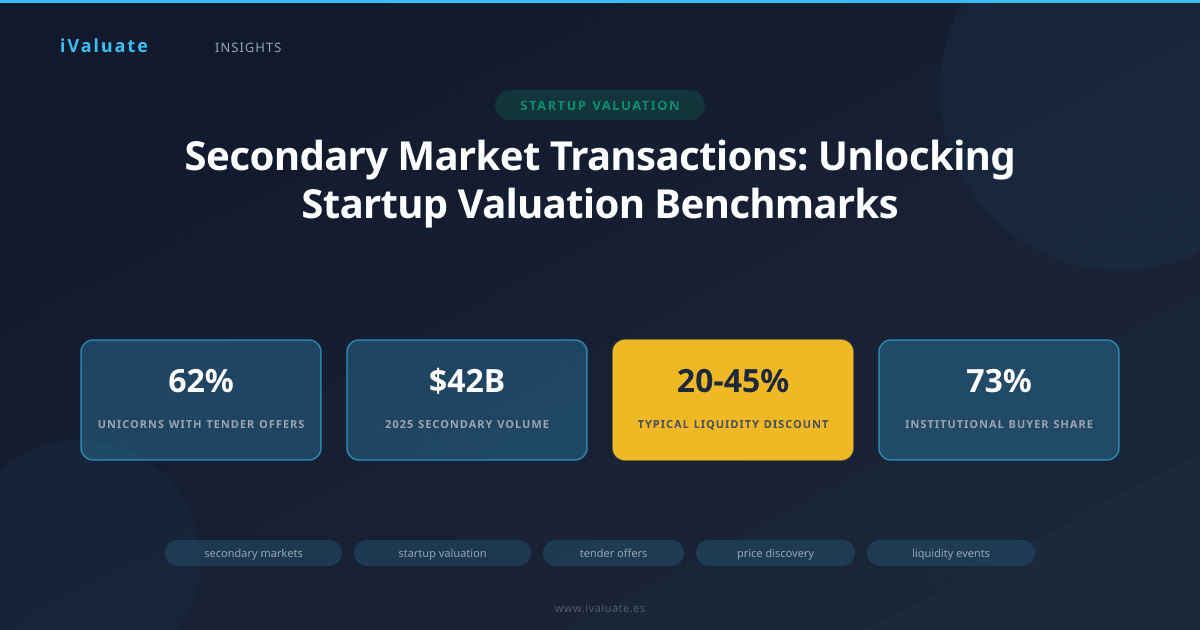
In 2025, approximately 62% of unicorn companies conducted at least one tender offer, compared to just 38% in 2021. The median tender offer allows shareholders to sell between 10-20% of their vested holdings, with pricing typically set at a 15-25% discount to the most recent primary round valuation. This discount reflects several factors: lack of liquidity, information asymmetry, and the absence of registration rights that primary investors negotiate.
For valuation professionals, tender offers provide highly relevant data points. The pricing reflects arms-length negotiations, involves material dollar amounts (typically $50-500 million in total consideration), and includes sophisticated buyers conducting thorough due diligence. However, the structured discount must be carefully analyzed and adjusted when extrapolating to enterprise value.
Direct Secondary Sales
Beyond formal tender offers, direct secondary transactions occur when individual shareholders sell to buyers through private negotiations. These deals happen continuously, facilitated by specialized platforms like Forge Global, Nasdaq Private Market, and Carta's CartaX. In 2025, these platforms processed approximately $42 billion in secondary volume across more than 8,000 transactions.
Direct secondary pricing exhibits greater variance than tender offers. Transactions involving small blocks (under $500,000) often trade at 25-40% discounts to the last primary round, reflecting the illiquidity premium and the challenges buyers face in conducting comprehensive due diligence on smaller positions. Larger blocks from institutional sellers typically command tighter spreads, often within 10-20% of primary valuations when the company demonstrates strong fundamentals.
02 Price Discovery in Secondary Markets
The fundamental value of secondary markets lies in their price discovery function. In public markets, continuous trading establishes consensus valuations minute by minute. Private companies lack this mechanism, relying instead on episodic primary fundraising rounds that may occur only every 12-24 months. Secondary transactions fill this gap, providing ongoing market feedback on valuation.
Information Content of Secondary Pricing
Secondary transaction prices contain rich information, but interpreting this data requires sophisticated analysis. A secondary sale at a 30% discount to the last primary round could indicate several scenarios: deteriorating company performance, changing market conditions, seller-specific liquidity needs, or simply appropriate discounting for illiquidity and minority position characteristics.
Research analyzing over 2,400 secondary transactions between 2022-2025 reveals important patterns. When companies subsequently raise primary capital within six months of secondary activity, the correlation between secondary pricing and new primary valuations averages 0.78—a strong relationship suggesting secondary markets effectively anticipate valuation trends. However, this correlation varies significantly by company stage and sector.
For late-stage companies (Series D and beyond) with strong revenue growth, secondary prices typically trade within 15% of subsequent primary rounds. For earlier-stage companies or those with declining metrics, secondary discounts often exceed 40%, and the predictive power diminishes substantially. This divergence reflects the greater uncertainty and information asymmetry characteristic of younger ventures.
The Liquidity Premium Framework
Valuation professionals must apply rigorous frameworks to extract enterprise value implications from secondary pricing. The liquidity premium—the discount investors demand for holding illiquid securities—represents the primary adjustment factor. Academic research and market practice suggest liquidity discounts for minority positions in private companies range from 20-45%, depending on multiple factors.
Key determinants of the liquidity discount include: expected time to liquidity event (IPO or acquisition), company financial performance trajectory, availability of secondary market infrastructure, and the specific rights attached to the securities being sold. Common stock held by employees typically trades at wider discounts than preferred stock held by institutional investors, reflecting both the different economic rights and the different seller motivations.
A practical example illustrates this framework: Consider a Series D company that raised capital at a $2 billion post-money valuation 18 months ago. Recent secondary transactions show common stock trading at $18 per share, while the Series D preferred price was $25 per share. The 28% discount reflects several factors: the preferred stock's liquidation preference and anti-dilution protection, the time value of waiting for liquidity, and current market conditions. After adjusting for these factors, a valuation professional might conclude the enterprise value has declined approximately 10-15% from the primary round, rather than the full 28% suggested by the raw secondary price.
03 Market Structure and Participant Dynamics
Understanding who participates in secondary markets and their motivations provides crucial context for interpreting pricing data. The secondary market ecosystem includes diverse participants with varying information access, investment horizons, and return requirements.
Seller Motivations and Selection Bias
Sellers in secondary markets include early employees seeking diversification, venture capital funds returning capital to limited partners, and founders reducing concentration risk. Each seller type brings different motivations that influence pricing. Employees facing tax bills from option exercises often accept deeper discounts for quick liquidity. Institutional sellers typically negotiate harder and achieve better pricing, particularly for larger blocks.
This creates selection bias that valuation professionals must consider. Secondary transactions may disproportionately represent shares from sellers with urgent liquidity needs or negative private information. In 2024-2025, analysis of secondary volume shows that companies experiencing operational challenges see secondary volume increase by an average of 340% compared to baseline periods, while pricing discounts widen by 15-20 percentage points.
Conversely, the strongest companies often restrict secondary activity through rights of first refusal (ROFR) and transfer restrictions, limiting the observable transaction data precisely when valuations are most robust. This adverse selection means secondary pricing may systematically understate value for high-performing companies while providing more accurate signals for struggling ventures.
Buyer Sophistication and Due Diligence
Secondary buyers range from individual accredited investors to specialized funds managing billions in private market assets. Institutional buyers—including firms like Forge Global Partners, Industry Ventures, and StepStone Group—conduct extensive due diligence before committing capital. Their pricing reflects analysis of company financials, market position, competitive dynamics, and exit probability.
The professionalization of secondary buying has improved price discovery quality. In 2025, approximately 73% of secondary transaction value involves institutional buyers, up from 52% in 2020. These sophisticated participants employ valuation methodologies similar to primary investors, including discounted cash flow analysis, comparable company multiples, and precedent transaction analysis. Their pricing decisions thus reflect fundamental value assessments rather than purely opportunistic liquidity provision.
04 Regulatory and Structural Considerations
The regulatory framework governing secondary transactions significantly impacts pricing and market structure. Securities laws, tax considerations, and contractual restrictions all influence how secondary markets function and what valuation conclusions can be drawn.
Transfer Restrictions and Company Rights
Most venture-backed companies impose transfer restrictions on shareholders through rights of first refusal, co-sale rights, and outright transfer prohibitions. These restrictions serve legitimate purposes—preventing competitors from acquiring stakes, maintaining cap table cleanliness, and controlling information flow—but they also constrain secondary market efficiency.
When companies actively facilitate secondary transactions through tender offers or by waiving transfer restrictions, the resulting prices carry greater informational value. The company's willingness to support liquidity at specific prices signals board and management confidence in valuation levels. Conversely, when companies block secondary transactions, the absence of observable pricing creates valuation uncertainty.
Recent legal developments have influenced this landscape. In 2024, several states enacted legislation strengthening employee rights to transfer vested equity, limiting company ROFR periods to 30 days and requiring clear disclosure of transfer processes. These changes have increased secondary market transparency and transaction volume, particularly for employee-held common stock.
Tax Implications and 409A Valuations
Secondary transaction pricing intersects importantly with 409A valuations, which establish fair market value for employee stock option grants. While 409A valuations typically employ formal appraisal methodologies, IRS regulations allow consideration of recent arm's-length transactions as evidence of fair market value.
Secondary sales can both inform and complicate 409A analyses. A robust secondary market with consistent pricing provides valuable calibration for 409A valuations. However, the discounts inherent in secondary transactions must be carefully analyzed. The IRS expects 409A valuations to reflect the value of common stock on a minority, non-marketable basis—characteristics that align with secondary market conditions but require adjustment for factors like seller distress or buyer-specific motivations.
In practice, valuation firms conducting 409A appraisals typically consider secondary transaction data as one input among several, applying adjustments for transaction size, seller type, and market conditions. A pattern of secondary sales at consistent pricing levels carries more weight than isolated transactions at outlier prices.
05 Case Studies: Secondary Markets in Action
Case Study 1: Late-Stage SaaS Company Tender Offer
A prominent enterprise software company with $400 million in ARR conducted a tender offer in Q2 2025, allowing shareholders to sell up to 15% of vested holdings. The company had last raised capital in 2023 at a $6 billion post-money valuation, implying a 15x ARR multiple—aggressive even for high-growth SaaS businesses.
The tender offer priced at $45 per share, representing a $4.5 billion valuation and a 25% discount to the 2023 round. Analysis of this pricing revealed several factors: the company's ARR growth had decelerated from 85% to 45% year-over-year, public SaaS multiples had compressed from 12x to 8x ARR for comparable companies, and the tender structure included a 10% discount for the liquidity provision itself.
For valuation professionals analyzing this company, the tender offer provided crucial data. Adjusting for the structural discount and comparing to public market multiples, the implied enterprise value of approximately $4.2-4.5 billion (10.5-11.3x ARR) appeared reasonable given the growth deceleration and market conditions. When the company ultimately pursued an IPO nine months later, the offering priced at a $4.8 billion valuation, validating the secondary market's price discovery function.
Case Study 2: Fintech Startup Secondary Volume Surge
A Series C fintech company experienced a 400% increase in secondary transaction volume during Q4 2024, with pricing declining from $12 per share to $7 per share over a three-month period. The company had raised its Series C at $15 per share just 14 months earlier, implying a $750 million valuation.
This secondary market activity signaled significant distress before it became publicly known. The volume surge reflected employee and early investor concerns about the company's burn rate and competitive position. Within two months, the company announced a down round at a $400 million valuation—a 47% decline that aligned closely with the secondary market's pricing signal.
This case illustrates both the predictive power and the limitations of secondary markets. The pricing accurately anticipated the down round, but the volume surge itself may have contributed to negative sentiment and made fundraising more difficult. Valuation professionals must consider whether secondary market activity reflects fundamental value or creates self-fulfilling prophecies in certain circumstances.
Case Study 3: Biotech Company with Restricted Secondary Market
A clinical-stage biotech company maintained strict transfer restrictions, blocking virtually all secondary transactions to protect confidential clinical trial data. Despite strong Phase II results and significant investor interest, the absence of secondary market activity created valuation uncertainty.
When the company eventually conducted a tender offer following positive Phase III data, the pricing surprised many observers. Shares traded at a 60% premium to the last primary round, reflecting the clinical progress and the pent-up demand for liquidity. However, the lack of continuous price discovery meant this value creation wasn't observable to stakeholders until the formal tender offer.
This case highlights how restricted secondary markets can obscure value, creating challenges for employees trying to understand their equity value and for companies attempting to recruit talent with competitive compensation packages. It also demonstrates that secondary market absence doesn't indicate value absence—it simply means valuation must rely more heavily on fundamental analysis rather than transaction-based evidence.
06 Analytical Framework for Valuation Professionals
Incorporating secondary market data into rigorous valuation analysis requires a structured framework that accounts for the unique characteristics of these transactions.
Data Collection and Validation
The first step involves gathering comprehensive secondary transaction data. Sources include specialized platforms (Forge, Nasdaq Private Market, CartaX), direct outreach to market participants, and company-disclosed tender offer terms. For each transaction, valuation professionals should document: transaction date, price per share, number of shares, buyer and seller type, share class, and any special terms or conditions.
Data validation is critical. Not all reported secondary transactions represent true arm's-length pricing. Related-party transactions, sales involving seller financing, or deals with unusual contingencies may not reflect fair market value. Cross-referencing multiple sources and seeking large sample sizes improves reliability.
Adjustment Methodology
Raw secondary prices require systematic adjustment to derive enterprise value implications. A recommended framework includes:
- Liquidity discount adjustment: Estimate the appropriate discount for illiquidity based on expected time to exit, company stage, and market conditions. Typical ranges: 20-30% for late-stage companies with near-term exit prospects, 35-45% for earlier-stage ventures.
- Minority interest discount: Secondary transactions typically involve minority positions without control rights. If valuing the enterprise or a control position, adjust for the lack of control premium (typically 15-25% for private companies).
- Security-specific adjustments: Account for differences between common and preferred stock, including liquidation preferences, participation rights, and anti-dilution protection. These features can create 20-40% value differentials.
- Transaction-specific factors: Adjust for seller distress, block size discounts/premiums, and buyer-specific motivations. Large blocks may trade at 5-10% premiums due to governance rights, while distressed sales may reflect 10-20% discounts.
Integration with Other Valuation Methods
Secondary market pricing should complement, not replace, fundamental valuation analysis. Best practice involves triangulating between multiple approaches: discounted cash flow analysis, comparable company multiples, precedent transactions, and secondary market data. When these methods converge, confidence in the valuation conclusion increases. When they diverge significantly, the differences warrant investigation.
For example, if DCF analysis suggests a $500 million enterprise value, public comparables indicate $450-550 million, but secondary transactions (after adjustments) imply $350 million, the valuation professional should investigate the disconnect. Possible explanations include: company-specific risks not captured in the DCF, public comparables that aren't truly comparable, or secondary market adverse selection.
07 Market Trends and Future Outlook
The secondary market landscape continues evolving rapidly, with several trends shaping how these transactions inform valuation practice.
Increased Institutionalization
Secondary markets are becoming more institutional and efficient. Trading platforms have improved price transparency, standardized transaction processes, and reduced friction costs. In 2025, the average time from price discovery to transaction close has decreased to 32 days, down from 67 days in 2020. This efficiency improvement enhances price discovery quality and makes secondary data more relevant for valuation purposes.
Major financial institutions are expanding secondary market participation. Goldman Sachs, Morgan Stanley, and JPMorgan have all launched or expanded private market secondary trading desks. This institutional involvement brings greater capital, more sophisticated pricing, and improved market infrastructure.
Regulatory Evolution
Regulatory frameworks are adapting to secondary market growth. The SEC has proposed rules to enhance private market transparency while maintaining appropriate investor protections. These regulations may require more frequent valuation disclosures and standardized reporting of secondary transactions, potentially improving data quality for valuation professionals.
Internationally, European and Asian regulators are developing frameworks for private market secondary trading. This global expansion creates opportunities for cross-border valuation benchmarking but also introduces complexity around regulatory arbitrage and varying disclosure standards.
Technology and Data Analytics
Advanced analytics are transforming how valuation professionals utilize secondary market data. Machine learning algorithms can now process thousands of transactions to identify pricing patterns, predict valuation trends, and flag anomalous transactions. These tools help separate signal from noise in increasingly large secondary market datasets.
Blockchain technology and tokenization may further revolutionize secondary markets. Several platforms are experimenting with tokenized private equity, potentially enabling more granular, continuous trading. While regulatory and practical challenges remain, these innovations could eventually provide real-time valuation data similar to public markets.
08 Practical Implications for Stakeholders
Different stakeholders derive distinct value from secondary market pricing information.
For Company Management and Boards
Secondary market activity provides boards with ongoing feedback on investor perception and valuation trends. Monitoring secondary pricing helps boards calibrate expectations for future fundraising, assess employee equity compensation competitiveness, and time liquidity events optimally. Companies that actively facilitate secondary liquidity through periodic tender offers often see improved employee retention and recruitment outcomes.
For Investors and Limited Partners
Institutional investors use secondary markets for both price discovery and portfolio management. Secondary pricing helps LPs value their private company holdings for financial reporting and performance measurement. It also provides exit opportunities for rebalancing portfolios or returning capital without waiting for company liquidity events.
Venture capital firms increasingly incorporate secondary market data into their own valuation processes, using it to validate or challenge their internal marks. This practice has become particularly important as institutional LPs demand more rigorous and transparent private market valuations.
For Employees and Individual Shareholders
For employees holding equity compensation, secondary markets provide both liquidity options and valuation transparency. Understanding secondary market pricing helps employees make informed decisions about option exercises, tax planning, and personal financial management. However, employees must recognize that secondary prices reflect minority, illiquid positions and may not represent the full value that would be realized in an IPO or acquisition.
09 Conclusion: The Evolving Role of Secondary Markets in Valuation
Secondary market transactions have evolved from occasional, opaque liquidity events into sophisticated price discovery mechanisms that provide essential valuation benchmarks for private companies. As venture-backed companies remain private longer and the private markets continue expanding, secondary transactions will play an increasingly central role in valuation practice.
For valuation professionals, secondary market data offers valuable real-world pricing evidence that complements traditional methodologies. However, extracting reliable valuation conclusions requires careful analysis of transaction mechanics, appropriate adjustments for liquidity and minority interest discounts, and thoughtful integration with fundamental valuation approaches. The most rigorous valuations triangulate between multiple methods, using secondary market data as one important input among several.
Looking ahead, continued institutionalization, regulatory evolution, and technological innovation will likely enhance secondary market efficiency and transparency. These improvements will make secondary pricing even more valuable for valuation purposes, though the fundamental analytical challenges—adjusting for illiquidity, accounting for adverse selection, and distinguishing signal from noise—will remain.
As the private markets mature, valuation professionals must stay current with secondary market developments and continuously refine their analytical frameworks. The companies and investors who best leverage secondary market insights will gain competitive advantages in pricing, negotiation, and strategic decision-making. Professional valuation platforms like iValuate are increasingly incorporating secondary market data and analytics into their offerings, helping practitioners efficiently access and analyze this critical information to deliver more accurate, market-informed valuations in an increasingly complex private market landscape.