Table of Contents8 sections
In the evolving landscape of startup finance, secondary market transactions have transformed from niche liquidity events into essential valuation benchmarks that inform investment decisions, compensation strategies, and strategic planning. As private companies remain private longer—with the median time to IPO extending beyond 10 years in 2025—secondary markets have become indispensable tools for price discovery in an otherwise opaque asset class.
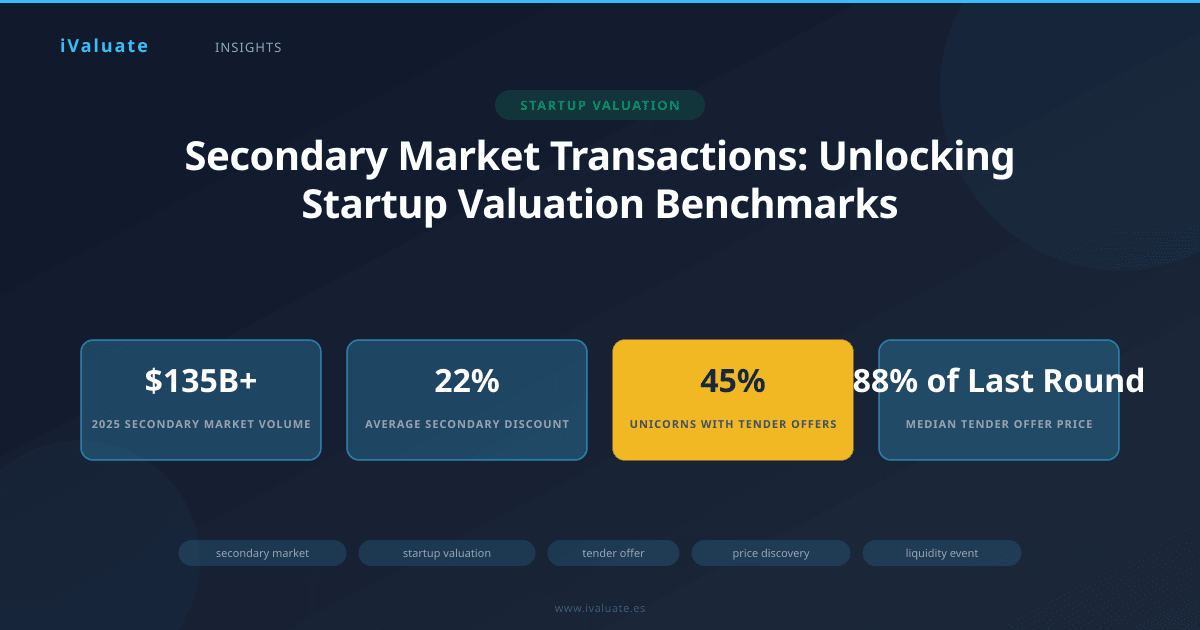
The secondary market for private company shares has matured significantly, with transaction volumes exceeding $110 billion in 2024 and projected to surpass $135 billion in 2025. This growth reflects not just increased liquidity needs but a fundamental shift in how sophisticated investors, founders, and advisors think about startup valuation between primary funding rounds.
01 The Secondary Market Landscape: Structure and Participants
Secondary transactions in private companies occur when existing shareholders sell their equity to new or existing investors, distinct from primary rounds where companies issue new shares. These transactions take several forms, each providing different valuation signals and serving distinct purposes.
Types of Secondary Transactions
Direct secondary sales involve individual shareholders selling their stakes to buyers, typically facilitated by brokers or specialized platforms. These transactions often occur at discounts ranging from 15% to 40% below the last primary round valuation, reflecting illiquidity premiums and information asymmetries. In 2025, direct secondary discounts for late-stage companies averaged 22%, down from 28% in 2023, suggesting improving market confidence.
Tender offers represent structured programs where companies facilitate employee and early investor liquidity at predetermined prices. These company-sponsored events typically involve significant due diligence, board approval, and often participation from existing institutional investors. Tender offers have become increasingly common, with approximately 45% of unicorns conducting at least one tender offer between 2023 and 2025.
Structured secondary funds purchase portfolios of startup equity from venture capital funds, angels, or employees. These transactions provide valuable pricing data across multiple companies simultaneously, though they often occur at steeper discounts due to portfolio risk and lack of company cooperation.
Market Participants and Motivations
The secondary market ecosystem includes diverse participants with varying motivations. Early employees seeking liquidity after years of equity accumulation represent the largest seller group, accounting for approximately 58% of secondary volume in 2024. Founders and executives increasingly use secondaries for portfolio diversification, particularly in companies that have delayed IPO plans.
On the buy side, specialized secondary funds like Industry Ventures, Forge Global, and newer entrants have deployed over $40 billion in dedicated capital. Traditional venture firms increasingly participate in secondary purchases to increase ownership in portfolio companies or gain exposure to companies they missed in earlier rounds. Family offices and high-net-worth individuals have also entered the market, attracted by access to pre-IPO companies at discounts to primary valuations.
02 Secondary Transactions as Valuation Benchmarks
The fundamental value of secondary transactions lies in their role as price discovery mechanisms. Unlike primary rounds, which may be influenced by strategic considerations, dilution concerns, or founder-friendly terms, secondary sales represent arms-length transactions between willing buyers and sellers with aligned economic interests.
Price Discovery Dynamics
Secondary market pricing provides several critical data points that traditional valuation methods struggle to capture. Real-time market sentiment emerges from actual transaction prices rather than theoretical models. When a late-stage fintech company's shares trade at 25% below its Series E valuation in multiple secondary transactions, this signals genuine market skepticism about growth projections or path to profitability.
The liquidity discount itself contains valuable information. A narrow discount of 10-15% suggests strong confidence in near-term liquidity events and company fundamentals. Conversely, discounts exceeding 40% indicate serious concerns about timeline to exit, company performance, or market conditions. In 2025, secondary discounts for AI infrastructure companies averaged just 12%, reflecting intense demand and confidence in rapid growth, while consumer subscription businesses saw average discounts of 35%, indicating sector-specific headwinds.
Volume and frequency of secondary transactions provide additional signals. High transaction volumes with minimal price dispersion suggest efficient price discovery and market consensus. Low volumes with wide bid-ask spreads indicate uncertainty and information gaps. Companies experiencing frequent secondary sales at consistent prices demonstrate market confidence, while those with sporadic, volatile secondary activity may face valuation questions.
Comparative Valuation Analysis
Secondary market data enables sophisticated comparative analysis across peer companies. When multiple enterprise SaaS companies with similar metrics trade at 8-10x forward revenue in secondary markets, this establishes a benchmark range for valuing comparable private companies. This approach proves particularly valuable when primary funding rounds are sparse or when comparable public companies trade at valuations disconnected from private market realities.
Secondary transactions provide the closest approximation to public market price discovery available in private markets, offering real-time validation or contradiction of primary round valuations.
Consider the case of a Series D enterprise software company valued at $2.8 billion in its last primary round at 15x forward revenue. If secondary transactions consistently occur at $1.9-2.1 billion (approximately 10x forward revenue), this 25-30% discount signals that sophisticated investors believe the primary valuation was inflated, perhaps due to favorable terms, strategic investor participation, or overly optimistic projections. For M&A advisors, compensation committees, or investors evaluating the company, the secondary market price provides crucial context.
03 Tender Offers: Structured Price Discovery
Tender offers represent the most transparent and reliable form of secondary market price discovery. These company-facilitated programs typically involve extensive preparation, including financial disclosure, due diligence periods, and formal pricing mechanisms.
Tender Offer Mechanics and Pricing
A typical tender offer process begins with board approval and determination of offer size, usually ranging from $20 million to $500 million depending on company size and liquidity needs. Companies engage financial advisors to establish a fair market value, often using multiple methodologies including discounted cash flow analysis, comparable company analysis, and precedent transactions.
The tender offer price generally falls within a range of the most recent primary round valuation, typically 80-100% for high-performing companies and 60-85% for those facing headwinds. In 2025, the median tender offer price for late-stage companies stood at 88% of last round valuation, up from 82% in 2023, reflecting improved private market conditions.
Participation rates provide additional valuation insights. Oversubscribed tender offers—where sellers offer more shares than the company will purchase—indicate that the offer price represents a floor, not a ceiling, for fair value. Undersubscribed tenders suggest the price may exceed what shareholders believe the equity is worth, signaling potential overvaluation concerns.
Case Study: Enterprise Cloud Infrastructure Company
In early 2025, a leading enterprise cloud infrastructure company conducted a $350 million tender offer at $42 per share, representing a 15% discount to its Series F price of $49.50. The company had achieved $580 million in ARR with 130% net dollar retention and a clear path to profitability within 18 months.
The tender offer was 2.8x oversubscribed, with employees and early investors seeking to sell $980 million worth of shares. The company increased the tender size to $425 million and still had to prorate allocations. This oversubscription, combined with concurrent direct secondary transactions occurring at $43-44 per share (above the tender price), validated the company's strong fundamentals and suggested the Series F valuation remained credible despite broader market volatility.
For valuation professionals analyzing this company or comparable peers, these data points provided concrete evidence: the market valued the company at approximately 8.5x forward revenue (based on $44 share price), consistent with high-quality public SaaS companies but below the 10x implied by the Series F. This information proved invaluable for compensation planning, employee equity communications, and strategic decision-making.
04 Challenges and Limitations in Secondary Market Valuation
While secondary transactions provide valuable price discovery, they come with significant limitations that sophisticated analysts must understand and adjust for.
Information Asymmetry and Selection Bias
Secondary market participants typically have less information than primary investors who receive extensive due diligence access, detailed financial projections, and management presentations. This information gap can lead to pricing inefficiencies, with discounts partially reflecting uncertainty rather than fundamental value concerns.
Selection bias affects which companies have active secondary markets. High-profile, well-performing companies attract secondary interest and tighter pricing, while struggling companies may have thin or non-existent secondary markets. This creates a sample bias where available secondary pricing skews toward better-performing companies, potentially overstating sector valuations.
Liquidity Premiums and Transaction Costs
Secondary market discounts incorporate substantial liquidity premiums. Shares that cannot be freely sold, lack voting rights, and may be subject to rights of first refusal or transfer restrictions naturally trade below freely tradable equivalents. Quantifying the pure liquidity discount versus fundamental valuation concerns requires careful analysis.
Transaction costs in secondary markets remain significant, with broker fees ranging from 3-5% and legal costs adding another 1-2%. These costs compress net proceeds for sellers and must be factored into valuation analysis. A 20% discount to last round pricing may represent only a 12-14% fundamental valuation discount after adjusting for liquidity premiums and transaction costs.
Timing and Market Conditions
Secondary market pricing reflects point-in-time market conditions that may diverge from long-term fundamental value. During the 2021-2022 peak, secondary markets for high-growth tech companies traded at premiums to primary rounds, creating misleading valuation signals. Conversely, the 2023 correction saw secondary discounts widen dramatically, overshooting fundamental deterioration.
Valuation professionals must contextualize secondary pricing within broader market conditions. A 30% secondary discount in a distressed market environment carries different implications than the same discount during stable conditions.
05 Integrating Secondary Market Data into Valuation Practice
Sophisticated valuation approaches incorporate secondary market data as one input among multiple methodologies, using it to validate, challenge, or refine conclusions from traditional approaches.
Triangulation Methodology
Best practice involves triangulating between primary round valuations, secondary market pricing, and fundamental analysis. For a late-stage company, this might involve:
- Establishing a DCF-based valuation range using conservative, base, and optimistic scenarios
- Analyzing comparable public company multiples adjusted for size, growth, and profitability differences
- Examining recent primary round pricing and terms
- Reviewing secondary market transactions over the past 6-12 months
- Synthesizing these inputs into a weighted valuation conclusion
When secondary market pricing falls significantly below DCF or comparable company valuations, this warrants investigation. Are the assumptions too aggressive? Do secondary buyers have information suggesting deteriorating fundamentals? Or does the discount primarily reflect liquidity premiums and market timing?
Adjusting for Share Class Differences
Secondary transactions typically involve common stock, while primary rounds often involve preferred shares with liquidation preferences, anti-dilution protection, and other rights. A rigorous valuation must adjust for these differences using option pricing models or probability-weighted scenario analysis.
For example, if preferred shares with a 1.5x liquidation preference trade at $50 in a primary round, equivalent common shares might fairly trade at $38-42 in secondary markets, representing a 15-24% discount purely due to preference stack differences, before considering any liquidity discount. Failing to adjust for share class creates misleading valuation comparisons.
Sector-Specific Considerations
Different sectors exhibit distinct secondary market dynamics. AI and machine learning companies in 2025 show minimal secondary discounts (averaging 8-12%) due to intense investor demand and rapid value creation. Fintech companies face wider discounts (25-35%) reflecting regulatory uncertainty and compressed multiples in public markets. Healthcare technology companies show moderate discounts (18-22%) with significant variance based on regulatory pathway clarity.
Valuation professionals must calibrate expectations and adjustments based on sector-specific secondary market patterns, recognizing that a 20% discount means something different in AI infrastructure versus consumer subscription businesses.
06 The Future of Secondary Markets and Valuation
The secondary market for private company equity continues to evolve rapidly, with several trends shaping its role in valuation practice.
Increased Transparency and Standardization
Platforms like Forge, Nasdaq Private Market, and Carta have brought greater transparency to secondary pricing, with some publishing anonymized transaction data and market indices. This increased transparency improves price discovery and enables more sophisticated analysis. The Forge Private Market Index, tracking secondary prices across hundreds of companies, has become a reference point for private market valuations, similar to public market indices.
Standardization of transaction processes, documentation, and disclosure is reducing information asymmetries and transaction costs. As secondary markets mature, the gap between primary and secondary pricing should narrow, making secondary transactions even more reliable as valuation benchmarks.
Regulatory Evolution
Regulatory frameworks continue adapting to secondary market growth. The SEC has increased scrutiny of secondary transaction disclosures and broker-dealer activities, while also considering rules to facilitate employee liquidity. These regulatory developments will likely increase secondary market participation while imposing greater disclosure requirements, further enhancing their value for price discovery.
Integration with Primary Capital Formation
Companies increasingly view secondary liquidity as integral to capital strategy rather than a separate consideration. Structured programs combining primary capital raises with secondary sales have become common, with approximately 35% of late-stage rounds in 2025 including secondary components. This integration provides cleaner price discovery by establishing a single market-clearing price for both primary and secondary shares.
As private companies remain private longer and secondary markets mature, these transactions will become the primary mechanism for ongoing price discovery between major funding events.
07 Practical Applications for Valuation Professionals
For CFOs, M&A advisors, and valuation specialists, secondary market data offers concrete applications across multiple contexts.
409A Valuations and Stock Compensation
Secondary market transactions provide critical support for 409A common stock valuations. When secondary transactions occur at $28-30 per share, this establishes a floor for fair market value that must be reconciled with any lower 409A valuation. Companies cannot credibly argue common stock is worth $18 when sophisticated investors are paying $29 in arms-length transactions.
This dynamic has led to more frequent 409A updates, with leading companies now updating valuations quarterly rather than annually when active secondary markets exist. The cost of outdated valuations—potential IRS challenges and employee dissatisfaction—exceeds the cost of more frequent professional valuations.
M&A Transaction Pricing
In M&A contexts, secondary market pricing provides negotiating leverage and valuation support. A strategic acquirer proposing a $2.5 billion purchase price faces challenges when recent secondary transactions value the company at $2.8-3.0 billion. Conversely, a company seeking a $4 billion valuation with secondary markets at $2.8 billion must explain the disconnect.
Sophisticated M&A advisors compile secondary transaction data as part of fairness opinions and valuation analyses, using it to validate or challenge proposed transaction prices. This data proves particularly valuable in situations with limited comparable companies or when primary round valuations are stale.
Portfolio Valuation and Reporting
Venture capital and private equity funds increasingly use secondary market data for portfolio company valuations, particularly for quarterly reporting under ASC 820 fair value standards. When secondary transactions occur, they provide Level 2 inputs (observable market data) that generally supersede Level 3 inputs (unobservable assumptions) like DCF models.
Fund administrators and auditors now routinely request secondary market data during valuation reviews. Funds that ignore significant secondary market activity at prices materially different from carrying values face audit challenges and potential restatements.
08 Conclusion: Secondary Markets as Essential Valuation Infrastructure
Secondary market transactions have evolved from opportunistic liquidity events into essential infrastructure for private company valuation. As companies remain private longer and the private markets continue to grow—with private company assets under management exceeding $13 trillion globally in 2025—the need for reliable, ongoing price discovery has never been greater.
For valuation professionals, secondary market data provides invaluable real-time feedback on valuation assumptions, market sentiment, and investor appetite. While not without limitations, these transactions offer the closest approximation to public market price discovery available in private markets. The key lies in understanding the nuances: adjusting for liquidity premiums, share class differences, information asymmetries, and market timing while integrating secondary data with traditional valuation methodologies.
The maturation of secondary markets represents a fundamental shift in private company finance. Companies, investors, and employees increasingly expect liquidity options before traditional exit events. This expectation, combined with improved transparency and standardization, will continue driving secondary market growth and enhancing their role in valuation practice.
For professionals navigating this complex landscape, staying current with secondary market trends, understanding platform mechanics, and developing frameworks for integrating secondary data into valuation analysis has become essential. Tools like iValuate help professionals efficiently analyze these transactions alongside traditional valuation approaches, enabling more informed decision-making in an increasingly complex private market environment. As secondary markets continue to mature, their role in establishing credible, market-based valuations will only grow, making fluency in secondary market dynamics a core competency for any serious valuation professional.