Table of Contents8 sections
The regulatory landscape surrounding fair value measurement and disclosure has entered a new phase of heightened scrutiny. Throughout 2025 and into early 2026, both the U.S. Securities and Exchange Commission (SEC) and the European Securities and Markets Authority (ESMA) have significantly intensified enforcement actions targeting deficiencies in fair value accounting practices. This enforcement wave reflects growing concerns about measurement quality, disclosure transparency, and the adequacy of internal controls over Level 3 valuations—particularly as market volatility and rising interest rates have exposed weaknesses in valuation methodologies across multiple asset classes.
For CFOs, audit committees, and valuation professionals, understanding the evolving enforcement priorities and regulatory expectations has become mission-critical. The financial penalties, restatement requirements, and reputational damage associated with fair value deficiencies now represent material enterprise risks that demand proactive governance and robust technical capabilities.
01 The Regulatory Framework: IFRS 13 and ASC 820 Under the Microscope
Fair value measurement standards—IFRS 13 under International Financial Reporting Standards and ASC 820 under U.S. GAAP—establish comprehensive frameworks for measuring and disclosing fair values. Both standards define fair value as the price that would be received to sell an asset or paid to transfer a liability in an orderly transaction between market participants at the measurement date. They also establish a three-level hierarchy based on the observability of inputs:
- Level 1: Quoted prices in active markets for identical assets or liabilities
- Level 2: Observable inputs other than Level 1 prices, such as quoted prices for similar assets or market-corroborated inputs
- Level 3: Unobservable inputs requiring significant management judgment and internal modeling
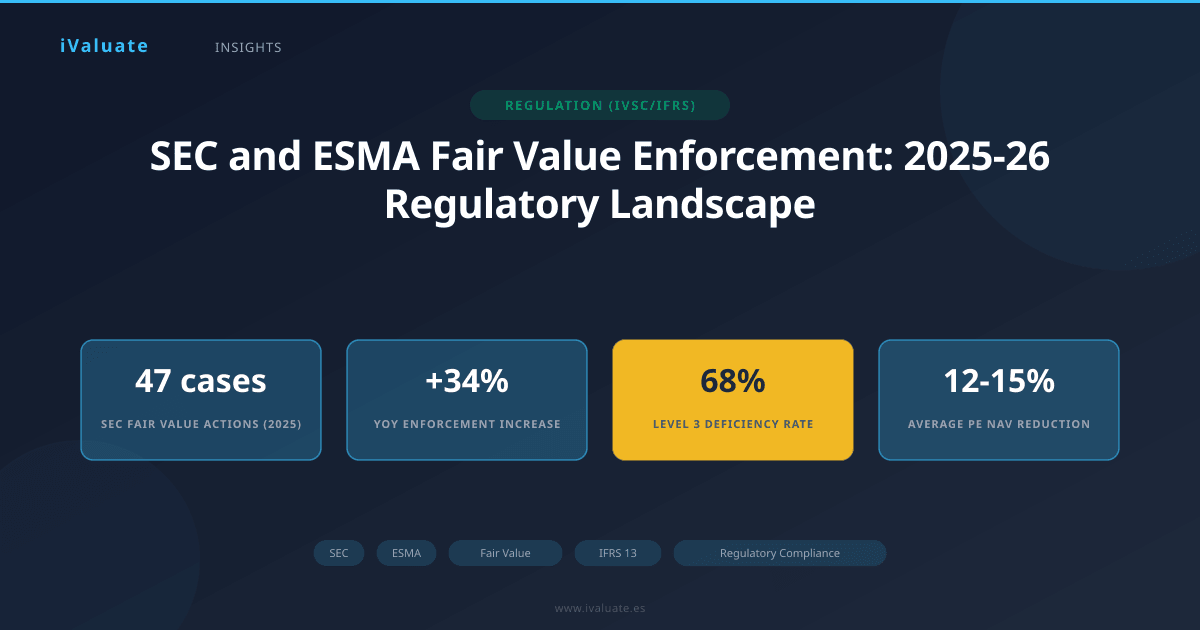
The regulatory focus has intensified specifically on Level 3 measurements, where the lack of observable market data creates opportunities for aggressive assumptions, inadequate documentation, and insufficient disclosure. According to SEC enforcement data through Q1 2026, approximately 68% of fair value-related enforcement actions involved deficiencies in Level 3 valuations, with financial services firms and private equity-backed companies representing the most frequently cited sectors.
02 SEC Enforcement Trends: Key Patterns and Priorities
The SEC's Division of Enforcement has demonstrated a clear pattern of escalating focus on fair value measurement quality. In fiscal year 2025, the SEC brought 47 enforcement actions specifically citing fair value measurement or disclosure deficiencies—a 34% increase from the prior year and the highest level since the 2008 financial crisis prompted enhanced scrutiny of mark-to-market accounting practices.
Common Deficiency Patterns
Analysis of recent SEC enforcement actions reveals several recurring themes that warrant particular attention from preparers and auditors:
Inadequate Valuation Methodology Documentation: The SEC has repeatedly cited companies for failing to maintain contemporaneous documentation of valuation methodologies, assumption selections, and changes in measurement approaches. In one notable 2025 case involving a specialty finance company, the SEC found that management changed discount rates applied to loan portfolios without documenting the rationale or obtaining appropriate approval from the audit committee. The resulting $8.2 million settlement included both monetary penalties and requirements for enhanced internal controls.
Insufficient Independence in Valuation Processes: Regulators have increasingly scrutinized the independence and competence of personnel performing fair value measurements. The SEC has challenged situations where business unit managers with compensation tied to portfolio performance exercised undue influence over valuation assumptions. In Q4 2025, a mid-sized asset manager agreed to a $12.5 million settlement after the SEC determined that portfolio managers had overridden independent valuation specialist recommendations to inflate fund NAVs.
Inadequate Disclosure of Uncertainty and Sensitivity: Both IFRS 13 and ASC 820 require entities to disclose information about the sensitivity of fair value measurements to changes in unobservable inputs. The SEC has found numerous instances where companies provided boilerplate sensitivity disclosures that failed to convey meaningful information about measurement uncertainty. Recent enforcement actions have emphasized that sensitivity analysis must be specific to the entity's actual positions and reflect reasonably possible alternative assumptions.
The Private Company Carve-Out Controversy
A particularly contentious area involves the practical expedient allowing certain investments in private companies to be measured at cost minus impairment, plus or minus observable price changes. The SEC has challenged companies that applied this expedient inappropriately or failed to adequately assess whether observable price changes should be recognized. In early 2026, the SEC brought charges against a business development company that continued using stale cost-basis measurements for portfolio companies despite clear evidence of impairment, including covenant violations and deteriorating operating performance.
03 ESMA's Coordinated European Enforcement Approach
ESMA's enforcement philosophy differs structurally from the SEC's approach, operating through coordination with national competent authorities rather than direct enforcement. However, ESMA's enforcement priorities and common findings reports have become increasingly influential in shaping European enforcement practices. The 2025 European Common Enforcement Priorities explicitly identified fair value measurement as a supervisory focus area, resulting in coordinated examinations across multiple jurisdictions.
ESMA's 2025-26 Fair Value Priorities
ESMA's public statements and enforcement decisions highlight several areas of particular concern:
Consistency with IFRS 13's Exit Price Notion: ESMA has emphasized that fair value measurements must reflect an exit price from the perspective of market participants, not entity-specific value. European enforcers have challenged situations where companies incorporated entity-specific synergies, strategic premiums, or other factors that would not be available to market participants generally. This has proven particularly relevant for business combinations and subsequent fair value measurements of intangible assets and goodwill.
Disclosure Quality and Comparability: ESMA's enforcement priorities explicitly call for enhanced disclosure of valuation techniques, inputs, and the effects of changes in measurement approaches. The regulator has expressed concern that boilerplate disclosures prevent users from understanding the judgments underlying fair value measurements. In 2025, ESMA issued enforcement decisions requiring several financial institutions to enhance disclosures around credit risk adjustments (CVA/DVA) in derivative valuations, specifying the models used and key parameter assumptions.
Cross-Border Consistency: Given Europe's integrated capital markets, ESMA has prioritized consistency in fair value measurement practices across jurisdictions. The regulator has coordinated examinations of multinational groups to identify situations where subsidiaries in different countries applied inconsistent measurement approaches to similar assets. This coordination has revealed significant variations in practice, particularly regarding real estate valuations and private equity investments.
04 Real-World Case Studies: Lessons from Recent Enforcement
Case Study 1: Technology Company Convertible Debt Valuation
In mid-2025, the SEC charged a publicly traded technology company with materially misstating the fair value of convertible debt instruments. The company had issued convertible notes with complex conversion features tied to both stock price performance and operational milestones. Management valued these instruments using a simplified Black-Scholes model that failed to capture the path-dependent nature of the conversion features and significantly understated the embedded derivative liability.
The enforcement action revealed several critical deficiencies: the company lacked personnel with sufficient expertise in complex derivative valuation; management did not engage external valuation specialists despite the complexity of the instruments; and the audit committee failed to adequately challenge management's methodology. The resulting restatement reduced reported equity by $127 million and triggered covenant violations under the company's credit facility. The settlement included $4.8 million in penalties and requirements for enhanced valuation governance, including mandatory engagement of independent valuation specialists for complex instruments.
Case Study 2: Private Equity Portfolio Valuation
ESMA coordinated enforcement actions in 2025 involving a pan-European private equity firm that managed funds domiciled in multiple jurisdictions. The investigation revealed systematic overvaluation of portfolio companies through the use of aggressive EBITDA adjustments, unsupported revenue growth assumptions, and inappropriately high valuation multiples that did not reflect market participant perspectives.
Specifically, the firm routinely added back expenses as "non-recurring" despite their repetitive nature, applied revenue growth rates that exceeded both historical performance and industry benchmarks without adequate support, and selected valuation multiples from the high end of observed ranges without documenting why premium multiples were appropriate for the specific portfolio companies. The coordinated enforcement resulted in fund NAV reductions averaging 12-15% across multiple vintage years, significant investor redemptions, and reputational damage that impaired the firm's ability to raise subsequent funds.
Case Study 3: Financial Institution CVA/DVA Disclosure
In Q1 2026, a major European bank faced enforcement action for inadequate disclosure of credit valuation adjustments (CVA) and debit valuation adjustments (DVA) on its derivative portfolio. While the bank's measurement methodology was technically sound, its disclosures failed to provide meaningful information about the models used, key assumptions regarding counterparty credit risk, and the sensitivity of measurements to changes in credit spreads.
The enforcement decision required the bank to significantly enhance its disclosures, including: specific identification of the models used for CVA/DVA calculation; quantitative disclosure of key inputs such as probability of default and loss given default assumptions; sensitivity analysis showing the impact of reasonably possible changes in credit spreads; and reconciliation of opening and closing CVA/DVA balances with clear attribution of changes to new transactions, market movements, and assumption changes. This case has become a reference point for disclosure expectations across the European banking sector.
05 Key Compliance Imperatives for 2026 and Beyond
The enforcement trends and regulatory priorities identified by both the SEC and ESMA point to several critical compliance imperatives for organizations with material fair value measurements:
Enhance Valuation Governance
Robust governance over fair value measurements has become non-negotiable. Leading practices include:
- Establishment of a formal valuation committee with appropriate expertise and independence from business units
- Clear documentation of valuation policies, including methodology selection criteria, approval requirements for changes, and escalation procedures for significant judgments
- Regular audit committee oversight with specific focus on Level 3 measurements, including detailed reviews of significant assumptions and sensitivity analyses
- Mandatory engagement of independent valuation specialists for complex or material measurements, with clear documentation of specialist qualifications and scope of work
Strengthen Technical Capabilities
The complexity of modern financial instruments and business models demands sophisticated technical capabilities. Organizations should assess whether internal personnel possess adequate expertise in relevant valuation methodologies, including option pricing models, discounted cash flow analysis, and market-based approaches. Where expertise gaps exist, companies must either invest in training and recruitment or engage external specialists on an ongoing basis.
Improve Disclosure Quality
Both regulators have made clear that boilerplate disclosures are unacceptable. Effective fair value disclosures should:
- Provide specific information about valuation techniques and inputs used for material measurements
- Include meaningful sensitivity analysis that reflects entity-specific positions and reasonably possible alternative assumptions
- Explain the rationale for significant judgments and changes in measurement approaches
- Reconcile Level 3 measurements with clear attribution of changes to observable factors versus unobservable assumption changes
- Discuss the effects of measurement uncertainty on financial position and performance
Document, Document, Document
Contemporaneous documentation has emerged as perhaps the single most important factor in regulatory examinations. Companies must maintain detailed documentation of:
- Valuation methodology selection and any changes in approach
- Sources and rationale for significant assumptions and inputs
- Market participant perspective analysis and consideration of entity-specific factors
- Reviews and approvals by appropriate levels of management and governance
- Engagement and conclusions of independent valuation specialists
Regulatory enforcement has made clear that fair value measurement is not merely a technical accounting exercise but a critical area of financial reporting that demands rigorous governance, sophisticated technical capabilities, and transparent disclosure. Organizations that treat fair value as a compliance checkbox rather than a substantive risk area do so at their peril.
06 The Technology Imperative: Tools and Automation
The volume and complexity of fair value measurements at many organizations have exceeded the capacity of manual processes and spreadsheet-based approaches. Leading companies have invested in specialized valuation platforms that provide:
- Centralized repositories for valuation models, assumptions, and supporting documentation
- Workflow management with appropriate review and approval controls
- Automated sensitivity analysis and scenario modeling capabilities
- Audit trails documenting all changes to assumptions and methodologies
- Integration with financial reporting systems to ensure consistency
These technology investments not only improve efficiency but also enhance control effectiveness and documentation quality—critical factors in regulatory examinations. The business case for valuation technology has strengthened considerably as the costs of enforcement actions and restatements have become more visible.
07 Looking Ahead: Emerging Regulatory Priorities
Several emerging areas warrant attention as potential future enforcement priorities:
ESG-Related Measurements: As sustainability reporting becomes mandatory in many jurisdictions, fair value measurements related to ESG factors—including carbon credits, renewable energy certificates, and ESG-linked financial instruments—will likely attract regulatory scrutiny. The lack of mature markets and standardized methodologies for many ESG-related items creates significant measurement challenges.
Digital Assets and Cryptocurrencies: Both the SEC and ESMA have signaled increased focus on fair value measurements of digital assets. The volatility, fragmented markets, and evolving regulatory treatment of cryptocurrencies create significant measurement and disclosure challenges that regulators are beginning to address through enforcement actions.
AI and Machine Learning in Valuation: As companies increasingly incorporate artificial intelligence and machine learning techniques into valuation processes, regulators will likely scrutinize whether these approaches comply with fair value standards, produce reliable measurements, and are adequately disclosed and controlled.
08 Conclusion: Proactive Compliance in an Enforcement-Focused Environment
The regulatory environment surrounding fair value measurement has fundamentally shifted. Both the SEC and ESMA have demonstrated through enforcement actions that fair value deficiencies will be pursued aggressively, with significant financial and reputational consequences. The 68% increase in SEC fair value enforcement actions over the past two years, combined with ESMA's coordinated European approach, signals that regulatory scrutiny will remain elevated for the foreseeable future.
For financial reporting professionals, the imperative is clear: fair value measurement and disclosure quality must be treated as a top-tier risk area warranting board-level attention, significant resource investment, and continuous improvement. Organizations that maintain robust valuation governance, invest in technical capabilities, provide transparent disclosures, and maintain rigorous documentation will be well-positioned to navigate regulatory examinations successfully.
The complexity and volume of fair value measurements at many organizations necessitate sophisticated tools and processes. Professional platforms like iValuate help companies perform rigorous valuations efficiently while maintaining the documentation, controls, and analytical capabilities that regulators now expect. As enforcement intensity continues to increase, the business case for investing in both people and technology to support fair value measurement quality has never been stronger.
The message from regulators is unambiguous: fair value measurement is not a technical accounting exercise to be delegated to junior staff or addressed through boilerplate disclosures. It is a critical area of financial reporting that demands senior management attention, technical rigor, and transparent communication with investors. Organizations that embrace this reality and invest accordingly will not only avoid enforcement risk but will provide more reliable, decision-useful information to capital markets—the ultimate objective of financial reporting standards.