Table of Contents11 sections
In the technology sector, traditional earnings-based valuation metrics often fail to capture the economic reality of high-growth companies. When a SaaS business is investing heavily in customer acquisition, product development, and market expansion, profitability becomes a strategic choice rather than an operational outcome. This fundamental characteristic has made revenue multiples—specifically Enterprise Value to Revenue (EV/Revenue)—the dominant valuation framework for technology companies, particularly those in the software-as-a-service segment.
As we navigate through 2025-2026, the SaaS valuation landscape has matured considerably from the exuberance of 2020-2021, yet revenue multiples remain the cornerstone metric for investors, acquirers, and financial advisors evaluating technology businesses. Understanding why this metric persists, how it's calculated, and what drives multiple expansion or compression has become essential knowledge for anyone involved in tech company valuation.
01 Why Revenue Multiples Dominate Tech Valuation
The primacy of revenue multiples in technology valuation stems from several structural characteristics of software businesses that distinguish them from traditional enterprises:
The Profitability Paradox
High-growth SaaS companies face a fundamental trade-off: they can optimize for near-term profitability or maximize long-term market capture. Consider that customer acquisition costs (CAC) are expensed immediately, while the lifetime value (LTV) of that customer accrues over years. A company growing annual recurring revenue (ARR) at 100% year-over-year will show significant losses on the income statement, yet may be creating enormous enterprise value.
In 2025, approximately 60% of publicly-traded SaaS companies with growth rates exceeding 40% remain unprofitable on a GAAP basis. Traditional EBITDA or P/E multiples become mathematically impossible to calculate for these businesses, yet they command valuations in the billions of dollars. Revenue multiples solve this analytical challenge by focusing on the metric that best predicts future cash generation potential.
Predictability and Recurring Revenue Economics
Unlike transactional businesses where revenue must be re-earned each period, SaaS companies benefit from subscription economics that create highly predictable revenue streams. Annual recurring revenue (ARR) and monthly recurring revenue (MRR) provide visibility into future performance that makes revenue a more reliable valuation anchor than in other industries.
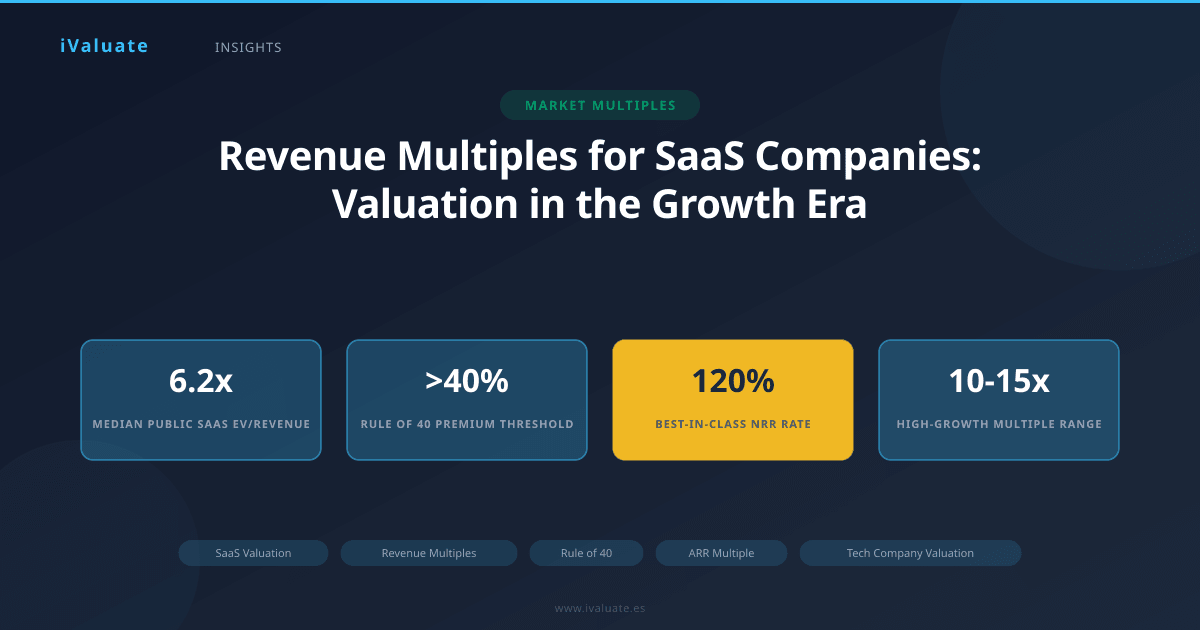
The median net revenue retention (NRR) rate for best-in-class SaaS companies currently sits at 120%, meaning existing customers expand their spending by 20% annually even before new customer acquisition. This expansion revenue characteristic means that today's revenue base contains embedded growth, justifying premium valuations relative to one-time transaction businesses.
02 Calculating and Interpreting EV/Revenue Multiples
The Enterprise Value to Revenue multiple is calculated as:
EV/Revenue = (Market Capitalization + Total Debt - Cash) / Annual Revenue
Enterprise value represents the theoretical takeover price of a company, including both equity value and net debt. Using EV rather than market capitalization ensures comparability across companies with different capital structures—a critical consideration when comparing bootstrapped SaaS companies carrying no debt against venture-backed competitors who may have raised significant debt financing.
Current Market Benchmarks: 2025-2026
The SaaS valuation environment has undergone significant recalibration since the peak multiples of 2021. Current benchmarks reflect a more disciplined market that rewards efficient growth:
- Public SaaS Median: The median EV/Revenue multiple for publicly-traded SaaS companies stands at 6.2x as of Q1 2025, down from the 2021 peak of 18.3x but up from the 2022-2023 trough of 4.1x
- High-Growth Premium: Companies growing revenue >50% annually command multiples of 10-15x, with best-in-class performers reaching 18-20x
- Mature SaaS: Profitable companies growing 15-25% annually typically trade at 4-7x revenue
- Private Market Discount: Private SaaS companies generally trade at 20-30% discounts to comparable public companies, placing median private multiples in the 4-5x range
These benchmarks vary significantly by subsector. Vertical SaaS companies serving specific industries (healthcare, financial services, construction) often command premium multiples of 8-12x due to higher switching costs and deeper product integration. Horizontal productivity tools face more competition and typically trade at 4-6x revenue.
03 The Rule of 40: The Critical Efficiency Metric
While revenue multiples provide the valuation framework, the Rule of 40 has emerged as the single most important metric driving multiple expansion or compression in SaaS valuations. This elegantly simple formula states:
Revenue Growth Rate (%) + Free Cash Flow Margin (%) ≥ 40%
A company growing revenue at 60% with a -20% FCF margin scores 40. A company growing at 25% with 15% FCF margin also scores 40. Both would be considered healthy, though the market often assigns different multiples based on the composition of that score.
How Rule of 40 Drives Valuation
Analysis of public SaaS companies in 2025 reveals a clear correlation between Rule of 40 scores and valuation multiples:
- Companies scoring <20 on Rule of 40: 2-4x revenue
- Companies scoring 20-40: 4-7x revenue
- Companies scoring 40-60: 7-12x revenue
- Companies scoring >60: 12-20x+ revenue
This relationship exists because the Rule of 40 captures the efficiency of growth. Investors have learned that growth at any cost destroys value. A company burning $2 to generate $1 of ARR will eventually face a reckoning. The Rule of 40 provides a framework for evaluating whether growth investments generate adequate returns.
The shift from growth-at-all-costs to efficient growth represents the defining change in SaaS valuation between 2021 and 2025. Companies that adapted their operating models to achieve Rule of 40 compliance saw their multiples expand 40-60% relative to peers who continued prioritizing growth over efficiency.
04 ARR Multiples: The Private Market Standard
In private markets, particularly for earlier-stage SaaS companies, valuations are often expressed as multiples of Annual Recurring Revenue (ARR) rather than total revenue. This distinction matters because ARR excludes one-time implementation fees, professional services revenue, and other non-recurring components that may inflate total revenue figures.
Current ARR Multiple Benchmarks
Private SaaS companies in 2025-2026 are seeing ARR multiples that vary dramatically based on growth profile and efficiency:
- Early-stage ($1-5M ARR): 5-8x ARR for companies growing >100% annually with strong unit economics
- Growth-stage ($5-20M ARR): 6-10x ARR for companies growing 60-100% with improving efficiency metrics
- Scale-stage ($20-50M ARR): 8-12x ARR for companies growing 40-60% while approaching Rule of 40
- Late-stage ($50M+ ARR): 6-10x ARR for companies growing 25-40% with strong profitability
These ranges assume strong underlying metrics: net revenue retention above 110%, CAC payback periods under 18 months, and gross margins exceeding 75%. Companies falling short on these benchmarks may see multiples compress by 30-50%.
05 Key Drivers of Multiple Expansion
Beyond growth rate and profitability, several factors drive premium valuations in the current market:
Net Revenue Retention
NRR has emerged as perhaps the most important single metric in SaaS valuation. Companies with NRR above 130% command multiples 50-70% higher than peers with NRR below 110%. This metric demonstrates product-market fit, pricing power, and the ability to expand within existing accounts—all indicators of sustainable competitive advantage.
Market Size and Positioning
Total addressable market (TAM) significantly impacts multiples. A company with $20M ARR growing 80% annually in a $500M market will trade at lower multiples than a similar company in a $10B market. Current market penetration below 5% of TAM typically supports premium valuations, as investors see substantial runway for continued growth.
Gross Margin Profile
Best-in-class SaaS companies maintain gross margins of 80-85%, with some pure-play software businesses exceeding 90%. Companies with significant professional services components or high infrastructure costs may see gross margins of 60-70%, which typically results in 20-30% lower revenue multiples due to reduced scalability and margin expansion potential.
Customer Concentration
Revenue concentration remains a critical risk factor. Companies where the top 10 customers represent more than 30% of ARR typically face 15-25% valuation discounts. Conversely, businesses with highly diversified customer bases and strong small/medium business (SMB) or mid-market presence often command premium multiples due to reduced customer concentration risk.
06 Real-World Valuation Examples
Case Study: Vertical SaaS Premium
Consider two companies each generating $30M in ARR with 50% growth rates. Company A provides horizontal project management software with 115% NRR and 75% gross margins. Company B offers specialized compliance software for financial institutions with 135% NRR and 82% gross margins, but serves a more concentrated customer base.
In current market conditions, Company A might command an 8x ARR multiple ($240M valuation) based on solid but unremarkable metrics in a competitive category. Company B, despite customer concentration concerns, could achieve a 10-11x multiple ($300-330M valuation) due to its vertical specialization, superior unit economics, and the high switching costs inherent in compliance software.
Case Study: The Profitability Inflection
A $50M ARR company growing 35% annually with -15% FCF margins might trade at 6x revenue ($300M valuation), scoring 20 on Rule of 40. If management implements operational improvements to reach breakeven (0% FCF margin) while maintaining 35% growth, the Rule of 40 score jumps to 35, and the multiple could expand to 8-9x ($400-450M valuation)—a 33-50% increase in enterprise value with no change in revenue growth.
This scenario played out repeatedly in 2023-2024 as SaaS companies responded to the changed funding environment by cutting sales and marketing spend, reducing headcount, and focusing on efficiency. Companies that successfully navigated this transition saw their valuations recover faster than peers who continued to prioritize growth over profitability.
07 Sector-Specific Multiple Variations
Not all SaaS businesses are valued equally. Current multiples vary significantly across subsectors:
- Cybersecurity SaaS: 8-14x revenue (premium for mission-critical nature and high switching costs)
- Healthcare/Life Sciences SaaS: 7-12x revenue (regulatory moats and long sales cycles)
- Financial Services SaaS: 6-10x revenue (embedded fintech components can drive premium multiples)
- HR/Payroll SaaS: 5-9x revenue (mature category with established competitors)
- Marketing/Sales SaaS: 4-8x revenue (highly competitive with lower switching costs)
- Vertical Industry SaaS: 7-13x revenue (varies by industry served and depth of integration)
These ranges reflect current market conditions in 2025-2026 and assume companies meet baseline efficiency metrics. Outlier performers in any category can command multiples well above these ranges.
08 The Limitations of Revenue Multiples
While revenue multiples provide essential valuation framework for unprofitable tech companies, sophisticated investors and advisors recognize their limitations:
Revenue Quality Matters
Not all revenue is created equal. A dollar of ARR from a Fortune 500 customer on a three-year contract carries more value than a dollar from a small business on a month-to-month subscription. Revenue multiples alone don't capture these qualitative differences, which is why detailed due diligence examines cohort retention, contract terms, and customer segmentation.
Path to Profitability
Revenue multiples can mask fundamental unit economics problems. A company growing rapidly while burning unsustainable amounts of capital may appear attractive on a revenue multiple basis but face a valuation cliff when growth slows and profitability remains elusive. This is why the Rule of 40 has become such a critical complementary metric—it forces consideration of the efficiency of growth.
Market Timing and Sentiment
Revenue multiples are highly sensitive to market conditions and investor sentiment. The same company with identical metrics might trade at 15x revenue in a bull market and 5x in a bear market. This volatility makes it essential to consider current market conditions when applying revenue multiples to private company valuations.
09 Practical Application for Business Owners and Advisors
For CFOs, business owners, and M&A advisors working with SaaS companies, several practical implications emerge from the current valuation environment:
Optimize for Rule of 40 Compliance
Companies planning exits in the next 12-24 months should prioritize achieving or exceeding Rule of 40 thresholds. This may mean moderating growth to improve profitability, or accepting near-term losses to accelerate growth—but the sum must reach 40 or higher to maximize valuation multiples.
Document and Highlight Key Metrics
Buyers and investors will scrutinize ARR composition, NRR, CAC payback, gross margin trends, and customer cohort behavior. Having clean, auditable data on these metrics can add 10-20% to valuation by reducing buyer risk perception and supporting premium multiple justification.
Understand Your Peer Set
Valuation is inherently relative. Identifying truly comparable companies—similar growth rates, business models, customer segments, and efficiency metrics—provides the foundation for defensible valuation ranges. Generic "SaaS multiple" benchmarks are less useful than carefully selected peer comparisons.
Consider Timing and Market Conditions
The SaaS M&A market in 2025-2026 shows strong activity for high-quality assets, with strategic buyers and private equity firms actively deploying capital. However, multiples remain below 2021 peaks and are likely to stay in the current range absent major market disruptions. Companies with strong metrics should consider that current conditions may represent attractive exit windows.
10 The Future of SaaS Valuation
Looking ahead, several trends are likely to influence how revenue multiples evolve:
AI Integration and Margin Expansion
Companies successfully integrating AI capabilities to reduce customer support costs, automate implementation, or enhance product functionality are beginning to command premium multiples. The ability to maintain or expand gross margins while improving product capabilities through AI represents a new source of competitive advantage that investors are willing to pay for.
Consumption-Based Models
The shift from seat-based to consumption-based pricing in certain SaaS categories (data platforms, infrastructure software, API-driven products) creates new valuation challenges. These models can produce higher NRR but more variable revenue, potentially affecting how investors apply revenue multiples.
Profitability as the New Growth
The market's emphasis on efficient growth and Rule of 40 compliance represents a permanent shift rather than a temporary reaction to higher interest rates. Even as capital markets normalize, investors will continue to reward companies that demonstrate disciplined growth and clear paths to profitability.
11 Conclusion
Revenue multiples remain the essential valuation framework for SaaS and technology companies, particularly those prioritizing growth over near-term profitability. The current market environment of 2025-2026 reflects a maturation of SaaS valuation methodology, where multiples of 6-8x revenue represent the new normal for quality assets, with premium multiples of 10-15x reserved for exceptional performers demonstrating efficient growth, strong unit economics, and clear competitive advantages.
The Rule of 40 has emerged as the critical metric linking operational performance to valuation multiples, forcing companies to balance growth and profitability in ways that create sustainable value. For business owners, understanding these dynamics and optimizing key metrics can translate directly into millions of dollars of enterprise value.
As the technology sector continues to evolve, the fundamental principles underlying revenue multiple valuation—recurring revenue predictability, scalable business models, and efficient growth—will remain constant. Professional valuation platforms like iValuate help CFOs, advisors, and business owners navigate these complexities by providing current market benchmarks, peer comparisons, and sophisticated modeling capabilities that translate operational metrics into defensible valuation ranges. In an environment where a single multiple point can represent millions in enterprise value, having access to professional-grade valuation tools and current market intelligence has never been more critical.