Table of Contents10 sections
For decades, corporate valuation has been fundamentally episodic—a snapshot captured at a specific moment in time, typically during fundraising rounds, M&A transactions, or annual reporting cycles. A private equity firm might commission a valuation in January, only to find market conditions radically different by March. A CFO preparing for an acquisition would rely on comps pulled weeks earlier, potentially missing critical market shifts. This point-in-time approach created information gaps that could cost millions in mispriced deals or missed opportunities.
The emergence of real-time valuation dashboards in 2025-2026 represents a fundamental paradigm shift. By integrating live market data feeds, automated comparable company screening, and dynamic modeling engines, these platforms enable continuous valuation monitoring that updates as market conditions evolve. This transformation isn't merely incremental—it's redefining how professionals approach valuation, risk management, and strategic decision-making.
01 The Limitations of Traditional Point-in-Time Valuation
Traditional valuation methodologies—discounted cash flow analysis, comparable company analysis, precedent transactions—remain conceptually sound. The problem lies not in the frameworks themselves but in their static application. When a valuation professional completes a DCF model or pulls trading multiples for comparable companies, that analysis reflects market conditions at a specific moment. Within days or weeks, critical inputs can shift dramatically:
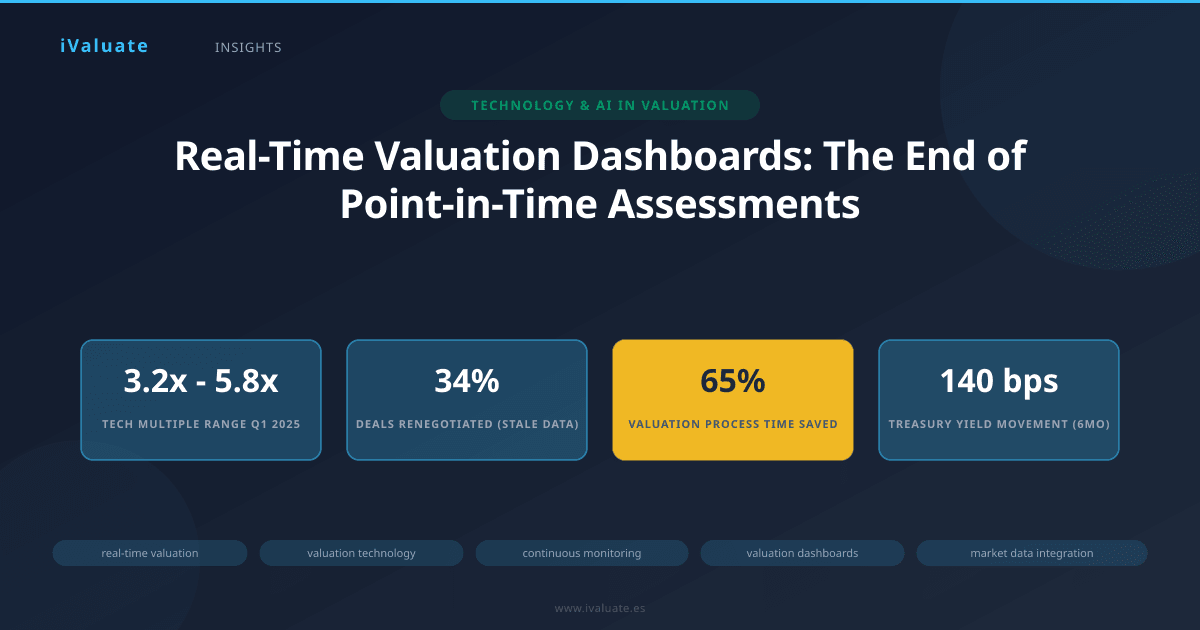
- Public market multiples: Technology sector EV/Revenue multiples fluctuated between 3.2x and 5.8x during Q1 2025 alone, driven by Federal Reserve policy signals and AI infrastructure spending announcements
- Discount rates: The 10-year Treasury yield moved 140 basis points between December 2024 and April 2025, directly impacting WACC calculations across all sectors
- Comparable company performance: Quarterly earnings releases can trigger 15-25% single-day moves in peer company valuations, immediately affecting relative valuation benchmarks
- Transaction precedents: New M&A deals continuously reset market expectations for multiples and deal structures in specific industries
Consider a middle-market software company seeking Series C funding in February 2025. A traditional valuation prepared in early January might reference public SaaS comparables trading at 6.5x forward revenue. By late February, following stronger-than-expected earnings from several public peers and two significant private market transactions, those multiples had expanded to 7.8x—a 20% increase. Relying on the January analysis would have resulted in significant dilution for existing shareholders or a failed fundraising round due to misaligned expectations.
The Cost of Information Lag
The financial impact of stale valuation data extends across multiple use cases. In M&A negotiations, buyers and sellers often work from valuations prepared weeks or months earlier, creating friction when market conditions have shifted. A 2024 study of middle-market transactions found that 34% of deals experienced significant renegotiation or termination due to valuation gaps that emerged between LOI signing and closing—gaps frequently attributable to outdated market assumptions.
For portfolio companies held by private equity firms, quarterly valuation updates have been standard practice. However, this quarterly cadence means investment committees make hold/sell decisions based on information that may be 30-90 days old. During periods of market volatility—such as the technology sector correction in Q2 2025—this lag can obscure emerging risks or opportunities worth hundreds of millions in portfolio value.
02 The Architecture of Real-Time Valuation Dashboards
Modern real-time valuation platforms integrate multiple data streams and analytical engines to provide continuous monitoring capabilities. Understanding the technical architecture helps explain both the power and limitations of these systems.
Live Market Data Integration
The foundation of real-time valuation is continuous market data ingestion. Leading platforms now integrate:
- Public equity pricing: Real-time stock prices, trading volumes, and implied volatility for comparable public companies, updated every 15 minutes during market hours
- Fixed income markets: Treasury yields, credit spreads, and corporate bond pricing that directly inform discount rate calculations
- Transaction databases: Automated feeds from M&A databases capturing new deal announcements, with algorithms parsing press releases and SEC filings for valuation-relevant details
- Economic indicators: GDP growth rates, inflation metrics, unemployment data, and sector-specific indicators (e.g., semiconductor orders, cloud infrastructure spending) that influence growth assumptions
- Alternative data: Web traffic analytics, app download statistics, and other digital signals that provide early indicators of company performance trends
The technical challenge lies in normalizing and validating this data. A single comparable company might report revenue across different segments, use varying accounting standards, or experience one-time events that distort multiples. Sophisticated platforms employ machine learning algorithms to identify and adjust for these anomalies, ensuring the underlying data feeding valuation models remains reliable.
Dynamic Valuation Models
Static Excel models, while powerful for point-in-time analysis, cannot efficiently incorporate continuous data updates. Real-time dashboards utilize cloud-based modeling engines that automatically recalculate valuations as inputs change. These systems typically support multiple valuation methodologies simultaneously:
Market approach models continuously update comparable company multiples, applying industry-specific adjustments for size, growth, profitability, and other differentiating factors. When a peer company reports earnings, the platform automatically recalculates relevant multiples (EV/Revenue, EV/EBITDA, P/E) and propagates those changes through to subject company valuations within minutes.
Income approach models dynamically adjust discount rates based on current risk-free rates and market-implied equity risk premiums. As the 10-year Treasury yield fluctuates, WACC calculations update automatically. Some advanced platforms even incorporate real-time credit spread data to refine cost of debt estimates for specific credit profiles.
Hybrid models weight multiple methodologies based on data quality and market conditions. During periods of high public market volatility, the system might automatically reduce weighting on market multiples and increase reliance on DCF approaches, or vice versa when transaction activity provides robust precedent data.
Intelligent Alerting and Threshold Monitoring
Raw data updates provide limited value without contextualization. Professional-grade dashboards incorporate configurable alerting systems that notify users when meaningful changes occur:
- Valuation movements exceeding specified thresholds (e.g., ±5% from last formal assessment)
- Comparable company multiple expansions or contractions beyond historical ranges
- New transaction precedents in relevant sectors or size ranges
- Macroeconomic indicators crossing levels that trigger model assumption reviews
- Divergence between different valuation methodologies suggesting model recalibration needs
A CFO monitoring their company's implied valuation might configure alerts for 7% movements in either direction, ensuring they're immediately aware of conditions that could affect strategic timing for fundraising, acquisitions, or other capital allocation decisions.
03 Practical Applications Across Professional Contexts
Private Equity Portfolio Management
For private equity firms managing portfolios of 15-50 companies, real-time dashboards have transformed portfolio monitoring and value creation tracking. Traditional quarterly valuation processes required significant professional time—analysts spending days updating models, reviewing comparables, and preparing reports for investment committees.
Modern platforms enable continuous monitoring with dramatically reduced manual effort. A senior associate can review the entire portfolio's valuation movements in a single dashboard view, immediately identifying which companies have experienced significant value changes and why. This allows investment committees to focus discussion time on companies experiencing material shifts rather than routine updates on stable holdings.
Consider a mid-market PE firm with a healthcare services portfolio company. In March 2025, CMS announced proposed reimbursement rate changes affecting the company's primary service lines. Within hours, the firm's real-time dashboard reflected updated revenue projections based on the new rates and showed comparable public companies' market reactions. The investment team immediately understood the 12-15% valuation impact and initiated strategic discussions about accelerating operational improvements to offset the headwind—weeks faster than traditional quarterly review cycles would have allowed.
Corporate Development and M&A
Corporate development teams pursuing acquisitions face intense pressure to move quickly while maintaining valuation discipline. Real-time dashboards provide critical advantages throughout the deal process:
During target screening, continuous monitoring of potential acquisition candidates' implied valuations helps identify optimal timing. When a target company's public comparables experience multiple compression, it may signal a more receptive seller or improved deal economics.
In active negotiations, real-time market data strengthens positioning. When a seller references a transaction precedent from two months earlier, buyers can immediately demonstrate how market conditions have shifted, supporting their valuation position with current data rather than stale analysis.
Between LOI and closing, continuous monitoring helps identify material adverse changes or positive developments that should inform final pricing adjustments. A 60-90 day period between signing and closing can encompass significant market movements—the dashboard ensures neither party is surprised by valuation implications at closing.
Financial Reporting and Fair Value Measurement
Public companies holding significant investments in private companies, earnout liabilities, or other hard-to-value instruments face quarterly fair value measurement requirements under ASC 820 and IFRS 13. Auditors increasingly expect robust processes for determining fair values, including consideration of market conditions at measurement dates.
Real-time dashboards provide audit-defensible documentation of market conditions and valuation inputs at specific reporting dates. Rather than scrambling to reconstruct market data from quarter-end, finance teams can simply export the dashboard state as of the measurement date, providing auditors with comprehensive support for fair value determinations.
A technology conglomerate with venture investments in 30+ private companies reduced its quarterly valuation close process from 18 days to 7 days after implementing a real-time dashboard. The platform continuously tracked relevant comparables and market conditions, allowing the team to focus on company-specific developments rather than rebuilding market analysis each quarter.
04 Real-World Implementation: Three Case Studies
Case Study 1: Growth Equity Firm Portfolio Monitoring
A growth equity firm managing $2.8 billion across 23 portfolio companies implemented a real-time valuation dashboard in Q4 2024. Previously, the firm conducted formal valuations quarterly, with analysts spending approximately 120 hours per quarter updating models and preparing reports.
The implementation integrated live data feeds for 180 public comparables across the portfolio's sector exposures (SaaS, fintech, healthcare IT, logistics technology). The platform automatically calculated revenue and EBITDA multiples daily, applied size and growth adjustments based on each portfolio company's characteristics, and generated valuation ranges using both market and income approaches.
Results after six months:
- Quarterly valuation process time reduced by 65% (from 120 to 42 hours), allowing analysts to focus on value creation initiatives rather than data gathering
- Investment committee identified three portfolio companies experiencing significant multiple expansion 4-6 weeks earlier than traditional quarterly reviews would have revealed, enabling accelerated exit processes that captured $47 million in additional value
- Early warning on one portfolio company affected by adverse regulatory developments allowed the firm to implement mitigation strategies two months faster than quarterly review cycles would have permitted
Case Study 2: Corporate M&A Team Deal Execution
A Fortune 500 industrial company's corporate development team pursued 8-12 acquisitions annually in the $50-200 million enterprise value range. The team struggled with valuation consistency across multiple simultaneous processes and frequently encountered situations where market conditions shifted materially between initial analysis and final negotiations.
After implementing a real-time dashboard in early 2025, the team established a standardized approach: all potential targets were added to the monitoring platform upon initial screening, with the system tracking relevant comparables and precedent transactions continuously. When targets entered active negotiations, the team could demonstrate current market conditions with data updated within the previous 24 hours.
In one notable transaction, the seller referenced a precedent transaction from January 2025 that implied a 9.2x EBITDA multiple. The buyer's real-time dashboard showed that three more recent transactions in the same subsector had occurred at 7.8-8.4x, and that public comparables had experienced 15% multiple compression since January. This data-driven positioning contributed to a final negotiated multiple of 8.1x—approximately $18 million below the seller's initial expectations on a $140 million transaction.
Case Study 3: Family Office Direct Investment Program
A multi-family office managing $1.2 billion made direct investments in 15-20 private companies alongside traditional public/private fund allocations. The investment committee met monthly to review the portfolio, but valuations were only formally updated semi-annually due to resource constraints.
The office implemented a real-time dashboard that tracked all direct investments plus a watch list of 40+ potential investment opportunities. The platform monitored relevant public comparables, tracked fundraising announcements in similar companies, and flagged significant market developments affecting portfolio sectors.
The continuous monitoring revealed that one portfolio company's sector had experienced significant multiple expansion—public comparables trading up 35% over six months while the portfolio company's last valuation remained static. This insight prompted the investment committee to engage with the company's management about accelerating growth initiatives to capitalize on favorable market conditions, ultimately leading to a successful exit at a 2.4x multiple versus the previous carrying value.
05 Critical Considerations and Limitations
While real-time valuation dashboards provide powerful capabilities, professional users must understand their limitations and appropriate application contexts.
Data Quality and Comparability Challenges
Automated comparable company selection algorithms can produce misleading results without proper oversight. A software company with 85% recurring revenue and 40% EBITDA margins is not truly comparable to one with 30% recurring revenue and 15% margins, even if both operate in "enterprise software." Sophisticated platforms allow users to define custom screening criteria and manually override algorithmic selections, but this requires professional judgment that cannot be fully automated.
Transaction precedents present even greater challenges. Deal multiples reported in press releases or databases often exclude earnouts, working capital adjustments, or other terms that significantly affect effective valuations. Real-time platforms can ingest transaction announcements quickly, but normalizing deal terms for true comparability still requires human analysis.
Model Assumptions and Judgment
Real-time dashboards excel at updating market-based inputs (multiples, discount rates, comparable trading levels) but cannot automatically adjust company-specific assumptions. If a portfolio company's revenue growth is slowing, its customer concentration is increasing, or its competitive position is eroding, the dashboard won't capture these factors unless users manually update the underlying assumptions.
This creates a critical workflow requirement: real-time market data updates must be complemented by regular reviews of company-specific inputs. Leading practitioners typically conduct formal assumption reviews quarterly while relying on continuous market data updates between those reviews.
Overreliance on Public Market Signals
During periods of extreme public market volatility—such as the March 2025 technology sector correction when the Nasdaq fell 18% in three weeks—real-time dashboards can show dramatic daily valuation swings. Private company valuations should reflect public market conditions but with appropriate adjustments for liquidity, size, and the long-term nature of private investments.
Sophisticated users configure their dashboards to apply smoothing algorithms or use trailing averages for public market multiples rather than spot prices, reducing noise while maintaining responsiveness to genuine market trends. A private equity firm might configure its dashboard to use 30-day average multiples rather than daily closes, balancing timeliness with stability.
06 The Technology Stack: What Powers Real-Time Valuation
Understanding the underlying technology helps users evaluate platform capabilities and limitations. Modern real-time valuation dashboards typically integrate:
- Data aggregation layer: APIs connecting to market data providers (Bloomberg, FactSet, S&P Capital IQ), transaction databases (Pitchbook, Mergermarket), and economic data sources (FRED, BEA)
- Data normalization engine: Machine learning models that standardize financial metrics across different reporting standards, identify and adjust for one-time items, and flag data quality issues
- Calculation engine: Cloud-based modeling infrastructure that recalculates valuations as inputs change, supporting multiple methodologies simultaneously with sub-minute refresh cycles
- Workflow and collaboration tools: Audit trails tracking assumption changes, commenting systems for team collaboration, and approval workflows for formal valuation updates
- Visualization and reporting: Customizable dashboards, automated report generation, and data export capabilities for integration with other systems
The most advanced platforms now incorporate generative AI capabilities that can draft valuation memos explaining key drivers of valuation changes, though these outputs still require professional review before use in client-facing or formal reporting contexts.
07 Regulatory and Audit Considerations
As real-time valuation dashboards become more prevalent, auditors and regulators are developing expectations around their use for financial reporting purposes. The key principle remains unchanged: technology can enhance efficiency and timeliness, but professional judgment and appropriate documentation remain essential.
For ASC 820 fair value measurements, auditors expect to see:
- Clear documentation of data sources and their reliability
- Evidence of management review and approval of key assumptions, not just automated outputs
- Reconciliation between continuous monitoring outputs and formal quarterly valuations
- Appropriate consideration of company-specific factors that automated systems may not capture
Leading practitioners maintain a clear distinction between "monitoring valuations" (continuous dashboard outputs used for internal decision-making) and "reporting valuations" (formal quarterly assessments used for financial reporting). The dashboard provides early warning and market context, but formal valuations still involve comprehensive analysis and professional judgment.
08 The Future of Continuous Valuation Monitoring
The trajectory of real-time valuation technology points toward several emerging capabilities that will further transform professional practice over the next 2-3 years.
Predictive Analytics and Scenario Modeling
Current dashboards are primarily reactive—they update valuations as market conditions change. Next-generation platforms will incorporate predictive capabilities, using historical patterns to forecast how specific events (Fed rate decisions, earnings announcements, regulatory changes) might affect valuations. Users will be able to model scenarios: "If the 10-year Treasury increases 50 basis points and tech multiples compress proportionally, how does that affect my portfolio?"
Enhanced Private Market Data
The private markets have historically lagged public markets in data availability and timeliness. However, secondary market platforms, equity management systems, and other data sources are creating more robust private market pricing signals. Future dashboards will integrate these sources, providing better real-time visibility into private company valuations beyond just public comparable inference.
Integrated Risk Monitoring
Valuation and risk management are inherently connected. Advanced platforms are beginning to integrate Value-at-Risk calculations, stress testing, and correlation analysis alongside traditional valuation metrics. A private equity firm could monitor not just individual portfolio company valuations but also portfolio-level risk concentrations and sensitivity to various market factors.
09 Implementation Best Practices
For organizations considering real-time valuation dashboards, successful implementation requires attention to several critical factors:
Start with clear use cases: Define specific decisions or processes that continuous monitoring will improve. "Better portfolio oversight" is too vague; "identify exit timing opportunities 30-60 days earlier" or "reduce quarterly close time by 40%" provide concrete targets.
Invest in data quality: The platform is only as good as its inputs. Allocate time to properly configure comparable company screens, validate data sources, and establish processes for maintaining data quality over time.
Maintain professional oversight: Technology should augment, not replace, professional judgment. Establish clear governance around when dashboard outputs can be used directly versus when they require additional analysis.
Train users appropriately: Ensure team members understand both the capabilities and limitations of the platform. A junior analyst should know when to rely on automated outputs and when to escalate for senior review.
Integrate with existing workflows: The dashboard should complement, not complicate, existing processes. Plan for integration with portfolio management systems, financial reporting tools, and other enterprise platforms.
10 Conclusion: From Snapshots to Continuous Intelligence
The shift from point-in-time valuations to continuous monitoring represents more than technological advancement—it reflects a fundamental reconceptualization of how valuation fits into professional decision-making. In an environment where market conditions can shift dramatically within weeks or even days, static analyses create blind spots that can cost millions in missed opportunities or mispriced transactions.
Real-time valuation dashboards don't eliminate the need for rigorous analysis, professional judgment, or formal valuation processes. Rather, they provide a continuous intelligence layer that keeps professionals informed between formal assessments, enables faster response to market developments, and supports more confident decision-making.
The firms that have most successfully adopted these platforms share common characteristics: they view technology as an enabler of better professional judgment rather than a replacement for it, they invest in data quality and user training, and they maintain clear governance around how continuous monitoring integrates with formal valuation processes.
As we progress through 2025 and into 2026, the competitive advantage will increasingly accrue to organizations that can combine deep valuation expertise with technological capabilities. The question is no longer whether to adopt continuous monitoring, but how to implement it most effectively within your specific professional context.
For professionals seeking to enhance their valuation capabilities with real-time monitoring, platforms like iValuate provide the infrastructure to transform static analyses into dynamic intelligence. By integrating live market data, automated modeling, and intelligent alerting, iValuate enables the continuous monitoring capabilities that modern valuation practice demands—helping professionals make better-informed decisions in an increasingly dynamic market environment.