Table of Contents10 sections
In the current market environment of 2025-2026, governance quality has emerged as a critical valuation driver that separates premium-valued companies from those trading at persistent discounts. While financial performance remains paramount, sophisticated investors increasingly recognize that weak governance structures represent a quantifiable risk that must be reflected in valuation multiples. The question is no longer whether governance matters—it's precisely how much it costs.
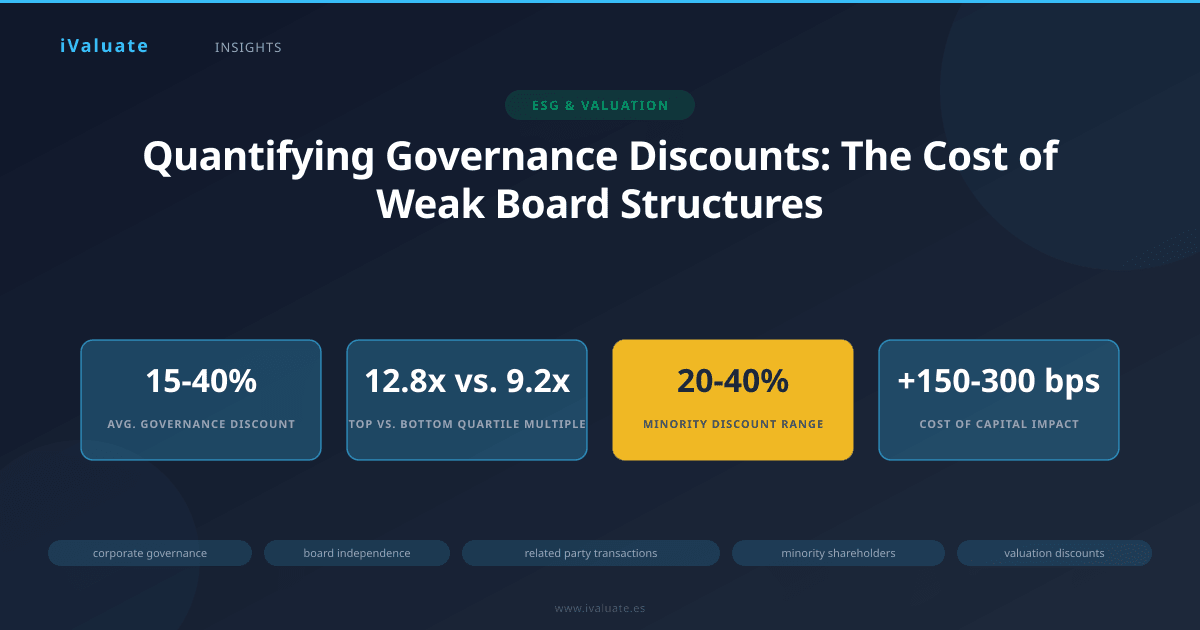
Recent empirical evidence demonstrates that companies with substandard governance frameworks trade at discounts ranging from 15% to 40% compared to peers with robust structures. These governance discounts reflect elevated agency costs, increased regulatory risk, reduced access to capital, and heightened probability of value-destructive decisions. For CFOs, board members, and M&A advisors, understanding how to quantify these discounts has become essential to accurate valuation work.
01 The Governance Premium: Defining the Valuation Gap
The governance premium represents the valuation differential between companies with strong governance practices and those with weak or opaque structures. This premium manifests across multiple valuation metrics—EV/EBITDA multiples, price-to-book ratios, and cost of capital—and persists across market cycles, though its magnitude varies with investor risk appetite.
In North American and Western European markets, where governance standards are relatively mature, the governance premium typically ranges from 10% to 25% for companies with demonstrably superior practices. However, in emerging markets and family-controlled businesses where governance challenges are more pronounced, this premium can exceed 40%. A 2024 study by the OECD Corporate Governance Committee found that companies in the top quartile of governance scores traded at an average EV/EBITDA multiple of 12.8x, compared to 9.2x for bottom-quartile firms—a 39% differential that persisted even after controlling for sector, size, and profitability.
This premium reflects several value drivers that strong governance enables:
- Lower cost of capital: Institutional investors demand 150-300 basis points less return from well-governed companies, reflecting reduced agency risk and information asymmetry
- Operational efficiency: Independent boards with relevant expertise make better strategic decisions, evidenced by 8-12% higher ROIC over five-year periods
- Reduced tail risk: Strong governance minimizes the probability of catastrophic events such as fraud, regulatory sanctions, or value-destructive M&A
- Enhanced market access: Well-governed companies secure better terms in debt and equity markets, with covenant-lite structures and lower spreads
02 Board Independence: The Foundation of Governance Quality
Board independence represents the single most significant governance factor affecting valuation. The presence of truly independent directors—those without material financial or personal relationships with management or controlling shareholders—serves as the primary check on agency problems and self-dealing.
Current market standards in developed economies call for boards to comprise at least 50% independent directors, with critical committees (audit, compensation, nominating) being entirely independent. However, the quality of independence matters as much as the quantity. A board populated with "independent" directors who lack relevant industry expertise, meet infrequently, or demonstrate patterns of rubber-stamping management proposals provides little actual oversight.
Quantitative research demonstrates clear valuation impacts from board independence levels:
- Companies with fewer than 30% independent directors trade at average discounts of 18-25% to sector peers
- Boards with 50-75% independence show no significant premium or discount relative to market
- Companies with 75%+ independence and demonstrated director engagement command premiums of 8-15%
The valuation impact intensifies in specific contexts. For companies undergoing ownership transitions, private equity exits, or cross-border M&A, board independence becomes a critical due diligence factor. In a 2025 survey of 200 institutional investors conducted by Governance Metrics International, 87% indicated they would apply valuation discounts of at least 15% to acquisition targets with boards dominated by insiders or affiliated directors.
Measuring True Independence
Sophisticated valuation practitioners look beyond simple independence percentages to assess the quality and effectiveness of board oversight. Key indicators include:
- Director tenure and refreshment: Boards with average tenures exceeding 15 years often develop problematic relationships with management, even if technically independent
- Meeting frequency and attendance: Boards meeting fewer than six times annually or showing attendance rates below 90% signal inadequate engagement
- Committee structure: Presence of independent risk, strategy, or ESG committees indicates sophisticated governance
- Executive session frequency: Regular meetings of independent directors without management present (quarterly minimum) demonstrate genuine oversight
When these qualitative factors are weak, valuation discounts should be applied even when independence percentages appear adequate. A company with 60% nominally independent directors who meet quarterly for two-hour sessions and have 12-year average tenures warrants a governance discount despite meeting basic independence thresholds.
03 Related Party Transactions: The Red Flag for Valuation Discounts
Related party transactions (RPTs) represent one of the most significant governance concerns in valuation analysis. These transactions—whether involving sales to affiliated entities, loans to executives, or asset transfers to controlling shareholders—create direct conflicts of interest and often result in value extraction from minority shareholders.
The prevalence and magnitude of RPTs directly correlate with valuation discounts. Research from the International Corporate Governance Network shows that companies with material RPTs (defined as exceeding 5% of revenues or assets) trade at average discounts of 22-35% compared to peers with minimal related party activity. This discount reflects both the direct value leakage from potentially non-arm's-length transactions and the signal that management prioritizes insider interests over shareholder value maximization.
In emerging markets where RPTs are endemic, the governance discount can approach 50%. A 2024 analysis of Southeast Asian family conglomerates found that companies with RPTs exceeding 15% of revenues traded at an average 47% discount to net asset value, compared to 8% discounts for companies with minimal related party activity.
Valuation Adjustments for Related Party Transactions
When valuing companies with significant RPTs, practitioners should implement several analytical adjustments:
Transaction Normalization: Adjust historical financial statements to reflect arm's-length pricing for related party transactions. This typically involves benchmarking against comparable third-party transactions or applying transfer pricing methodologies. For example, if a company purchases raw materials from a controlling shareholder affiliate at prices 15% above market rates, EBITDA should be adjusted upward to reflect normalized costs.
Discount Rate Adjustments: Increase the weighted average cost of capital (WACC) by 200-400 basis points for companies with material RPTs to reflect elevated agency risk. The specific adjustment should scale with RPT magnitude and the adequacy of approval processes. Companies with robust RPT approval procedures (independent committee review, fairness opinions, minority shareholder approval) warrant smaller adjustments than those with opaque processes.
Multiple Compression: Apply valuation multiples from the lower quartile of comparable companies rather than median multiples. If sector peers trade at 10-14x EBITDA, companies with significant RPTs should be valued at 9-10x absent other compelling factors.
Explicit Discount Application: In control transactions or fairness opinions, apply an explicit governance discount of 15-30% to reflect RPT concerns. This discount should be clearly articulated and supported by comparable transaction analysis.
Case Study: Family Conglomerate Valuation
Consider a mid-market manufacturing company with €250 million in revenues, owned 65% by the founding family. The company purchases logistics services from a family-owned trucking company at €8 million annually—approximately 15% above market rates based on third-party benchmarking. Additionally, the company has made interest-free loans totaling €12 million to family members, representing 8% of total assets.
In a standard DCF analysis, the company might appear to justify an enterprise value of €180 million based on normalized EBITDA of €30 million and a 6.0x multiple. However, proper governance adjustments would include:
- EBITDA adjustment: +€1.2 million to reflect market-rate logistics costs
- Balance sheet adjustment: -€12 million for non-productive loans to related parties
- WACC increase: +300 basis points (from 9% to 12%) to reflect governance risk
- Multiple compression: From 6.0x to 5.2x to reflect RPT concerns
After these adjustments, the supportable enterprise value falls to approximately €150 million—a 17% governance discount from the unadjusted valuation. This discount directly reflects the value destruction from related party transactions and the elevated risk they represent.
04 Minority Protection Mechanisms and Their Valuation Impact
For companies with controlling shareholders—whether family owners, private equity sponsors, or government entities—the strength of minority shareholder protections significantly affects valuation. These protections determine whether minority investors can expect fair treatment or face systematic value extraction by controlling parties.
Effective minority protection mechanisms include:
- Supermajority voting requirements: Requiring 75-80% approval for major decisions (M&A, related party transactions, charter amendments) gives minorities effective veto rights
- Independent director approval: Requiring majority-of-minority or independent director approval for conflict transactions
- Tag-along rights: Allowing minority shareholders to participate in control sales at the same price and terms
- Put rights: Providing minorities with liquidity options at fair value in specified circumstances
- Appraisal rights: Enabling dissenting shareholders to demand independent valuation and buyout
- Transparent disclosure: Regular, detailed reporting on related party transactions and conflicts of interest
The absence of these protections creates what valuation practitioners term the "minority discount"—the reduction in per-share value reflecting the vulnerability of minority positions. This discount typically ranges from 20% to 40% of pro-rata value, depending on the severity of governance concerns and the jurisdiction's legal protections.
Quantifying the Minority Discount
Several methodologies exist for quantifying minority discounts in valuation work:
Market Evidence Approach: Analyze pricing differentials between controlling and non-controlling stakes in comparable companies. In markets with dual-class share structures, the premium paid for voting shares over non-voting shares provides direct evidence of control value. Recent data from European markets shows voting share premiums averaging 15-25% for well-governed companies but exceeding 40% for companies with weak minority protections.
Transaction Analysis: Compare prices paid in control transactions versus minority stake purchases for similar companies. A 2025 analysis of middle-market private equity transactions found that minority investments were priced at average discounts of 28% compared to control acquisitions, after adjusting for timing and company performance.
Discounted Cash Flow Adjustment: Model the expected value extraction from minorities over the investment horizon and discount this leakage at an appropriate risk-adjusted rate. For example, if a controlling shareholder is expected to extract 3% of company value annually through RPTs or dilutive transactions, and the minority investor has a 7-year expected hold period, the present value of this extraction at a 12% discount rate represents a 14% reduction in minority stake value.
The minority discount becomes particularly acute in jurisdictions with weak legal protections for shareholders. In a 2024 study of emerging market valuations, companies domiciled in countries with below-median shareholder protection scores (based on World Bank Doing Business indicators) traded at average discounts of 35% compared to companies in strong-protection jurisdictions, even after controlling for all other factors.
05 Governance Due Diligence in M&A: Identifying Discount Factors
For M&A practitioners and private equity investors, governance due diligence has evolved from a compliance checkbox to a critical value assessment tool. Identifying governance weaknesses during due diligence allows buyers to quantify appropriate valuation discounts and structure deals that reflect true risk-adjusted value.
A comprehensive governance due diligence process should examine:
Board Effectiveness Assessment
- Review of board composition, independence, and expertise relative to company needs
- Analysis of board and committee meeting minutes to assess engagement quality
- Director questionnaires to identify potential conflicts and assess time commitment
- Evaluation of board evaluation processes and director education programs
- Assessment of management succession planning and executive development
Related Party Transaction Analysis
- Complete inventory of all RPTs over the prior three years, including immaterial transactions
- Benchmarking of RPT pricing against market comparables
- Review of RPT approval processes and documentation
- Analysis of ongoing commitments and contingent liabilities involving related parties
- Assessment of business rationale for RPTs and availability of third-party alternatives
Shareholder Rights Review
- Analysis of charter provisions, shareholder agreements, and voting structures
- Assessment of minority protection mechanisms and their enforceability
- Review of historical shareholder treatment in dividends, capital raises, and transactions
- Evaluation of disclosure practices and transparency
- Assessment of dispute resolution mechanisms and their track record
Findings from this due diligence directly inform valuation adjustments. Material governance weaknesses should trigger explicit discounts in the valuation analysis, with clear documentation of the rationale and magnitude of each adjustment.
06 Industry-Specific Governance Considerations
Governance concerns and their valuation impacts vary significantly across industries. Certain sectors face heightened governance risks that warrant additional scrutiny and potentially larger discounts.
Financial Services
Banks, insurers, and asset managers face unique governance challenges given their fiduciary responsibilities and regulatory oversight. Weak governance in financial institutions can result in catastrophic losses, as demonstrated repeatedly in financial crises. Key concerns include risk committee effectiveness, related party lending, and conflicts of interest in investment decisions. Governance discounts in financial services typically range from 20-35% for institutions with identified weaknesses.
Family-Controlled Businesses
Family businesses represent the most common context for governance discounts globally. While family ownership can provide long-term orientation and patient capital, it often comes with nepotistic hiring, related party transactions, and weak minority protections. The governance discount for family businesses averages 25-30% but can exceed 50% for companies with multiple generations of family members in management roles and minimal independent oversight.
State-Owned Enterprises
Government-controlled companies face distinct governance challenges including political interference, non-commercial objectives, and weak accountability. These concerns typically result in valuation discounts of 30-45% compared to private sector peers, reflecting both governance issues and the uncertainty around government policy changes.
07 Improving Governance to Reduce Valuation Discounts
For companies seeking to maximize value—whether preparing for a sale, raising capital, or simply optimizing shareholder returns—improving governance structures offers one of the highest-return investments available. The valuation impact of governance improvements can be substantial and relatively quick to realize.
Priority governance enhancements include:
- Board reconstitution: Adding genuinely independent directors with relevant expertise and demonstrated engagement. The optimal board size for most companies is 5-9 directors, with 60-75% independence.
- RPT elimination or restructuring: Terminating unnecessary related party relationships and ensuring remaining transactions are at arm's length with robust approval processes.
- Minority protection adoption: Implementing tag-along rights, independent director approval requirements, and transparent disclosure practices.
- Committee structure enhancement: Establishing fully independent audit, compensation, and nominating committees with clear charters and regular meetings.
- Governance documentation: Adopting comprehensive governance policies covering conflicts of interest, whistleblower protection, and related party transactions.
The valuation impact of these improvements can be dramatic. A 2025 study tracking companies that implemented comprehensive governance reforms found average valuation multiple expansion of 18% over 24 months, even absent improvements in underlying financial performance. For a mid-market company valued at €100 million, this represents €18 million in value creation from governance improvements alone.
08 Regulatory Developments and Future Trends
The governance landscape continues to evolve rapidly, with regulatory developments in 2025-2026 further emphasizing the importance of strong structures. The European Union's revised Shareholder Rights Directive II implementation has strengthened related party transaction requirements across member states, while the UK Corporate Governance Code 2024 revision increased expectations for board diversity and stakeholder engagement.
In the United States, the SEC's 2024 final rules on board diversity disclosure and cybersecurity governance have raised the bar for public company governance. Private companies increasingly face similar expectations from institutional investors and lenders, who apply public company governance standards in their investment decisions.
Looking forward, several trends will likely increase the valuation significance of governance quality:
- ESG integration: Governance represents the "G" in ESG, and as ESG factors become more central to investment decisions, governance quality will command increasing premiums.
- Stakeholder capitalism: Boards are increasingly expected to consider broader stakeholder interests, requiring more sophisticated governance structures.
- Technology governance: Cybersecurity, AI ethics, and data privacy require board-level expertise and oversight, creating new dimensions of governance quality.
- Activism and engagement: Institutional investors are becoming more active in pushing for governance improvements, making weak structures increasingly untenable.
09 Practical Application: Building Governance Adjustments into Valuation Models
For valuation practitioners, the challenge lies in systematically incorporating governance quality into valuation models. While the conceptual case for governance adjustments is clear, implementation requires structured methodologies that produce defensible, consistent results.
A practical framework for governance adjustments includes:
Step 1: Governance Assessment Scorecard
Develop a quantitative scorecard evaluating key governance dimensions: board independence (0-25 points), related party transactions (0-25 points), minority protections (0-25 points), and disclosure quality (0-25 points). Companies scoring 75+ points warrant no discount; 50-75 points suggest 10-20% discounts; below 50 points indicate 20-40% discounts.
Step 2: Peer Benchmarking
Compare the subject company's governance profile against relevant peers and transaction comparables. Identify the valuation differential between strong and weak governance companies in the peer set.
Step 3: Risk-Adjusted Discount Rate
Increase WACC by 50-100 basis points for each major governance weakness (non-independent board, material RPTs, weak minority protections). This approach captures governance risk in the discount rate rather than terminal value.
Step 4: Multiple Adjustment
Apply valuation multiples from the lower quartile of comparables for companies with significant governance concerns, or apply explicit percentage discounts to multiples derived from median comparables.
Step 5: Sensitivity Analysis
Model valuation outcomes under different governance scenarios to demonstrate the value impact of potential improvements or deterioration.
These adjustments should be clearly documented in valuation reports, with explicit linkage between identified governance weaknesses and the magnitude of discounts applied. This transparency allows clients and stakeholders to understand the valuation impact and potentially address governance concerns to enhance value.
10 Conclusion: Governance as a Value Driver in Modern Valuation
The evidence is unequivocal: governance quality represents a material value driver that must be explicitly addressed in rigorous valuation work. Companies with weak board structures, problematic related party transactions, and inadequate minority protections trade at persistent, quantifiable discounts ranging from 15% to 40% compared to well-governed peers. These discounts reflect real economic costs—elevated agency risk, reduced operational efficiency, limited market access, and increased probability of value destruction.
For CFOs and board members, improving governance structures offers one of the highest-return investments available, with valuation impacts often exceeding those from operational improvements. For M&A advisors and private equity investors, rigorous governance due diligence and appropriate valuation adjustments protect against overpayment and identify value creation opportunities.
As markets continue to evolve in 2025 and beyond, governance quality will only increase in importance. Institutional investors, regulators, and other stakeholders are demanding higher standards, and companies that fail to meet these expectations will face growing valuation penalties. Conversely, companies that embrace governance excellence will benefit from lower costs of capital, enhanced strategic flexibility, and premium valuations.
For valuation professionals seeking to incorporate these governance considerations systematically into their work, modern analytical platforms like iValuate provide the tools to efficiently assess governance quality, benchmark against peers, and quantify appropriate valuation adjustments. As governance continues to evolve from a compliance concern to a core value driver, the ability to rigorously analyze and quantify its impact will increasingly separate sophisticated valuation practitioners from those relying on outdated methodologies.