Table of Contents9 sections
In the current economic environment of 2025-2026, characterized by elevated interest rates, compressed multiples, and heightened scrutiny from lenders and investors, operational restructuring has emerged as the primary value creation lever for distressed companies. Unlike financial engineering or strategic repositioning, operational turnarounds focus on fundamental business improvements that directly impact cash generation and enterprise value.
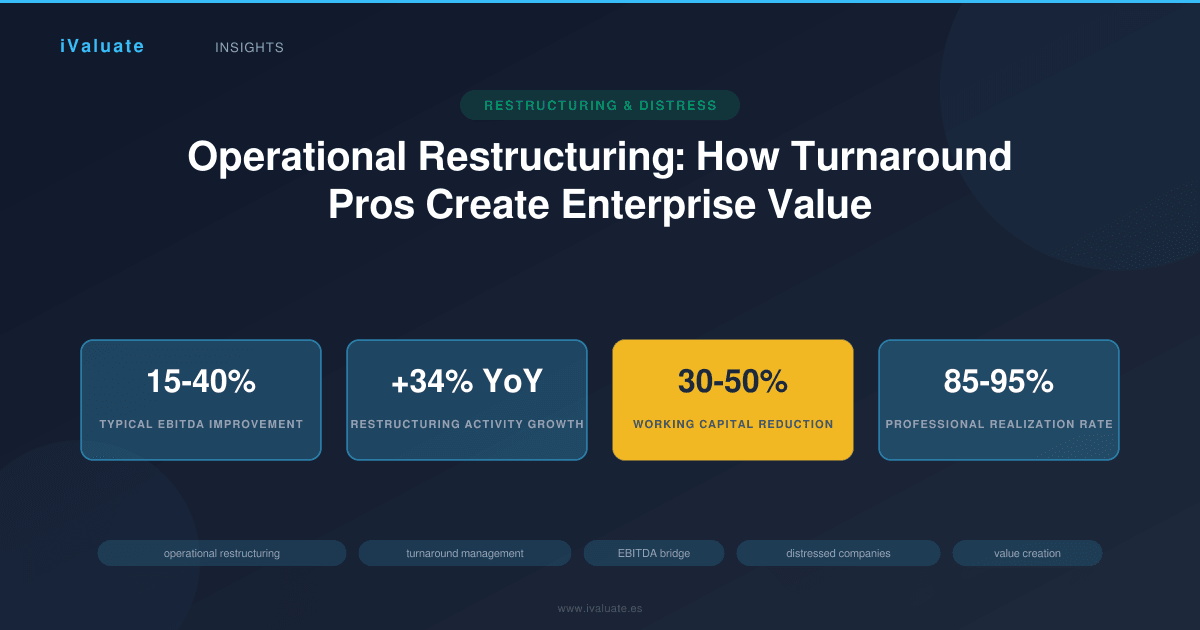
The data tells a compelling story: companies that successfully execute operational restructuring programs typically achieve EBITDA improvements of 15-40% within 12-18 months, with the most sophisticated turnaround professionals consistently delivering results at the upper end of this range. These improvements translate directly to enterprise value, with each dollar of sustainable EBITDA improvement worth 4-8x in valuation terms, depending on industry and market conditions.
01 The Economic Imperative for Operational Restructuring
The macroeconomic backdrop of 2025-2026 has created unprecedented pressure on middle-market companies. With the Federal Reserve maintaining benchmark rates in the 4.5-5.0% range and credit spreads widening across most sectors, the cost of capital has increased dramatically. Companies that could previously refinance their way through operational challenges now face a stark reality: improve operations or face insolvency.
This environment has driven a significant increase in restructuring activity. According to recent data, operational restructuring engagements increased 34% year-over-year in 2025, with particular concentration in sectors facing structural headwinds such as retail, manufacturing, and commercial real estate services. The median EBITDA margin for companies entering restructuring was just 3.2%, compared to industry averages of 12-15%, highlighting the severity of operational dysfunction in distressed situations.
Key Insight: The shift from financial to operational restructuring reflects a fundamental change in the distressed landscape. With limited refinancing options and covenant-lite structures largely exhausted, value creation must come from business fundamentals rather than capital structure optimization.
02 The Operational Restructuring Framework
Professional turnaround specialists employ a systematic methodology that has been refined over decades of crisis management. This framework typically encompasses five core dimensions, each with specific diagnostic tools, intervention strategies, and value creation mechanisms.
Revenue Stabilization and Enhancement
Contrary to popular perception, operational restructuring is not exclusively about cost reduction. The first priority in any turnaround is stabilizing and, where possible, enhancing revenue. Companies in distress often experience accelerating revenue decline as customers, suppliers, and employees lose confidence. Breaking this negative momentum requires immediate, visible action.
Turnaround professionals typically implement rapid revenue diagnostics that segment customers by profitability, payment behavior, and strategic importance. This analysis frequently reveals that 15-25% of revenue is actually value-destructive when fully loaded costs and working capital requirements are considered. Simultaneously, high-value customer relationships may be at risk due to service failures or competitive pressure.
A representative case from 2025 involved a specialty chemicals distributor with $180 million in revenue and negative EBITDA of $4.2 million. Customer profitability analysis revealed that the bottom 30% of customers (by revenue) generated 42% of accounts receivable but only 18% of gross profit. By implementing minimum order quantities, eliminating unprofitable SKUs, and redeploying sales resources to high-value accounts, the company increased revenue per customer by 23% while reducing total revenue by just 8%. More importantly, this strategic revenue reduction improved EBITDA by $8.7 million within six months.
Cost Structure Transformation
While revenue stabilization provides the foundation, cost structure transformation typically delivers the largest and most immediate EBITDA impact. The key distinction between amateur and professional cost reduction is sustainability: cutting costs that return within 6-12 months creates no lasting value and may accelerate decline.
Professional turnaround specialists utilize detailed cost benchmarking against industry peers and best-in-class operators. This analysis typically reveals that distressed companies operate with cost structures 20-35% above efficient peers, with the excess distributed across multiple categories rather than concentrated in a single area.
The most impactful cost categories, in order of typical value creation, include:
- Labor costs: Representing 40-60% of operating expenses in most businesses, labor optimization through span-of-control analysis, organizational redesign, and productivity improvement typically yields 15-25% reduction in labor cost per unit of output
- Procurement and materials: Distressed companies often have fragmented purchasing, poor supplier management, and inadequate specifications. Systematic procurement transformation delivers 8-15% savings on addressable spend
- Occupancy and facilities: Real estate footprint optimization, including facility consolidation and lease renegotiation, can reduce occupancy costs by 20-40%
- Discretionary spending: Travel, professional services, marketing, and other discretionary categories often represent 10-15% of costs and can be reduced by 30-50% without operational impact
The critical success factor is implementing these reductions through a structured program with clear accountability, weekly tracking, and rapid course correction. Companies that approach cost reduction as a one-time exercise rather than a managed program typically capture only 40-60% of identified opportunities.
Working Capital Optimization
Working capital represents one of the most overlooked value creation opportunities in operational restructuring. Many distressed companies have working capital levels 30-50% above industry norms, effectively trapping cash that could be used to fund operations, reduce debt, or invest in growth.
The three components of working capital—inventory, accounts receivable, and accounts payable—each require distinct intervention strategies:
Inventory optimization begins with SKU rationalization and demand forecasting improvement. Distressed companies typically carry 25-40% obsolete or slow-moving inventory. Aggressive liquidation of this inventory, even at substantial discounts, generates immediate cash and reduces carrying costs. Simultaneously, implementing more sophisticated inventory management systems and processes can reduce ongoing inventory requirements by 20-30%.
Accounts receivable management in distressed situations requires balancing aggressive collection with customer relationship preservation. The key is segmentation: high-value strategic customers may warrant payment flexibility, while marginal customers should face strict terms and rapid escalation. Professional turnaround teams typically reduce DSO (days sales outstanding) by 8-15 days within 90 days of engagement.
Accounts payable extension is perhaps the most delicate aspect of working capital management. While extending payment terms generates cash, aggressive extension can trigger supplier credit holds that disrupt operations. The optimal approach involves transparent communication with strategic suppliers, offering them visibility into the restructuring plan and, where necessary, negotiating extended terms in exchange for continued business or volume commitments.
A 2025 case study illustrates the power of working capital optimization: a $240 million industrial services company reduced working capital from 22% of revenue to 14% within six months, generating $19.2 million in cash. This cash infusion eliminated the need for a distressed debt raise and provided runway for operational improvements to take effect.
03 The EBITDA Bridge: Quantifying Value Creation
The EBITDA bridge is the primary analytical tool turnaround professionals use to plan, track, and communicate value creation. This waterfall analysis starts with baseline EBITDA and shows the incremental impact of each operational initiative, building to a target EBITDA that reflects the company's stabilized earning power.
A typical EBITDA bridge for an operational restructuring might include:
- Baseline EBITDA: $8.5 million (current run-rate)
- Revenue optimization: +$2.8 million (price realization, customer mix improvement, elimination of value-destructive revenue)
- Labor productivity: +$5.2 million (organizational redesign, span-of-control improvement, productivity enhancement)
- Procurement savings: +$3.1 million (supplier consolidation, specification optimization, strategic sourcing)
- Facility optimization: +$1.8 million (consolidation, lease renegotiation, utilization improvement)
- Discretionary spend reduction: +$1.4 million (travel, professional services, marketing optimization)
- Other operational improvements: +$0.9 million (various smaller initiatives)
- Target EBITDA: $23.7 million (stabilized run-rate)
This represents a 179% improvement in EBITDA, or $15.2 million in absolute terms. At a conservative 5.5x EBITDA multiple, this operational improvement creates $83.6 million in enterprise value. The EBITDA bridge serves multiple purposes: it provides a roadmap for the turnaround team, creates accountability for initiative owners, enables weekly progress tracking, and communicates value creation to lenders, investors, and other stakeholders.
Critical Success Factor: The EBITDA bridge must be conservative, achievable, and supported by detailed initiative plans. Overly aggressive bridges that fail to materialize destroy credibility and can trigger covenant violations or liquidity crises.
Tracking and Reporting Mechanisms
Professional turnaround engagements implement rigorous tracking and reporting mechanisms that provide real-time visibility into progress. Weekly EBITDA bridge updates show actual results versus plan for each initiative, with variance explanations and corrective actions. This discipline ensures that underperforming initiatives are identified and addressed quickly, while successful initiatives can be accelerated or expanded.
Leading turnaround firms typically achieve 85-95% realization of planned EBITDA improvements, compared to 50-70% for companies attempting restructuring without professional guidance. This difference reflects both superior planning and more effective execution management.
04 Organizational and Cultural Transformation
While financial metrics provide the scorecard, sustainable operational improvement requires fundamental organizational and cultural change. Distressed companies typically suffer from decision-making paralysis, accountability gaps, and a culture of excuse-making rather than problem-solving.
Turnaround professionals address these issues through several mechanisms:
Leadership and Governance
Many operational restructurings involve leadership changes, either at the CEO level or within the senior management team. The decision to replace leadership is based on capability assessment: does the existing team have the skills, experience, and mindset to execute a turnaround? In approximately 60% of cases, at least one C-suite change occurs during the first 90 days of a restructuring engagement.
Equally important is governance structure. Turnaround situations require rapid decision-making and clear accountability. Professional restructuring advisors typically implement a "war room" governance model with daily operational meetings, weekly executive committee reviews, and bi-weekly board updates. This cadence ensures that issues are identified and resolved quickly, before they cascade into larger problems.
Performance Management Systems
Distressed companies often lack basic performance management infrastructure. Implementing daily or weekly KPI tracking, visible performance dashboards, and clear accountability for results creates transparency and drives behavior change. The specific metrics vary by industry and situation, but typically include operational metrics (units per labor hour, on-time delivery, quality metrics), financial metrics (daily cash, weekly EBITDA, working capital), and initiative-specific metrics (savings realized, customers contacted, inventory reduced).
Communication and Change Management
Effective communication is essential for turnaround success. Employees, customers, suppliers, and lenders all need to understand the situation, the plan, and their role in the solution. Turnaround professionals typically implement structured communication programs with weekly all-hands meetings, regular customer and supplier updates, and transparent lender reporting.
The tone of communication matters enormously. Successful turnarounds balance urgency with optimism, acknowledging challenges while emphasizing the path forward. Companies that communicate effectively retain key employees and maintain customer and supplier confidence, while those that communicate poorly experience accelerating attrition and relationship deterioration.
05 Industry-Specific Considerations
While the core principles of operational restructuring apply across industries, specific sectors present unique challenges and opportunities.
Manufacturing and Distribution
Manufacturing companies in distress typically face capacity utilization issues, with plants operating at 45-65% of capacity. The temptation is to close facilities, but this often destroys customer relationships and creates stranded overhead. More sophisticated approaches involve product line rationalization, customer segmentation, and strategic facility consolidation that maintains service levels while improving utilization and reducing costs.
Distribution businesses face working capital intensity and thin margins. Successful restructurings focus on SKU rationalization (reducing the number of products carried), customer profitability management, and warehouse optimization. A 2025 case involved a specialty distributor that reduced SKUs by 38%, improved inventory turns from 4.2x to 6.8x, and increased EBITDA margin from 2.1% to 7.3%.
Business Services
Service businesses are fundamentally people businesses, making labor productivity the primary value creation lever. Span-of-control analysis typically reveals that distressed service companies have 30-40% more management layers than efficient peers. Organizational flattening, combined with technology enablement and process standardization, can improve labor productivity by 25-40%.
Retail and Consumer
Retail restructurings in 2025-2026 face the dual challenge of secular decline (continued shift to e-commerce) and cyclical pressure (reduced consumer spending). Successful retail turnarounds require brutal honesty about store-level economics, rapid closure of value-destructive locations, and investment in omnichannel capabilities. The key metric is four-wall EBITDA by location; stores that don't cover their direct costs must be closed, regardless of historical significance or emotional attachment.
06 The Role of Technology and Data Analytics
Modern operational restructuring increasingly leverages advanced analytics and technology tools. While distressed companies often lack sophisticated systems, turnaround professionals bring analytical capabilities that provide insights impossible to achieve through traditional methods.
Machine learning algorithms can identify patterns in customer behavior, predict payment default risk, and optimize pricing strategies. Process mining tools analyze transaction data to identify inefficiencies and automation opportunities. Advanced forecasting models improve inventory management and production planning.
The investment in these capabilities pays dividends: companies that employ advanced analytics in their restructuring achieve 20-30% better outcomes than those relying solely on traditional methods. However, the key is pragmatism—implementing tools that deliver rapid value rather than pursuing technology for its own sake.
07 Valuation Implications of Operational Restructuring
From a valuation perspective, operational restructuring creates value through multiple mechanisms. The most obvious is increased EBITDA, which directly increases enterprise value through the applicable multiple. However, successful operational restructuring also improves valuation multiples by reducing business risk, improving cash conversion, and demonstrating management capability.
Consider a company with $10 million in baseline EBITDA trading at 4.5x (reflecting distress and execution risk). Through operational restructuring, EBITDA increases to $18 million, and the multiple expands to 6.5x as the business stabilizes and risk decreases. Enterprise value increases from $45 million to $117 million—a 160% improvement driven by both EBITDA growth and multiple expansion.
The cash flow implications are equally important. Operational restructuring typically improves cash conversion (EBITDA to free cash flow) from 30-50% to 70-85% through working capital optimization and reduced capital intensity. This improved cash generation supports debt reduction, provides flexibility for strategic investment, and further enhances valuation.
08 Common Pitfalls and How to Avoid Them
Despite the proven value creation potential, many operational restructurings fail to achieve their objectives. The most common pitfalls include:
- Insufficient urgency: Treating restructuring as a gradual improvement program rather than a crisis response. Successful turnarounds operate with extreme urgency, implementing changes in weeks rather than months
- Inadequate cost reduction: Cutting 10-15% when 25-35% is required. This "salami slicing" approach fails to stabilize the business and often necessitates multiple rounds of cuts that destroy morale and credibility
- Poor execution management: Developing excellent plans but failing to implement them effectively. Execution requires dedicated resources, clear accountability, and relentless follow-up
- Neglecting revenue: Focusing exclusively on cost reduction while revenue continues to decline. Sustainable turnarounds stabilize revenue before optimizing costs
- Communication failures: Leaving stakeholders uncertain about the plan and their role. Effective communication is not optional—it's essential for turnaround success
09 The Path Forward: Building Sustainable Value
As we progress through 2025-2026, the importance of operational excellence has never been greater. Companies that master operational restructuring principles—whether in distress or simply seeking to improve performance—will create substantial value for stakeholders. The most successful organizations view operational improvement not as a one-time crisis response but as a continuous discipline embedded in their culture and management systems.
For CFOs, board members, and business owners facing operational challenges, the message is clear: early intervention with professional expertise delivers dramatically better outcomes than delayed action. The difference between a successful turnaround and a liquidation often comes down to timing and execution quality.
Professional platforms and tools have emerged to support this work, enabling turnaround specialists and corporate leaders to perform sophisticated analyses, track initiatives, and quantify value creation with unprecedented precision. Solutions like iValuate provide the analytical infrastructure to model restructuring scenarios, build EBITDA bridges, and communicate value creation to stakeholders—transforming what was once an art into a rigorous, data-driven discipline.
The companies that emerge from operational restructuring are fundamentally stronger: leaner cost structures, better working capital management, clearer strategic focus, and more disciplined management systems. These improvements create lasting competitive advantage and position companies for sustainable growth when market conditions improve. In an environment where capital is expensive and margins are compressed, operational excellence is not just a turnaround tool—it's the foundation of enduring enterprise value.