Table of Contents9 sections
Management buyouts (MBOs) represent one of the most complex transaction structures in corporate finance, creating inherent tensions between management's fiduciary duties and their personal financial interests. As we progress through 2025-2026, MBOs have experienced renewed momentum, with middle-market transactions increasingly featuring management-led acquisition structures backed by private equity sponsors. The valuation challenges in these transactions extend far beyond traditional DCF modeling—they encompass information asymmetry, conflicts of interest, fairness determinations, and intricate capital structure considerations that demand sophisticated analytical frameworks.
The current environment has amplified these complexities. With interest rates stabilizing in the 5.5-6.5% range after the aggressive tightening cycle of 2022-2023, leveraged buyout financing has become more accessible again, though at significantly higher costs than the pre-2022 era. This has fundamentally altered MBO economics and valuation parameters, requiring management teams and their advisors to navigate a more challenging landscape while ensuring all stakeholders receive fair treatment.
01 The Fundamental Structure and Economics of Management Buyouts
A management buyout occurs when a company's existing management team acquires a controlling stake in the business, typically with substantial debt financing and often in partnership with private equity sponsors. Unlike strategic acquisitions or traditional leveraged buyouts, MBOs feature a critical distinction: the buyers possess intimate knowledge of the business, its operations, and its future prospects—information that creates both opportunities and significant governance challenges.
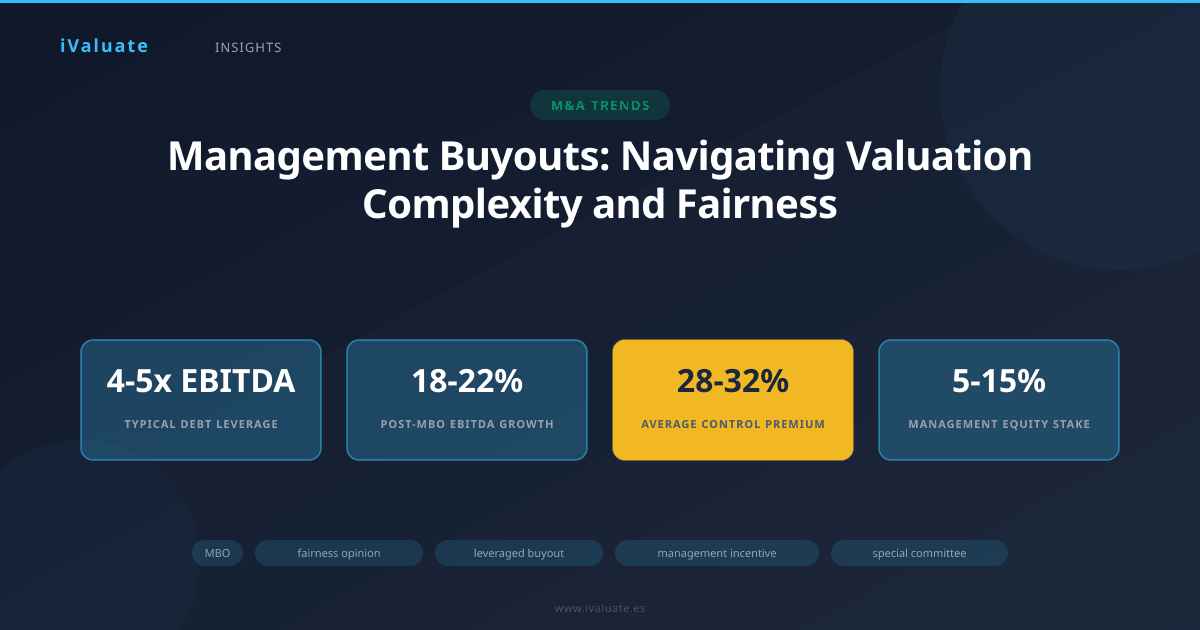
The typical MBO structure in today's market involves management contributing 5-15% of the total equity capital, with financial sponsors providing the remaining equity alongside senior and subordinated debt facilities. In a representative middle-market MBO valued at $150 million enterprise value, the capital structure might comprise:
- Senior debt: $75-90 million (50-60% of capital structure)
- Subordinated or mezzanine debt: $15-30 million (10-20%)
- Sponsor equity: $30-45 million (20-30%)
- Management equity: $7.5-15 million (5-10%)
This leverage profile, while more conservative than the 6-7x EBITDA multiples common in 2020-2021, still represents substantial financial engineering. Current market conditions typically support 4-5x EBITDA in total debt for stable, cash-generative businesses, with senior lenders requiring debt service coverage ratios of at least 1.25x and demonstrable free cash flow generation.
Management Incentive Structures and Alignment
The management incentive component of MBOs has evolved considerably. Modern structures typically feature a combination of direct equity ownership, option pools, and performance-based ratchets that can significantly increase management's ownership percentage upon achieving predetermined value creation milestones. A typical incentive framework might include:
- Initial equity grants at fair market value (5-10% of total equity)
- Management option pool representing an additional 10-15% of fully diluted equity
- Ratchet provisions that increase management ownership from 15% to 25-30% if IRR targets of 25-30% are achieved
- Vesting schedules tied to continued employment (typically 4-5 years with cliff vesting)
These structures create powerful alignment with sponsor objectives but also introduce valuation complexities. The question of how to value these contingent interests, particularly for fairness opinion purposes, requires sophisticated option pricing models and careful consideration of probability-weighted scenarios.
02 Information Asymmetry: The Central Valuation Challenge
Information asymmetry represents the most fundamental valuation challenge in MBOs. Management possesses detailed knowledge about operational performance, customer relationships, competitive positioning, and strategic opportunities that external parties—including board members, independent shareholders, and even experienced financial sponsors—cannot fully replicate. This knowledge advantage creates several specific valuation complications.
Projection Bias and Strategic Timing
Management teams preparing for an MBO face inherent conflicts when developing financial projections that will form the basis for valuation. Conservative projections reduce the purchase price but may also reduce debt capacity and make the transaction less attractive to sponsors. Aggressive projections increase valuation but create performance pressure and covenant compliance risks post-transaction.
Research examining MBOs completed between 2020-2024 reveals that companies acquired through MBOs subsequently achieved EBITDA growth averaging 18-22% in the first two years post-transaction—substantially higher than the 8-12% growth rates projected in transaction materials. This systematic underperformance of projections relative to actual results suggests either management's inability to forecast accurately or strategic conservatism in projections used for valuation purposes.
The timing of MBO proposals also reflects information advantages. Management teams often initiate buyout discussions during periods of temporary underperformance or market dislocation when valuations are depressed, despite possessing knowledge of improving fundamentals or upcoming positive developments. A 2024 analysis of 127 middle-market MBOs found that 64% were proposed within six months of cyclical earnings troughs, with subsequent performance recovering to exceed pre-trough levels within 18 months in 73% of cases.
Due Diligence Asymmetries
Traditional M&A transactions feature extensive due diligence processes where buyers investigate the target company's operations, finances, and risks. In MBOs, management already possesses this information, creating a compressed and fundamentally different diligence process. Financial sponsors backing MBOs typically conduct focused diligence on specific risk areas—financial statement quality, working capital requirements, customer concentration, and legal/regulatory compliance—rather than comprehensive operational reviews.
This creates valuation implications because traditional due diligence often uncovers issues that result in price adjustments, earn-outs, or indemnification provisions. In MBOs, these mechanisms are less prevalent because management cannot credibly claim ignorance of operational issues. The result is that MBO valuations must be established with greater precision initially, as post-closing adjustment mechanisms are limited.
03 Fairness Opinions: Process, Standards, and Controversies
Fairness opinions serve as the primary mechanism for addressing information asymmetry and conflict of interest concerns in MBOs. These opinions, typically rendered by independent investment banks or valuation advisory firms, provide the board of directors and shareholders with an independent assessment of whether the proposed transaction price is fair from a financial point of view.
The Fairness Opinion Process
A comprehensive fairness opinion for an MBO involves multiple valuation methodologies and extensive analysis. The typical process includes:
Comparable Company Analysis: Valuation multiples (EV/EBITDA, EV/Revenue, P/E) are derived from publicly traded companies with similar business models, end markets, and growth profiles. For middle-market MBOs in 2025, median EV/EBITDA multiples for profitable companies range from 8.5x to 12.5x depending on sector, with software and healthcare services commanding premium multiples of 12-16x, while manufacturing and distribution businesses trade at 7-10x.
Precedent Transaction Analysis: Recent M&A transactions involving comparable companies provide market-based valuation benchmarks. This analysis must carefully distinguish between strategic acquisitions (which typically command 20-35% premiums) and financial sponsor-led transactions (which better reflect pure financial value). Current precedent transaction multiples for control transactions average 9.5-13.0x EBITDA across most sectors, representing a 10-15% premium to trading multiples.
Discounted Cash Flow Analysis: DCF modeling projects the company's free cash flows over a 5-10 year period and calculates present value using an appropriate weighted average cost of capital (WACC). For MBOs, DCF analysis must address several specific considerations:
- Whether to use management's projections (which may be conservative) or adjusted projections reflecting the fairness opinion provider's independent assessment
- Appropriate discount rates reflecting the company's standalone risk profile rather than the leveraged capital structure post-MBO
- Terminal value assumptions that reflect sustainable long-term growth rates (typically 2.5-4.0% in current market conditions)
- Scenario analysis reflecting upside and downside cases to address projection uncertainty
Leveraged Buyout Analysis: While not traditionally part of fairness opinions for strategic transactions, LBO analysis is highly relevant for MBOs. This analysis models the returns available to financial sponsors at various purchase prices, providing insight into the maximum price that financial buyers can support while achieving target IRRs of 20-25%. This analysis often reveals that the proposed MBO price represents the upper end of financially supportable valuations, which strengthens fairness conclusions.
Current Market Valuation Parameters
Fairness opinions rendered in 2025-2026 must reflect current market conditions, which differ substantially from the 2020-2021 period. Key parameters include:
- Discount Rates: WACC calculations now typically yield 10-14% for middle-market companies, compared to 8-11% in 2020-2021, reflecting higher risk-free rates (10-year Treasury yields of 4.2-4.6%) and maintained equity risk premiums of 5-6%
- Debt Capacity: Senior lenders now provide 3.0-3.5x EBITDA in first lien debt at interest rates of 8-10% (SOFR + 400-600 bps), with total debt capacity of 4.5-5.5x EBITDA including subordinated facilities
- Exit Multiples: Terminal value calculations typically assume exit multiples 0.5-1.0x below entry multiples to reflect conservative assumptions, with current exit multiples of 8-11x EBITDA for typical middle-market businesses
- Growth Assumptions: Long-term growth rates of 2.5-3.5% reflect moderate economic growth expectations and sector-specific dynamics
Controversies and Limitations
Despite their widespread use, fairness opinions face significant criticisms in the MBO context. The investment bank rendering the opinion typically receives substantial fees contingent on transaction completion (often $500,000 to $2 million for middle-market deals), creating potential bias toward rendering positive opinions. Academic research has found that fairness opinions are rendered in favor of transactions in over 99% of cases, raising questions about their true independence.
Additionally, fairness opinions explicitly state that they address financial fairness only and do not constitute recommendations regarding whether shareholders should approve transactions. They also typically include extensive disclaimers regarding reliance on management projections and limitations on due diligence scope. Courts have increasingly scrutinized these limitations, particularly in cases where subsequent performance dramatically exceeds projections used in fairness analyses.
04 Special Committee Processes and Enhanced Governance
Given the inherent conflicts in MBOs, best practices require the formation of a special committee of independent directors to evaluate the transaction, negotiate with management and sponsors, and make recommendations to the full board and shareholders. The special committee process has evolved significantly following high-profile litigation and regulatory scrutiny.
Committee Composition and Authority
Effective special committees typically comprise 3-5 independent directors with relevant industry experience and no financial or personal relationships with management. The committee must have:
- Exclusive authority to evaluate, negotiate, and recommend action on the MBO proposal
- Power to retain independent legal and financial advisors
- Access to all company information and personnel
- Authority to explore and negotiate with alternative bidders
- Ability to reject the MBO proposal without full board override
The committee's financial advisor must be truly independent—separate from any firm providing financing, fairness opinions to management, or other services that could create conflicts. Compensation structures should include substantial fixed fees rather than purely success-based arrangements to reduce bias toward transaction approval.
Market Check Processes
One of the most contentious issues in MBO governance is whether the special committee must conduct an active market check—soliciting alternative bids from strategic buyers or other financial sponsors. Delaware case law, which governs most U.S. public company MBOs, has established that boards must either conduct a pre-signing market check or ensure robust post-signing competition through a "go-shop" period.
In practice, pre-signing market checks in MBOs face significant challenges. Management's continued leadership is often essential to the company's value, creating reluctance to approach competitors who might recruit key personnel or exploit competitively sensitive information. Additionally, management teams proposing MBOs typically refuse to participate in processes that might result in their termination or subordination to new owners.
As a result, most MBOs in 2025-2026 feature post-signing go-shop periods of 30-45 days during which the special committee and its advisors can solicit alternative proposals. These processes rarely generate superior bids—data from 2023-2024 shows that only 8% of MBOs with go-shop provisions received qualifying alternative proposals, and only 3% ultimately transacted with alternative buyers. This low success rate reflects both management's informational advantages and the difficulty of competing against an incumbent team with intimate business knowledge.
05 Valuation Methodologies: Addressing MBO-Specific Considerations
Beyond standard valuation approaches, MBOs require several specialized analytical considerations that directly impact fairness determinations and transaction pricing.
Minority Discount and Control Premium Analysis
When existing shareholders will become minority investors post-MBO or be cashed out entirely, valuation must address whether minority discounts or control premiums are appropriate. Academic research suggests that control premiums in arm's-length transactions average 25-35%, while minority discounts for illiquid interests range from 20-40% depending on the degree of control rights and liquidity restrictions.
In MBOs, this analysis becomes complex because management is acquiring control, which theoretically justifies paying a control premium. However, if management already effectively controlled the company pre-transaction through their operational authority, the appropriate premium may be lower. Fairness opinions must carefully analyze the actual shift in control rights and economic interests to determine appropriate adjustments.
Synergy and Value Creation Potential
A critical question in MBO valuation is whether the purchase price should reflect value creation opportunities that management intends to pursue post-transaction. Management teams often justify MBO proposals by citing operational improvements, strategic initiatives, or market opportunities they plan to execute. The question becomes: should these opportunities be valued as part of the company's current worth, or do they represent post-acquisition value creation that accrues to the new ownership structure?
Best practice suggests that value creation opportunities requiring substantial new capital investment, significant operational changes, or acceptance of materially increased risk should not be fully reflected in current valuation. However, opportunities that could be pursued under current ownership and represent natural extensions of existing strategy should be incorporated into projections and valuation. This distinction is often contentious and requires careful analysis of capital requirements, execution risk, and strategic rationale.
Illiquidity Considerations
For private companies or thinly traded public companies, illiquidity discounts represent another complex valuation issue. Academic research and market practice suggest illiquidity discounts of 20-35% may be appropriate for minority interests in private companies, reflecting the inability to readily monetize holdings and limited access to information.
However, in MBOs where shareholders receive cash consideration, illiquidity discounts are generally inappropriate because the transaction itself provides liquidity. The relevant question is whether the price reflects fair value for a controlling interest, not whether it compensates for illiquidity. Fairness opinions must clearly articulate this distinction and ensure that valuation methodologies reflect control-basis values rather than minority, illiquid interests.
06 Case Study: Manufacturing Company MBO Valuation Challenge
Consider a representative case from 2024 involving a specialty manufacturing company with $45 million in EBITDA. The management team, in partnership with a middle-market private equity sponsor, proposed an MBO at $450 million enterprise value, representing 10.0x EBITDA. The special committee's analysis revealed several valuation complexities:
Projection Concerns: Management's projections showed EBITDA growing to $52 million in Year 3, representing 5% annual growth. However, the company had achieved 12% annual EBITDA growth over the prior three years, and industry conditions remained favorable. The special committee's financial advisor developed alternative projections showing potential for $58 million EBITDA in Year 3 based on historical performance and market analysis.
Multiple Analysis: Comparable public companies traded at 11.5x EBITDA on average, while recent precedent transactions showed a median multiple of 11.8x. The proposed 10.0x multiple represented a 13-15% discount to these benchmarks, which management attributed to the company's private status and smaller scale.
DCF Valuation: Using management's projections and a 12% WACC, DCF analysis yielded a valuation of $425-465 million. However, using the financial advisor's adjusted projections, the DCF range increased to $490-530 million, suggesting the proposed price was at the low end of fair value.
After extensive negotiations, the special committee secured an increased price of $477 million (10.6x EBITDA), along with enhanced terms for minority shareholders who wished to roll equity into the new structure. The fairness opinion concluded that the revised price was fair from a financial point of view, though it noted the valuation fell in the lower half of the DCF range using adjusted projections.
This case illustrates the practical challenges special committees face: management's informational advantages, the difficulty of developing truly independent projections, and the negotiating dynamics when management can credibly threaten to abandon the transaction if pricing becomes uneconomical for their equity participation.
07 Regulatory Considerations and Disclosure Requirements
MBOs involving public companies face extensive regulatory requirements designed to protect minority shareholders and ensure adequate disclosure of conflicts and valuation considerations.
SEC Rule 13e-3 and Going-Private Transactions
When an MBO will result in a public company going private, SEC Rule 13e-3 requires extensive disclosures in a Schedule 13E-3 filing, including:
- Detailed description of the transaction structure and management's interests
- Discussion of alternatives considered and reasons for the proposed transaction
- Complete disclosure of valuation analyses, including all methodologies and assumptions
- Fairness opinion and detailed description of the opinion provider's analyses
- Description of any reports, opinions, or appraisals materially relating to the transaction
These requirements create substantial transparency but also generate extensive documentation that can be scrutinized in subsequent litigation. Management teams and special committees must ensure that all disclosures are accurate, complete, and internally consistent, as any material misstatements or omissions can provide grounds for shareholder lawsuits.
State Law Fiduciary Duties
Beyond federal securities laws, MBOs trigger state corporate law fiduciary duty requirements. In Delaware, which governs most major U.S. corporations, the standard of review for MBOs has evolved through several landmark cases. The current framework, established in Kahn v. M&F Worldwide Corp. (MFW), provides that MBOs can receive business judgment rule protection (rather than more stringent entire fairness review) if:
- The transaction is approved by a fully empowered special committee of independent directors
- The transaction is approved by a majority of minority shareholders in a non-coerced vote
- Both protections are established at the outset of the transaction
Meeting the MFW standard has become best practice for public company MBOs, as it significantly reduces litigation risk and provides greater certainty of transaction completion. However, achieving these protections requires careful process design and documentation from the transaction's inception.
08 Current Market Dynamics and Outlook
The MBO market in 2025-2026 reflects several notable trends that impact valuation considerations and transaction structures.
Increased Scrutiny and Governance Standards
Following several high-profile MBO controversies in 2022-2023 where subsequent performance dramatically exceeded transaction projections, institutional investors and proxy advisory firms have increased scrutiny of MBO transactions. ISS and Glass Lewis, the leading proxy advisory firms, now recommend voting against MBOs where:
- The premium to unaffected trading prices is less than 20%
- The special committee process appears inadequate or rushed
- Projections used in valuation appear materially conservative relative to historical performance
- Management's post-transaction equity ownership exceeds 25% without corresponding capital contribution
This increased scrutiny has led to higher average premiums (currently 28-32% for public company MBOs) and more robust special committee processes, including longer negotiation periods and more frequent use of pre-signing market checks.
Private Equity Sponsor Dynamics
The role of private equity sponsors in MBOs has evolved considerably. Sponsors now typically require management teams to invest 15-25% of their net worth in the transaction, ensuring meaningful financial commitment and alignment. Additionally, sponsor equity commitments have increased to 30-40% of total capitalization (compared to 20-30% in prior cycles) due to reduced debt availability and lender conservatism.
These dynamics have created a more balanced negotiating environment. Management teams cannot simply accept the highest price if it requires debt levels that create excessive financial risk, while sponsors must ensure pricing allows management to achieve meaningful returns that justify their career risk and financial commitment.
Technology and Valuation Tools
The increasing sophistication of valuation technology has impacted MBO processes significantly. Special committees now have access to advanced analytical tools that enable more rigorous independent analysis of projections, comparable company selection, and scenario modeling. Platforms like iValuate provide special committees and their advisors with comprehensive valuation capabilities, including automated comparable company analysis, DCF modeling, and sensitivity analysis that previously required extensive manual work by investment banking teams.
This democratization of valuation technology has reduced information asymmetries and enabled special committees to conduct more thorough analyses with greater efficiency. The result is more informed negotiations and valuation determinations that better reflect comprehensive analytical frameworks rather than relying solely on management's or sponsors' representations.
09 Conclusion: Balancing Interests in Complex Transactions
Management buyouts represent a unique intersection of opportunity and conflict, where the potential for value creation must be balanced against inherent information asymmetries and governance challenges. The valuation considerations in MBOs extend far beyond technical financial modeling to encompass fundamental questions of fairness, process integrity, and stakeholder protection.
As we progress through 2025-2026, several principles have emerged as essential to successful MBO execution:
First, robust special committee processes with truly independent advisors remain the cornerstone of defensible MBO transactions. Committees must have adequate time, resources, and authority to conduct thorough analyses and negotiate effectively with management and sponsors.
Second, valuation must reflect comprehensive methodologies that address MBO-specific considerations including projection reliability, information asymmetry, and the appropriate allocation of value creation opportunities between current and future ownership.
Third, transparency and disclosure are essential. All material information regarding valuation, conflicts, and process must be clearly communicated to stakeholders, with particular attention to explaining how key valuation judgments were reached.
Fourth, market checks—whether pre-signing or through robust go-shop periods—provide important validation of pricing and process, even when they rarely generate alternative bids.
The evolution of valuation technology and analytical tools has enhanced the ability of special committees and their advisors to conduct sophisticated independent analyses. Modern platforms like iValuate enable comprehensive valuation work that previously required extensive investment banking resources, helping to level the playing field between management teams with intimate business knowledge and independent committees seeking to protect shareholder interests.
Looking ahead, MBO activity is likely to remain robust as private equity sponsors continue seeking opportunities to partner with strong management teams, and executives increasingly view buyouts as attractive paths to equity ownership and operational control. However, the transactions that succeed will be those that demonstrate genuine fairness through rigorous process, comprehensive valuation analysis, and transparent disclosure—ensuring that all stakeholders can have confidence that their interests have been appropriately protected and valued.