Table of Contents7 sections
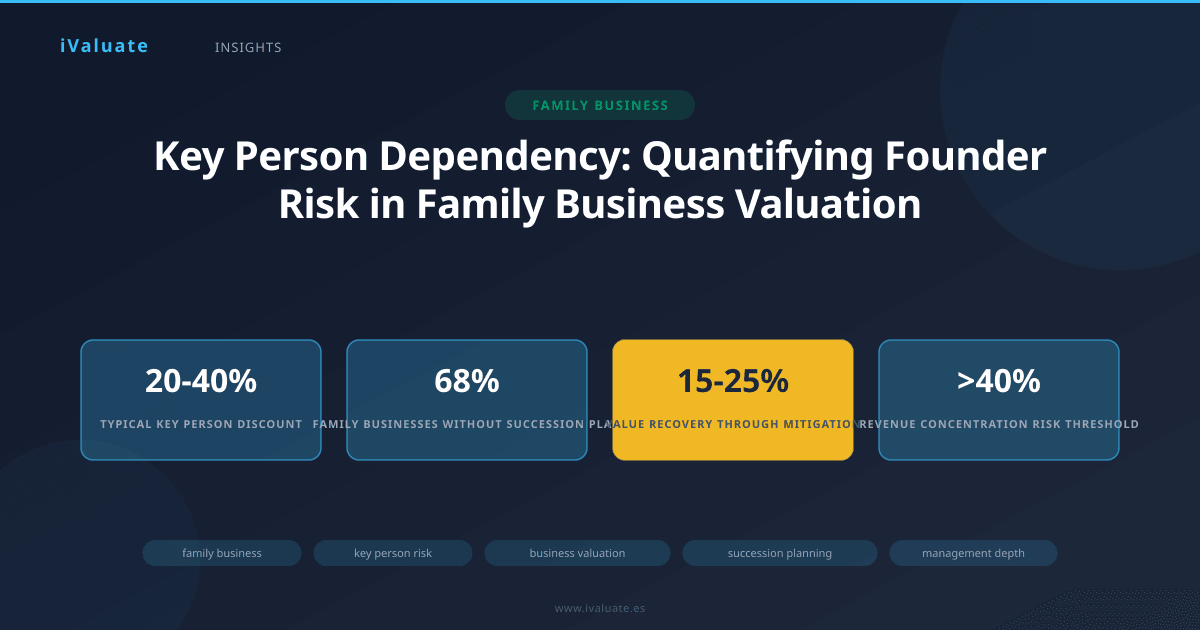
In the family business landscape of 2025-2026, one of the most significant—and often underestimated—valuation challenges is key person dependency. When a founder or family patriarch controls critical relationships, institutional knowledge, or operational expertise, the business faces substantial value impairment. Recent market data indicates that businesses with high owner dependency trade at discounts ranging from 20% to 40% compared to comparable companies with robust management depth.
This phenomenon, formally known as "key man discount" in valuation parlance, represents more than theoretical risk. It reflects the rational concern of buyers, investors, and lenders that a business's cash flows may deteriorate significantly if the key individual becomes unavailable due to death, disability, retirement, or departure. For family businesses contemplating succession, sale, or external capital raises, understanding and addressing key person dependency is not optional—it's essential to preserving enterprise value.
01 The Economic Reality of Key Person Dependency
Key person dependency manifests when a business's operations, customer relationships, supplier arrangements, or strategic direction are disproportionately concentrated in one or a small number of individuals. In family businesses, this typically centers on the founder or controlling family member who built the enterprise and maintains its critical functions.
From a valuation perspective, key person dependency increases business risk in several measurable ways:
- Revenue concentration risk: When 40% or more of revenue depends on relationships managed exclusively by the owner, acquirers apply significant risk premiums
- Operational continuity risk: Specialized knowledge or processes known only to the key person create execution uncertainty
- Strategic direction risk: Businesses lacking documented strategy beyond the founder's vision face planning gaps
- Cultural leadership risk: Family businesses often derive organizational cohesion from the founder's personal leadership style
The 2025 PwC Family Business Survey found that 68% of family businesses lack a documented succession plan, with 43% acknowledging that their business would face "significant operational challenges" if the primary owner were suddenly unavailable. These statistics translate directly into valuation adjustments.
Quantifying the Key Man Discount
Professional valuators employ several methodologies to quantify key person dependency risk. The most common approaches include:
Probability-Weighted Scenario Analysis: This method models different scenarios based on the key person's continued involvement. A typical framework might assess:
- Base case: Key person remains active (100% of projected cash flows)
- Transition scenario: Key person departs with planned succession (75-85% of projected cash flows)
- Sudden departure: Key person unavailable without succession plan (40-60% of projected cash flows)
The probability-weighted average of these scenarios, adjusted for the likelihood of each occurrence, produces a risk-adjusted valuation. For a 62-year-old founder with no succession plan, actuarial tables might suggest a 15-20% probability of sudden unavailability over a five-year projection period—a material risk factor.
Discount Rate Adjustment: Alternatively, valuators may increase the discount rate (or reduce multiples) to reflect key person risk. A business that might warrant a 12% discount rate with strong management depth could see that rate increase to 15-18% when heavily dependent on a single individual. Applied to a discounted cash flow analysis, this 300-600 basis point adjustment can reduce enterprise value by 20-35%.
A manufacturing company generating $8 million in EBITDA might command a 6.5x multiple with diversified management, yielding a $52 million valuation. With significant founder dependency, that multiple could compress to 4.5-5.0x, reducing enterprise value to $36-40 million—a $12-16 million impact from key person risk alone.
02 Assessing Management Depth and Organizational Resilience
Management depth refers to the breadth and capability of the leadership team beyond the key person. In family business valuation, assessing management depth requires examining both formal organizational structure and practical operational reality.
Critical Evaluation Dimensions
Functional Leadership Distribution: Professional valuators examine whether critical business functions have dedicated, capable leaders who operate with genuine autonomy. Key questions include:
- Does the business have a CFO or controller who manages financial operations independently?
- Is there a sales leader who owns customer relationships and revenue strategy?
- Do operations managers make day-to-day decisions without constant owner involvement?
- Can the business execute its strategic plan if the owner takes a three-month absence?
In 2025-2026 market conditions, buyers increasingly use "stress testing" during due diligence—requesting that founders step back from operations for 2-4 weeks to observe how the business functions. Companies that maintain performance during these tests command premium valuations.
Relationship Diversification: Perhaps the most critical assessment involves customer and supplier relationships. A distributor where the founder personally manages the top 15 customers (representing 65% of revenue) faces severe key person dependency. Conversely, a business where account managers own customer relationships, supported by CRM systems and documented processes, demonstrates resilience.
Recent transaction data from the middle market shows that businesses with relationship concentration ratios above 50% (where the key person controls more than half of critical relationships) experience valuation discounts averaging 28% compared to sector benchmarks.
The Documentation Imperative
Management depth isn't merely about having other people in leadership roles—it requires documented systems, processes, and institutional knowledge. The presence or absence of documentation provides objective evidence of organizational resilience:
- Strategic planning documents: Multi-year plans that exist beyond the founder's mental model
- Standard operating procedures: Documented processes for critical operations
- Customer relationship management: Systematic tracking of customer interactions, preferences, and history
- Financial planning and analysis: Regular management reporting that informs decision-making
- Succession and contingency plans: Documented protocols for leadership transitions
A 2024 study by the Exit Planning Institute found that businesses with comprehensive documentation sold for multiples averaging 1.2x higher than comparable companies lacking such systems—a direct correlation between documentation and value preservation.
03 Real-World Impact: Three Case Studies
Case Study 1: Regional HVAC Contractor
A third-generation HVAC contracting business with $22 million in revenue sought to bring in a private equity partner in early 2025. The 58-year-old CEO had built strong customer relationships over three decades, personally managing the company's 40 largest commercial accounts.
Initial valuation discussions centered on a 7.5x EBITDA multiple (market rate for the sector), suggesting a $16.5 million enterprise value on $2.2 million in EBITDA. However, due diligence revealed:
- The CEO was the primary contact for accounts representing 58% of revenue
- No documented customer relationship management system existed
- The sales team had minimal direct customer interaction
- Succession planning was informal and undocumented
The PE firm's valuation analysis applied a 30% key person discount, reducing the effective multiple to 5.25x and the enterprise value to $11.6 million—a $4.9 million reduction attributable entirely to key person dependency.
The business owner implemented a two-year mitigation plan, systematically transitioning customer relationships to account managers, implementing a CRM system, and developing a formal succession structure. When the transaction closed in late 2026, the business commanded a 6.8x multiple—recovering substantial value through dependency reduction.
Case Study 2: Specialty Food Manufacturer
A family-owned specialty food manufacturer with $45 million in revenue and strong EBITDA margins (18%) engaged investment bankers for a potential sale in 2025. The founder, age 67, had developed proprietary recipes and maintained exclusive relationships with key ingredient suppliers.
Despite strong financial performance, buyer interest was tepid. Strategic acquirers expressed concern about:
- Recipe knowledge residing exclusively with the founder
- Supplier relationships lacking formal contracts or secondary contacts
- Product development pipeline dependent on founder's culinary expertise
The business ultimately sold at 8.2x EBITDA—approximately 25% below the 10-11x multiples achieved by comparable specialty food companies in 2025. The acquirer structured the deal with a significant earnout (35% of total consideration) contingent on the founder's continued involvement for three years, effectively transferring key person risk to the seller through deal structure.
Case Study 3: Professional Services Firm
A consulting firm specializing in regulatory compliance services demonstrated how proactive management depth development preserves value. The founding partner, recognizing key person dependency risk at age 55, implemented a five-year transition plan:
- Promoted three senior consultants to partner, with equity participation
- Systematically transitioned client relationships over 18-month periods
- Documented methodologies and created training programs
- Established a management committee for strategic decisions
When the founder sold his stake to the partner group in 2026, the business commanded a premium valuation—9.5x EBITDA compared to the 7-8x typical for professional services firms. The acquirers (internal partners) secured favorable SBA lending terms because lenders viewed the management transition as substantially de-risked.
04 Mitigation Strategies: Building Organizational Resilience
Addressing key person dependency requires systematic effort across multiple dimensions. The most effective mitigation strategies combine structural changes, process documentation, and leadership development.
Leadership Team Development
Identify and Empower Second-Tier Leaders: Family businesses must cultivate genuine leadership depth by identifying high-potential managers and providing them with real authority. This means:
- Delegating decision-making authority, not just tasks
- Creating accountability structures where leaders own outcomes
- Providing compensation and equity incentives that retain key managers
- Investing in executive development and external training
The transition from founder-centric to team-based leadership typically requires 24-36 months of sustained effort. Businesses that compress this timeline often see superficial changes that fail to convince buyers or investors of genuine risk reduction.
Relationship Transition Protocols
Systematically transitioning customer, supplier, and partner relationships from the key person to other team members represents perhaps the most critical mitigation activity. Effective protocols include:
- Gradual introduction: Bringing team members into existing relationships over 6-12 months
- Joint accountability: Creating shared responsibility for relationship management
- Documented handoffs: Formal transition plans with milestones and success metrics
- Relationship mapping: Identifying all stakeholder contacts and creating redundancy
A practical approach involves the "rule of three"—ensuring that at least three people in the organization have meaningful relationships with each critical customer or supplier. This redundancy creates resilience without requiring complete founder withdrawal.
Process Documentation and Systematization
Converting tacit knowledge into explicit, documented systems reduces dependency on any individual's expertise. Priority areas include:
- Core operational processes: Manufacturing procedures, service delivery protocols, quality control systems
- Strategic planning: Market analysis frameworks, competitive positioning, growth strategies
- Financial management: Budgeting processes, cash flow management, capital allocation decisions
- Customer intelligence: Preferences, buying patterns, relationship history, decision-making processes
Modern technology platforms facilitate this documentation. CRM systems, project management tools, and knowledge management platforms create institutional memory that survives individual departures. In valuation contexts, the presence of these systems provides tangible evidence of reduced key person dependency.
Formal Succession Planning
A documented succession plan addresses both planned and emergency transitions. Comprehensive plans include:
- Identified successors for each critical role, with development timelines
- Emergency protocols if the key person becomes suddenly unavailable
- Financial arrangements (life insurance, buy-sell agreements, estate planning)
- Communication strategies for stakeholders (employees, customers, suppliers, lenders)
- Transition timelines with specific milestones and responsibilities
From a valuation perspective, the existence of a formal, board-approved succession plan can reduce key person discounts by 30-50%. A business facing a 35% key person discount might see that reduced to 15-20% with a credible succession plan—a material value preservation.
Family businesses that implement comprehensive key person risk mitigation strategies typically see valuation improvements of 15-25% over 3-5 year periods, even without revenue growth. The value creation comes entirely from risk reduction and organizational resilience building.
05 The Valuation Professional's Perspective
When conducting family business valuations, professionals employ rigorous frameworks to assess and quantify key person dependency. The evaluation typically follows a structured approach:
Risk Assessment Matrix
Valuators score businesses across multiple dependency dimensions, typically using a 1-5 scale:
- Customer relationship concentration: What percentage of revenue depends on key person relationships?
- Operational knowledge concentration: How much critical process knowledge resides with the key person?
- Strategic direction dependency: Can the business execute its strategy without the key person?
- External relationship concentration: Are supplier, lender, and partner relationships diversified?
- Management team capability: Can the existing team operate independently?
Businesses scoring high dependency (4-5) across multiple dimensions typically face key person discounts in the 30-40% range. Those with moderate dependency (2-3 scores) see 15-25% discounts. Companies with low dependency (1-2 scores) face minimal or no key person adjustments.
Comparable Transaction Analysis
Professional valuators examine comparable transactions to calibrate key person discounts. In the 2025-2026 market, transaction databases reveal clear patterns:
- Businesses with founder-CEOs over age 60 and no succession plan trade at 22% discounts on average
- Companies where the owner controls 60%+ of customer relationships see 26% valuation reductions
- Family businesses with documented succession plans and management depth trade at premiums of 12-18% versus those without
These empirical benchmarks provide objective support for valuation adjustments, moving the analysis beyond subjective judgment.
06 Strategic Implications for Family Business Owners
Understanding key person dependency's valuation impact should drive strategic decision-making for family business owners, particularly those considering:
- Succession planning: Beginning transition processes 5-7 years before intended exit maximizes value preservation
- Growth capital raises: Private equity and debt providers apply stricter key person scrutiny; addressing dependency before fundraising improves terms
- Strategic sales: Buyers increasingly conduct "management depth due diligence"; businesses with strong teams command premium multiples
- Estate planning: Key person dependency affects estate valuations for tax purposes; mitigation strategies can influence estate tax exposure
The financial impact is substantial. Consider a family business worth $30 million with strong management depth versus $20 million with high founder dependency. That $10 million difference—33% of value—represents real wealth that can be preserved through systematic risk mitigation.
The Time Value of Mitigation
Key person risk mitigation requires time. Leadership development, relationship transitions, and process documentation cannot be accomplished in months—they require years of sustained effort. Family business owners who begin this work early in their 50s position themselves for maximum value realization in their 60s.
Conversely, owners who wait until their late 60s or early 70s to address key person dependency face compressed timelines that limit mitigation effectiveness. Buyers and investors recognize rushed transitions and discount accordingly.
07 Conclusion: From Dependency to Resilience
Key person dependency represents one of the most significant value determinants in family business valuation, yet it remains among the most addressable risks. Unlike market conditions or competitive dynamics, management depth and organizational resilience are largely within the business owner's control.
The 2025-2026 market environment has heightened buyer and investor focus on key person risk. Demographic trends show record numbers of baby boomer business owners approaching retirement, while buyers have become increasingly sophisticated in identifying and pricing dependency risk. This dynamic creates both urgency and opportunity for family businesses.
The path from dependency to resilience requires systematic effort across leadership development, relationship transition, process documentation, and succession planning. While the journey typically spans 3-5 years, the value preservation—often 20-40% of enterprise value—justifies the investment many times over.
For family business owners serious about maximizing value, addressing key person dependency isn't a nice-to-have—it's a financial imperative. The businesses that thrive through ownership transitions are those that build organizational resilience systematically, creating enterprises that transcend any individual's involvement.
Professional valuation platforms like iValuate help business owners and their advisors quantify key person dependency risk and model the value impact of mitigation strategies. By providing data-driven insights into how management depth affects valuation multiples and discount rates, these tools enable informed decision-making about organizational development investments. Whether you're planning succession, considering a sale, or simply building long-term enterprise value, understanding and addressing key person dependency through rigorous analysis—supported by platforms like iValuate—positions your family business for optimal value realization.