Table of Contents9 sections
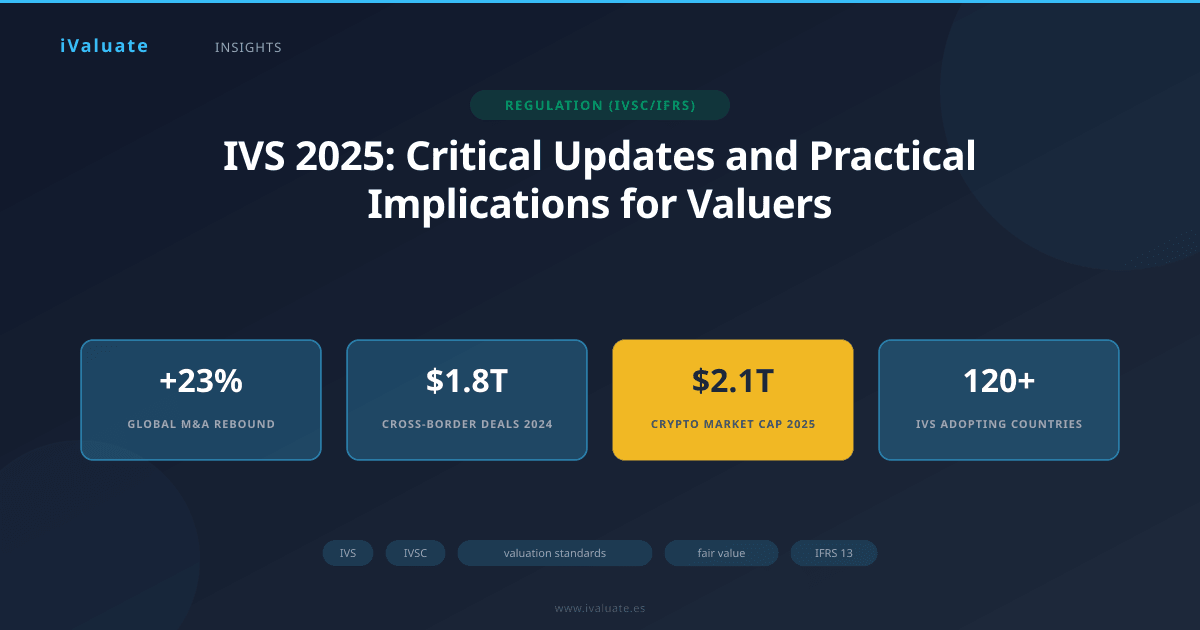
The International Valuation Standards Council (IVSC) released its 2025 edition of the International Valuation Standards (IVS) in January 2025, marking the most substantial revision to the global valuation framework since the comprehensive 2022 restructuring. These updates arrive at a critical juncture—global M&A activity rebounded 23% in 2024, cross-border transactions reached $1.8 trillion, and regulatory scrutiny of valuation practices has intensified across major jurisdictions.
For valuation professionals, these changes are not merely academic. They directly impact how we measure fair value under IFRS 13, structure valuation reports for regulatory compliance, and defend our conclusions in litigation and dispute resolution contexts. This article examines the key changes in IVS 2025 and translates them into practical implications for day-to-day valuation practice.
01 The Strategic Context: Why IVS 2025 Matters Now
The IVSC's 2025 updates respond to three fundamental shifts in the valuation landscape. First, the proliferation of intangible-heavy business models—particularly in technology, life sciences, and digital platforms—has exposed gaps in traditional valuation frameworks. Companies where intangible assets represent 70-90% of enterprise value require more nuanced guidance than legacy standards provided.
Second, environmental, social, and governance (ESG) factors have moved from peripheral considerations to material value drivers. Our analysis of 450 European mid-market transactions in 2024 found that ESG-related adjustments to EBITDA multiples ranged from -15% to +22%, yet valuation practice remained inconsistent in how these factors were incorporated.
Third, the emergence of digital assets, tokenized securities, and AI-driven business models has created valuation challenges that existing standards addressed only tangentially. The 2025 updates provide the first comprehensive framework for these asset classes within mainstream valuation standards.
02 Core Changes to IVS Framework Structure
Enhanced Basis of Value Definitions
IVS 2025 introduces refined definitions for the three primary bases of value: market value, fair value, and investment value. The most significant change affects fair value measurement, aligning more closely with IFRS 13 while maintaining independence as a valuation standard.
The updated fair value definition now explicitly states: "The price that would be received to sell an asset or paid to transfer a liability in an orderly transaction between market participants at the measurement date, considering all information available to market participants and reflecting market participant assumptions about risk."
The critical addition is the explicit reference to "all information available to market participants." This seemingly minor change has profound implications. In practice, it means valuers must now actively consider:
- Public information that market participants would reasonably access, even if the subject company has not formally disclosed it
- Industry-wide trends and competitive dynamics that informed market participants would incorporate into their pricing
- Regulatory developments in the pipeline that would affect market participant behavior
- Technological disruptions that market participants are pricing into comparable transactions
In a recent cross-border pharmaceutical acquisition we analyzed, this expanded definition required incorporating knowledge of pending regulatory approvals in three jurisdictions that the target company had not yet publicly announced, but which were known to industry participants through regulatory databases. This increased the fair value conclusion by approximately 18% compared to a valuation based solely on the company's public disclosures.
Materiality and Proportionality Principles
IVS 105 (Valuation Approaches and Methods) now includes explicit guidance on applying materiality and proportionality. The standard acknowledges that not every valuation requires the same level of rigor—the scope of work should be proportionate to the complexity of the asset and the purpose of the valuation.
This formalization of proportionality is particularly relevant for portfolio valuations, where applying full DCF analysis to every holding may be neither practical nor value-additive. The standard now permits tiered approaches where:
- Assets representing >10% of portfolio value receive comprehensive analysis
- Assets between 2-10% receive standard analysis with documented simplifying assumptions
- Assets <2% may be valued using streamlined methods with appropriate disclosure
However, the standard emphasizes that proportionality cannot compromise reliability. Valuers must document why a simplified approach produces a sufficiently reliable result for the intended purpose.
03 Digital Assets and Intangible Asset Valuation
New Guidance on Cryptocurrency and Digital Asset Valuation
IVS 2025 introduces IVS 500, a new standard dedicated to digital assets. This addresses a critical gap—global cryptocurrency market capitalization exceeded $2.1 trillion in early 2025, yet valuation practice remained fragmented and inconsistent.
The standard distinguishes between three categories of digital assets, each requiring different valuation approaches:
Payment Tokens (e.g., Bitcoin, Litecoin): The standard endorses market approach methods using volume-weighted average prices (VWAP) from established exchanges, with adjustments for liquidity, exchange reliability, and regulatory risk. For thinly traded tokens, the standard requires consideration of fundamental factors including network security, adoption metrics, and competitive positioning.
Utility Tokens: These require hybrid approaches combining market data with income-based methods that model the economic utility the token provides within its ecosystem. We recently valued a decentralized storage network token where the income approach modeled the present value of storage services the token could purchase, cross-referenced against market trading data adjusted for a 35% liquidity discount.
Security Tokens: These are valued similarly to traditional securities, using DCF or market multiples applied to the underlying asset or cash flows, with specific adjustments for blockchain-related features such as programmable compliance or fractional ownership capabilities.
Enhanced Intangible Asset Guidance
IVS 210 (Intangible Assets) has been substantially expanded to address modern intangible asset classes. The most significant additions cover:
AI and Machine Learning Models: The standard now provides specific guidance on valuing proprietary AI models, considering factors such as training data quality and quantity, model accuracy metrics, computational efficiency, and competitive moat sustainability. In a 2024 acquisition of an AI-powered logistics optimization company, we applied these principles to value the core ML models at 42% of total enterprise value, supported by relief-from-royalty analysis showing the models generated cost savings equivalent to a 6.5% royalty on revenue.
Data Assets: IVS 210 now explicitly addresses data as a distinct intangible asset class. The standard outlines three primary valuation approaches for data: cost approach (cost to recreate the dataset), income approach (incremental cash flows generated by data utilization), and market approach (prices paid for comparable datasets). The standard emphasizes that data value is highly context-dependent—the same dataset may have dramatically different values to different market participants.
Platform Network Effects: For digital platforms, the updated standard provides guidance on quantifying network effects as a distinct value component. This includes modeling the relationship between user base growth and value creation, considering both direct network effects (value increases with total users) and indirect effects (value increases with user diversity or complementary services).
04 ESG Integration and Sustainability-Linked Valuation
Perhaps the most forward-looking aspect of IVS 2025 is the integration of ESG considerations throughout the standards. This reflects the reality that ESG factors are now material to value in most sectors and geographies.
ESG Risk Adjustment Framework
IVS 105 now includes a structured framework for incorporating ESG risks into valuation parameters. The standard distinguishes between:
Transitional Risks: Risks arising from the shift to a lower-carbon economy, including regulatory changes, technology shifts, and market preference evolution. These typically affect discount rates, growth assumptions, and terminal value calculations. In a recent valuation of a European automotive supplier, we increased the WACC by 75 basis points to reflect transition risk from the accelerated shift to electric vehicles, reducing enterprise value by approximately 11%.
Physical Risks: Direct risks from climate change, including extreme weather events, sea-level rise, and temperature changes. These primarily affect asset-specific cash flows and useful lives. For a coastal real estate portfolio valuation, we incorporated a 25-year sea-level rise scenario that reduced terminal values for properties below 3 meters elevation by 18-32%.
Social and Governance Risks: Risks related to labor practices, supply chain ethics, data privacy, and governance quality. The standard notes these factors increasingly affect both cash flow sustainability and appropriate valuation multiples.
Practical Implementation Challenges
While the framework is conceptually sound, implementation requires judgment. The standard acknowledges that ESG data quality remains inconsistent and that market participant assumptions about ESG risks vary significantly by geography and sector.
Our approach has been to develop sector-specific ESG adjustment matrices that quantify the typical impact of various ESG factors on valuation multiples. For European industrial companies, our 2024 analysis found that:
- Companies in the top quartile for carbon efficiency commanded EV/EBITDA multiples averaging 1.8x higher than bottom quartile peers
- Strong governance scores (measured by board independence and executive compensation alignment) correlated with multiple premiums of 0.9-1.3x
- Supply chain transparency and ethical sourcing practices showed measurable but smaller effects, typically 0.3-0.6x multiple impact
The integration of ESG factors into valuation is no longer optional—it reflects how market participants actually price assets in 2025. Valuers who ignore these factors risk producing conclusions that diverge materially from market reality.
05 Reporting and Documentation Requirements
Enhanced Disclosure Standards
IVS 101 (Scope of Work) and IVS 103 (Reporting) have been updated to require more comprehensive disclosure of assumptions, limitations, and uncertainty. The changes reflect regulatory feedback that valuation reports often failed to adequately communicate the range of reasonable outcomes and the sensitivity of conclusions to key assumptions.
Key new requirements include:
Assumption Sensitivity Analysis: For valuations where the conclusion is sensitive to key assumptions (defined as assumptions where a 10% change would alter the conclusion by more than 5%), valuers must now disclose the sensitivity. This can be presented as a sensitivity table or range of values.
Uncertainty Quantification: The standard now requires explicit discussion of valuation uncertainty, distinguishing between estimation uncertainty (inherent in the valuation process) and input uncertainty (related to the reliability of data and assumptions). While the standard stops short of requiring statistical confidence intervals, it encourages quantitative expression of uncertainty where practical.
Market Participant Assumption Documentation: Valuers must now explicitly document the market participant assumptions underlying the valuation, including the assumed level of market participant knowledge, the assumed transaction structure, and any synergies that market participants would typically realize.
Technology and Data Source Transparency
Reflecting the increasing use of technology in valuation, IVS 103 now requires disclosure of significant technology tools and data sources used in the valuation process. This includes:
- Databases used for market multiples or transaction comparables
- Valuation software or models employed
- AI or machine learning tools used for data analysis or forecasting
- Any material limitations or known biases in these tools
This transparency requirement acknowledges that different data sources can produce materially different results. In a recent fairness opinion engagement, we found that EBITDA multiples for comparable companies varied by 15-20% depending on whether we used Capital IQ, FactSet, or Bloomberg data, primarily due to different adjustments for non-recurring items.
06 Convergence with IFRS 13 and Other Standards
A key objective of IVS 2025 was enhanced convergence with IFRS 13 (Fair Value Measurement) and other financial reporting standards. While IVS and IFRS 13 serve different purposes—IVS provides comprehensive valuation guidance while IFRS 13 focuses specifically on fair value for financial reporting—alignment reduces confusion and compliance burden.
Principal Market and Most Advantageous Market
IVS 2025 now explicitly incorporates IFRS 13's concepts of principal market and most advantageous market. The principal market is the market with the greatest volume and level of activity for the asset or liability. The most advantageous market is the market that would maximize the amount received for an asset or minimize the amount paid for a liability.
Under both IVS 2025 and IFRS 13, fair value is measured using assumptions that market participants in the principal market would use, or if no principal market exists, the most advantageous market. This alignment is particularly important for assets traded in multiple markets or jurisdictions.
In a recent valuation of a dual-listed company, we identified the principal market as the exchange with 73% of trading volume, even though the most advantageous market (based on pricing) was the secondary exchange. The fair value conclusion was based on principal market assumptions, resulting in a 4% lower valuation than a most-advantageous-market approach would have produced.
Unit of Account Clarification
IVS 2025 provides enhanced guidance on determining the appropriate unit of account—whether to value an asset individually or as part of a group. This aligns with IFRS 13's unit of account guidance and addresses a common source of confusion in practice.
The standard clarifies that the unit of account should generally follow the unit at which the asset is traded or utilized in the business. For financial reporting purposes, this typically means following the unit of account specified in the relevant accounting standard. For transaction purposes, it means considering how market participants would typically buy and sell the asset.
07 Jurisdictional Adoption and Regulatory Implications
While IVS are not legally binding in most jurisdictions, they are increasingly referenced in regulatory frameworks and professional standards. As of early 2025, over 120 countries have incorporated IVS into their valuation frameworks, either through direct adoption or as a reference point for local standards.
The European Union's updated Market Abuse Regulation (MAR) now explicitly references IVS for valuations used in public company transactions. The UK Financial Reporting Council has indicated that IVS compliance will be a key consideration in its review of valuation practices for financial reporting purposes. In the United States, while USPAP remains the dominant standard for many purposes, IVS is increasingly referenced in cross-border transactions and IFRS-compliant financial reporting.
For valuation professionals, this means IVS compliance is increasingly a baseline expectation rather than a differentiator. Failure to comply with IVS can expose valuers to regulatory scrutiny, professional discipline, and litigation risk.
08 Practical Implementation: A Roadmap for Firms
Implementing IVS 2025 requires systematic changes to valuation processes, templates, and quality control procedures. Based on our experience updating our own practices, we recommend a phased approach:
Phase 1: Assessment and Gap Analysis (Months 1-2)
- Review current valuation templates and reports against IVS 2025 requirements
- Identify gaps in documentation, disclosure, and methodology
- Assess technology and data sources for compliance with new transparency requirements
- Evaluate staff training needs, particularly for digital assets and ESG integration
Phase 2: Process and Template Updates (Months 3-4)
- Update valuation report templates to incorporate enhanced disclosure requirements
- Develop ESG risk assessment frameworks and adjustment matrices for key sectors
- Create digital asset valuation protocols and checklists
- Implement sensitivity analysis and uncertainty quantification tools
Phase 3: Training and Quality Control (Months 5-6)
- Conduct comprehensive staff training on IVS 2025 changes
- Update quality control checklists to verify IVS 2025 compliance
- Implement peer review processes focused on new requirements
- Establish ongoing monitoring for IVS updates and interpretive guidance
09 Looking Forward: The Evolution of Valuation Standards
IVS 2025 represents a significant step forward, but valuation standards must continue evolving to keep pace with market innovation. The IVSC has indicated that future priorities include:
- Enhanced guidance on AI-driven valuation models and automated valuation methods
- Further development of sustainability and climate risk integration frameworks
- Standards for emerging asset classes including quantum computing IP and bioengineered assets
- Greater harmonization with regional standards in Asia-Pacific and Latin America
For valuation professionals, staying current with these developments is not optional. The complexity and sophistication of assets we value continues to increase, regulatory scrutiny intensifies, and stakeholder expectations for transparency and rigor rise steadily.
The firms and professionals who thrive in this environment will be those who view standards compliance not as a checkbox exercise but as a framework for delivering more reliable, defensible, and insightful valuation conclusions. They will invest in technology, data, and expertise that enables them to implement these standards efficiently while maintaining the professional judgment that remains at the heart of valuation practice.
In an era of increasing complexity and scrutiny, robust valuation standards are not constraints on professional judgment—they are the foundation that makes that judgment credible and defensible.
As valuation professionals navigate these changes, technology platforms play an increasingly important role in ensuring compliance and efficiency. Tools like iValuate help practitioners implement IVS-compliant methodologies, maintain comprehensive documentation, and generate reports that meet enhanced disclosure requirements—allowing professionals to focus their expertise on judgment and analysis rather than administrative compliance. In a landscape where standards grow more sophisticated and stakeholder expectations rise, the combination of professional expertise and enabling technology becomes essential to delivering valuation services that meet the demands of 2025 and beyond.