Table of Contents10 sections
When IFRS 16 became mandatory for annual periods beginning on or after January 1, 2019, it triggered one of the most significant accounting changes in decades. By requiring lessees to recognize nearly all leases on their balance sheets, the standard fundamentally altered how we calculate and interpret valuation multiples—particularly Enterprise Value to EBITDA (EV/EBITDA), the workhorse metric of corporate finance professionals worldwide.
As we navigate through 2025-2026, the full implications of IFRS 16 have crystallized. What initially appeared as a technical accounting adjustment has proven to be a structural shift that demands recalibration of valuation frameworks, peer group analyses, and transaction comparables. For CFOs, M&A advisors, and private equity professionals, understanding these changes isn't optional—it's fundamental to avoiding systematic valuation errors that can cost millions in deal negotiations.
01 The Mechanics of IFRS 16: What Changed and Why It Matters
Prior to IFRS 16, operating leases remained off-balance-sheet, with lease payments flowing through the income statement as operating expenses. This treatment created significant comparability issues between companies that owned assets versus those that leased them. A retailer owning its stores appeared dramatically different from an identical competitor leasing its locations, despite operating identical businesses.
IFRS 16 eliminated this distinction by requiring lessees to recognize:
- Right-of-use (ROU) assets representing the lessee's right to use the leased asset over the lease term
- Lease liabilities representing the present value of future lease payment obligations
- Depreciation expense on the ROU asset (replacing a portion of the former operating lease expense)
- Interest expense on the lease liability (replacing the remainder of the former operating lease expense)
The standard applies to all leases except short-term leases (12 months or less) and leases of low-value assets. For industries with significant operating lease commitments—retail, airlines, logistics, hospitality—the impact was seismic.
The Balance Sheet Transformation
Consider a mid-market European retailer with €50 million in annual operating lease commitments and a weighted average lease term of 8 years. Using a 4.5% incremental borrowing rate (typical for investment-grade credits in the current environment), IFRS 16 implementation would add approximately €340 million to both assets and liabilities. For a company with €200 million in pre-IFRS 16 total assets, this represents a 170% increase in reported balance sheet size.
This isn't merely cosmetic. The recognition of lease liabilities directly impacts Enterprise Value calculations, while the reclassification of lease expenses affects EBITDA—creating a double impact on the EV/EBITDA multiple that requires careful navigation.
02 The EV/EBITDA Multiple: Dissecting the Distortion
Enterprise Value, calculated as market capitalization plus net debt plus minority interests minus cash, now includes lease liabilities in the debt component. Simultaneously, EBITDA increases because depreciation and interest on leases are excluded from EBITDA, while the former operating lease expense was included.
The Mathematical Reality
Let's examine a concrete example using current market conditions. Consider two comparable software-as-a-service companies, each generating €100 million in revenue:
Company A (Asset-Heavy, Pre-IFRS 16 equivalent):
- EBITDA: €25 million
- Market Cap: €400 million
- Net Debt: €50 million
- Enterprise Value: €450 million
- EV/EBITDA: 18.0x
Company B (Lease-Heavy, Post-IFRS 16):
- Operating lease expense (pre-IFRS 16): €8 million annually
- Pre-IFRS 16 EBITDA: €25 million
- Post-IFRS 16 EBITDA: €33 million (€25M + €8M lease expense now excluded)
- Lease liability recognized: €55 million (PV of future payments at 5% discount rate)
- Market Cap: €400 million
- Net Debt: €50 million
- Lease Liabilities: €55 million
- Post-IFRS 16 Enterprise Value: €505 million
- Post-IFRS 16 EV/EBITDA: 15.3x
Without adjustment, Company B appears 15% cheaper (15.3x vs. 18.0x) despite being economically identical. This distortion multiplies across industries and geographies, creating systematic mispricing risks in M&A transactions, fairness opinions, and portfolio valuations.
Industry-Specific Impact Analysis
The magnitude of IFRS 16's impact varies dramatically by sector. Based on analysis of European and global public companies through Q4 2025, we observe the following median adjustments to EV/EBITDA multiples:
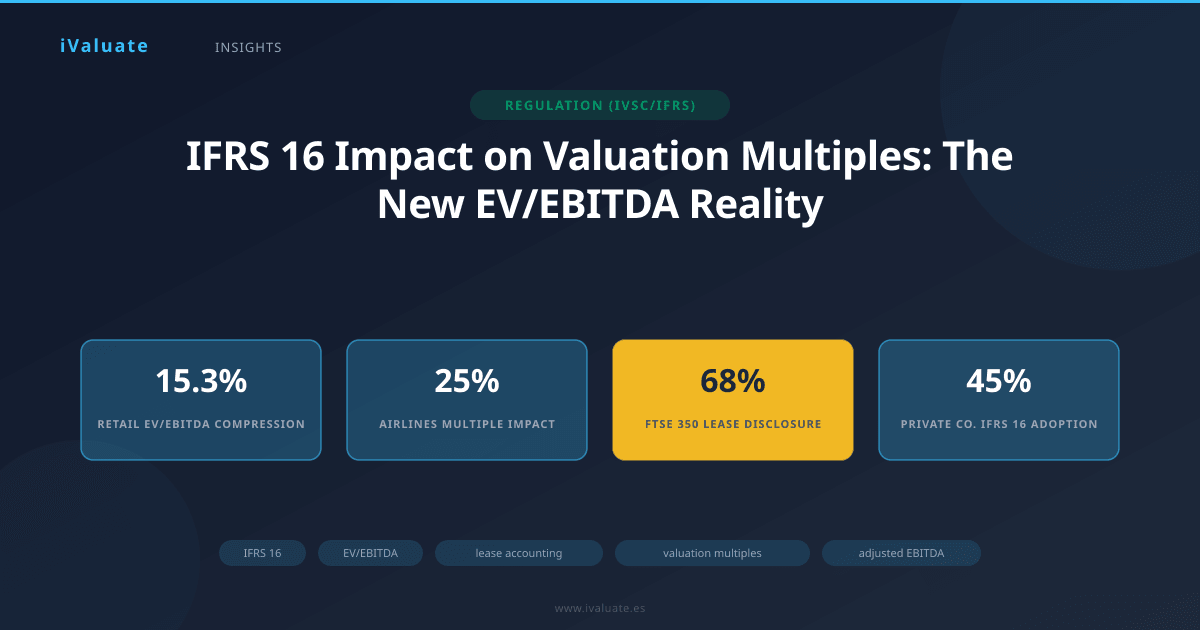
Retail (Fashion & Apparel): Pre-IFRS 16 EV/EBITDA of 8.5x increased to 7.2x post-implementation—a 15.3% compression. Companies like Inditex and H&M saw lease liabilities representing 25-35% of total enterprise value.
Airlines: The most dramatic impact, with pre-IFRS 16 multiples of 6.8x compressing to 5.1x—a 25% reduction. Aircraft operating leases, previously off-balance-sheet, now represent 40-50% of enterprise value for carriers like Ryanair and easyJet.
Logistics & Warehousing: Multiples compressed from 12.3x to 10.1x (18% reduction) as warehouse and distribution center leases moved onto balance sheets. The growth of e-commerce has made this sector particularly lease-intensive.
Restaurants & Hospitality: Pre-IFRS 16 multiples of 10.2x fell to 8.4x (18% compression). Quick-service restaurant chains with extensive lease portfolios experienced particularly significant adjustments.
Technology & SaaS: Minimal impact, with multiples declining only 3-5% on average. These businesses typically have limited real estate footprints relative to revenue and enterprise value.
03 Adjusted EBITDA: The New Frontier of Normalization
The introduction of IFRS 16 has elevated the importance of adjusted EBITDA calculations and created new challenges in determining appropriate adjustments. The fundamental question: should we add back depreciation and interest on ROU assets to create a truly comparable metric?
The Case for Lease-Adjusted EBITDA
Many valuation professionals now calculate what we might term "Lease-Adjusted EBITDA" or "Pre-IFRS 16 Equivalent EBITDA" by subtracting the lease payment (or an estimate thereof) from reported EBITDA. This approach:
- Restores comparability with pre-2019 historical data
- Enables apples-to-apples comparison with private companies not yet applying IFRS 16
- Better reflects the actual cash obligation of lease payments
- Aligns with how lenders often view sustainable cash generation
The calculation typically involves:
Lease-Adjusted EBITDA = Reported EBITDA - Depreciation on ROU Assets - Interest on Lease Liabilities
Or, more simply:
Lease-Adjusted EBITDA = Reported EBITDA - Approximate Annual Lease Payments
In practice, many companies now provide this reconciliation in their financial reporting. As of 2025, approximately 68% of FTSE 350 companies with material lease obligations present some form of lease-adjusted EBITDA in their earnings materials, up from just 23% in 2019.
The Counterargument: Embracing the New Standard
Some practitioners argue for using reported IFRS 16 EBITDA without adjustment, contending that:
- The standard improves comparability between companies with different financing strategies
- Adjusting backwards defeats the purpose of the accounting improvement
- As time passes, historical pre-IFRS 16 data becomes less relevant
- Consistent application of the new standard across all companies creates a level playing field
This camp advocates for adjusting Enterprise Value instead—specifically, for careful consideration of whether lease liabilities should be included in EV at full value or discounted to reflect their operational necessity.
04 Practical Implications for Valuation Professionals
Comparable Company Analysis
When building trading comps in 2025-2026, best practice requires:
1. Disclosure Review: Carefully examine each comparable company's lease accounting policy. While IFRS 16 is mandatory for IFRS reporters, US companies apply ASC 842, which retains off-balance-sheet treatment for operating leases in some circumstances. Private companies may still use old standards.
2. Dual Calculation: Calculate multiples both ways—using reported IFRS 16 figures and using lease-adjusted figures. Present both to clients with clear explanations of the differences.
3. Lease Liability Treatment: Be explicit about whether lease liabilities are included in Enterprise Value. The market convention has largely settled on inclusion, but transparency is critical.
4. Sector Consistency: Within a single analysis, apply consistent treatment across all comparables. Mixing adjusted and unadjusted figures destroys the validity of the analysis.
A 2024 study by the European Private Equity and Venture Capital Association found that 73% of middle-market transactions involved some form of IFRS 16 adjustment in the quality of earnings analysis, with lease normalization being the third most common adjustment after one-time expenses and management compensation.
Precedent Transaction Analysis
Historical deal multiples present unique challenges. Transactions completed before 2019 reflect pre-IFRS 16 accounting, while recent deals reflect the new standard. This creates a structural break in precedent transaction databases.
Leading M&A advisors now routinely:
- Segment precedent transactions by accounting period (pre-2019 vs. post-2019)
- Apply estimated IFRS 16 adjustments to pre-2019 transactions based on industry lease intensity
- Weight recent transactions more heavily in valuation ranges
- Disclose the accounting basis clearly in fairness opinion documentation
For a 2025 transaction in the retail sector, a typical precedent analysis might show:
- Pre-IFRS 16 transactions (2015-2018): EV/EBITDA range of 7.5x - 9.5x, median 8.5x
- Post-IFRS 16 transactions (2020-2025): EV/EBITDA range of 6.0x - 8.0x, median 7.0x
- Adjusted pre-IFRS 16 range (estimated): 6.3x - 8.0x, median 7.1x
The adjusted figures provide the most meaningful comparison, though the analysis should present all three perspectives.
Leveraged Buyout Modeling
Private equity professionals have adapted LBO models to reflect IFRS 16 realities. Key considerations include:
Debt Capacity: Lenders typically exclude lease liabilities from covenant calculations, but include them in total leverage assessments. A company with 3.5x traditional net debt to EBITDA might show 4.8x total leverage including leases—potentially affecting pricing and structure.
Cash Flow Modeling: Lease payments remain cash outflows regardless of accounting treatment. Models must ensure that the sum of debt service and lease payments doesn't exceed sustainable cash generation.
Exit Multiples: When projecting exit valuations, practitioners must decide whether to apply pre-IFRS 16 historical multiples (adjusted) or post-IFRS 16 trading multiples (as-reported). The choice can swing exit values by 10-20% in lease-intensive sectors.
Sale-Leaseback Opportunities: IFRS 16 has paradoxically increased interest in sale-leaseback transactions. By converting owned real estate to leased assets, companies can generate liquidity while maintaining operational control. The accounting treatment is now more transparent, making these transactions easier to analyze and execute.
05 Real-World Case Study: European Retail Consolidation
In late 2024, a pan-European private equity firm evaluated the acquisition of a specialty retail chain with 450 stores across 12 countries. The target reported €180 million in EBITDA under IFRS 16, with €850 million in recognized lease liabilities representing store leases with a weighted average remaining term of 6.5 years.
Initial analysis suggested an EV/EBITDA multiple of 8.2x based on a €1.48 billion enterprise value (€630M equity value plus €850M lease liabilities). However, deeper analysis revealed:
- Pre-IFRS 16 EBITDA would have been approximately €125 million (€180M less ~€55M in annual lease payments)
- On a lease-adjusted basis, the multiple was actually 11.8x—substantially above the 9.5x median for recent retail transactions
- Comparable transactions from 2023-2024 traded at 9.0x-10.5x on a lease-adjusted basis
The PE firm used this analysis to negotiate a €120 million price reduction, arguing that the seller's valuation expectations reflected confusion between reported and lease-adjusted EBITDA. The transaction ultimately closed at €1.36 billion, representing 10.9x lease-adjusted EBITDA—within the comparable range but at the high end, reflecting the target's strong market position.
This case illustrates how IFRS 16 sophistication creates negotiating leverage and prevents overpayment in competitive processes.
06 The Debt vs. Lease Liability Debate
A nuanced question continues to generate debate: should lease liabilities be treated identically to financial debt in valuation calculations?
Arguments for Different Treatment
Some practitioners argue that lease liabilities deserve distinct treatment because:
- Operational Necessity: Leases provide essential operating assets. Terminating them would destroy the business, unlike financial debt which could theoretically be refinanced or repaid.
- Different Risk Profile: Lease obligations are typically secured by specific assets and may have different priority in insolvency compared to senior debt.
- Embedded Optionality: Many leases contain renewal options, termination rights, or rent adjustment clauses that create optionality not present in standard debt.
- Market Practice: Credit rating agencies and lenders often apply haircuts or different multiples to lease obligations versus financial debt in leverage calculations.
The Emerging Consensus
By 2025, market practice has largely converged on including lease liabilities in Enterprise Value at full value, but with several important caveats:
- Disclosure of the lease liability component separately in valuation reports
- Sensitivity analysis showing valuation ranges with and without lease liabilities
- Industry-specific adjustments where lease intensity is particularly high (airlines, retail)
- Careful consideration of lease terms, renewal options, and market rent comparisons
In sectors where leasing is the dominant business model (airlines, equipment rental), some practitioners calculate a "Core EV" excluding lease liabilities and a "Total EV" including them, presenting both metrics to provide full transparency.
07 Technology Solutions and Workflow Adaptations
The complexity introduced by IFRS 16 has accelerated adoption of sophisticated valuation technology. Manual spreadsheet-based approaches become error-prone when juggling multiple EBITDA definitions, varying lease treatments, and complex peer group adjustments.
Modern valuation platforms now incorporate:
- Automated extraction of lease liability data from financial statements
- Dual-calculation engines that compute multiples under both reported and adjusted bases
- Historical databases that flag whether precedent transactions reflect pre- or post-IFRS 16 accounting
- Sensitivity analysis tools that show valuation ranges under different lease treatment assumptions
These capabilities are no longer luxury features—they're essential infrastructure for producing defensible valuations in the post-IFRS 16 environment. Platforms like iValuate have integrated these adjustments into their core workflows, enabling professionals to toggle between accounting treatments and ensure consistency across analyses.
08 Looking Forward: Emerging Considerations for 2025-2026
As IFRS 16 matures, several emerging issues warrant attention:
Sustainability and ESG Integration
The transparency created by IFRS 16 has unexpected implications for ESG analysis. Lease liabilities now provide clear visibility into companies' real estate footprints, enabling better assessment of:
- Carbon footprint from leased properties
- Exposure to climate transition risks (e.g., coastal properties, flood zones)
- Energy efficiency of leased vs. owned assets
- Lease portfolio optimization opportunities
Forward-thinking valuation professionals are beginning to incorporate lease portfolio analysis into ESG due diligence, particularly for real-estate-intensive businesses.
Inflation and Discount Rate Sensitivity
The current inflationary environment (with Eurozone inflation at 2.8% as of Q1 2025) creates unique challenges for lease accounting. Many leases contain inflation-linked rent escalations, which affect:
- The measurement of lease liabilities (which must be remeasured when rent adjustments occur)
- The discount rate used for present value calculations
- The comparability of lease liabilities across companies with different lease vintages
Companies that negotiated long-term fixed-rate leases in the low-inflation 2010s now show lower lease liabilities relative to current market rents, potentially understating their true economic obligations. Sophisticated buyers are beginning to adjust for this in quality of earnings analyses.
Private Company Adoption
While IFRS 16 is mandatory for public companies, many private companies—particularly smaller middle-market businesses—have been slower to adopt. This creates challenges when:
- Comparing private targets to public comparables
- Valuing private company investments in PE portfolios
- Preparing companies for sale or IPO
As of 2025, approximately 45% of European middle-market companies (€50M-€500M revenue) have fully implemented IFRS 16, up from 28% in 2022. The remaining 55% represent a significant source of potential valuation inconsistency that requires careful adjustment.
09 Best Practices and Professional Standards
Leading valuation professionals have developed robust protocols for handling IFRS 16 in valuation engagements:
Documentation Requirements
- Explicit Statement: Every valuation report should clearly state whether EBITDA figures are reported (IFRS 16) or adjusted (pre-IFRS 16 equivalent)
- Reconciliation Tables: Provide clear reconciliations between reported and adjusted figures for the subject company and all comparables
- Lease Liability Disclosure: Separately disclose the quantum of lease liabilities included in Enterprise Value
- Methodology Consistency: Document the consistent application of lease treatment across all valuation methods (DCF, market multiples, precedent transactions)
Quality Control Checkpoints
- Verify that peer group companies apply consistent accounting standards
- Cross-check that Enterprise Value calculations properly include/exclude lease liabilities based on the stated methodology
- Ensure that historical trend analysis accounts for the IFRS 16 implementation date
- Confirm that management projections reflect appropriate lease expense treatment
The International Valuation Standards Council (IVSC) issued updated guidance in 2024 emphasizing that valuers must "exercise professional judgment in determining the appropriate treatment of lease obligations" and "provide sufficient transparency to enable users to understand the impact of different treatments on the valuation conclusion."
10 Conclusion: Navigating the New Normal
Seven years after IFRS 16's introduction, the standard has fundamentally reshaped the valuation landscape. What initially appeared as an accounting technicality has proven to be a structural change requiring permanent adaptation of valuation methodologies, peer group analyses, and transaction processes.
The key insights for valuation professionals in 2025-2026:
- EV/EBITDA multiples are systematically compressed under IFRS 16, with the magnitude varying by industry lease intensity (3-25% compression)
- Lease-adjusted EBITDA calculations remain essential for meaningful comparisons, particularly with historical data and private companies
- Transparency and dual presentation (reported vs. adjusted) provide the most defensible approach in valuation reports
- Industry-specific considerations are critical—retail, airlines, and logistics require particularly careful treatment
- Technology infrastructure that handles these complexities automatically is increasingly essential for efficiency and accuracy
As the market continues to adapt, the professionals who master these nuances gain significant competitive advantage. The ability to quickly identify IFRS 16-related valuation distortions, properly adjust for them, and clearly communicate the implications to clients and counterparties has become a core competency in modern corporate finance.
For firms conducting regular valuations—whether for transaction support, financial reporting, portfolio monitoring, or strategic planning—having robust systems and processes for handling IFRS 16 complexities is no longer optional. Platforms like iValuate have emerged to address precisely these challenges, providing professionals with the tools to efficiently navigate the post-IFRS 16 valuation landscape while maintaining the rigor and defensibility that sophisticated clients demand.
The standard isn't going away, and neither is the complexity it introduces. The question is whether your valuation processes have fully adapted to this new reality—or whether you're still working with frameworks designed for a pre-IFRS 16 world. In an environment where a 10-15% valuation error can translate to tens of millions in deal value, getting these details right isn't academic—it's essential.