Table of Contents11 sections
In the evolving landscape of corporate valuation, social factors have transitioned from peripheral ESG considerations to core value drivers—particularly for workforce-dependent businesses. As of 2025, institutional investors managing over $42 trillion in assets now systematically incorporate social metrics into their valuation models, recognizing that human capital represents both the largest cost center and the primary source of competitive advantage for service-oriented, technology, and knowledge-based companies.
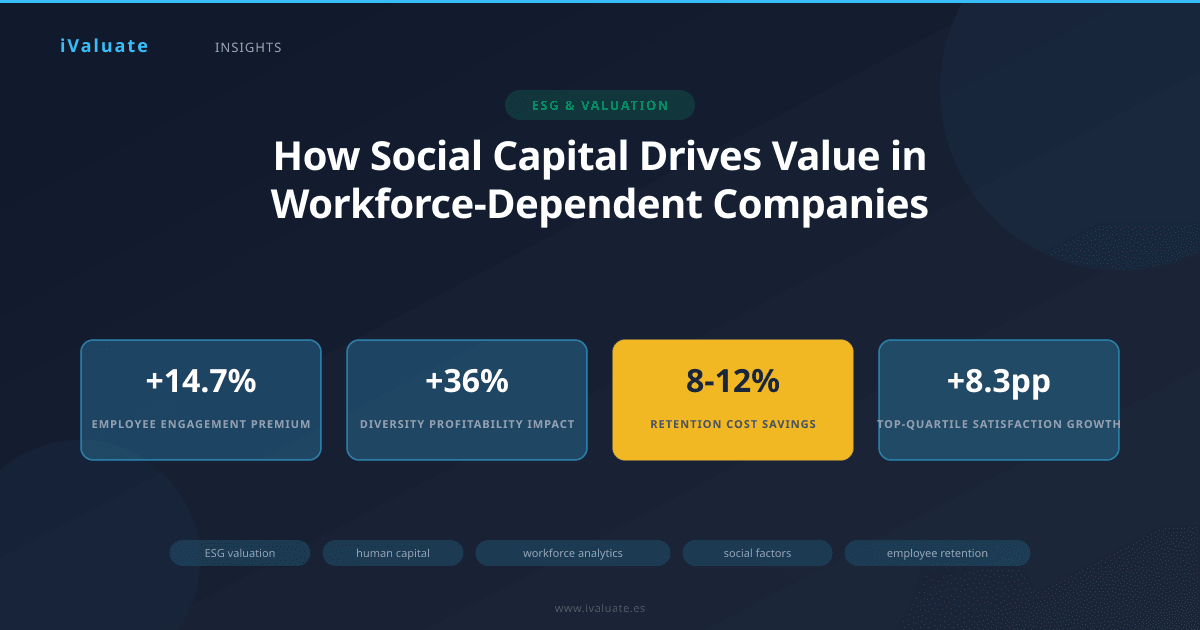
The quantification of social factors in valuation has accelerated dramatically following several high-profile cases where labor disputes, diversity controversies, and employee satisfaction issues triggered material value destruction. A 2024 analysis of S&P 500 companies revealed that firms in the top quartile for employee engagement metrics traded at an average 14.7% premium to sector peers, controlling for traditional financial metrics. This premium reflects reduced operational risk, enhanced innovation capacity, and superior talent retention—factors that directly impact both cash flow stability and growth potential.
01 The Human Capital Premium: Quantifying Workforce Quality
Traditional valuation methodologies have historically treated labor as a fungible input cost, focusing primarily on wage rates and headcount efficiency. This approach fundamentally mischaracterizes the economics of modern workforce-dependent businesses, where employee quality, institutional knowledge, and organizational culture create durable competitive moats that resist commoditization.
Contemporary valuation frameworks now incorporate human capital quality through multiple channels. First, employee retention rates directly influence the cost structure through reduced recruitment, training, and productivity ramp-up expenses. A technology services firm with 95% annual retention versus 75% retention realizes approximately 8-12% lower operating costs when fully loaded costs of turnover are considered—including lost productivity during transition periods, knowledge loss, and the opportunity cost of management time devoted to hiring.
Second, workforce stability enhances revenue predictability and customer retention. Professional services firms, healthcare providers, and B2B software companies with stable teams demonstrate 15-20% higher customer retention rates, as client relationships depend heavily on personal trust and institutional knowledge. This stability translates directly into higher revenue multiples, with best-in-class firms commanding EV/Revenue multiples 2.5-3.5x higher than industry medians.
Measuring the Retention Premium
Sophisticated buyers now conduct detailed workforce analytics during due diligence, examining:
- Voluntary turnover rates by role and tenure cohort – Critical employees (top 20% of performers) should exhibit sub-10% annual turnover
- Time-to-productivity metrics – How quickly new hires reach full effectiveness, indicating knowledge transfer efficiency
- Internal promotion rates – Companies promoting 60%+ of management positions internally demonstrate stronger succession planning
- Compensation positioning – Total compensation at 75th percentile or higher for critical roles reduces flight risk
A 2025 private equity analysis of healthcare services acquisitions found that targets with documented employee Net Promoter Scores (eNPS) above +30 achieved 18% higher exit multiples over a typical 5-year hold period, attributable to sustained organic growth and operational stability. Conversely, acquisitions of companies with eNPS below -10 required average additional investment of 12-15% of purchase price to remediate cultural and retention issues.
02 Diversity as a Value Driver: Beyond Compliance
Workforce diversity has evolved from a compliance checkbox to a quantifiable performance driver, particularly for companies operating in innovation-intensive sectors or serving diverse customer bases. The business case for diversity now rests on empirical evidence linking heterogeneous teams to superior problem-solving, broader market insights, and enhanced risk management.
McKinsey's 2024 diversity research, analyzing 1,800 companies across 15 countries, found that organizations in the top quartile for ethnic and cultural diversity on executive teams were 36% more likely to outperform on profitability metrics. For gender diversity, the outperformance probability reached 25%. These findings have prompted leading valuation practitioners to incorporate diversity metrics into their discount rate calculations and growth assumptions.
Quantifying the Diversity Premium
The valuation impact of diversity manifests through several mechanisms:
Market access and customer alignment: Companies serving diverse customer bases benefit from workforce composition that mirrors their markets. A consumer products company with 45% ethnic minority representation in product development and marketing roles demonstrated 23% higher success rates for new product launches in multicultural markets compared to peers with homogeneous teams.
Innovation velocity: Patent analysis reveals that diverse research teams produce patents with 15-20% higher citation rates and broader application ranges, indicating more impactful innovation. For technology and pharmaceutical companies where intellectual property drives valuation, this translates to meaningful differences in growth trajectories.
Risk mitigation: Homogeneous leadership teams exhibit higher susceptibility to groupthink and blind spots. A 2025 study of corporate governance failures found that 73% of companies experiencing material reputational crises or regulatory penalties had below-median diversity scores in their C-suite and board composition two years prior to the event.
Forward-thinking valuation professionals now apply a 50-100 basis point reduction in cost of equity for companies demonstrating top-quartile diversity metrics, reflecting lower systematic risk and enhanced growth optionality.
03 Labor Practices and Social License to Operate
The concept of "social license to operate" has emerged as a critical intangible asset, particularly for companies in sectors facing public scrutiny over labor practices—including retail, logistics, manufacturing, and gig economy platforms. Social license represents the ongoing acceptance of a company's operations by employees, communities, and society at large, and its erosion can trigger rapid value destruction through regulatory intervention, consumer boycotts, or talent flight.
The 2023-2024 period witnessed several high-profile cases where labor practice controversies resulted in measurable valuation impacts. A major logistics company faced a 22% stock price decline over six months following sustained negative publicity about warehouse working conditions, despite meeting all legal requirements. The decline reflected investor concerns about regulatory risk, unionization potential, and long-term talent acquisition challenges.
Assessing Labor Risk in Valuation
Comprehensive labor risk assessment examines multiple dimensions:
- Wage positioning relative to living wage benchmarks – Companies paying below living wage in their operating geographies face elevated regulatory and reputational risk
- Benefits comprehensiveness – Healthcare coverage, retirement contributions, paid leave policies signal long-term employee investment
- Workplace safety metrics – Lost-time injury rates, OSHA violations, workers' compensation costs indicate operational risk
- Labor relations history – Union organizing attempts, strikes, unfair labor practice charges create contingent liabilities
- Contractor classification practices – Misclassification risk in gig economy and professional services models
A 2025 analysis of retail sector valuations revealed that companies with documented living wage commitments traded at EV/EBITDA multiples averaging 1.2x higher than peers, despite modestly higher labor costs. This premium reflects investor confidence in sustainable business models less vulnerable to regulatory intervention or consumer backlash.
04 Employee Satisfaction: The Leading Indicator
Employee satisfaction metrics have emerged as powerful leading indicators of financial performance, with sophisticated investors incorporating platforms like Glassdoor ratings, Great Place to Work certifications, and proprietary employee survey data into their valuation models. The correlation between employee satisfaction and subsequent financial performance has been extensively documented, with causality running primarily from satisfaction to performance rather than reverse.
A longitudinal study tracking 500 mid-market companies from 2020-2025 found that firms improving their Glassdoor ratings by one full star (on a 5-point scale) experienced average revenue growth 8.3 percentage points higher than peers over the subsequent three years. The mechanism operates through multiple channels: enhanced productivity, superior customer service, reduced turnover costs, and improved ability to attract top talent.
Satisfaction Metrics in DCF Models
Leading valuation practitioners now incorporate employee satisfaction into discounted cash flow models through adjusted growth rates and terminal value assumptions. A company with demonstrated high employee satisfaction (top quartile in industry benchmarks) might justify:
- Revenue growth assumptions 100-200 basis points above industry median, reflecting superior execution capability
- Operating margin expansion potential 50-100 basis points higher, due to productivity advantages and lower turnover costs
- Terminal growth rates 25-50 basis points higher, indicating sustainable competitive advantage
- Cost of equity 25-75 basis points lower, reflecting reduced operational and execution risk
For a mid-market technology services company with $100 million in revenue and 20% EBITDA margins, these adjustments can translate to valuation differences of $25-40 million, or 15-25% of enterprise value—a material impact that justifies the analytical investment required to assess workforce quality.
05 Case Study: The Human Capital Valuation Gap
Consider two comparable professional services firms evaluated in Q1 2025, both generating $75 million in revenue with 22% EBITDA margins. Firm A maintained 92% employee retention, 4.2 Glassdoor rating, 40% leadership diversity, and comprehensive benefits including equity participation for all employees. Firm B showed 68% retention, 3.1 Glassdoor rating, 15% leadership diversity, and market-median compensation with limited benefits.
Traditional valuation approaches focusing solely on historical financials might value these firms similarly at 8-9x EBITDA, or approximately $130-150 million. However, sophisticated buyers incorporating human capital analysis arrived at markedly different conclusions:
Firm A valuation: 10.5x EBITDA ($173 million) based on projected revenue CAGR of 12% versus 7% industry median, margin expansion to 24% over three years, and reduced integration risk. The buyer identified the stable, engaged workforce as the primary value driver enabling organic growth and cross-selling opportunities.
Firm B valuation: 7.2x EBITDA ($119 million) with a $12 million escrow for retention and cultural remediation. Due diligence revealed that 35% of revenue concentrated in relationships with five senior employees showing flight risk, and client feedback indicated service quality concerns linked to high staff turnover.
The $54 million valuation gap (45% difference) reflected purely the human capital quality differential, as financial performance was otherwise comparable. This case illustrates how social factors now drive material valuation outcomes in workforce-dependent businesses.
06 Sector-Specific Considerations
The relative importance of social factors varies significantly across sectors, requiring tailored analytical approaches:
Technology and Professional Services
Human capital represents 60-75% of operating costs and the primary competitive differentiator. Key metrics include: technical skill depth, innovation track record, client relationship stability, and ability to attract specialized talent. Companies in AI, cybersecurity, and cloud services face particularly acute talent competition, making retention and satisfaction metrics critical to valuation.
Healthcare Services
Clinical quality and patient outcomes correlate directly with workforce stability and satisfaction. Nursing turnover above 20% annually correlates with measurably worse patient outcomes and higher malpractice risk. Physician satisfaction drives referral patterns and patient loyalty. Leading healthcare investors now require detailed workforce analytics including tenure distributions, certification levels, and satisfaction scores by role.
Retail and Hospitality
Customer experience quality depends heavily on frontline employee engagement. Companies with top-quartile employee satisfaction demonstrate 10-15% higher customer satisfaction scores and 12-18% higher same-store sales growth. The shift toward experience-based retail amplifies the importance of knowledgeable, engaged staff as a competitive differentiator.
Manufacturing and Logistics
Workforce stability affects quality control, safety performance, and operational efficiency. Plants with below-median turnover achieve 15-25% fewer defects and 30-40% lower safety incident rates. As manufacturing becomes more automated and technically sophisticated, the quality of remaining human capital increases in importance.
07 Due Diligence Best Practices
Comprehensive assessment of social factors in valuation requires structured due diligence incorporating both quantitative metrics and qualitative assessment:
Quantitative analysis:
- Three-year trend analysis of turnover by role, tenure cohort, and performance level
- Compensation benchmarking against 50th, 75th, and 90th percentiles for critical roles
- Benefits cost as percentage of total compensation versus industry standards
- Training and development investment per employee
- Internal promotion rates and succession planning depth
- Diversity metrics across all organizational levels with trend analysis
- Employee satisfaction survey results with participation rates and trend data
- Glassdoor, Indeed, and other public platform ratings and review content analysis
Qualitative assessment:
- Structured interviews with employees across levels and functions
- Assessment of cultural alignment with acquirer or investment thesis
- Evaluation of leadership development programs and career pathing
- Review of employee communications, town halls, and engagement initiatives
- Analysis of exit interview data and voluntary departure reasons
- Assessment of remote work policies, flexibility, and work-life balance support
Best-in-class due diligence teams now include organizational psychologists or HR consultants alongside traditional financial and operational experts, recognizing that human capital assessment requires specialized expertise.
08 Regulatory and Reporting Developments
The regulatory landscape surrounding social factor disclosure continues to evolve, with material implications for valuation practice. The European Union's Corporate Sustainability Reporting Directive (CSRD), fully effective in 2025, requires detailed workforce disclosures including diversity metrics, pay equity data, training investments, and employee satisfaction indicators for companies operating in EU markets.
In the United States, the SEC's 2024 human capital disclosure rules require public companies to disclose material human capital measures and objectives, with specific attention to turnover, diversity, and employee development. While less prescriptive than CSRD, these rules have elevated workforce metrics to standard components of public company reporting.
These regulatory developments enhance data availability for valuation professionals while simultaneously increasing the materiality of social factors. Companies with poor social performance face both direct regulatory compliance costs and indirect costs through reputational damage and investor scrutiny.
09 Valuation Adjustments and Modeling Approaches
Incorporating social factors into valuation models requires methodological rigor to avoid double-counting or subjective adjustments. Three primary approaches have emerged:
1. Adjusted Growth and Margin Assumptions
Modify base case projections to reflect human capital quality impact on operational performance. Companies with superior workforce metrics justify higher growth rates (typically 50-200 bps) and margin expansion potential (25-100 bps) based on empirical performance data from comparable companies.
2. Risk-Adjusted Discount Rates
Incorporate social factors into cost of equity calculations through adjustments to beta or company-specific risk premiums. Companies with material labor risks or poor social performance warrant 50-150 basis point increases to discount rates, while best-in-class performers justify 25-75 basis point reductions.
3. Scenario Analysis and Contingent Liabilities
Model explicit downside scenarios related to social factor risks: unionization impact, key employee departure, regulatory intervention, or reputational crises. Probability-weight these scenarios to arrive at risk-adjusted valuations, with contingent liabilities reflected in purchase price adjustments or escrows.
A comprehensive approach often combines all three methods, with the relative emphasis depending on sector characteristics and the magnitude of social factor impact on the specific business model.
10 The Future of Social Factor Valuation
Several trends will shape the evolution of social factor integration in valuation practice over the coming years:
Data standardization and transparency: Emerging standards from organizations like the International Sustainability Standards Board (ISSB) will improve comparability and reliability of social metrics, enabling more sophisticated benchmarking and peer analysis.
Artificial intelligence and predictive analytics: Machine learning models analyzing employee review sentiment, Glassdoor ratings, LinkedIn employee movement patterns, and other alternative data sources will provide real-time workforce quality indicators, enabling more dynamic valuation adjustments.
Stakeholder capitalism and long-term value: The continued shift toward stakeholder-oriented business models will further elevate social factors from risk mitigation considerations to proactive value creation strategies, with compensation structures and performance metrics increasingly tied to workforce outcomes.
Integration with financial performance: As the empirical evidence linking social performance to financial outcomes strengthens, the distinction between "ESG factors" and "fundamental analysis" will continue to blur, with workforce quality metrics becoming standard components of all valuation models.
11 Conclusion: Social Capital as Strategic Asset
The integration of social factors into corporate valuation represents a fundamental evolution in how we assess business value, particularly for workforce-dependent companies where human capital drives competitive advantage. The empirical evidence is now overwhelming: employee satisfaction, diversity, retention, and labor practices directly impact financial performance through multiple channels including productivity, innovation, customer satisfaction, and risk mitigation.
For valuation professionals, CFOs, and investors, this evolution requires enhanced analytical capabilities, new data sources, and interdisciplinary expertise. The companies and investors who master this integration will achieve superior outcomes through better investment decisions, more accurate valuations, and enhanced ability to create value through workforce optimization.
The quantification of social factors has moved beyond theoretical frameworks to practical application, with material valuation impacts now routinely observed in M&A transactions, public market valuations, and private equity investments. As regulatory requirements expand and stakeholder expectations evolve, the importance of rigorous social factor analysis will only increase.
Professional valuation platforms like iValuate are evolving to incorporate these sophisticated workforce analytics alongside traditional financial metrics, enabling practitioners to efficiently assess human capital quality and integrate social factors into comprehensive valuation models. The future of valuation is holistic, data-driven, and increasingly focused on the intangible assets—particularly human capital—that drive sustainable competitive advantage in the modern economy.