Table of Contents9 sections
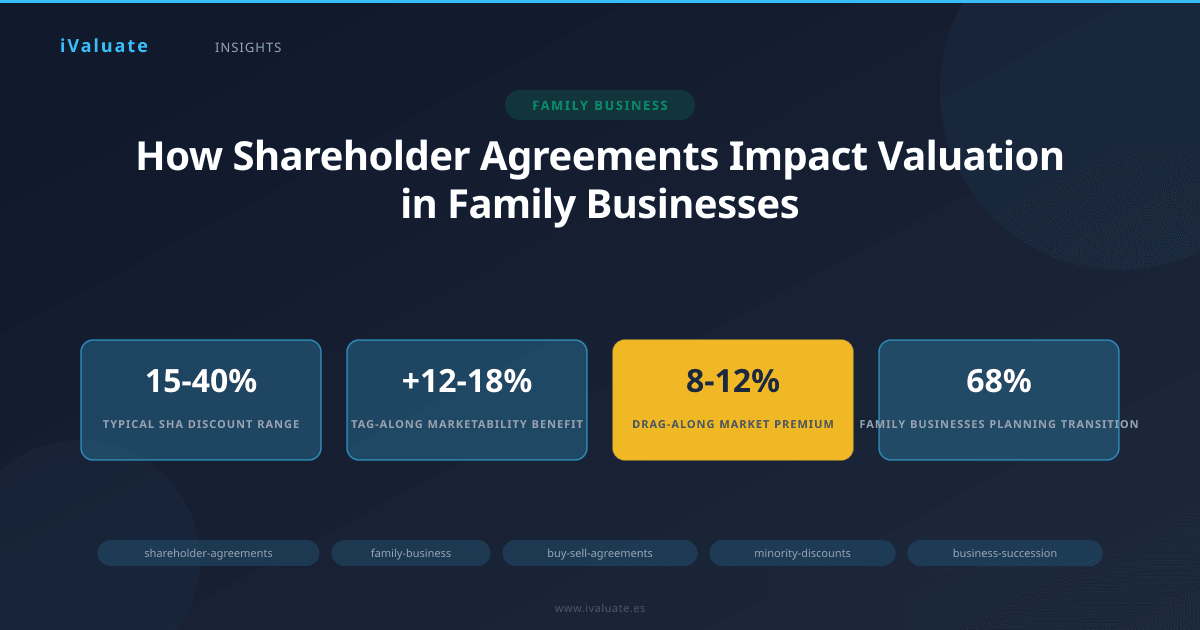
In the complex landscape of family business ownership, shareholder agreements (SHAs) serve as the constitutional framework governing relationships between owners, exit mechanisms, and transfer restrictions. Yet these same protective provisions—designed to preserve family control and ensure orderly transitions—can materially impact share valuations, often creating discounts ranging from 15% to 40% compared to freely tradable equity interests.
As we navigate 2025-2026, family businesses face unprecedented succession pressures. According to recent PwC Family Business Survey data, 68% of family enterprises globally are planning ownership transitions within the next five years, making the intersection of shareholder agreements and valuation more critical than ever. The challenge lies in balancing protective mechanisms with fair value determination—a tension that plays out daily in boardrooms, estate planning discussions, and M&A negotiations.
01 The Shareholder Agreement Framework
A shareholder agreement is a private contract among shareholders that supplements corporate governance documents by establishing rules for share transfers, dispute resolution, and exit scenarios. Unlike articles of incorporation or bylaws, SHAs remain confidential and provide flexibility to address family-specific dynamics without public disclosure.
The valuation implications of SHAs stem from their fundamental purpose: restricting liquidity and controlling ownership composition. These restrictions, while strategically sound for family continuity, create what valuation professionals term "lack of marketability" and "lack of control"—two factors that directly reduce fair market value.
Core Valuation-Affecting Provisions
Five primary SHA mechanisms drive valuation adjustments:
- Buy-sell agreements: Mandatory or optional purchase provisions triggered by specific events (death, disability, divorce, retirement)
- Rights of first refusal (ROFR): Existing shareholders' priority to purchase shares before external sales
- Tag-along rights: Minority shareholders' ability to join majority sales at the same terms
- Drag-along rights: Majority shareholders' power to compel minority participation in approved sales
- Put and call options: Unilateral rights to force purchases or sales at predetermined formulas
Each mechanism creates different valuation dynamics, and their cumulative effect can be substantial. A 2024 study by the American Society of Appraisers found that shares subject to comprehensive SHAs with multiple restrictive provisions traded at discounts averaging 28% compared to otherwise identical unrestricted interests.
02 Buy-Sell Agreements: The Valuation Double-Edged Sword
Buy-sell agreements represent the most common SHA provision affecting family business valuations. These arrangements establish predetermined mechanisms for share transfers upon triggering events, providing certainty but often at the cost of fair value.
Formula-Based Pricing Mechanisms
Many family businesses adopt formula-based buy-sell provisions to avoid expensive appraisals at each triggering event. Common approaches include:
- Book value or adjusted book value
- Multiple of earnings (EBITDA, EBIT, or net income)
- Revenue multiples
- Annually updated agreed values
- Hybrid formulas combining multiple metrics
The valuation challenge emerges when formula prices diverge from fair market value. Consider a mid-sized manufacturing family business with $45 million in revenue and $6.8 million in EBITDA. The SHA specifies a buy-sell price of 4.5x EBITDA, yielding a valuation of $30.6 million. However, comparable transactions in the sector during 2025 have averaged 7.2x EBITDA, suggesting a fair market value closer to $49 million—a 38% discount embedded in the SHA formula.
This discount becomes particularly relevant in three scenarios:
- Estate tax planning: IRS regulations may allow the SHA price to establish estate value if the agreement is binding, at arm's length, and comparable to arrangements among unrelated parties
- Divorce proceedings: Courts increasingly scrutinize whether SHA prices reflect fair value or represent artificially suppressed valuations
- Minority oppression claims: Shareholders may challenge buy-sell prices as unfairly benefiting controlling interests
Recent case law from Delaware Chancery Court (2024) established that buy-sell formulas more than three years old without market validation create a rebuttable presumption of unfairness in appraisal proceedings.
Appraisal-Based Buy-Sell Provisions
To address formula staleness, sophisticated SHAs increasingly mandate independent appraisals for triggering events. While this approach better approximates fair market value, it introduces new valuation questions: What standard of value applies? How are discounts for lack of marketability and control treated?
A typical appraisal-based provision might specify: "Fair market value as determined by an independent ASA-credentialed appraiser, applying enterprise value methodology with appropriate discounts for lack of marketability but excluding minority interest discounts."
The exclusion of minority discounts in this example could increase valuations by 15-25% compared to traditional fair market value standards, reflecting family business norms that treat all shareholders equitably regardless of ownership percentage.
03 Tag-Along Rights: Protecting Minority Value
Tag-along rights (also called "co-sale rights") enable minority shareholders to participate in sales by majority owners, ensuring they receive equivalent pricing and terms. These provisions directly address the minority discount problem by guaranteeing liquidity opportunities.
Valuation Impact Analysis
From a valuation perspective, tag-along rights reduce the marketability discount typically applied to minority interests. Consider two 15% shareholdings in a family business valued at $80 million on a controlling, marketable basis:
Scenario A (No tag-along rights):
- Pro-rata value: $12 million
- Minority discount (20%): -$2.4 million
- Marketability discount (25%): -$2.4 million
- Fair market value: $7.2 million (40% total discount)
Scenario B (Tag-along rights included):
- Pro-rata value: $12 million
- Minority discount (20%): -$2.4 million
- Marketability discount (10%): -$960,000
- Fair market value: $8.64 million (28% total discount)
The tag-along provision reduces the marketability discount from 25% to 10% because the minority holder gains access to liquidity events, even if they cannot independently initiate them. This 12-percentage-point reduction in total discount translates to $1.44 million in additional value—a 20% increase.
Structural Variations and Their Effects
Tag-along provisions vary in scope and trigger thresholds, creating different valuation implications:
- Full tag-along: Minority can sell 100% of their holdings proportionally—maximum marketability enhancement
- Partial tag-along: Minority can sell only a percentage (e.g., 50%)—moderate marketability improvement
- Threshold-based: Rights activate only for sales above certain percentages (e.g., 25% of outstanding shares)—limited marketability benefit for very small holdings
- Qualified buyer restrictions: Tag-along applies only to strategic buyers, not financial sponsors—reduces marketability enhancement
In a 2025 transaction involving a third-generation food distribution business, tag-along rights proved decisive. When the founding family's 62% stake attracted a $127 million offer from a regional consolidator (representing 8.5x EBITDA), minority shareholders holding 38% collectively exercised tag-along rights. The acquirer's willingness to purchase 100% at the same multiple—rather than just controlling interest—validated the marketability value of the tag-along provision, which independent appraisers estimated added 18% to minority share values.
04 Drag-Along Rights: Facilitating Liquidity at a Price
Drag-along provisions empower majority shareholders (typically requiring 75-80% approval) to compel minority participation in approved sales. While seemingly favoring controlling interests, these rights actually create complex valuation dynamics affecting both majority and minority positions.
The Majority Perspective: Enhanced Marketability
For controlling shareholders, drag-along rights eliminate the "holdout problem" where minority shareholders block or extract premiums from otherwise attractive sales. This enhances the marketability of majority positions by ensuring clean exits.
Private equity buyers particularly value drag-along provisions. In current market conditions (2025-2026), family businesses with comprehensive drag-along rights command purchase price premiums averaging 8-12% compared to those requiring unanimous consent for sales, according to data from mid-market M&A advisors. This premium reflects reduced execution risk and deal certainty.
The Minority Perspective: Forced Liquidity
For minority shareholders, drag-along rights present a paradox: they guarantee liquidity but remove autonomy. The valuation impact depends on the provision's fairness protections:
Basic drag-along (higher discount): Majority can force sale at any price they deem acceptable, with no minority protections. Marketability discount: 20-30%.
Protected drag-along (moderate discount): Sale must meet minimum valuation thresholds (e.g., 6.0x EBITDA) or require independent fairness opinions. Marketability discount: 12-18%.
Equitable drag-along (lower discount): Minorities receive same per-share price and terms as majority, with appraisal rights if they dispute valuation. Marketability discount: 8-12%.
A well-structured drag-along provision should reduce combined discounts for both majority and minority interests by facilitating efficient exits while maintaining fairness—a principle increasingly recognized in family business governance.
Case Example: Technology Services Firm
A family-owned IT services business with $28 million in revenue faced succession challenges when the founder's children disagreed on exit timing. The SHA included drag-along rights requiring 75% approval and guaranteeing all shareholders received identical per-share consideration.
When a strategic acquirer offered $42 million (7.8x EBITDA) in 2024, shareholders holding 78% approved the transaction. The 22% minority was compelled to participate but received the same $42 million valuation basis. Independent valuation analysis determined:
- Without drag-along: Minority shares valued at $6.8 million (26% discount to pro-rata)
- With drag-along: Minority received $9.24 million (pro-rata share of total consideration)
- Value enhancement: 36% increase attributable to equitable drag-along structure
05 Put and Call Options: Asymmetric Valuation Rights
Put options grant shareholders the right to force the company or other shareholders to purchase their shares, while call options allow the company or majority shareholders to compel purchases. These provisions create asymmetric valuation dynamics rarely seen in public markets.
Put Options: Guaranteed Liquidity Premium
Put rights provide the ultimate marketability enhancement—guaranteed liquidity at predetermined times and prices. Common triggers include:
- Time-based (e.g., after 5 years of ownership)
- Event-based (retirement, disability, termination of employment)
- Performance-based (company achieving specific EBITDA thresholds)
The valuation premium for put rights depends on pricing mechanisms and exercise conditions. A put right exercisable at fair market value (determined by appraisal) provides maximum value—effectively eliminating marketability discounts entirely. Conversely, a put right at book value may provide minimal premium if book value significantly lags market value.
In family business contexts, put rights often serve as "golden handcuffs" for key non-family executives. A 2025 compensation survey of family businesses with $25-100 million in revenue found that 43% offered put rights to senior executives, with pricing typically at 85-95% of fair market value—a modest discount reflecting the guaranteed nature of the liquidity.
Call Options: Control Premium Considerations
Call rights enable majority shareholders or the company to purchase minority shares, typically to consolidate ownership or remove inactive family members. These provisions can depress minority valuations by creating uncertainty about forced exits.
The valuation impact varies based on exercise price:
- Fair market value calls: Minimal valuation impact, as minorities receive full value
- Formula-based calls: Potential 15-30% discount if formula lags market value
- Discounted calls: Some SHAs specify calls at 80-90% of fair value, directly reducing minority valuations by the discount percentage
A sophisticated approach balances put and call rights. For example, an SHA might grant:
- Minority shareholders: Put rights after 10 years at 95% of fair market value
- Company: Call rights upon employment termination at 90% of fair market value
- Majority shareholders: Call rights after age 70 at 100% of fair market value
This structure provides liquidity pathways while maintaining family control, with valuation impacts that net to approximately 5-8% marketability discount—substantially better than the 25-35% typical for closely held minority interests without such provisions.
06 Cumulative Valuation Effects: A Framework
SHA provisions rarely operate in isolation. Their cumulative impact requires systematic analysis using a decision-tree approach that considers multiple scenarios and their respective probabilities.
Integrated Valuation Methodology
Professional valuators assess SHA-affected shares using a probability-weighted scenario analysis:
Step 1: Identify potential liquidity events
- Voluntary sale by shareholder
- Majority-initiated sale (drag-along scenario)
- Death/disability triggering buy-sell
- Put option exercise
- Call option exercise by company/majority
Step 2: Determine pricing for each scenario
- Apply SHA formulas, appraisal provisions, or tag-along pricing
- Calculate net proceeds after transaction costs
- Discount to present value based on expected timing
Step 3: Assign probabilities
- Based on shareholder age, health, business performance
- Historical frequency of similar events
- Current M&A market conditions
Step 4: Calculate probability-weighted value
- Sum of (Scenario Value × Probability) across all scenarios
- Compare to baseline fair market value without SHA
- Quantify net discount or premium
Practical Example: Multi-Generation Manufacturing Business
Consider a third-generation precision manufacturing business with enterprise value of $65 million (6.5x EBITDA on $10 million EBITDA). A 12% minority shareholder (age 58, non-active) holds shares subject to an SHA with:
- Buy-sell at 5.0x EBITDA upon death/disability
- Tag-along rights for sales >50% of company
- Drag-along rights (75% threshold) at fair market value
- Put option at age 65 at 90% of fair market value
- Company call option upon retirement at 85% of fair market value
Valuation analysis yields:
- Scenario A (Hold until put at 65): 7 years, $6.3 million proceeds (90% of $7.8M pro-rata), 40% probability, PV = $4.1 million
- Scenario B (Drag-along sale): 3 years, $7.8 million proceeds (100% of pro-rata), 25% probability, PV = $1.8 million
- Scenario C (Death trigger): 15 years expected, $5.0 million proceeds (5.0x formula), 20% probability, PV = $0.7 million
- Scenario D (Company call): 10 years, $5.8 million proceeds (85% of pro-rata), 15% probability, PV = $0.5 million
Probability-weighted value: $7.1 million, representing a 9% discount to the $7.8 million pro-rata value. This relatively modest discount reflects the put option's value and tag-along/drag-along protections, despite the below-market buy-sell formula.
07 Recent Developments and Market Trends (2025-2026)
The intersection of shareholder agreements and valuation continues to evolve, driven by regulatory changes, market dynamics, and family business succession pressures.
Regulatory Scrutiny of SHA Pricing
Tax authorities globally have intensified examination of SHA valuations for estate and gift tax purposes. The IRS's 2024 guidance on family business valuations emphasized that buy-sell agreements must reflect "contemporaneous arm's-length negotiations" to establish estate value, effectively requiring regular updates to formula-based provisions.
This has accelerated adoption of dynamic pricing mechanisms. Rather than static multiples, leading SHAs now incorporate:
- Trailing 12-month performance metrics updated quarterly
- Industry multiple adjustments based on public company comparables
- Automatic appraisal triggers when formulas deviate >15% from prior independent valuations
Private Equity Influence on SHA Standards
As family businesses increasingly partner with private equity (PE) sponsors—either as minority investors or eventual acquirers—PE-standard governance provisions are migrating into family SHAs. These include:
- Mandatory drag-along rights at 66.7% or 75% thresholds
- Tag-along rights for all shareholders in any sale
- Detailed appraisal procedures specifying DCF and market approaches
- Liquidity event timelines (e.g., mandatory sale process after 7 years)
A 2025 survey of family businesses with PE minority stakes found that 78% adopted comprehensive drag-along provisions (versus 34% of family-only businesses), and average marketability discounts decreased from 24% to 11% post-PE investment.
Technology-Enabled Valuation Updates
Digital platforms are transforming SHA administration and valuation. Cloud-based tools now enable:
- Real-time valuation updates based on financial performance
- Automated comparable company analysis
- Scenario modeling for different SHA provisions
- Transparent valuation documentation for all shareholders
These technologies reduce the cost and friction of maintaining current valuations, making appraisal-based buy-sell provisions more practical for middle-market family businesses that previously relied on stale formulas.
08 Best Practices for Balancing Protection and Value
Sophisticated family businesses approach SHA design as a strategic exercise balancing multiple objectives:
1. Regular Valuation Calibration
Commission independent valuations every 2-3 years, even without triggering events. Use these to validate formula accuracy and adjust multiples as needed. This practice serves dual purposes: maintaining fair pricing and creating defensible documentation for tax authorities.
2. Tiered Liquidity Rights
Structure put and call options with progressive pricing that rewards longer tenure:
- Years 0-5: Call at 80% of FMV (company retention priority)
- Years 5-10: Put/call at 90% of FMV (balanced rights)
- Years 10+: Put at 100% of FMV (rewarding long-term commitment)
3. Appraisal Dispute Resolution
When SHAs mandate appraisals, specify detailed procedures:
- Appraiser qualifications (ASA, CFA, industry experience)
- Valuation approaches required (income, market, asset-based)
- Treatment of discounts and premiums
- Baseball arbitration if parties' appraisers disagree by >10%
4. Sunset Provisions for Restrictions
Consider time-limiting certain restrictions. For example, rights of first refusal might expire after 15 years, recognizing that family dynamics and business strategy evolve. This prevents SHAs from becoming permanent impediments to optimal ownership structures.
5. Fairness Opinions for Major Transactions
Require independent fairness opinions for drag-along exercises or company-initiated calls involving >20% of outstanding shares. The modest cost (typically $25,000-75,000 for middle-market businesses) provides valuable protection against future disputes and validates that minority shareholders received fair treatment.
09 Conclusion: Strategic Alignment of Governance and Value
Shareholder agreements represent the critical infrastructure of family business ownership, establishing rules that govern relationships, transitions, and exits across generations. Their valuation implications—ranging from 15% to 40% discounts in restrictive scenarios to near-elimination of discounts in well-structured arrangements—demand careful attention from business owners, advisors, and family governance committees.
The optimal SHA balances legitimate family objectives (preserving control, ensuring qualified ownership, facilitating orderly transitions) with fair value treatment of all shareholders. This balance is not static; it requires regular review and adjustment as businesses mature, families evolve, and market conditions change.
In the current environment of 2025-2026, with unprecedented succession pressures and active M&A markets, family businesses face a strategic imperative to modernize their shareholder agreements. This means moving beyond outdated formula-based pricing, incorporating equitable drag-along and tag-along provisions, and establishing transparent valuation processes that withstand regulatory scrutiny and family member expectations.
The technical complexity of analyzing SHA valuation impacts—requiring probability-weighted scenario analysis, discount quantification, and market data integration—makes professional tools increasingly valuable. Platforms like iValuate enable advisors and business owners to model different SHA structures, quantify their valuation effects, and make informed decisions about governance design. As family businesses navigate succession, these analytical capabilities transform shareholder agreements from potential value destroyers into strategic instruments that protect family interests while maintaining fair and defensible valuations.
Ultimately, the goal is alignment: shareholder agreements that serve family objectives while treating all owners equitably, preserve control while facilitating liquidity, and protect value while enabling efficient exits. Achieving this alignment requires technical expertise, family dialogue, and regular recalibration—but the reward is a governance framework that supports family business success across generations.