Table of Contents9 sections
Shareholder agreements (SHAs) represent one of the most consequential yet frequently underestimated factors in family business valuation. While traditional valuation methodologies focus on cash flows, market multiples, and risk-adjusted discount rates, the contractual framework governing share transferability can materially impact the economic value realized by shareholders—often creating discounts ranging from 15% to 40% depending on the restrictiveness of transfer provisions.
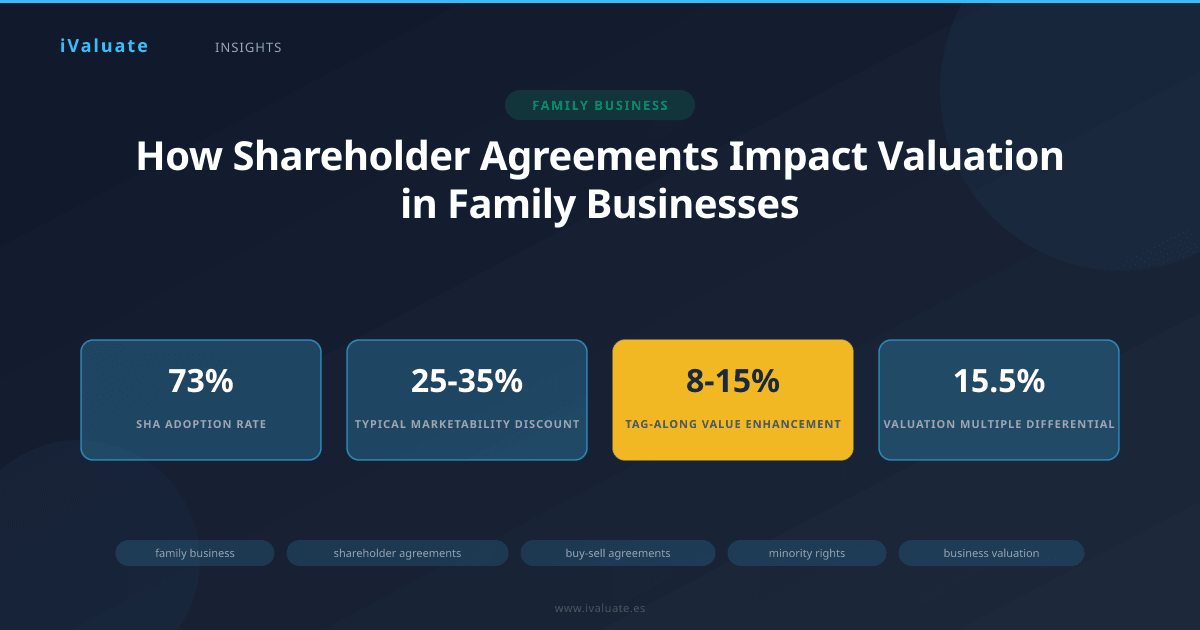
In 2025-2026, as family businesses navigate generational transitions amid elevated interest rates and compressed public market multiples, the intersection of shareholder agreements and valuation has become increasingly critical. Recent survey data from the Family Business Institute indicates that 73% of family-owned enterprises with revenues exceeding $50 million now maintain formal shareholder agreements, up from 58% in 2020. Yet fewer than half of these agreements contain properly structured valuation clauses that reflect current market realities.
01 The Economic Reality of Transfer Restrictions
Shareholder agreements fundamentally alter the bundle of rights associated with equity ownership. While a shareholder in a publicly traded company enjoys near-perfect liquidity and can exit at prevailing market prices within seconds, shareholders in family businesses face contractual constraints that create what valuation professionals term "lack of marketability" and "lack of control" discounts.
The magnitude of these discounts depends on several interrelated factors embedded within the SHA:
- Right of first refusal (ROFR) provisions: Typically create 10-20% discounts by introducing transaction friction and uncertainty
- Absolute transfer restrictions: Can generate 25-40% discounts when shares cannot be sold to third parties under any circumstances
- Mandatory buy-sell triggers: Impact depends on whether pricing formulas reflect fair market value or use predetermined multiples
- Tag-along and drag-along mechanisms: Can either enhance or diminish minority share value depending on structure
A 2024 study analyzing 847 private company transactions found that companies with restrictive shareholder agreements traded at enterprise value multiples averaging 8.7x EBITDA, compared to 10.3x EBITDA for comparable businesses with more flexible governance structures—a 15.5% differential attributable primarily to transfer restrictions rather than operational differences.
02 Buy-Sell Agreements: Mechanics and Valuation Implications
Buy-sell agreements establish predetermined mechanisms for share transfers triggered by specific events: death, disability, retirement, divorce, bankruptcy, or voluntary departure. These provisions serve legitimate business continuity purposes but create valuation complexities that require careful analysis.
Cross-Purchase vs. Redemption Structures
The structural choice between cross-purchase arrangements (where remaining shareholders purchase departing shares) and entity redemption (where the company itself repurchases shares) carries distinct valuation implications:
In cross-purchase structures, remaining shareholders acquire proportionate ownership increases, potentially enhancing per-share value through increased control. However, this benefit must be weighed against the liquidity demands placed on continuing shareholders, which may necessitate premium financing costs or force suboptimal asset liquidations.
Entity redemptions avoid burdening individual shareholders but reduce total enterprise value and may trigger adverse tax consequences. A manufacturing company we analyzed in 2025 faced a $4.2 million redemption obligation following a founder's retirement. The redemption reduced working capital by 18%, forcing the company to curtail a planned facility expansion and ultimately depressing the value of remaining shares by approximately 12% relative to pre-redemption levels.
Valuation Formula Provisions
The most contentious aspect of buy-sell agreements involves the pricing mechanism. Common approaches include:
Fixed price formulas: Shareholders agree to update share values annually, often based on book value or a multiple of earnings. These provisions create significant valuation risk, as agreed prices frequently lag economic reality. In our experience, fixed-price provisions in family business SHAs are outdated by an average of 22 months, creating potential windfalls or penalties depending on whether the triggering event occurs during a growth phase or downturn.
Formula-based pricing: Agreements specify a multiple of revenue, EBITDA, or book value. While more dynamic than fixed prices, formula approaches often fail to capture company-specific factors, competitive positioning, or market conditions. A distribution business with a 5.0x EBITDA formula in its SHA faced a triggering event in late 2024 when industry multiples had compressed to 4.2x due to supply chain normalization and margin pressure. The formula overvalued departing shares by approximately $1.8 million, creating tension among remaining family shareholders.
Independent appraisal provisions: The most robust approach requires professional valuation upon triggering events. However, agreements must carefully specify the standard of value (fair market value, fair value, or investment value), premise of value (going concern vs. liquidation), and level of value (controlling vs. minority interest). Ambiguous appraisal provisions generated 34% of family business valuation disputes litigated in 2024-2025, according to business court filings.
Critical consideration: Buy-sell pricing mechanisms should be stress-tested against multiple scenarios—economic downturns, margin compression, and liquidity constraints—to ensure they produce equitable outcomes regardless of when triggering events occur.
03 Tag-Along Rights: Protecting Minority Shareholders
Tag-along rights (also called "co-sale rights") allow minority shareholders to participate in sales initiated by majority or controlling shareholders. These provisions protect minority interests by preventing scenarios where controlling shareholders exit at premium valuations while minorities remain locked in illiquid positions.
Economic Impact on Share Value
Well-structured tag-along rights typically enhance minority share values by 8-15% by providing a liquidity pathway that would otherwise be unavailable. The value enhancement depends on several factors:
- Trigger thresholds: Whether tag-along rights activate for any sale or only for transfers exceeding specified ownership percentages
- Pro-rata vs. full participation: Whether minorities can sell proportionate stakes or their entire holdings
- Price parity: Whether minorities receive the same per-share price as controlling shareholders or a discounted amount
A case example illustrates the valuation significance: A third-generation food processing company with $85 million in revenue maintained an SHA granting tag-along rights to all shareholders for any sale exceeding 25% of outstanding shares. When the founding family decided to sell 60% to a private equity buyer in early 2025 at 9.2x EBITDA, minority shareholders (representing 18% of equity) exercised tag-along rights, receiving the same valuation multiple. Without tag-along protection, these minority shares would likely have been valued at 6.5-7.0x EBITDA, reflecting typical minority discounts of 25-30%.
Structural Nuances That Matter
Tag-along provisions require careful drafting to avoid unintended consequences:
Threshold considerations: Setting tag-along triggers too low (e.g., any transfer over 5%) may impede legitimate estate planning transfers or small-scale liquidity events. Conversely, high thresholds (e.g., 50%+) may fail to protect minorities in scenarios where controlling shareholders sell just below the trigger.
Timing and notice requirements: Minorities typically receive 20-45 days to exercise tag-along rights after receiving notice of a proposed sale. Insufficient time periods disadvantage minority shareholders who may need to consult advisors or arrange personal financial affairs. Excessive periods can cause deal fatigue and increase the risk of transaction failure.
Buyer approval rights: Some agreements allow prospective buyers to reject minority participation, effectively nullifying tag-along protection. Best practice provisions make minority participation a condition of the controlling shareholder's sale, ensuring economic parity.
04 Drag-Along Rights: Facilitating Liquidity Events
Drag-along rights enable majority or controlling shareholders to compel minority shareholders to participate in approved sales, preventing small stakeholders from blocking value-maximizing transactions. These provisions have become increasingly prevalent as private equity and strategic buyers demand 100% ownership in acquisition transactions.
Valuation Implications for Minority Interests
Drag-along rights create a nuanced valuation dynamic. On one hand, they eliminate the "holdout premium" that minorities might otherwise extract by threatening to block transactions. This typically reduces minority share values by 5-10% relative to scenarios where minorities possess blocking rights.
Conversely, drag-along provisions can enhance minority values by ensuring participation in premium-priced exit events that might not occur if buyer demands for 100% ownership cannot be satisfied. The net effect depends on the probability and pricing of potential exit scenarios.
Quantitative modeling of a representative family business illustrates this dynamic: A specialty manufacturing company with 65% family ownership and 35% held by non-family management maintained drag-along provisions requiring 75% shareholder approval for activation. Scenario analysis revealed:
- Scenario 1 (No drag-along): Minority shares valued at $8.2 million based on discounted cash flow analysis with 30% marketability discount
- Scenario 2 (Drag-along included): Minority shares valued at $9.1 million, reflecting 15% probability of exit event at 10.5x EBITDA within 5 years, partially offset by loss of holdout value
The 11% value enhancement attributable to drag-along rights reflected the specific circumstances of this business, including strong strategic buyer interest and family shareholders' stated succession planning timeline.
Protecting Minority Interests in Drag-Along Scenarios
Well-designed drag-along provisions include safeguards that prevent value destruction for minorities:
Minimum price thresholds: Drag-along rights activate only if the proposed sale price meets or exceeds specified valuation benchmarks (e.g., 8.0x trailing twelve-month EBITDA or 1.2x book value). This prevents controlling shareholders from forcing minorities into disadvantageous sales.
Independent fairness opinions: Requiring third-party valuation opinions for drag-along transactions provides objective validation that minorities receive fair value. In 2025, approximately 42% of family business SHAs with drag-along provisions included fairness opinion requirements for transactions exceeding $25 million in enterprise value.
Qualified buyer definitions: Some agreements limit drag-along rights to sales involving strategic buyers or financial sponsors meeting specified creditworthiness criteria, preventing forced sales to undercapitalized or operationally risky buyers.
Key insight: Drag-along provisions should be viewed as liquidity enablers rather than minority oppression mechanisms. Properly structured, they enhance overall enterprise value while protecting all shareholders through appropriate guardrails.
05 Put and Call Options: Asymmetric Rights and Valuation
Put and call options create asymmetric rights allowing one party to force transactions while the counterparty must comply. These provisions appear frequently in family business SHAs, particularly in generational transition scenarios or when bringing in outside investors.
Put Options: Minority Liquidity Rights
Put options grant shareholders (typically minorities) the right to require the company or other shareholders to purchase their shares at predetermined prices or pursuant to specified formulas. These provisions enhance minority share values by creating liquidity that would otherwise be unavailable, typically adding 10-18% to baseline valuations.
The value enhancement depends critically on:
- Exercise timing: Whether puts are exercisable immediately, after specified holding periods, or only upon triggering events
- Pricing mechanisms: Whether put prices reflect fair market value or predetermined formulas
- Payment terms: Whether purchase obligations must be satisfied immediately or can be structured as installment payments
A representative example: A regional logistics company granted put options to non-family executives who received equity compensation, exercisable after five years of service at fair market value determined by independent appraisal. When a key executive exercised puts in 2025 for shares representing 4% of equity, the independent appraisal valued shares at $3.8 million. However, the company's limited cash flow required structuring payment over four years, creating present value considerations that reduced the executive's realized value by approximately 12% (assuming 8% discount rate).
Call Options: Controlling Shareholder Rights
Call options allow controlling shareholders or the company to purchase shares from minorities at predetermined prices or formulas. These provisions typically reduce minority share values by 12-22% by introducing uncertainty about holding period and eliminating the minority's ability to time exits advantageously.
Call options serve legitimate purposes in family businesses, including:
- Facilitating ownership consolidation during generational transitions
- Removing shareholders who violate non-compete or confidentiality obligations
- Enabling repurchase of shares from divorced spouses or creditors in bankruptcy scenarios
However, call provisions can be abused if pricing mechanisms undervalue shares or if controlling shareholders can exercise calls opportunistically. Best practices include:
Fair value pricing: Call prices should reflect fair market value determined by independent appraisal rather than book value or outdated formulas. A 2024 analysis of 156 family business disputes found that 67% of call option controversies involved pricing mechanisms that failed to reflect economic reality.
Limited exercise windows: Restricting call rights to specific circumstances (e.g., employment termination, breach of obligations) rather than allowing exercise at will prevents opportunistic timing by controlling shareholders.
Right of first refusal integration: Coordinating call options with ROFR provisions ensures consistent treatment across different transfer scenarios.
06 Valuation Methodology Considerations
Accurately valuing shares subject to shareholder agreement restrictions requires adapting traditional valuation methodologies to reflect contractual constraints.
Discounted Cash Flow Adjustments
When using DCF methodology, shareholder agreement provisions affect both the discount rate and terminal value calculations. Restricted transferability increases the required rate of return by 200-400 basis points depending on restriction severity, reflecting the illiquidity premium investors demand.
For minority interests subject to tag-along and drag-along rights, terminal value calculations should incorporate probability-weighted exit scenarios reflecting the likelihood of participating in premium-priced sales versus remaining indefinitely illiquid.
Market Approach Modifications
Guideline public company and transaction multiples require adjustment when valuing shares subject to SHAs. The typical sequence involves:
- Selecting appropriate public company or transaction comparables
- Calculating indicated multiples (EV/EBITDA, EV/Revenue, P/E)
- Applying company-specific adjustments for size, growth, profitability
- Applying control premium or minority discount as appropriate
- Applying marketability discount reflecting SHA restrictions
The marketability discount for shares subject to comprehensive SHAs with restrictive transfer provisions typically ranges from 25-35%, compared to 20-25% for shares with more flexible agreements including tag-along rights.
Option Pricing Models for Put/Call Provisions
Sophisticated valuations of shares with put or call options employ option pricing models (Black-Scholes or binomial models) to quantify the value of these asymmetric rights. Key inputs include:
- Current share value (underlying asset price)
- Exercise price specified in SHA
- Time to expiration or exercise window
- Volatility of underlying business value
- Risk-free rate
A manufacturing company valuation we conducted in 2025 illustrates this approach: Minority shares with five-year put options exercisable at fair market value were valued using a binomial model that incorporated 35% business value volatility (estimated from comparable public companies) and 4.2% risk-free rate. The model indicated that put option rights added approximately $1.4 million (14%) to baseline minority share value of $10 million.
07 Recent Market Trends and Emerging Practices
Several trends are reshaping how family businesses structure shareholder agreements and valuation provisions in 2025-2026:
Dynamic valuation formulas: Rather than static multiples, progressive SHAs now incorporate market-responsive formulas that adjust based on industry conditions, interest rate environments, or public market comparable performance. Approximately 28% of new family business SHAs drafted in 2024-2025 included dynamic pricing mechanisms, up from 12% in 2020-2021.
Hybrid liquidity windows: Some agreements now establish periodic liquidity windows (e.g., every 24-36 months) during which shareholders can sell to the company or other shareholders at independently appraised values, balancing stability with liquidity needs.
Earnout and deferred consideration: To manage cash flow constraints, modern buy-sell provisions increasingly incorporate earnout structures where departing shareholders receive base payments at closing plus performance-based earnouts over 2-4 years, aligning interests and spreading payment obligations.
Institutional investor provisions: As family businesses increasingly partner with private equity and family offices, SHAs must accommodate institutional investor requirements including information rights, board representation, and specific exit timelines, creating additional valuation complexity.
08 Practical Implications for Business Owners and Advisors
For family business owners, CFOs, and their advisors, several practical considerations emerge:
Regular SHA review and updates: Shareholder agreements should be reviewed every 24-36 months to ensure valuation provisions reflect current market conditions, business performance, and family circumstances. Agreements drafted during low-interest-rate environments (2010-2021) may contain valuation formulas that produce inappropriate results in today's higher-rate environment.
Scenario testing: Before finalizing SHA provisions, model multiple scenarios including economic downturns, unexpected deaths, family disputes, and premium exit opportunities to ensure provisions produce equitable outcomes across diverse circumstances.
Integration with estate and tax planning: Shareholder agreement provisions must coordinate with estate planning strategies, particularly regarding valuation discounts for gift and estate tax purposes. Recent IRS scrutiny of family business valuations makes this coordination increasingly critical.
Professional valuation input: Engage qualified valuation professionals when drafting or updating shareholder agreements to ensure pricing mechanisms reflect sound methodology and current market practices. The cost of professional input (typically $15,000-$45,000 for comprehensive SHA valuation analysis) is modest compared to potential disputes or value destruction from poorly structured provisions.
09 Conclusion: Aligning Governance and Value
Shareholder agreements represent far more than legal formalities—they constitute fundamental economic arrangements that materially impact share values in family businesses. The difference between well-structured and poorly designed SHAs can easily represent 20-30% of shareholder value, particularly for minority interests.
As family businesses navigate succession planning, generational transitions, and potential liquidity events in 2025-2026, the intersection of shareholder agreements and valuation deserves careful attention from business owners, boards, and their advisors. The key is balancing legitimate business continuity and family harmony objectives with fair economic treatment of all shareholders.
Tag-along rights that ensure minority participation in premium exits, drag-along provisions that facilitate value-maximizing transactions while protecting against underpriced sales, and buy-sell mechanisms that reflect current market realities all contribute to shareholder agreement frameworks that enhance rather than diminish enterprise value.
For professionals conducting valuations of family businesses, thorough analysis of shareholder agreement provisions is not optional—it's essential to reaching supportable conclusions about share value. Modern valuation platforms like iValuate enable efficient analysis of how SHA provisions impact value across multiple methodologies and scenarios, helping advisors deliver technically rigorous valuations that withstand scrutiny in transaction negotiations, dispute resolution, and tax reporting contexts.
Ultimately, the most successful family businesses recognize that shareholder agreements and valuation are not competing priorities but complementary elements of sound governance. When properly aligned, they create frameworks that protect family harmony, ensure business continuity, and maximize value for all stakeholders across generations.