Table of Contents8 sections
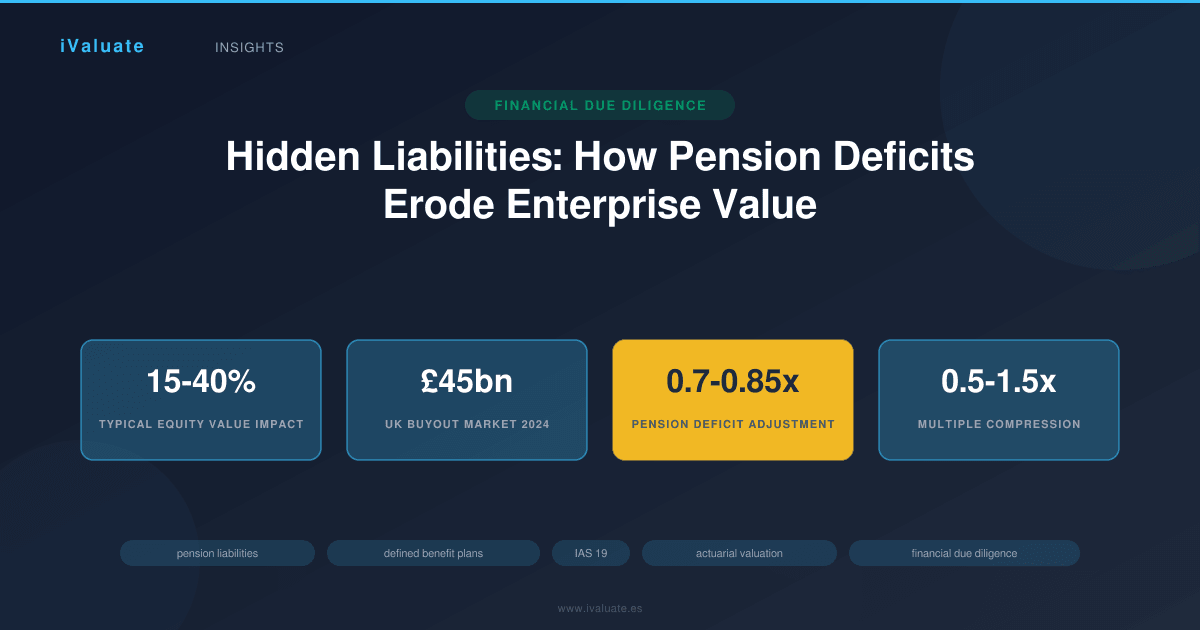
In the complex landscape of corporate valuation and financial due diligence, few items generate as much confusion—and potential value destruction—as defined benefit (DB) pension obligations. While most acquirers meticulously scrutinize revenue quality, working capital, and EBITDA adjustments, pension liabilities often receive cursory treatment until late in the process. This oversight can prove costly: in industries with legacy DB plans, unfunded pension obligations can reduce enterprise value by 15% to 40%, fundamentally altering deal economics and post-acquisition cash flow profiles.
As we navigate the 2025-2026 market environment, characterized by elevated interest rates following the aggressive monetary tightening cycle of 2022-2024, pension accounting has become even more critical. The interplay between discount rates, longevity assumptions, and asset performance creates a dynamic liability that requires sophisticated analysis. For CFOs, M&A advisors, and private equity professionals, understanding the nuances of pension valuation is no longer optional—it's essential for protecting shareholder value.
01 The Mechanics of Defined Benefit Pension Obligations
Defined benefit pension plans promise employees a specified monthly benefit at retirement, typically based on salary history and years of service. Unlike defined contribution plans (401(k) in the US, workplace pensions in the UK), where the employer's obligation ends with the contribution, DB plans create a long-term liability that extends decades into the future. The employer bears investment risk, longevity risk, and inflation risk—a trifecta that can devastate balance sheets when poorly managed.
Under IAS 19 (Employee Benefits), the international accounting standard that governs pension reporting, companies must recognize the net defined benefit liability (or asset) on their balance sheet. This figure represents the present value of the defined benefit obligation (DBO) minus the fair value of plan assets. The calculation involves multiple actuarial assumptions:
- Discount rate: The rate used to present-value future benefit payments, typically based on high-quality corporate bond yields. In early 2025, UK discount rates hover around 4.8-5.2% for typical plan durations, up from 1.3-1.8% in 2020, dramatically reducing reported liabilities.
- Inflation assumptions: Both general price inflation and salary growth projections affect future benefit obligations. Current UK RPI assumptions range from 3.0-3.4%, with CPI typically 0.7-1.0% lower.
- Mortality tables: Life expectancy assumptions directly impact liability duration. The adoption of CMI_2023 mortality tables in the UK, reflecting post-pandemic mortality experience, has modestly reduced liabilities for some plans.
- Expected return on assets: While this doesn't affect the balance sheet liability under IAS 19, it influences pension expense and cash funding requirements.
The sensitivity to these assumptions is profound. A 0.5% decrease in the discount rate can increase pension liabilities by 8-12% for a typical mature plan. Similarly, a one-year increase in life expectancy can add 3-5% to obligations. These aren't theoretical concerns—they represent real economic exposure that flows through to equity value.
02 The Pension Deficit: From Accounting Entry to Valuation Impact
When plan assets fall short of the defined benefit obligation, a pension deficit emerges. This deficit has three distinct impacts on enterprise value, each requiring separate analysis during due diligence:
1. Balance Sheet Impact and Net Debt Adjustments
The most direct effect appears on the balance sheet. Under IAS 19, the net pension deficit is recorded as a liability, reducing shareholders' equity. In an M&A context, sophisticated buyers treat pension deficits as debt-like obligations when calculating enterprise value. However, the treatment isn't always straightforward.
Consider a UK manufacturing company with £500 million in enterprise value, £100 million in net financial debt, and a £75 million pension deficit (DBO of £425 million less plan assets of £350 million). A simplistic approach would add the full £75 million deficit to net debt, yielding an implied equity value of £325 million. But this ignores three critical factors:
- Tax shield: Pension contributions are tax-deductible. At a 25% UK corporate tax rate, the after-tax cost of funding the deficit is approximately £56 million, not £75 million.
- Funding timeline: Regulatory requirements may allow the deficit to be funded over 10-15 years, creating a present value consideration. If the company can fund £7.5 million annually over 10 years at a 5% discount rate, the present value is approximately £58 million.
- Surplus restrictions: In some jurisdictions, pension surpluses cannot be recovered by the company, creating an asymmetric risk profile that warrants a valuation discount beyond the accounting figures.
Leading practitioners typically apply a 0.7-0.85x multiple to pension deficits when calculating adjusted net debt, reflecting the tax benefit and extended funding horizon. This nuanced approach can shift equity value by millions in large transactions.
2. Cash Flow Impact: Ongoing Service Cost and Deficit Contributions
Beyond the balance sheet, pension obligations create two distinct cash flow drains that affect normalized EBITDA and free cash flow projections:
The service cost represents the present value of benefits earned by active employees during the period. For a mature workforce in a closed plan (no new entrants), this may be £5-15 million annually for a mid-sized company. This is an ongoing operational expense that should be reflected in normalized EBITDA calculations, yet it's often buried in pension expense line items that also include non-cash interest costs.
More significant are deficit reduction contributions—the additional cash payments required to eliminate funding shortfalls over time. UK pension regulations, enforced by The Pensions Regulator, typically require agreed deficit recovery plans following triennial valuations. These contributions can be substantial: a company with a £200 million deficit might commit to £20-25 million in annual deficit payments over 8-10 years, representing a meaningful cash drain that doesn't appear in EBITDA but devastates free cash flow.
In a recent 2024 transaction involving a UK industrial services company, the target had reported EBITDA of £45 million but faced £12 million in annual deficit contributions through 2032. The buyer reduced the EBITDA multiple from 8.5x to 7.2x, arguing that the pension-adjusted free cash flow yield was materially lower than comparable companies without legacy DB obligations. The valuation impact exceeded £50 million—more than 10% of enterprise value.
3. Risk Premium and Multiple Compression
Perhaps most insidious is the risk premium that pension obligations introduce into valuation multiples. Investors and acquirers demand higher returns (lower multiples) for companies with significant pension exposure due to:
- Volatility: Pension deficits can swing by tens of millions annually based on discount rate movements, creating earnings and balance sheet volatility that equity markets penalize.
- Regulatory risk: Pension regulators can impose additional funding requirements, restrict dividends, or demand security over company assets if funding deteriorates.
- Covenant constraints: Pension trustees often negotiate for veto rights over major corporate actions (acquisitions, dividends, asset sales), limiting management flexibility.
- Longevity tail risk: Medical advances could extend life expectancy beyond actuarial assumptions, creating open-ended liability growth.
Empirical research on UK and European public companies suggests that firms with pension deficits exceeding 15% of market capitalization trade at EV/EBITDA multiples 0.5-1.5x lower than pension-light peers, controlling for sector, growth, and profitability. In private M&A, this discount manifests as lower headline multiples or aggressive price adjustments during negotiations.
03 Actuarial Valuation: Beyond the IAS 19 Numbers
While IAS 19 provides the accounting framework, transaction due diligence requires a deeper actuarial analysis. The accounting valuation, prepared annually by scheme actuaries, serves financial reporting purposes but may not reflect economic reality or regulatory funding requirements. Sophisticated buyers commission independent actuarial reviews that examine:
Assumption Benchmarking
Are the target's actuarial assumptions reasonable relative to market practice? In 2025, we observe significant variation in key assumptions across UK pension schemes:
- Discount rates: Range from 4.6% to 5.4% for schemes with similar duration profiles, depending on whether actuaries reference gilt yields plus a spread or direct corporate bond yields.
- Inflation: RPI assumptions vary from 2.9% to 3.5%, with the lower end reflecting expectations of RPI/CPI reform impacts.
- Mortality: Some schemes still use CMI_2021 with conservative long-term improvement rates of 1.5% p.a., while others have adopted CMI_2023 with 1.0-1.25% improvements, reflecting pandemic mortality effects.
A target company using aggressive (liability-reducing) assumptions may be understating its true economic obligation. For example, if a scheme uses a 5.3% discount rate when market practice suggests 4.9%, the liability could be understated by 6-8%. On a £300 million DBO, this represents £18-24 million of hidden liability that should be reflected in purchase price adjustments.
Asset-Liability Matching and Investment Risk
The composition of plan assets materially affects future funding volatility. A scheme heavily invested in equities (40-60% allocation) offers higher expected returns but creates significant downside risk. In contrast, liability-driven investment (LDI) strategies using gilts and interest rate swaps provide better matching but lower return potential.
During due diligence, buyers should analyze:
- The scheme's strategic asset allocation and whether it's appropriate for the plan's maturity
- Hedging ratios for interest rate and inflation risk—many schemes now hedge 70-90% of these risks
- Concentration risks in illiquid assets (property, private equity) that could impair liquidity during market stress
- The funding level on different bases: IAS 19 (accounting), Technical Provisions (regulatory), and buyout (insurance transfer cost)
The gap between these bases can be enormous. A scheme showing a £50 million deficit under IAS 19 might have a £90 million Technical Provisions deficit and require £140 million for a full buyout with an insurer. Understanding these different measures is critical for assessing true economic exposure and future cash requirements.
Regulatory Funding and Trustee Negotiations
In the UK, pension schemes undergo triennial valuations that determine regulatory funding requirements. The Pensions Regulator has become increasingly assertive post-2018, particularly following high-profile corporate failures where pension schemes suffered while shareholders and creditors extracted value.
Key due diligence questions include:
- When is the next triennial valuation due, and what deficit might it reveal?
- What is the agreed recovery plan, and how many years remain?
- Has the company provided any contingent assets or security to the scheme?
- Are there any "employer covenant" concerns that might trigger accelerated funding demands?
- What are the trustee's expectations regarding post-transaction funding and security?
In leveraged buyouts, pension trustees often demand additional security or accelerated funding to compensate for the weakened employer covenant resulting from increased debt. These negotiations can derail transactions or require buyers to escrow significant funds, directly impacting returns.
04 Case Studies: Pension Liabilities in Real Transactions
Case Study 1: European Automotive Supplier (2024)
A private equity firm pursued a €800 million acquisition of a German automotive components manufacturer with operations across Europe. Initial due diligence identified pension obligations of €180 million (DBO) against assets of €145 million—a €35 million deficit representing 4.4% of enterprise value. Management characterized this as "manageable" and "fully reflected in the accounts."
Detailed actuarial review revealed multiple concerns:
- The German scheme used a 3.8% discount rate when market rates for similar duration obligations were 3.4-3.5%, understating liabilities by approximately €12 million
- A UK subsidiary scheme had a £22 million (€25 million) deficit on a Technical Provisions basis, significantly worse than the £15 million IAS 19 deficit
- The company faced €15 million in annual deficit contributions through 2031, plus €8 million in ongoing service costs
- Trustees had indicated they would seek additional security following any change of control
The buyer reduced the headline multiple from 9.5x EBITDA to 8.8x and negotiated a €40 million escrow to cover potential additional funding requirements. The total valuation impact exceeded €90 million—more than double the reported accounting deficit. The transaction ultimately completed, but at significantly revised economics that reduced the sponsor's IRR projections by 280 basis points.
Case Study 2: UK Retail Chain (2025)
A strategic buyer evaluated a struggling UK retail chain with £250 million in revenue. The target had a closed DB pension scheme with 2,400 deferred and pensioner members, no active accrual. The IAS 19 position showed a £68 million deficit (£312 million DBO, £244 million assets).
The buyer's analysis identified this as a "value trap":
- The scheme was only 78% funded on a Technical Provisions basis, requiring £18 million annually in deficit contributions through 2035
- On a buyout basis (the cost to transfer to an insurer), the deficit exceeded £110 million
- The company's weak covenant meant trustees would likely demand accelerated funding or security post-acquisition
- The target's EBITDA of £22 million was entirely consumed by deficit contributions and interest expense, leaving no free cash flow
Rather than walking away, the buyer restructured the transaction as an asset purchase, leaving the pension scheme with the old corporate entity and providing a controlled wind-down fund. This creative solution preserved 1,800 jobs in the operating business while ensuring pension members received their benefits through the Pension Protection Fund. The transaction value was 65% lower than initial discussions, reflecting the true economic burden of the pension obligation.
Case Study 3: Industrial Conglomerate Carve-Out (2024)
A multinational conglomerate divested a European industrial division for €1.2 billion. The carve-out included a proportionate share of the parent's DB pension schemes across five countries, with total obligations of €420 million and assets of €385 million. The seller proposed a "clean exit" where the buyer would assume the full pension obligation with no adjustment beyond the €35 million accounting deficit.
The buyer's pension advisors identified significant issues:
- The allocation methodology for shared schemes was based on headcount rather than liability, potentially overstating the carve-out's share by €25 million
- Asset allocation didn't match—the carve-out would receive a pro-rata share of the parent's growth-oriented portfolio (55% equities) despite having a mature, risk-averse liability profile
- Separation would trigger immediate funding valuations in three jurisdictions, likely revealing larger deficits than the IAS 19 figures
- The buyer would lose the benefit of the parent's strong covenant, potentially requiring €50 million in additional security for trustees
After intense negotiation, the parties agreed to a €75 million price reduction and a €30 million escrow for pension funding. The seller also agreed to retain certain high-risk legacy liabilities. This case illustrates how pension obligations in carve-out transactions require even more scrutiny than standalone acquisitions, as allocation methodologies and separation mechanics create unique risks.
05 The 2025-2026 Environment: Rising Rates and Strategic Implications
The current interest rate environment has created a paradoxical situation for pension obligations. The rapid rise in discount rates from 2022-2024—with UK gilt yields increasing from 1.5% to 4.5%+—has mechanically reduced reported pension deficits by 25-40% for many schemes. A company that showed a £100 million deficit in 2021 might report only £60-70 million today, purely due to higher discount rates.
However, this accounting improvement masks several realities:
- Asset values declined: The same rate increases that reduced liabilities also hammered bond portfolios, with many LDI strategies suffering significant losses in 2022 before recovering.
- Inflation surge: The 2022-2023 inflation spike increased future benefit obligations for schemes with inflation-linked pensions, partially offsetting discount rate benefits.
- Volatility remains: While deficits have narrowed, the sensitivity to rate movements remains high. A return to lower rates would quickly reverse recent improvements.
- Buyout costs elevated: Insurance companies pricing pension buyouts demand significant premiums over Technical Provisions, meaning the "exit cost" for pension obligations remains high despite improved funding ratios.
For M&A professionals, this environment demands careful analysis of whether reported improvements are sustainable or merely mark-to-market gains that could reverse. Stress testing pension obligations under multiple rate scenarios—including a return to 3.0-3.5% discount rates—provides critical insight into downside risk.
06 Best Practices for Due Diligence and Valuation
Based on two decades of advising on transactions involving significant pension obligations, several best practices emerge:
1. Engage Specialist Advisors Early
Pension actuaries and benefits consultants should be involved from the preliminary due diligence phase, not brought in weeks before closing. Early identification of pension issues allows for proper valuation adjustment, deal structuring, and trustee engagement. The cost of specialist advice (typically £30,000-100,000 for mid-market transactions) is trivial compared to the potential value at risk.
2. Obtain Multiple Valuation Bases
Request calculations on IAS 19, Technical Provisions, and buyout bases. Understanding the spread between these figures reveals the true range of economic exposure. If the buyout cost is 150-180% of the IAS 19 liability, this signals significant embedded risk that should influence valuation multiples.
3. Model Cash Flow Impact Explicitly
Build detailed pension cash flow projections into your financial model, separating service cost, deficit contributions, and administrative expenses. Stress test these under different funding scenarios. Calculate pension-adjusted free cash flow and use this for DCF valuation rather than relying solely on EBITDA multiples that may not capture the cash burden.
4. Assess Covenant and Trustee Dynamics
Meet with pension trustees (or their advisors) during due diligence to understand their concerns and expectations. Trustees have significant power to influence transaction terms, and early engagement can prevent last-minute surprises. Understanding the trustee's risk appetite and funding expectations is as important as the actuarial numbers.
5. Consider De-risking Strategies
For companies with material pension obligations, evaluate de-risking options as part of the transaction:
- Buyout: Transfer the entire obligation to an insurance company (typical cost: 105-115% of Technical Provisions)
- Buy-in: Purchase a bulk annuity that remains a scheme asset but matches liabilities precisely
- Longevity swap: Hedge the longevity risk while retaining investment management
- Enhanced transfer values: Offer deferred members incentives to transfer out, reducing liability
While these strategies require upfront investment, they can eliminate volatility and create value through multiple expansion. A company that executes a full buyout might see its valuation multiple increase by 0.5-1.0x due to reduced risk, potentially offsetting much of the buyout cost.
6. Structure Appropriate Protections
Transaction documentation should include robust protections:
- Specific indemnities for pension-related liabilities beyond disclosed amounts
- Escrows or holdbacks to cover potential funding increases
- Caps on deficit contribution obligations in the sale agreement
- Seller obligations to maintain certain funding levels through closing
- Allocation of responsibility for triennial valuation outcomes if timing straddles the transaction
07 Looking Forward: The Evolution of Pension Risk
As we progress through 2025 and into 2026, several trends are reshaping the pension landscape:
Accelerating buyout market: The UK pension buyout market reached £45 billion in 2024, up from £32 billion in 2023. As funding levels improve and insurance capacity expands, more companies are eliminating DB obligations entirely. This creates opportunities for acquirers to negotiate seller-funded buyouts as a condition of transaction.
Regulatory evolution: The UK's Pension Schemes Act 2021 introduced new criminal offenses for actions that detrimentally affect pension schemes. This heightened regulatory scrutiny means buyers must demonstrate credible funding plans and may face personal liability for pension-related decisions. Similar regulatory tightening is occurring across Europe.
ESG considerations: Pension obligations increasingly feature in ESG analysis, with investors scrutinizing how companies manage their responsibilities to retirees. Poor pension governance can impact ESG ratings and access to capital, creating an additional valuation consideration beyond pure financial metrics.
Technological advancement: Sophisticated pension modeling tools now allow real-time analysis of funding positions, asset-liability matching, and risk metrics. Platforms like iValuate are incorporating pension liability analysis into comprehensive valuation workflows, enabling professionals to quickly assess the impact of different actuarial assumptions and funding scenarios on enterprise value. This technological evolution is democratizing access to complex pension analytics that were previously available only to large advisory firms.
08 Conclusion: Pension Obligations as a Strategic Valuation Lever
Defined benefit pension obligations represent one of the most complex and consequential elements of corporate valuation, yet they remain poorly understood by many market participants. The interplay of actuarial assumptions, accounting standards, regulatory requirements, and economic reality creates a multi-dimensional challenge that demands sophisticated analysis.
For companies with legacy DB plans, pension deficits can reduce equity value by 15-40% through direct balance sheet impact, ongoing cash flow requirements, and risk-based multiple compression. The magnitude of this impact means that pension analysis cannot be relegated to a checklist item in due diligence—it must be a central element of valuation strategy.
The current environment of elevated interest rates has provided temporary relief to many schemes, but the underlying risks remain. Longevity continues to increase, regulatory scrutiny intensifies, and market volatility can quickly reverse funding improvements. Successful investors and advisors recognize that pension obligations require the same rigorous analysis as revenue quality, working capital, or tax structuring.
As the M&A market evolves through 2025-2026, we expect to see continued divergence in valuations between pension-heavy and pension-light companies. Those who master the technical complexities of IAS 19, actuarial valuation, and regulatory funding will identify opportunities that others miss—whether through aggressive price adjustments, creative restructuring, or strategic de-risking that unlocks value.
The integration of advanced analytics and valuation technology is making this sophisticated analysis more accessible. Professional platforms like iValuate enable CFOs, M&A advisors, and private equity professionals to model pension impacts efficiently, stress test assumptions, and communicate complex pension dynamics to stakeholders. In an environment where precision matters and margins are tight, these tools are becoming essential infrastructure for serious practitioners.
Ultimately, pension obligations are neither an insurmountable barrier nor a mere accounting entry—they are a strategic variable that, when properly analyzed and managed, can be a source of competitive advantage in transaction execution and value creation.