Table of Contents7 sections
The geopolitical landscape of 2026 has fundamentally altered the practice of business valuation. What was once treated as a secondary consideration—political risk—has moved to the forefront of every major transaction discussion. The confluence of renewed U.S. tariff policies, escalating EU-U.S. trade tensions, persistent Middle East conflicts, and fragmenting global supply chains has forced valuation professionals to recalibrate their methodologies in ways not seen since the Cold War era.
For CFOs contemplating M&A transactions, private equity firms evaluating cross-border opportunities, and advisors pricing deals, the question is no longer whether to account for geopolitical risk, but how to quantify it with precision and defend those adjustments to skeptical counterparties.
01 The 2026 Geopolitical Risk Environment: A Quantitative Assessment
The current geopolitical climate differs markedly from previous periods of uncertainty. Unlike the discrete shocks of Brexit (2016) or the initial COVID-19 pandemic (2020), today's risk environment is characterized by persistent, multi-vector tensions that compound rather than offset each other.
Following the 2025 U.S. presidential transition, the administration implemented what it termed "reciprocal tariff architecture"—a framework imposing tariffs ranging from 15% to 60% on imports from major trading partners, with the highest rates targeting Chinese manufactured goods and European automotive products. By Q1 2026, these policies had triggered retaliatory measures affecting approximately $1.8 trillion in annual bilateral trade flows.
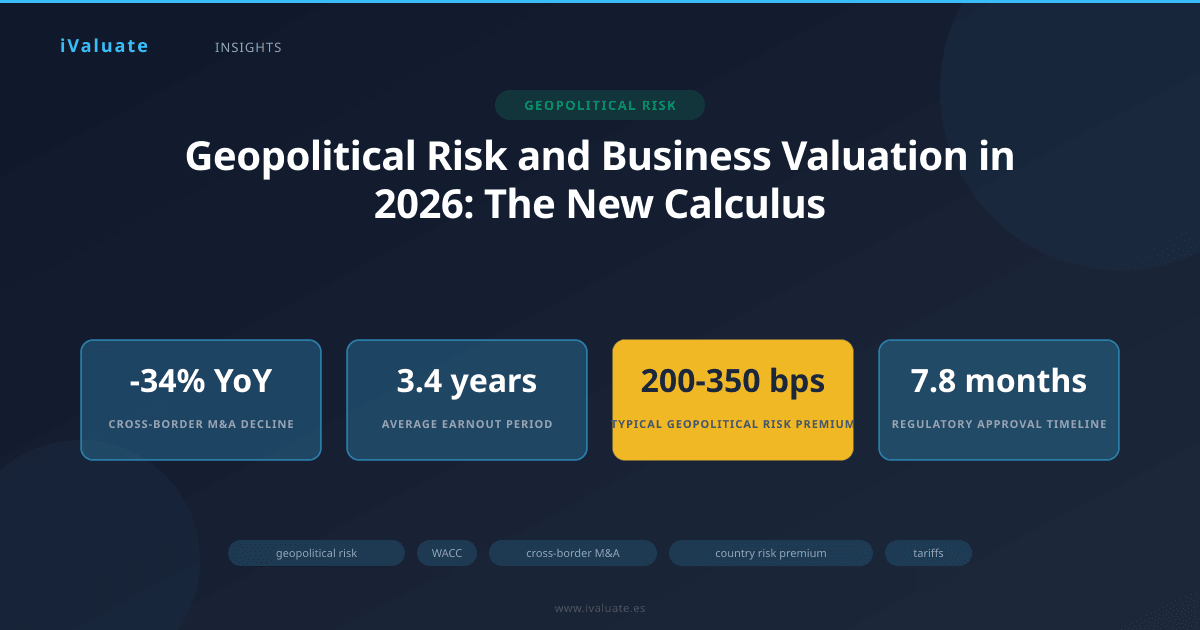
The impact on transaction volumes has been immediate and measurable. Cross-border M&A activity involving U.S. targets or acquirers declined 34% year-over-year in the first quarter of 2026, according to preliminary data from major deal databases. More significantly, the composition of deals has shifted dramatically—strategic transactions with clear synergy rationales now represent 71% of announced deals, up from 58% in 2023, as financial buyers retreat from markets where regulatory approval timelines have become unpredictable.
Country Risk Premiums: The New Baseline
Country risk premiums (CRPs) have expanded across nearly all emerging and several developed markets. The traditional Damodaran methodology, which anchors CRP to sovereign credit default swap spreads and equity market volatility, now yields premiums that many practitioners consider insufficient given the non-financial dimensions of current risks.
Consider the practical implications: A cross-border acquisition of a German automotive supplier by a U.S. industrial conglomerate in early 2026 incorporated a 280-basis-point CRP for tariff-related revenue uncertainty—nearly double the 150-basis-point premium that would have been applied in 2023 for a comparable transaction. This adjustment alone reduced the target's enterprise value by approximately 18% relative to pre-tariff valuation frameworks.
The Middle East conflict's expansion in late 2025 has similarly impacted energy sector valuations. Brent crude price volatility, measured by 90-day realized volatility, reached 47% in January 2026—levels not sustained since the 2008 financial crisis. For upstream oil and gas assets, this translates to discount rate adjustments of 200-350 basis points depending on geographic exposure and the percentage of reserves in or near conflict zones.
02 WACC Recalibration: Beyond Traditional Risk Factors
The weighted average cost of capital (WACC) has long been the workhorse of discounted cash flow valuation. In 2026, however, the traditional CAPM-based approach to estimating the cost of equity requires significant augmentation to capture geopolitical risk adequately.
The Equity Risk Premium Debate
Market participants are divided on whether current geopolitical tensions warrant an increase to the baseline equity risk premium (ERP) or whether risks should be captured through company-specific adjustments. The historical ERP for U.S. markets has hovered between 4.5% and 5.5% over the past decade. Some practitioners now argue for a 50-100 basis point increase to the baseline ERP to reflect systemic political uncertainty.
The counterargument—which I find more analytically defensible—is that broad ERP increases lack precision and fail to differentiate between companies with vastly different geopolitical exposures. A domestic U.S. healthcare services company faces fundamentally different risks than a semiconductor manufacturer with fabrication facilities in Taiwan and 60% of revenues from Chinese customers.
Layered Risk Premium Approach
Leading valuation practices in 2026 have adopted a layered approach to geopolitical risk premiums within WACC calculations:
- Base Country Risk Premium: Applied to all cash flows generated in specific jurisdictions, reflecting sovereign risk, currency convertibility, and regulatory stability
- Trade Policy Risk Premium: An additional 50-200 basis points for companies with significant exposure to products or supply chains affected by current or probable future tariffs
- Sanctions Risk Premium: For businesses operating in or dependent on markets subject to economic sanctions, premiums of 150-400 basis points depending on the severity and enforcement likelihood
- Supply Chain Disruption Premium: Applied when critical inputs or distribution channels traverse geopolitically sensitive routes, typically 75-150 basis points
A European pharmaceutical company acquiring a Chinese API (active pharmaceutical ingredient) manufacturer in Q4 2025 applied a combined geopolitical risk premium of 380 basis points to the target's projected cash flows. This reflected: 120 bps for China country risk, 160 bps for potential U.S. sanctions on dual-use chemical precursors, and 100 bps for supply chain vulnerability given the concentration of production in a single province.
03 M&A Deal Pricing: The Valuation Gap Widens
Perhaps nowhere is the impact of geopolitical risk more visible than in the widening gap between buyer and seller valuation expectations. This "bid-ask spread" has expanded to levels that are causing deal failure rates to climb.
Earnout Structures and Contingent Consideration
In response to valuation uncertainty, transaction structures have evolved significantly. Earnout provisions—where a portion of the purchase price is contingent on future performance—appeared in 43% of middle-market M&A transactions in Q1 2026, compared to 28% in 2023. The average earnout period has also extended from 2.1 years to 3.4 years, reflecting the time required for geopolitical situations to clarify.
These structures attempt to bridge valuation gaps by shifting risk. If tariffs are reduced or trade agreements reached, sellers capture upside through earnout payments. If geopolitical conditions deteriorate further, buyers are protected from overpayment. However, earnouts introduce their own complexities—disputes over earnout achievement have increased 67% year-over-year, according to commercial litigation data.
Sector-Specific Impacts on Transaction Multiples
The impact on trading and transaction multiples varies dramatically by sector. Technology companies with hardware manufacturing exposure have seen median EV/EBITDA multiples compress from 14.2x in 2023 to 11.8x in early 2026—a 17% decline. Conversely, domestic infrastructure and defense contractors have experienced multiple expansion, with median multiples rising from 12.1x to 13.9x over the same period.
Energy sector valuations present a particularly complex picture. Upstream oil and gas companies with Middle East exposure traded at an average 23% discount to Western Hemisphere peers as of March 2026, despite potentially superior reserve economics. A proposed acquisition of a UAE-based oil services company by a European major in February 2026 collapsed when the parties could not agree on the appropriate discount rate—the buyer insisted on a 14.5% WACC while the seller argued that 11.2% adequately captured risks, a gap that translated to a $340 million valuation difference on a $1.8 billion transaction.
04 Cross-Border Transaction Volumes: The Retreat from Globalization
The data on cross-border M&A tells a story of retrenchment. Total announced cross-border deal value in 2025 reached $847 billion, down 29% from the 2021 peak of $1.19 trillion. Early 2026 data suggests this trend is accelerating rather than stabilizing.
Regional Realignment
Transaction flows are realigning along geopolitical fault lines. Intra-European M&A activity increased 18% in 2025, as companies consolidate within a relatively stable regulatory environment. Similarly, intra-Asian deals (excluding China) grew 22%, driven by ASEAN economic integration and companies seeking to diversify away from Chinese manufacturing concentration.
Conversely, U.S.-China cross-border transactions fell to their lowest level since 2009, with just $12.4 billion in announced deals in 2025—a 78% decline from the 2016 peak. The few transactions that do occur face extraordinary scrutiny from CFIUS (Committee on Foreign Investment in the United States) and Chinese regulatory counterparts, with average approval timelines extending to 14-18 months.
The Rise of Nearshoring Valuations
One beneficiary of geopolitical tensions has been nearshoring-focused assets. Mexican manufacturing facilities serving the U.S. market have commanded premium valuations, with EV/Revenue multiples averaging 1.8x compared to 1.3x for comparable Asian facilities. A U.S. automotive parts manufacturer's acquisition of a Mexican supplier in late 2025 at 2.1x revenues—a 40% premium to the sector median—was justified entirely on the basis of tariff avoidance and supply chain resilience.
05 Practical Adjustments: How Advisors Are Adapting
Valuation professionals have developed several practical frameworks for incorporating geopolitical risk into their analyses with greater rigor and transparency.
Scenario-Based Valuation
Rather than selecting a single discount rate or set of assumptions, leading practitioners now routinely prepare scenario-based valuations with explicit probability weightings. A typical framework might include:
- Base Case (50% probability): Current tariff and trade policy environment persists with modest escalation
- Optimistic Case (25% probability): Trade agreements reached, tariffs reduced by 40-60% within 24 months
- Pessimistic Case (25% probability): Further escalation, additional sectors targeted, potential sanctions expansion
Each scenario receives a full valuation with scenario-specific assumptions for revenue growth, margin pressure from tariffs, and discount rates. The probability-weighted average provides a more defensible valuation range than a single-point estimate.
Sensitivity Analysis and Risk Matrices
Sophisticated valuation reports in 2026 include detailed sensitivity tables showing how enterprise value changes with various geopolitical outcomes. A recent fairness opinion for a cross-border technology transaction included a risk matrix with 15 discrete scenarios, showing valuation impacts ranging from -42% to +18% relative to the base case.
This transparency serves multiple purposes: it demonstrates analytical rigor, provides negotiating parameters for deal structuring, and creates a documented basis for post-transaction dispute resolution if earnouts are involved.
Real Options Valuation for Flexibility
For assets with embedded strategic flexibility—such as manufacturing facilities that can shift production between regions or supply contracts with alternative sourcing provisions—real options valuation techniques have gained traction. The value of optionality to redirect supply chains or alter market focus has increased substantially in the current environment.
A European consumer goods company's valuation of a potential Asian manufacturing acquisition in early 2026 explicitly valued the option to shift 40% of production to Eastern European facilities at an estimated $67 million, using a Black-Scholes framework adapted for strategic options. This optionality value represented 8% of the total enterprise value and proved decisive in justifying the acquisition price to the board.
06 Regulatory and Tax Considerations
Beyond pure valuation mechanics, geopolitical risk manifests in regulatory approval processes and tax structuring that directly impact deal economics.
Extended Regulatory Timelines
The average time from signing to closing for cross-border transactions requiring regulatory approval has extended from 4.2 months in 2022 to 7.8 months in 2025. This extension creates several valuation challenges:
- Increased financing costs and commitment fee expenses
- Greater business risk during the interim period when the target operates under restrictions
- Higher probability of material adverse change (MAC) clause triggers
- Opportunity costs from delayed integration and synergy realization
Sophisticated buyers now build these costs into their valuation models, effectively reducing the price they're willing to pay by 3-7% depending on the complexity of regulatory approvals required.
Tax Structuring in a Fragmenting World
The global tax environment has become significantly more complex with the implementation of Pillar Two minimum taxation and increased scrutiny of transfer pricing in cross-border structures. Valuation professionals must now model after-tax cash flows with greater precision, as the effective tax rate for multinational structures can vary by 400-600 basis points depending on jurisdictional choices and substance requirements.
07 Looking Forward: Valuation in an Age of Persistent Uncertainty
The geopolitical risk environment of 2026 appears unlikely to resolve quickly. Unlike discrete events that markets can price and move past, the current situation reflects deeper structural shifts in the global economic order—the transition from a unipolar to multipolar world, the weaponization of economic interdependence, and the prioritization of security over efficiency in supply chain design.
For valuation professionals, this means that the adjustments and frameworks developed over the past 18 months are not temporary expedients but rather permanent additions to the analytical toolkit. The days of treating country risk premiums as academic exercises or applying standardized WACC calculations across diverse geopolitical contexts are over.
Several trends are likely to intensify:
- Greater valuation dispersion: The range between the 25th and 75th percentile transaction multiples within sectors will continue to widen as geopolitical exposure becomes a primary value driver
- Increased use of insurance products: Political risk insurance, trade credit insurance, and specialized warranty and indemnity products will become standard components of cross-border transactions, with premiums explicitly factored into deal economics
- Regionalization of valuation standards: As global markets fragment, regional valuation conventions may diverge more significantly, particularly regarding appropriate risk premiums and the treatment of intangible assets
- Enhanced disclosure requirements: Regulators and investors will demand more granular disclosure of geopolitical exposures and their impact on valuations, particularly for public companies and regulated financial institutions
Key Takeaway: The integration of geopolitical risk into business valuation has evolved from an art to a science. Practitioners who develop robust, transparent frameworks for quantifying political risk will differentiate themselves in an increasingly complex market environment.
The technical challenges are significant, but the imperative is clear: valuation methodologies must evolve to reflect the realities of a world where political decisions can alter cash flows as dramatically as market forces. Those who master this integration—combining traditional financial analysis with sophisticated political risk assessment—will provide the most value to their clients in the years ahead.
For professionals navigating this complex landscape, platforms like iValuate are increasingly essential. The ability to rapidly model multiple scenarios, adjust discount rates with precision, and generate comprehensive sensitivity analyses allows advisors to respond to fast-moving geopolitical developments with the rigor that clients and regulators demand. In an environment where the difference between a well-supported and poorly-supported valuation can mean millions in deal value or regulatory scrutiny, having sophisticated analytical tools is no longer optional—it's a competitive necessity that iValuate helps professionals achieve efficiently and defensibly.