Table of Contents9 sections
The global business landscape in 2026 has become a minefield of geopolitical complexity. Trade wars, escalating tariff regimes, regional conflicts, and sanctions have fundamentally altered how valuation professionals assess risk and determine fair value in cross-border transactions. For CFOs, M&A advisors, and private equity professionals, the challenge is no longer simply quantifying business fundamentals—it's incorporating rapidly shifting political risk into discount rates, terminal values, and deal structures.
The return of aggressive US tariff policies under the second Trump administration, combined with retaliatory measures from the European Union and China, has created a fragmented global trading system. Meanwhile, ongoing Middle East conflicts continue to inject volatility into energy markets, while sanctions regimes targeting Russia, Iran, and other nations have carved out entire sectors from the investable universe. This article examines how these geopolitical realities are impacting business valuation methodologies, M&A deal pricing, and the fundamental assumptions underlying weighted average cost of capital (WACC) calculations.
01 The New Tariff Landscape and Its Valuation Implications
The reinstatement of comprehensive US tariff policies in late 2025 marked a decisive shift in global trade dynamics. The Trump administration's "America First 2.0" agenda introduced a baseline 10% universal tariff on all imports, with targeted rates reaching 60% on Chinese goods and 25% on automobiles from Mexico and the European Union. These measures, ostensibly designed to reshore manufacturing and reduce trade deficits, have created significant valuation challenges across multiple sectors.
For companies with complex global supply chains, the impact on earnings projections has been substantial. A mid-market industrial manufacturer we recently valued saw its EBITDA forecasts reduced by 18% over the next three years due to tariff-related cost increases that could not be fully passed through to customers. The company's reliance on Chinese components for 40% of its cost of goods sold meant that even with partial supply chain diversification, margins would compress significantly.
Adjusting Cash Flow Projections for Tariff Scenarios
Valuation professionals are now routinely building multiple tariff scenarios into their discounted cash flow (DCF) models. A base case typically assumes current tariff levels remain stable, while alternative scenarios model both escalation and de-escalation paths. The probability-weighted approach has become standard practice, with most advisors assigning 50-60% weight to the base case, 25-30% to an escalation scenario, and 15-20% to a negotiated reduction scenario.
The challenge extends beyond simple cost increases. Tariffs create strategic uncertainties that affect capital allocation decisions, market access, and competitive positioning. Companies face difficult choices: absorb costs and accept margin compression, raise prices and risk market share loss, or undertake costly supply chain restructuring. Each path carries different cash flow implications and requires different valuation treatments.
In cross-border M&A transactions involving manufacturing assets, we're now seeing tariff adjustment clauses becoming standard in purchase agreements, with earn-out structures tied to the actual tariff environment that materializes post-closing.
02 Country Risk Premiums in a Fragmented World
The traditional approach to country risk premium (CRP) calculation—adding a spread based on sovereign credit ratings and equity market volatility—has proven inadequate for capturing the multifaceted political risks of 2026. Valuation advisors are increasingly adopting more granular frameworks that disaggregate country risk into specific components: expropriation risk, currency inconvertibility, trade policy volatility, sanctions exposure, and political violence.
For developed markets, CRPs have expanded significantly. The United States, traditionally assigned a zero or minimal country risk premium as the baseline market, now carries a 50-75 basis point premium in some European and Asian valuations due to trade policy unpredictability. European Union member states show premiums ranging from 75 basis points (Germany, Netherlands) to 200 basis points (Italy, Spain) reflecting both fiscal concerns and exposure to energy supply disruptions.
Emerging Market Premiums in 2026
Emerging market premiums have diverged dramatically based on geopolitical alignment. Countries perceived as caught between US and Chinese spheres of influence—including Vietnam, Indonesia, and Mexico—carry premiums of 400-600 basis points, up from 300-400 basis points in 2023. This reflects not just economic volatility but the risk of being forced to choose sides in trade disputes or facing secondary sanctions.
Consider a recent cross-border acquisition of a Vietnamese manufacturing platform by a European strategic buyer. The valuation incorporated a 525 basis point country risk premium, reflecting concerns about potential US tariffs on Vietnamese exports (given the country's role as a transshipment point for Chinese goods) and the risk of Chinese economic retaliation if Vietnam aligned too closely with Western interests. The buyer also insisted on a 15% holdback in escrow specifically to cover potential tariff-related losses in the first two years post-closing.
03 WACC Adjustments in the Current Environment
The weighted average cost of capital serves as the fundamental discount rate in most corporate valuations, and geopolitical risk flows through multiple WACC components. In 2026, we're seeing adjustments across the equity risk premium, beta calculations, and the debt component of the capital structure.
Equity Risk Premium Expansion
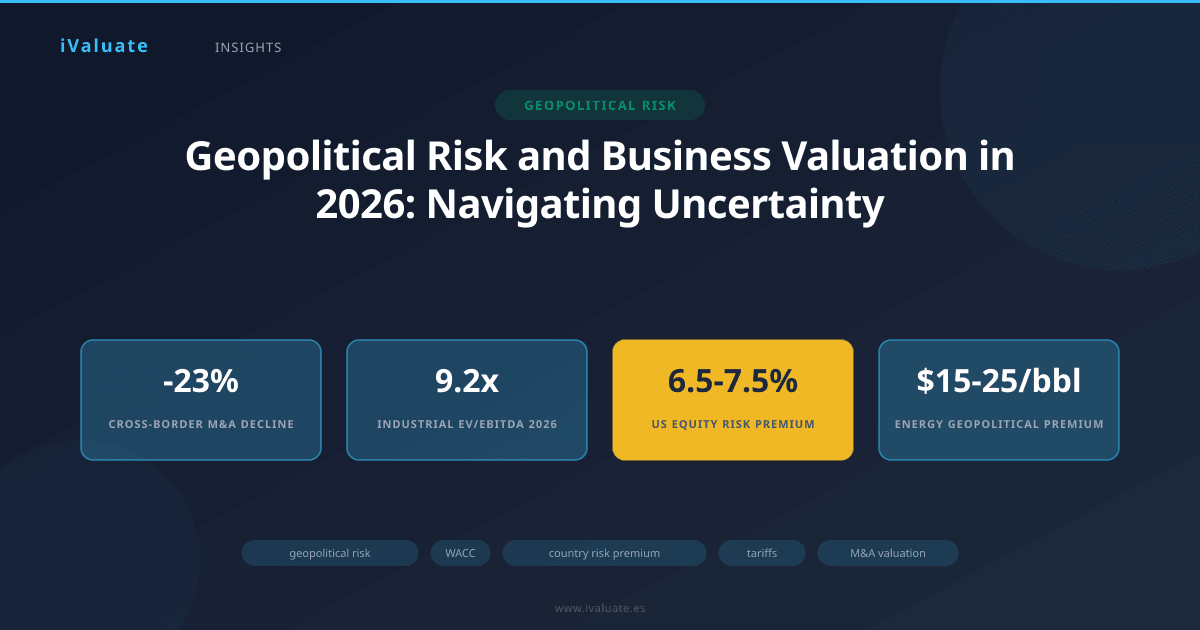
The equity risk premium (ERP)—the additional return investors demand for bearing equity risk over risk-free rates—has expanded from the 5.0-5.5% range common in 2020-2023 to 6.5-7.5% for US equities in 2026. This 150-200 basis point increase reflects heightened uncertainty about future cash flows across all sectors. For European equities, ERPs have risen even more dramatically, reaching 7.5-8.5%, driven by energy security concerns and exposure to potential escalation of the Russia-Ukraine situation.
When valuing companies with significant international operations, advisors are applying jurisdiction-specific ERPs rather than a single blended rate. A multinational consumer goods company with operations across North America, Europe, and Asia might see its WACC calculated with different discount rates for each regional cash flow stream, then aggregated at the consolidated level. This approach, while more complex, provides a more accurate reflection of the diverse risk profiles across geographies.
Beta Recalibration for Trade-Exposed Sectors
Historical beta calculations have become less reliable predictors of future volatility for companies in trade-sensitive sectors. Automotive, semiconductors, machinery, and consumer electronics have all seen their systematic risk profiles shift as tariff policies create new sources of earnings volatility uncorrelated with broad market movements.
Valuation professionals are increasingly using forward-looking implied betas derived from options markets or adjusting historical betas upward by 0.2-0.4 for companies with high import/export exposure. A semiconductor equipment manufacturer we valued in Q1 2026 had a five-year historical beta of 1.15, but we applied an adjusted beta of 1.45 to reflect the heightened sensitivity to US-China technology restrictions and potential supply chain disruptions.
04 Energy Sector Valuations and Middle East Risk
The ongoing instability in the Middle East, including periodic escalations between Israel and Iran, attacks on shipping in the Red Sea, and tensions in the Persian Gulf, has created persistent volatility in energy markets. Brent crude prices have traded in a wide $75-$115 per barrel range throughout 2025-2026, with geopolitical risk premiums accounting for an estimated $15-$25 of the price at any given time.
For energy sector valuations, this volatility has profound implications. Traditional DCF models for upstream oil and gas assets typically use long-term price decks that normalize short-term fluctuations. However, the structural nature of current geopolitical risks—particularly the threat of broader regional conflict that could disrupt 20-25% of global oil supply—requires a different approach.
Scenario Analysis in Energy Valuations
Leading energy advisors are now employing Monte Carlo simulations that explicitly model geopolitical event risk. Rather than a single price deck, these models incorporate probability distributions for various scenarios: baseline stability (45% probability), moderate disruption with 2-4 million barrels per day offline (35% probability), and major disruption affecting 8-12 million barrels per day (20% probability).
A recent valuation of a mid-sized exploration and production company with assets in the North Sea and West Africa illustrated this approach. Under the baseline scenario with Brent at $85/barrel, the asset valued at $2.8 billion. The moderate disruption scenario, with prices averaging $105/barrel but also including higher operating costs and insurance premiums, yielded a value of $3.4 billion. The major disruption scenario produced a value of $4.1 billion but with significantly higher volatility and execution risk. The probability-weighted valuation came to $3.2 billion, with explicit disclosure of the scenario assumptions to the board and potential investors.
Energy sector M&A in 2026 increasingly features price adjustment mechanisms tied to geopolitical events, with specific triggers related to Middle East supply disruptions, sanctions changes, or major shipping route closures.
05 Sanctions Regimes and Investability Constraints
The expansion of Western sanctions targeting Russia, Iran, and Chinese technology companies has created entire categories of uninvestable or severely discounted assets. For valuation professionals, this raises fundamental questions about market value versus intrinsic value when large segments of the potential buyer universe are legally prohibited from transacting.
Russian assets held by Western companies have proven particularly challenging to value. Many firms have written these assets down to zero or near-zero values, not because the underlying businesses lack cash flow generation capability, but because sanctions make them effectively untransferable to willing buyers at any price. This represents a pure political risk discount that traditional valuation frameworks struggle to capture.
Secondary Sanctions Risk
Perhaps more insidious is the impact of secondary sanctions risk—the possibility that transacting with certain counterparties, even in non-sanctioned jurisdictions, could trigger penalties. This has created a chilling effect on M&A activity involving companies with any Russian, Iranian, or sanctioned Chinese entity in their ownership structure or customer base.
We recently advised on a potential acquisition of a Central Asian logistics company that derived 15% of its revenue from Russian clients. Despite strong fundamentals and attractive pricing, three of four potential buyers withdrew from the process due to compliance concerns. The eventual buyer demanded a 35% discount to our initial valuation range, with extensive representations and warranties regarding sanctions compliance and a requirement that the target fully exit the Russian market within 12 months of closing.
06 Cross-Border M&A Volume and Deal Pricing Trends
The cumulative impact of geopolitical risk on cross-border M&A has been significant. Global cross-border deal volume declined 23% in 2025 compared to 2023, with the trend continuing into early 2026. Deal values have fallen even more sharply—down 31%—indicating that not only are fewer deals happening, but they're happening at lower valuations.
However, the impact has been highly uneven across regions and sectors. US inbound M&A (foreign buyers acquiring US assets) fell only 12%, while US outbound M&A (US buyers acquiring foreign assets) dropped 34%, reflecting American buyers' increased caution about international exposure. European cross-border M&A declined 28%, with particular weakness in deals involving Asian counterparties.
Valuation Multiples Under Pressure
Deal pricing multiples have compressed across most sectors with significant geopolitical exposure. Industrial companies with complex international supply chains traded at a median EV/EBITDA multiple of 9.2x in 2026, down from 11.1x in 2023. Technology companies subject to export controls or with significant China exposure saw multiples compress from 14.5x to 11.8x over the same period.
Interestingly, companies with predominantly domestic operations in stable jurisdictions have seen their relative valuations improve. A US-based business services company with 95% domestic revenue commanded a 15% premium to comparable firms with international exposure in a recent sale process. Buyers explicitly cited the reduced geopolitical risk profile as justification for the premium pricing.
07 Practical Frameworks for Incorporating Geopolitical Risk
Given the complexity and fluidity of geopolitical risk in 2026, valuation professionals need structured frameworks for incorporating these factors into their analyses. Based on current best practices across leading advisory firms, we recommend a multi-layered approach:
1. Explicit Risk Mapping
Begin every valuation engagement with a comprehensive geopolitical risk mapping exercise. Identify all material exposures: supply chain dependencies on high-risk jurisdictions, revenue concentration in politically volatile markets, exposure to specific tariff regimes, sanctions risk in the customer or supplier base, and reliance on cross-border capital flows or currency convertibility.
2. Scenario-Based Forecasting
Develop at minimum three scenarios (base, adverse, favorable) for each material geopolitical risk factor. Assign probabilities based on current intelligence, historical precedent, and expert consultation. Build fully integrated financial models for each scenario, capturing both direct impacts (tariffs, supply disruptions) and indirect effects (demand destruction, competitive dynamics).
3. Granular Discount Rate Construction
Move beyond single WACC calculations to jurisdiction-specific or even asset-specific discount rates. For multinational companies, calculate separate WACCs for each major geographic segment, incorporating appropriate country risk premiums, local market equity risk premiums, and currency risk factors. Use these segment-specific rates to discount the respective cash flow streams.
4. Sensitivity Analysis and Risk Quantification
Present valuation conclusions as ranges rather than point estimates, with explicit sensitivity analysis showing the impact of key geopolitical assumptions. Quantify the value impact of specific risk factors: "A 10 percentage point increase in tariffs on Chinese imports would reduce enterprise value by $45-60 million, or 8-11%." This transparency helps stakeholders understand the drivers of value and the magnitude of various risks.
5. Dynamic Monitoring and Revaluation Triggers
In the current environment, valuations can become stale quickly. Establish clear triggers that would necessitate revaluation: major policy announcements, sanctions changes, outbreak of conflict, or significant shifts in commodity prices driven by geopolitical events. For portfolio companies and ongoing M&A processes, implement quarterly or even monthly monitoring of key geopolitical risk indicators.
08 Case Study: Manufacturing Sector Cross-Border Acquisition
To illustrate these principles in practice, consider a recent engagement involving a German automotive supplier's acquisition of a US-based competitor. The target company generated $420 million in revenue, with 35% from sales to US automakers, 40% from exports to Europe and Asia, and 25% from aftermarket distribution.
The initial valuation, conducted in Q3 2025 before the full scope of new US tariff policies was clear, indicated an enterprise value of $380-420 million (9.0-10.0x EBITDA). However, as tariff policies crystallized in Q4 2025 and Q1 2026, several risk factors emerged:
- 25% tariffs on automotive components imported to the EU would impact 40% of the target's revenue
- Potential retaliatory tariffs on German automotive exports to the US created uncertainty about the buyer's ability to integrate the acquisition
- Supply chain analysis revealed 18% of the target's COGS sourced from China, subject to 60% US tariffs
- Currency volatility between USD and EUR increased due to trade tensions, creating additional hedging costs
The revised valuation incorporated these factors through multiple channels. Cash flow projections were reduced by 12% in years 1-3 to reflect margin compression from tariffs that couldn't be fully passed through. The WACC increased from 9.5% to 10.8%, reflecting a 75 basis point increase in the equity risk premium and a 55 basis point increase in the country risk premium applied to European operations. Scenario analysis showed a range of $285 million (adverse case with full tariff escalation) to $395 million (favorable case with negotiated tariff reductions).
The final deal structure reflected this uncertainty: a base purchase price of $320 million, with earn-outs tied to EBITDA performance over three years (potentially adding $40-60 million) and a specific tariff adjustment mechanism. If average effective tariff rates on the target's products exceeded 15% in years 1-2, the buyer would receive credits against the earn-out. This creative structure allowed the deal to close while fairly allocating geopolitical risk between buyer and seller.
09 The Road Ahead: Valuation in an Age of Uncertainty
As we progress through 2026, the trajectory of geopolitical risk remains highly uncertain. Potential catalysts for both improvement and deterioration abound: trade negotiations between the US and EU could reduce tariff burdens, or they could collapse into deeper protectionism; Middle East tensions could escalate into broader regional conflict or stabilize through diplomatic engagement; sanctions regimes could expand to new targets or be partially lifted as part of broader geopolitical realignments.
For valuation professionals, this uncertainty demands intellectual humility and methodological rigor. The days of mechanically applying standard market multiples or using historical WACC assumptions without critical examination are over. Every valuation in 2026 requires thoughtful consideration of geopolitical risk factors, explicit modeling of alternative scenarios, and transparent communication of the assumptions underlying value conclusions.
The firms and professionals who adapt most successfully to this environment will be those who invest in geopolitical intelligence capabilities, develop sophisticated scenario modeling frameworks, and maintain the flexibility to update their analyses as conditions evolve. They will also be those who can clearly articulate to clients and stakeholders not just what a business is worth, but how and why that value could change under different geopolitical scenarios.
In this complex environment, having access to sophisticated analytical tools becomes essential. Platforms like iValuate enable professionals to rapidly model multiple scenarios, adjust discount rate assumptions, and perform sensitivity analysis—capabilities that are no longer optional but necessary for credible valuation work in 2026.
The integration of geopolitical risk into business valuation represents a maturation of the profession, acknowledging that value is not determined solely by company-specific fundamentals but by the broader context in which businesses operate. As trade wars, tariffs, sanctions, and regional conflicts continue to reshape the global economy, valuation professionals must evolve their methodologies to capture these realities. Those who do will provide their clients with the insights needed to navigate uncertainty, structure resilient deals, and make informed capital allocation decisions in an increasingly complex world.
The challenge is significant, but so is the opportunity. By developing more sophisticated approaches to geopolitical risk assessment and incorporating these factors rigorously into valuation frameworks, advisors can deliver greater value to their clients and contribute to more efficient capital markets. The tools and techniques discussed in this article—from granular country risk premiums to scenario-based forecasting to creative deal structures—represent the emerging best practices of the profession. As we move further into 2026 and beyond, these approaches will increasingly become the standard by which valuation quality is measured.