Table of Contents8 sections
The global business landscape in 2026 is characterized by unprecedented geopolitical complexity. The resurgence of protectionist trade policies, escalating tariff regimes, and regional conflicts have fundamentally altered how valuation professionals assess cross-border transactions and price domestic deals with international exposure. For CFOs, M&A advisors, and private equity professionals, the challenge is no longer whether to incorporate geopolitical risk into valuation models—it's how to quantify these risks with precision and defend assumptions to sophisticated counterparties.
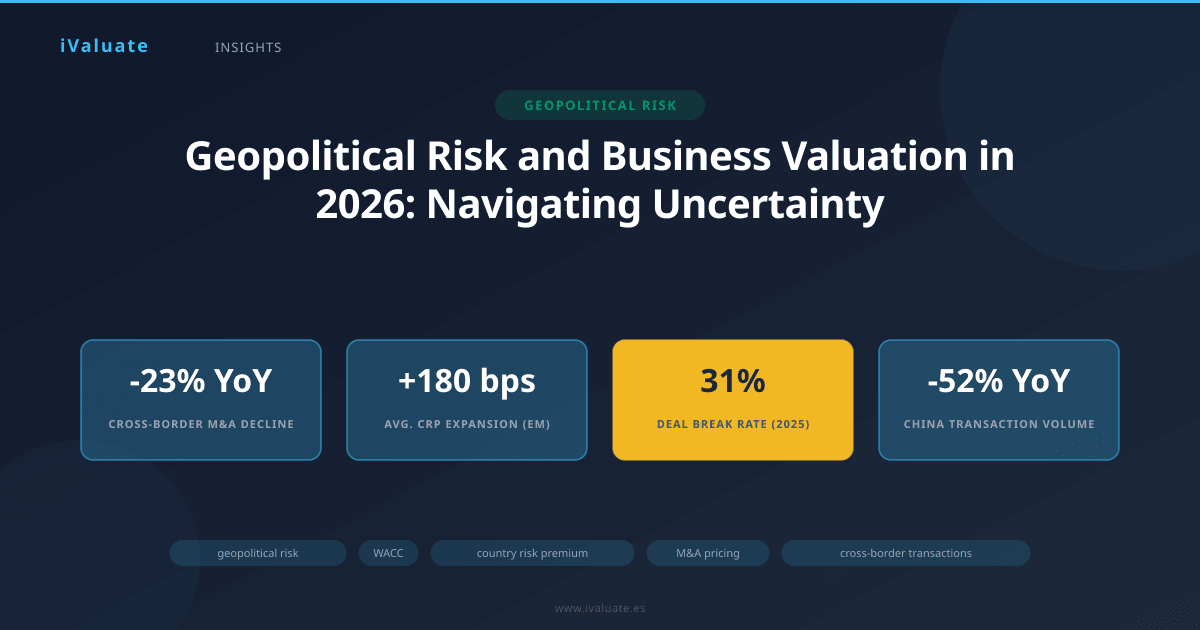
The confluence of renewed US tariff policies under the second Trump administration, persistent EU-US trade tensions, ongoing Middle East conflicts affecting energy markets, and China's strategic decoupling from Western economies has created a valuation environment where traditional models require significant recalibration. Cross-border M&A transaction volumes have contracted 23% year-over-year in Q1 2026, while country risk premiums for emerging markets have expanded by an average of 180 basis points since early 2024.
01 The New Tariff Regime: Quantifying Trade War Impact on Enterprise Value
The Trump administration's 2025-2026 tariff policies have introduced material uncertainty into business valuations across multiple sectors. The implementation of universal baseline tariffs of 10% on all imports, with sector-specific rates reaching 60% on Chinese goods and 25% on automotive imports, has forced valuation professionals to fundamentally reassess cash flow projections and terminal value assumptions.
For companies with significant import exposure, the immediate impact manifests in compressed EBITDA margins. A mid-market industrial distributor we analyzed saw projected EBITDA margins decline from 12.5% to 9.8% after incorporating tariff pass-through limitations and competitive pricing constraints. This 270-basis-point compression translated to a 22% reduction in enterprise value using comparable transaction multiples, dropping the implied EV/EBITDA from 8.2x to 6.4x.
Adjusting Revenue and Cost Assumptions
The valuation implications extend beyond simple cost increases. Sophisticated models now incorporate:
- Demand elasticity scenarios: Consumer goods companies face volume declines of 8-15% when tariff-driven price increases exceed 12%, based on 2025-2026 market data
- Supply chain reconfiguration costs: One-time restructuring expenses averaging $2.3 million for middle-market manufacturers relocating production from China to Vietnam or Mexico
- Working capital impacts: Inventory builds averaging 18-25 additional days of supply as companies front-load imports ahead of tariff implementation
- Competitive positioning shifts: Market share redistribution favoring domestic producers, with implications for long-term growth rates in terminal value calculations
In a recent cross-border acquisition of a European automotive components supplier by a US private equity firm, the buy-side team increased the country risk premium from 150 bps to 280 bps and reduced terminal growth rates from 3.0% to 2.2% to reflect tariff uncertainty and potential retaliatory measures from the EU. The combined effect reduced the justified purchase price by approximately 18%.
02 WACC Recalibration: Incorporating Geopolitical Risk Premiums
The weighted average cost of capital remains the cornerstone of discounted cash flow valuation, and 2026 has witnessed significant evolution in how practitioners incorporate geopolitical risk into discount rate assumptions. The traditional build-up method—starting with a risk-free rate and adding equity risk premium, size premium, and company-specific risk—now routinely includes explicit geopolitical risk adjustments.
Country Risk Premium Expansion
Country risk premiums have expanded materially across both emerging and developed markets. Using the Damodaran methodology of sovereign credit default swap spreads adjusted for equity market volatility, we observe:
- Mexico: CRP increased from 2.8% (2024) to 4.1% (2026), reflecting nearshoring benefits offset by policy uncertainty and cartel-related security concerns
- Turkey: CRP expanded from 5.2% to 7.9%, driven by currency volatility and Middle East proximity risks
- Vietnam: CRP rose from 2.1% to 3.3% as manufacturing relocation increased geopolitical scrutiny and potential secondary tariff exposure
- Germany: Even developed European markets saw CRP increases from 0.8% to 1.6%, reflecting energy security concerns and trade policy uncertainty
For cross-border transactions, the application of these premiums requires nuanced judgment. A US acquirer of a Mexican manufacturing business might apply the full 4.1% CRP to cash flows generated in Mexico, while cash flows from US sales of Mexican-produced goods might warrant a blended premium of 2.0-2.5%, depending on tariff exposure and supply chain flexibility.
Political Risk as a Distinct WACC Component
Leading valuation practices in 2026 increasingly separate political risk from traditional country risk, particularly for deals involving:
- Critical infrastructure or strategic industries subject to national security review
- Technology companies with dual-use applications or data sovereignty concerns
- Energy sector assets exposed to sanctions regimes or resource nationalism
- Cross-border transactions between geopolitically opposed jurisdictions (US-China, EU-Russia)
Political risk premiums of 100-300 basis points are now standard in semiconductor, telecommunications, and defense-adjacent sectors. In a 2025 transaction involving a European semiconductor equipment manufacturer with 35% revenue exposure to Chinese customers, the acquirer applied a 250 bps political risk premium specifically to China-sourced cash flows, reflecting the probability of export control expansion or complete market access loss.
The distinction between systematic country risk and idiosyncratic political risk has become critical in 2026. While country risk affects all investments in a jurisdiction, political risk is transaction-specific and relates to regulatory intervention, expropriation, or forced divestiture probability.
03 Middle East Conflict and Energy Sector Valuation Dynamics
The ongoing conflicts in the Middle East have created acute valuation challenges for energy sector transactions. Brent crude volatility has ranged from $68 to $112 per barrel in the first quarter of 2026, with geopolitical risk premiums embedded in oil prices estimated at $15-22 per barrel by major investment banks.
Commodity Price Assumptions and Scenario Analysis
Energy sector valuations now routinely employ Monte Carlo simulation with geopolitically-informed probability distributions rather than simple sensitivity tables. A typical upstream oil and gas valuation model in 2026 incorporates:
- Base case scenario (45% probability): Brent crude averaging $82-88/bbl with gradual geopolitical risk premium compression
- Escalation scenario (30% probability): Prices sustained above $100/bbl due to supply disruption or Strait of Hormuz closure risk
- Resolution scenario (25% probability): Rapid de-escalation driving prices toward $70-75/bbl as geopolitical premiums dissipate
The probability-weighted approach yields materially different valuations than deterministic models. In a recent fairness opinion for a $1.8 billion oilfield services acquisition, the probability-weighted DCF valuation came in 12% below the scenario-midpoint approach, reflecting the asymmetric impact of downside scenarios on highly leveraged business models.
Downstream and Midstream Considerations
Refining and petrochemical assets face distinct geopolitical valuation challenges. European refiners, in particular, have seen valuation multiples compress from 6.5x EV/EBITDA in 2023 to 4.8x in early 2026, driven by:
- Structural margin compression from Russian crude supply disruption and sanctions compliance costs
- Demand uncertainty related to accelerated energy transition policies in response to supply security concerns
- Stranded asset risk as governments prioritize renewable energy independence
Midstream infrastructure assets, traditionally valued for stable, fee-based cash flows, now require geopolitical overlays when exposure exists to sanctioned jurisdictions or transit routes through conflict zones. LNG export terminals serving European markets command premium valuations (10-12x EV/EBITDA) relative to those dependent on Asian demand (7-9x), reflecting Europe's strategic imperative for energy diversification.
04 Cross-Border M&A: Deal Pricing and Volume Trends
Cross-border transaction activity in 2026 reflects the chilling effect of geopolitical uncertainty. Global cross-border M&A volume declined to $847 billion in 2025, down from $1.1 trillion in 2021, with the contraction accelerating in early 2026.
Valuation Gaps and Deal Breaks
The bid-ask spread in cross-border transactions has widened significantly. Sellers anchored to pre-2024 valuation multiples confront buyers applying elevated discount rates and conservative growth assumptions. In technology sector cross-border deals, we observe median valuation gaps of 28-35% between seller expectations and buyer offers, compared to 15-18% gaps in domestic transactions.
Deal break rates have increased correspondingly. Approximately 31% of announced cross-border transactions in 2025 were terminated prior to closing, compared to a historical average of 18-22%. Regulatory approval uncertainty, financing market volatility, and material adverse change provisions triggered by geopolitical events account for the majority of breaks.
Geographic Patterns and Safe Haven Premiums
Transaction flow has shifted toward perceived safe haven jurisdictions. Inbound M&A into Switzerland, Singapore, and the UAE has increased 34%, 41%, and 67% respectively year-over-year, while transactions involving Chinese targets or acquirers have declined 52%. This geographic reallocation manifests in valuation multiples:
- Swiss industrial companies: Trading at median EV/EBITDA of 13.2x, a 240 bps premium to comparable German firms
- Singaporean technology services: Commanding 15.8x EV/EBITDA versus 11.4x for comparable Indian companies
- UAE logistics and infrastructure: Attracting 11.5x multiples compared to 7.8x for Turkish assets with similar growth profiles
These premiums reflect not just superior growth prospects but explicit geopolitical stability value that sophisticated buyers are willing to pay.
05 Sector-Specific Valuation Adjustments
Technology and Semiconductors
The technology sector faces perhaps the most complex geopolitical valuation landscape. US export controls on advanced semiconductors and manufacturing equipment to China have created bifurcated markets with distinct valuation implications. Companies with significant China revenue exposure trade at 25-40% discounts to peers with diversified geographic profiles.
In private market transactions, earnout structures have become prevalent to bridge valuation gaps. A recent acquisition of a semiconductor design firm included a three-year earnout tied to maintaining China market access, effectively transferring geopolitical risk from buyer to seller. The base purchase price reflected a 35% discount to comparable transactions, with earnout potential recovering 60% of that discount if adverse regulatory scenarios don't materialize.
Consumer and Retail
Consumer-facing businesses with complex global supply chains face margin compression and working capital intensity increases. Fast fashion retailers dependent on Chinese manufacturing have seen EBITDA multiples contract from 9-11x in 2022 to 6-7x in 2026. Valuation models now explicitly forecast:
- Gross margin compression of 200-350 bps from tariff absorption and expedited shipping costs
- Inventory obsolescence increases of 40-60 bps of sales as supply chain unpredictability rises
- Capital expenditure increases of 15-25% for supply chain diversification and nearshoring initiatives
Financial Services
Banks and financial institutions with cross-border operations face regulatory fragmentation and sanctions compliance costs. A European bank with significant Russian exposure wrote down assets by 68% in 2022-2023, and 2026 valuations continue to apply heightened risk premiums to institutions with emerging market exposure. Sanctions compliance costs now average 8-12 basis points of assets for globally active banks, a material headwind to ROE and valuation multiples.
06 Practical Framework for Geopolitical Risk Incorporation
For valuation professionals navigating this environment, a systematic framework is essential:
Step 1: Geopolitical Exposure Mapping
Quantify exposure across multiple dimensions:
- Revenue by customer jurisdiction (not just billing location)
- Supply chain dependencies by critical input and country of origin
- Asset location and redeployability constraints
- Regulatory approval requirements for ownership changes
- Currency exposure and natural hedging positions
Step 2: Scenario Development
Develop 3-5 geopolitical scenarios with explicit probability assignments:
- Status quo continuation with gradual escalation
- Negotiated de-escalation and tariff reduction
- Significant escalation with expanded sanctions/tariffs
- Black swan events (conflict expansion, regime change, etc.)
Step 3: Cash Flow Impact Modeling
For each scenario, model specific impacts:
- Revenue effects from demand changes, market access loss, or competitive shifts
- Cost structure changes from tariffs, supply chain reconfiguration, or compliance
- Working capital requirements and capital expenditure needs
- Tax implications of restructuring or transfer pricing adjustments
Step 4: Discount Rate Calibration
Apply appropriate risk premiums with clear documentation:
- Country risk premiums based on current sovereign CDS spreads and equity volatility
- Political risk premiums for transaction-specific regulatory or expropriation risk
- Liquidity premiums for assets in jurisdictions with impaired capital markets
Step 5: Probability Weighting and Sensitivity Analysis
Calculate probability-weighted valuations and conduct sensitivity analysis on key assumptions, particularly scenario probabilities and discount rate components. Present results in ranges rather than false precision point estimates.
In 2026, valuation credibility increasingly depends on transparent documentation of geopolitical assumptions and their quantitative impact. Buyers and sellers both benefit from explicit scenario analysis that frames negotiation around probability assessments rather than arguing over single-point forecasts.
07 Regulatory and Due Diligence Considerations
Geopolitical risk has elevated the importance of regulatory due diligence in cross-border transactions. CFIUS reviews in the United States now average 8-11 months for transactions involving critical technology or infrastructure, compared to 4-6 months in 2020. European FDI screening has similarly intensified, with 18 EU member states implementing or strengthening foreign investment review mechanisms since 2022.
Valuation implications include:
- Deal certainty discounts: Buyers demand 8-15% valuation discounts for transactions requiring CFIUS or EU FDI approval, reflecting break risk and timeline uncertainty
- Mitigation cost provisions: Transactions increasingly include provisions for mitigation measures (data segregation, board composition restrictions, etc.) with costs of $2-8 million for middle-market deals
- Reverse break fees: Now standard at 3-6% of transaction value for deals with material regulatory risk, compared to 2-3% historically
08 Looking Forward: Valuation in an Era of Persistent Uncertainty
The geopolitical landscape of 2026 represents not a temporary disruption but a structural shift in the global business environment. The post-Cold War era of relatively frictionless globalization has given way to a multipolar world characterized by strategic competition, economic nationalism, and regional bloc formation.
For valuation professionals, this environment demands evolution beyond traditional methodologies. The incorporation of geopolitical risk is no longer an exotic adjustment for frontier market transactions—it's a core competency for any deal involving international exposure. The most sophisticated practitioners are developing proprietary geopolitical risk frameworks, maintaining databases of country and political risk premiums, and building relationships with political risk consultants and insurance providers.
Transaction volumes will likely remain suppressed relative to the 2010-2021 period until greater policy clarity emerges. However, opportunities exist for investors with superior geopolitical risk assessment capabilities and the conviction to act when others are paralyzed by uncertainty. The valuation gap between perceived safe haven assets and those in uncertain jurisdictions has created potential for significant alpha generation.
As we progress through 2026, several trends merit close attention: the potential for US-China tariff negotiation and partial de-escalation, the evolution of EU strategic autonomy policies, the trajectory of Middle East conflicts and their energy market implications, and the development of alternative payment and trade systems that could fragment global markets further.
For CFOs considering strategic transactions, private equity firms deploying capital, and M&A advisors counseling clients, the imperative is clear: geopolitical risk assessment must be integrated into every stage of the transaction process, from initial screening through post-merger integration. Valuation models must be stress-tested against multiple geopolitical scenarios, discount rates must reflect current risk premiums rather than historical averages, and deal structures must incorporate flexibility to adapt to rapidly changing conditions.
The complexity of this environment underscores the value of sophisticated analytical tools and frameworks. Platforms like iValuate enable professionals to efficiently incorporate country risk premiums, conduct scenario analysis, and generate defensible valuations that withstand scrutiny from sophisticated counterparties and regulators. In an era where valuation assumptions can make or break transactions worth hundreds of millions or billions of dollars, the combination of expert judgment and robust analytical infrastructure is not optional—it's essential for success.