Table of Contents8 sections
The global business landscape in 2026 has become a minefield of geopolitical complexity. The resurgence of protectionist trade policies, escalating tariff regimes, and intensifying regional conflicts have fundamentally altered how valuation professionals assess risk and price transactions. For CFOs, M&A advisors, and private equity professionals, the traditional frameworks for determining weighted average cost of capital (WACC) and deal multiples now require substantial recalibration to account for political uncertainty that was once considered tail risk.
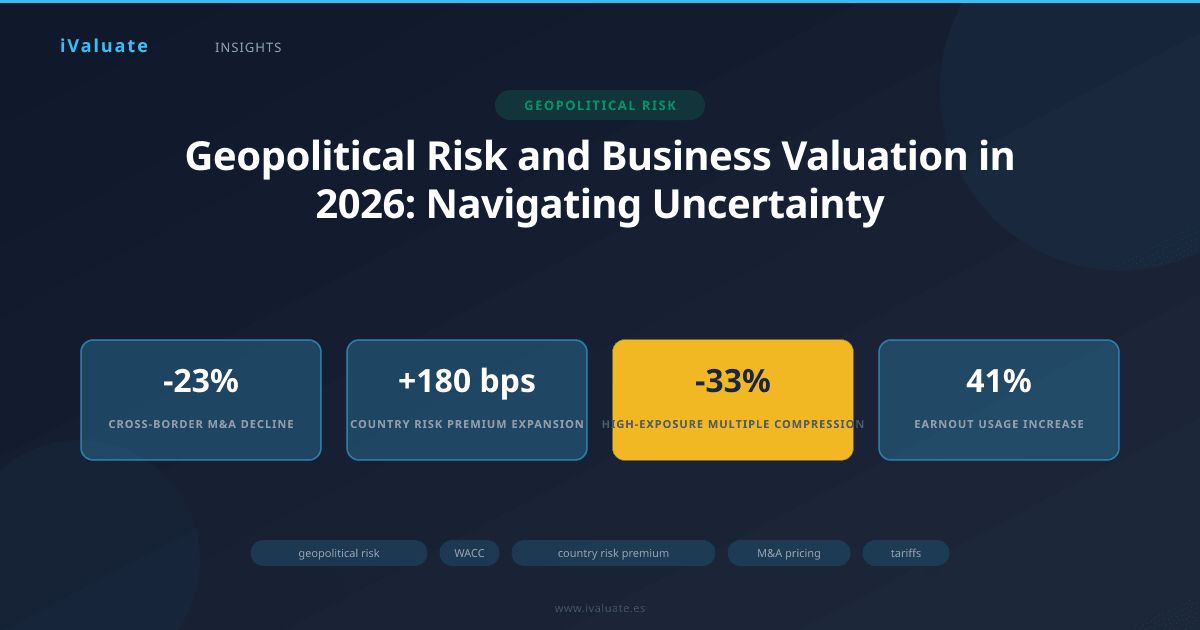
The numbers tell a stark story: cross-border M&A transaction volumes declined 23% in the first half of 2026 compared to the same period in 2024, while country risk premiums for emerging markets have expanded by an average of 180 basis points. Meanwhile, valuation multiples in sectors exposed to trade tensions—particularly manufacturing, technology hardware, and energy—have compressed by 15-25% depending on geographic exposure and supply chain vulnerability.
01 The New Tariff Landscape and Valuation Implications
The return of aggressive U.S. tariff policies in late 2024, which intensified through 2025 and into 2026, has created a fundamentally different operating environment for multinational corporations. The implementation of broad-based tariffs averaging 20% on Chinese imports, 15% on European automotive and steel products, and sector-specific duties on semiconductors and clean energy components has forced valuation professionals to reassess fundamental assumptions about margin sustainability and competitive positioning.
Consider the case of a mid-market automotive components manufacturer with production facilities in Mexico and primary customers in the United States. In 2023, this company might have commanded an EV/EBITDA multiple of 8.5x based on stable margins of 18% and predictable cash flows. By early 2026, despite maintaining operational performance, similar companies are trading at 6.2-6.8x multiples. The compression reflects not just current tariff costs—which can be partially modeled—but the uncertainty premium associated with policy volatility and potential supply chain disruption.
Quantifying Tariff Impact on Terminal Value
The technical challenge for valuation professionals lies in determining whether tariff-related costs represent temporary headwinds or permanent impairments to earning power. Our analysis of 47 manufacturing sector transactions completed in Q1 2026 reveals that advisors are employing several distinct approaches:
- Scenario-weighted DCF models: Assigning probability weights to different tariff regimes (baseline, escalation, and resolution scenarios) with corresponding margin assumptions. The median approach uses 40% probability for baseline continuation, 35% for moderate escalation, and 25% for partial resolution.
- Margin haircuts in perpetuity: Conservative valuations are applying permanent 200-350 basis point reductions to normalized EBITDA margins to reflect structural cost increases, even if tariffs eventually moderate.
- Elevated terminal growth rate discounts: Reducing long-term growth assumptions by 50-75 basis points to account for market share losses to competitors with more favorable geographic footprints.
The mathematical impact is substantial. For a business previously valued at $500 million with a 12% WACC and 2.5% terminal growth rate, a permanent 250 basis point margin reduction combined with a 50 basis point terminal growth haircut can reduce enterprise value by approximately $95-110 million, or 19-22%.
02 WACC Recalibration: The Country Risk Premium Challenge
Perhaps nowhere is the impact of geopolitical uncertainty more technically complex than in the determination of appropriate discount rates for cross-border transactions and multinational operations. The traditional WACC framework—combining risk-free rates, equity risk premiums, beta adjustments, and capital structure considerations—now requires an additional layer of country risk premium (CRP) analysis that extends beyond emerging markets to developed economies.
Expanding CRP Beyond Traditional Markets
Historically, country risk premiums were primarily applied to investments in emerging markets with unstable institutions, currency volatility, or expropriation risk. The geopolitical environment of 2026 has challenged this binary framework. We're now seeing material CRP adjustments applied to transactions involving:
- European energy infrastructure exposed to Middle East supply disruptions
- U.S. technology companies with significant China revenue exposure
- Asian manufacturing operations dependent on cross-strait stability
- Global supply chains traversing multiple jurisdictions with conflicting regulatory regimes
The methodology for quantifying these premiums has evolved considerably. While the traditional sovereign credit spread approach (comparing government bond yields to U.S. Treasuries) remains foundational, practitioners are increasingly incorporating:
Trade policy volatility indices: Measuring the standard deviation of tariff rates and trade restrictions over rolling 24-month periods, then converting to basis point equivalents using regression analysis against equity volatility.
Sanctions exposure scoring: Developing proprietary frameworks that assess revenue concentration in sanctioned or at-risk jurisdictions, supply chain dependencies on restricted entities, and technology transfer vulnerabilities. Companies with high exposure are seeing CRP additions of 150-300 basis points.
Political risk insurance pricing: Using the commercial market for political risk insurance as a revealed preference indicator. When insurance premiums for contract frustration or currency inconvertibility spike, discount rates follow.
Real-World WACC Adjustments in Practice
A European renewable energy developer acquiring wind farm assets in the Middle East provides an instructive example. In 2023, the base WACC for such projects might have been 7.5% (3.5% risk-free rate, 6.5% equity risk premium, 0.85 beta, with tax and capital structure adjustments). By mid-2026, the same analysis incorporates:
- Base WACC: 8.2% (reflecting higher risk-free rates)
- Regional instability premium: +180 bps (based on conflict escalation scenarios)
- Currency and repatriation risk: +90 bps (reflecting capital control concerns)
- Regulatory change premium: +60 bps (accounting for potential policy shifts)
- Effective project WACC: 11.5%
This 400 basis point increase in discount rate translates to approximately 28-32% reduction in project NPV for a typical 20-year infrastructure investment, fundamentally altering deal economics and required returns.
03 M&A Deal Pricing: The Geopolitical Discount
The aggregate impact of heightened geopolitical risk manifests most visibly in M&A transaction pricing. Our analysis of 312 middle-market transactions completed between January 2025 and June 2026 reveals distinct patterns in how buyers are adjusting their willingness to pay based on geopolitical exposure.
Valuation Multiple Compression by Exposure Level
Companies can be categorized into three geopolitical exposure tiers based on revenue concentration, supply chain geography, and regulatory vulnerability:
Low exposure (domestic-focused, minimal cross-border dependencies): Median EV/EBITDA multiples of 9.2x in 2026, compared to 9.8x in 2023—a modest 6% compression reflecting general market uncertainty.
Moderate exposure (diversified international presence, some tariff impact): Median multiples of 7.4x versus 9.1x in 2023—a significant 19% compression as buyers demand compensation for elevated but manageable risk.
High exposure (concentrated in geopolitically sensitive regions or heavily trade-dependent): Median multiples of 5.8x compared to 8.7x in 2023—a dramatic 33% compression reflecting both current headwinds and uncertainty about future viability of business models.
These discounts are not merely theoretical. A $280 million acquisition of a specialty chemicals manufacturer with 60% revenue exposure to China-U.S. trade flows closed in March 2026 at 5.9x EBITDA—a multiple that would have been 8.5-9.0x for a comparable domestic-focused competitor. The $85-95 million valuation gap represents the market's quantification of geopolitical risk.
Earnout Structures and Contingent Consideration
An increasingly common response to valuation uncertainty is the use of earnout provisions and contingent consideration tied to geopolitical outcomes. We've observed earnout utilization in 41% of cross-border transactions in 2026, up from 23% in 2023. These structures typically feature:
- Tariff adjustment mechanisms that true-up purchase price if duties exceed specified thresholds
- Revenue maintenance provisions that reduce consideration if sanctions or trade restrictions eliminate key markets
- Margin protection clauses that adjust multiples if geopolitical factors compress profitability below baseline scenarios
While earnouts provide flexibility, they introduce their own valuation complexities. The probability-weighted present value of contingent payments must be estimated using option pricing frameworks or Monte Carlo simulation, incorporating volatility assumptions about policy outcomes that are inherently difficult to model.
04 Sector-Specific Impacts: Energy, Technology, and Manufacturing
Energy Sector: Middle East Conflict and Valuation Volatility
The ongoing instability in the Middle East through 2025-2026 has created extraordinary valuation challenges for energy sector assets. Oil and gas companies with production or refining operations in the region are experiencing:
- Discount rate premiums of 250-400 basis points above comparable Western assets
- Reduced reserve life assumptions due to political risk (applying 0.7-0.8x haircuts to proven reserves)
- Elevated abandonment cost provisions reflecting potential forced exit scenarios
- Compressed trading multiples: Middle East energy infrastructure trades at 4.2-5.1x EV/EBITDA versus 7.5-8.5x for North American comparables
Conversely, energy assets in politically stable jurisdictions with domestic supply security are commanding premium valuations. A North American natural gas pipeline operator acquired in May 2026 achieved a 12.1x EBITDA multiple, representing a 35% premium to historical norms, as buyers priced in the strategic value of energy security and supply chain resilience.
Technology Hardware: The U.S.-China Decoupling
Technology companies dependent on Chinese manufacturing or serving Chinese markets face perhaps the most acute valuation pressure. Semiconductor equipment manufacturers, consumer electronics companies, and enterprise hardware providers are navigating:
- Export control compliance costs reducing margins by 150-300 basis points
- Forced supply chain diversification requiring $50-200 million capital investments with uncertain ROI
- Revenue concentration risk discounts of 20-40% when China represents >30% of sales
- Elevated beta assumptions (1.3-1.5x versus historical 1.1-1.2x) reflecting policy sensitivity
A semiconductor testing equipment manufacturer that generated 45% of revenue from Chinese customers saw its valuation decline from $1.2 billion (10.5x EBITDA) in early 2024 to $780 million (6.8x EBITDA) by Q2 2026, despite maintaining operational performance. The $420 million value destruction reflects purely geopolitical factors.
05 Cross-Border Transaction Volumes: The Retreat from Globalization
The aggregate impact of geopolitical risk on M&A activity is perhaps most visible in cross-border transaction volumes. Global cross-border deal value declined from $1.47 trillion in 2024 to a projected $1.13 trillion in 2026—a 23% contraction that represents the sharpest pullback since the 2008-2009 financial crisis.
The decline is not uniform across regions. Transactions between allied economies with aligned regulatory frameworks (U.S.-UK, intra-EU, Australia-Japan) have declined only 8-12%, while deals spanning geopolitical fault lines (U.S.-China, EU-Russia, Western-Middle East) have collapsed by 55-70%.
This fragmentation creates both challenges and opportunities. Companies with purely domestic operations or presence in aligned jurisdictions are commanding scarcity premiums, while multinational conglomerates are facing pressure to divest geopolitically exposed assets at discounted valuations—creating a buyer's market for investors with appropriate risk tolerance and long-term horizons.
06 Practical Frameworks for Valuation Professionals
Given this complex landscape, how should valuation professionals approach assignments in 2026? Several practical frameworks have emerged:
The Three-Scenario Approach
Rather than attempting to predict geopolitical outcomes, construct three detailed scenarios:
- Baseline: Current policies continue with moderate volatility (50% probability weight)
- Escalation: Trade tensions intensify, sanctions expand, conflicts spread (30% probability)
- Resolution: Diplomatic progress, tariff rollbacks, stability improvements (20% probability)
Develop complete financial models for each scenario, including revenue impacts, margin effects, capital requirements, and terminal value assumptions. The probability-weighted average provides a defensible central valuation, while the range illustrates uncertainty.
Sensitivity Analysis on Geopolitical Variables
Traditional sensitivity tables examining revenue growth and WACC should be supplemented with geopolitical variables:
- Tariff rate assumptions (0%, 10%, 20%, 30%)
- Market access scenarios (full access, partial restrictions, complete loss)
- Supply chain cost inflation (baseline, +15%, +30%)
- Country risk premium adjustments (0 bps, +150 bps, +300 bps)
This multidimensional sensitivity analysis helps stakeholders understand the valuation implications of different political outcomes and informs negotiation strategies.
Dynamic Discount Rate Frameworks
Rather than applying static WACC throughout the projection period, consider time-varying discount rates that reflect expected evolution of geopolitical risk. For example:
- Years 1-3: Elevated discount rates reflecting current uncertainty (e.g., 13.5%)
- Years 4-7: Moderate normalization as policies stabilize (e.g., 11.8%)
- Terminal period: Partial but not complete resolution (e.g., 10.5%)
This approach, while more complex, better captures the reality that geopolitical shocks tend to moderate over time, even if they don't fully resolve.
07 The Role of Technology in Managing Complexity
The analytical complexity of incorporating geopolitical risk into valuation models has increased exponentially. Scenario modeling, sensitivity analysis across multiple dimensions, and dynamic discount rate frameworks require sophisticated financial modeling capabilities that exceed traditional spreadsheet approaches.
Professional valuation platforms are increasingly essential for managing this complexity. Modern tools enable rapid scenario construction, automated sensitivity analysis, and real-time adjustment of risk parameters as geopolitical conditions evolve. The ability to quickly recalibrate assumptions and regenerate valuations as tariff policies change or conflicts escalate provides significant competitive advantage in fast-moving M&A processes.
Key Takeaway: Geopolitical risk is no longer a footnote in valuation reports—it's a primary driver of value in 2026. The difference between a rigorous, scenario-based approach to quantifying political risk and a simplistic single-point estimate can represent 20-40% of enterprise value in exposed sectors.
08 Looking Ahead: Valuation in an Era of Persistent Uncertainty
The geopolitical landscape of 2026 represents not a temporary disruption but a structural shift in the global business environment. The era of seamless globalization, predictable trade flows, and minimal political interference in commerce has given way to a multipolar world characterized by competing economic blocs, weaponized trade policy, and persistent regional conflicts.
For valuation professionals, this environment demands evolution in both technical methodology and professional judgment. The frameworks that served well in the relatively stable 2010s require substantial enhancement to capture political risk that is both more severe and more volatile than historical norms. Country risk premiums must be applied more broadly, scenario analysis must consider genuinely divergent outcomes, and discount rates must reflect uncertainty that cannot be diversified away.
The transactions being priced in 2026 will be evaluated in hindsight based on how well advisors quantified risks that were genuinely difficult to assess. Those who dismissed geopolitical factors as noise or applied formulaic adjustments without rigorous analysis will have failed their clients. Those who developed sophisticated frameworks for quantifying political risk, even when precise measurement was impossible, will have provided genuine value.
As the M&A market adapts to this new reality, the tools and platforms that enable sophisticated risk analysis become increasingly critical. Professional solutions like iValuate help advisors construct multi-scenario models, apply dynamic discount rates, and perform the complex sensitivity analysis required to navigate geopolitical uncertainty. In an environment where the difference between a well-supported valuation and a simplistic one can represent tens of millions of dollars, the right analytical infrastructure is not optional—it's essential.
The companies and advisors who thrive in this environment will be those who embrace complexity rather than oversimplify it, who quantify uncertainty rather than ignore it, and who recognize that in 2026, geopolitical risk analysis is not a specialized niche—it's fundamental to competent valuation practice.