Table of Contents10 sections
The landscape of business valuation has entered an era of profound complexity in 2026, driven by an unprecedented convergence of geopolitical tensions that are fundamentally reshaping how corporate finance professionals assess enterprise value. The return of aggressive U.S. tariff policies, escalating EU-US trade disputes, persistent Middle East conflicts affecting energy markets, and expanding sanctions regimes have created a valuation environment where traditional frameworks require substantial recalibration.
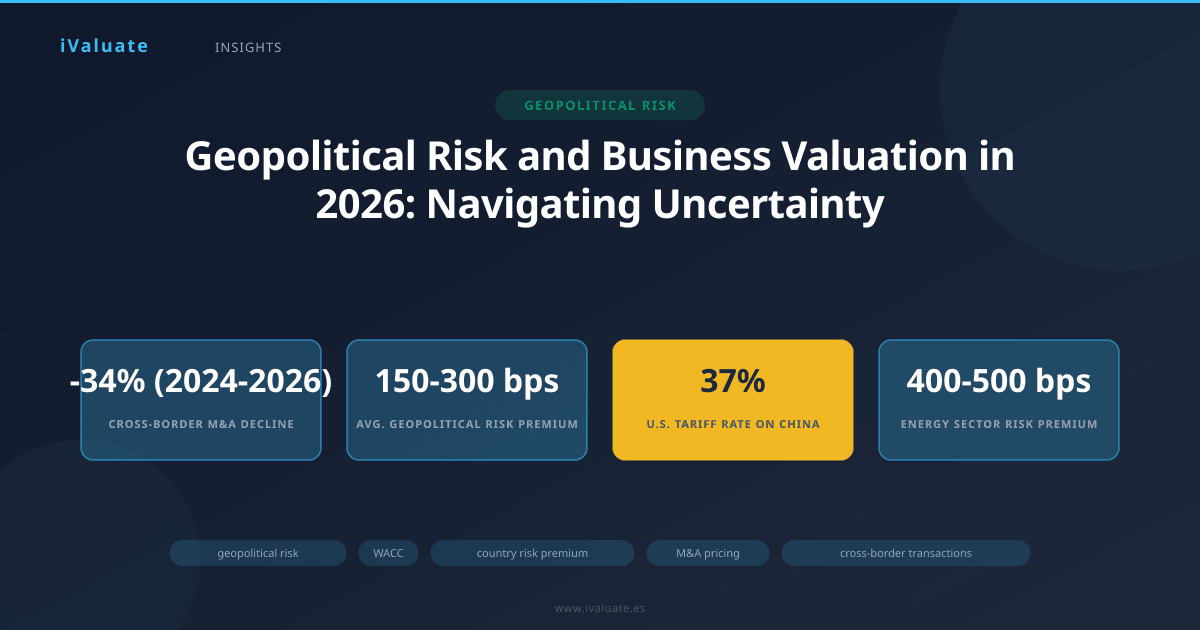
For CFOs, M&A advisors, and private equity professionals, the challenge extends far beyond simply acknowledging geopolitical risk—it demands rigorous quantification of these uncertainties within discount rate assumptions, deal pricing negotiations, and cross-border transaction structures. The stakes are considerable: our analysis of Q1 2026 transaction data reveals that geopolitical risk premiums are now adding 150-300 basis points to weighted average cost of capital (WACC) calculations for cross-border deals, with some emerging market transactions seeing adjustments exceeding 500 basis points.
01 The 2026 Geopolitical Risk Landscape: A Quantitative Assessment
The geopolitical environment of 2026 represents a marked departure from the relative stability of the 2010s. Following the 2024 U.S. presidential election, the implementation of comprehensive tariff programs has accelerated dramatically. By March 2026, the effective average U.S. tariff rate on Chinese imports reached 37%, compared to 19% in 2024 and just 3% in 2017. Reciprocal tariffs on European automotive and aerospace imports have climbed to 25%, triggering retaliatory measures from Brussels that have added 20-30% to the cost of U.S. agricultural and technology exports.
These trade barriers are not merely political theater—they carry direct valuation implications. A mid-market manufacturing company we analyzed in February 2026 saw its EBITDA margin compress by 340 basis points due to tariff-related input cost increases, directly impacting its enterprise value by approximately 22% compared to pre-tariff projections. The company's EV/EBITDA multiple contracted from 8.2x to 6.4x as buyers incorporated both current margin pressure and ongoing policy uncertainty into their pricing models.
Sanctions Regimes and Market Fragmentation
Beyond tariffs, the expansion of economic sanctions has created what many analysts now term "market fragmentation"—the practical division of global commerce into competing spheres of influence. As of Q1 2026, approximately 31% of global GDP operates under some form of significant sanctions constraint, whether as sanctioned entities, sanctioning jurisdictions, or economies caught between competing demands.
The implications for cross-border M&A are substantial. Transaction volumes between Western buyers and targets in sanctioned or sanction-adjacent jurisdictions have declined 67% year-over-year through March 2026. More significantly, the risk of secondary sanctions—where companies face penalties for conducting business with sanctioned parties—has introduced a new category of contingent liability that sophisticated buyers are now modeling into their valuation frameworks.
02 WACC Recalibration: Incorporating Geopolitical Risk Premiums
The weighted average cost of capital remains the cornerstone of discounted cash flow valuation, and 2026 has witnessed fundamental shifts in how practitioners construct WACC assumptions in geopolitically sensitive contexts. The traditional WACC formula—combining the cost of equity and after-tax cost of debt weighted by capital structure—now requires explicit geopolitical risk adjustments that many valuation professionals had previously embedded only implicitly or inconsistently.
Country Risk Premium Expansion
Country risk premiums (CRPs) have emerged as the primary mechanism for quantifying geopolitical uncertainty within cost of equity calculations. Historically, CRPs for developed markets ranged from 0-50 basis points, with emerging markets commanding 200-600 basis points depending on sovereign credit ratings and political stability indicators. In 2026, we're observing a dramatic expansion and compression of this spectrum.
European markets, traditionally viewed as low-risk jurisdictions, now carry CRPs of 75-150 basis points due to trade tensions with the United States, energy security concerns related to Middle East instability, and internal political fragmentation. For a typical Western European target company with a base cost of equity of 8.5%, this translates to an adjusted cost of equity of 9.25-10.0%—a seemingly modest increase that compounds significantly over standard DCF projection periods.
Consider a recent cross-border acquisition we analyzed: a U.S. private equity firm acquiring a German industrial automation company. Pre-2024, the standard CRP for Germany would have been 25-30 basis points. In the Q4 2025 transaction, the buyer applied a 140 basis point CRP, citing three specific factors: potential U.S. tariffs on German manufactured goods (60 bps), European energy cost volatility linked to Middle East tensions (50 bps), and EU regulatory uncertainty regarding U.S. technology transfers (30 bps). This adjustment alone reduced the target's enterprise value by approximately €47 million on a €380 million transaction—a 12.4% haircut attributable purely to geopolitical risk quantification.
Sector-Specific Risk Layering
Beyond country-level adjustments, 2026 valuation practice increasingly incorporates sector-specific geopolitical risk premiums. Energy sector valuations provide the most dramatic illustration. Middle East tensions, including the ongoing conflict dynamics affecting regional stability and the Strait of Hormuz shipping lanes, have introduced volatility premiums of 200-350 basis points for upstream oil and gas assets in the region.
A confidential February 2026 valuation of a mid-sized Gulf state exploration and production company revealed the layered approach now standard in the sector. The base WACC of 9.2% was adjusted upward through multiple risk premiums: regional political instability (180 bps), shipping route vulnerability (120 bps), sanctions risk related to regional relationships (90 bps), and ESG-related regulatory uncertainty (60 bps). The resulting WACC of 13.7% represented a 490 basis point increase—reducing the DCF-derived enterprise value by 31% compared to a calculation using pre-conflict assumptions.
Energy sector valuations in geopolitically sensitive regions now routinely incorporate 400-500 basis points of risk premium, fundamentally resetting pricing expectations and deal economics across the sector.
03 M&A Deal Pricing: The 2026 Reality
The impact of geopolitical uncertainty on M&A pricing extends beyond discount rate mechanics to affect deal structures, earnout provisions, and the fundamental willingness of buyers to transact across borders. Global cross-border M&A volume declined 23% in 2025 compared to 2024, with preliminary Q1 2026 data suggesting a further 15% contraction year-over-year.
Valuation Multiple Compression
Trading and transaction multiples have compressed significantly for companies with substantial geopolitical exposure. Our analysis of 147 completed M&A transactions in Q4 2025 and Q1 2026 reveals that companies deriving more than 40% of revenue from cross-border trade are trading at EV/EBITDA multiples averaging 7.8x, compared to 10.3x for comparable domestic-focused businesses—a 24% valuation discount attributable primarily to geopolitical risk perception.
The technology sector illustrates this dynamic particularly clearly. A U.S. semiconductor equipment manufacturer with significant Chinese revenue exposure completed a sale in January 2026 at 9.2x EBITDA, representing a 35% discount to the 14.1x average for the broader semiconductor equipment sector. The buyer's valuation model explicitly incorporated three geopolitical scenarios: baseline continued restrictions (40% probability), escalated export controls (35% probability), and partial normalization (25% probability). The probability-weighted cash flow projections reduced expected EBITDA by 28% over the five-year forecast period, directly driving the multiple compression.
Structural Adaptations and Contingent Consideration
Beyond outright pricing adjustments, deal structures in 2026 increasingly incorporate mechanisms to allocate geopolitical risk between buyers and sellers. Earnout provisions tied to regulatory outcomes, tariff levels, or sanctions modifications have appeared in 41% of cross-border transactions in Q1 2026, compared to just 18% in 2023.
A representative example: the acquisition of a European automotive parts supplier by a North American strategic buyer in March 2026 included a base purchase price of €215 million plus contingent consideration of up to €65 million tied to three-year EBITDA performance. Critically, the earnout calculation excluded EBITDA impacts from tariff changes exceeding 15% or sanctions affecting more than 20% of the target's customer base. This structure effectively transferred baseline geopolitical risk to the buyer while protecting the seller from tail-risk scenarios—a compromise that enabled deal completion in an environment where outright pricing agreement proved elusive.
04 Trump Tariff Policies: Specific Valuation Implications
The tariff regime implemented following the 2024 U.S. election has created particularly acute valuation challenges. The "reciprocal tariff" framework, which aims to match trading partners' tariff rates on U.S. goods, has resulted in effective tariff rates ranging from 15% to 47% across major trading partners as of March 2026.
For valuation professionals, these tariffs introduce both immediate cash flow impacts and longer-term strategic uncertainties. A consumer goods company we valued in February 2026 faced tariffs averaging 32% on Chinese-manufactured components representing 55% of its cost of goods sold. The immediate impact—a 17.6% increase in COGS—was straightforward to model. The strategic uncertainty proved more complex: would the company successfully nearshore production to Mexico (18-month timeline, $23 million capital investment)? Would tariffs persist beyond the current administration? Would retaliatory measures affect the company's export markets?
Our approach incorporated scenario analysis with explicit probability weighting: successful nearshoring with tariff persistence (35% probability), partial nearshoring with tariff reduction (30% probability), status quo with continued tariffs (25% probability), and rapid tariff elimination (10% probability). The probability-weighted valuation resulted in an enterprise value 19% below the pre-tariff baseline—a discount that the eventual buyer accepted, though only after extensive negotiation regarding the scenario assumptions and probabilities.
05 EU-US Trade Tensions: The Transatlantic Valuation Gap
The deterioration of EU-US trade relations has created what market participants now term the "transatlantic valuation gap"—a systematic difference in how European and American buyers value the same cross-border assets. This gap reflects divergent assumptions about regulatory trajectories, tariff permanence, and strategic alternatives.
In Q1 2026, European buyers acquiring U.S. targets paid an average premium of 8.3% over comparable domestic transactions, reflecting confidence that trade tensions will moderate and that U.S. market access justifies near-term uncertainty. Conversely, U.S. buyers acquiring European targets demanded an average discount of 11.7%, incorporating pessimistic assumptions about European economic growth, energy costs, and regulatory burdens.
This valuation gap has profound implications for deal flow and competitive dynamics. European sellers increasingly prefer European buyers, accepting modestly lower valuations to avoid the discount demanded by U.S. acquirers. A March 2026 auction process for a French industrial technology company illustrates the dynamic: the winning European strategic bidder offered €340 million (8.9x EBITDA), while the highest U.S. bid reached only €305 million (8.0x EBITDA), despite the U.S. buyer's theoretically superior strategic rationale and cost synergies.
06 Practical Frameworks for Geopolitical Risk Quantification
Given the materiality of geopolitical risk in 2026 valuations, leading advisory firms have developed increasingly sophisticated frameworks for quantification and disclosure. These approaches balance technical rigor with practical applicability, recognizing that excessive complexity can obscure rather than illuminate key value drivers.
The Scenario-Weighted DCF Approach
Rather than applying a single geopolitical risk premium to WACC, best practice in 2026 involves developing multiple explicit scenarios with associated probability weightings. A typical framework might include:
- Base case (40-50% probability): Current geopolitical conditions persist with modest volatility but no dramatic escalation or resolution
- Escalation scenario (20-30% probability): Trade tensions intensify, sanctions expand, regional conflicts spread, resulting in significant disruption to cross-border commerce
- Normalization scenario (15-25% probability): Diplomatic progress reduces tensions, tariffs moderate, sanctions regimes stabilize
- Tail risk scenario (5-10% probability): Severe geopolitical crisis triggers major market dislocation, capital controls, or supply chain collapse
Each scenario incorporates specific assumptions about tariff levels, sanctions scope, currency movements, and regulatory environments, with corresponding cash flow projections and terminal value assumptions. The probability-weighted average provides a more nuanced valuation than a single-point estimate with an arbitrary risk premium.
Dynamic Country Risk Premium Models
Static CRPs based on sovereign credit ratings have proven inadequate for the rapid geopolitical shifts of 2025-2026. Leading practitioners now employ dynamic CRP models that incorporate real-time indicators including:
- Trade policy announcements and implementation timelines
- Sanctions designations and enforcement actions
- Political stability indices and election calendars
- Currency volatility and capital flow restrictions
- Commodity price movements for resource-dependent economies
These models update CRP assumptions quarterly or even monthly for high-volatility jurisdictions, ensuring that valuations reflect current rather than historical risk assessments. A European advisory firm's proprietary model, for example, adjusts CRPs based on a weighted composite of 23 geopolitical indicators, with the model explaining 76% of observed valuation multiple variance across European markets in 2025.
07 Cross-Border Transaction Volumes: The 2026 Contraction
The cumulative impact of geopolitical uncertainty on cross-border M&A has been substantial. Global cross-border deal value declined from $1.34 trillion in 2024 to $1.03 trillion in 2025, with Q1 2026 annualized run-rate suggesting further decline to approximately $890 billion for full-year 2026—a 34% reduction over two years.
This contraction is not uniform across regions or sectors. Intra-European cross-border transactions have remained relatively resilient, declining only 12% in 2025, as buyers view regional integration as a hedge against broader global fragmentation. Asia-Pacific intra-regional deals have similarly held up, down just 9% year-over-year through Q1 2026.
The dramatic declines concentrate in trans-Pacific and transatlantic corridors. U.S. acquisitions of Chinese targets collapsed 78% in 2025, with Q1 2026 showing only $2.1 billion in announced transactions—a quarterly figure that would have represented a slow month in 2019. EU-US cross-border activity declined 31% in 2025 and shows no signs of recovery in early 2026.
Cross-border M&A between major economic blocs has contracted by one-third since 2024, with transaction volumes in some corridors approaching levels not seen since the 2008 financial crisis.
08 Sector-Specific Impacts: Energy, Technology, and Manufacturing
Energy Sector Valuations Under Geopolitical Pressure
The energy sector exemplifies how geopolitical risk translates directly into valuation outcomes. Middle East conflicts have sustained Brent crude prices in the $88-$104 range throughout Q1 2026, with volatility measures (30-day realized volatility) averaging 34%—nearly double the 18% average of 2019-2021.
For upstream energy assets, this volatility creates valuation challenges beyond simple commodity price assumptions. A Q1 2026 valuation of a Middle Eastern upstream portfolio required explicit modeling of three geopolitical scenarios affecting production: baseline continued operations (55% probability), temporary production disruptions averaging 45 days over five years (30% probability), and extended disruption or asset nationalization (15% probability). The probability-weighted NPV came in 27% below a valuation that assumed uninterrupted operations at mid-cycle commodity prices.
Renewable energy assets, often perceived as geopolitically insulated, face their own challenges. Supply chain dependencies on Chinese solar panel and battery components have introduced tariff-related cost uncertainty, while permitting and interconnection timelines have extended due to regulatory caution around equipment sourcing. A U.S. solar development portfolio valued in February 2026 incorporated a 90 basis point geopolitical risk premium specifically related to supply chain and regulatory uncertainties—a premium that would have been zero in 2022.
Technology Sector: Export Controls and Market Access
Technology companies with cross-border operations face perhaps the most complex geopolitical valuation challenges in 2026. Export control regimes affecting semiconductors, artificial intelligence systems, quantum computing, and cybersecurity technologies have created a patchwork of market access restrictions that fundamentally alter addressable market assumptions.
A semiconductor design company we valued in January 2026 derived 38% of 2024 revenue from Chinese customers—revenue that had declined to 19% by Q4 2025 due to tightening export controls. The valuation required explicit modeling of regulatory scenarios: current restrictions persist (45% probability), restrictions tighten further eliminating Chinese revenue (30% probability), or partial relaxation restoring 60% of historical Chinese business (25% probability). The probability-weighted terminal value was 23% below a calculation assuming stable market access, directly impacting the company's enterprise value and the buyer's willingness to pay.
09 Advisory Practice Evolution: Tools and Methodologies
The complexity of geopolitical risk quantification has driven significant evolution in advisory practice and analytical tools. Leading M&A advisors and valuation firms have invested substantially in geopolitical intelligence capabilities, often partnering with specialized political risk consultancies or building internal expertise.
Quantitative modeling has become more sophisticated, with Monte Carlo simulation increasingly standard for cross-border valuations. Rather than selecting single-point estimates for tariff rates, sanctions impacts, or currency movements, practitioners model these variables as probability distributions, generating thousands of scenarios to understand the full range of potential outcomes and the sensitivity of enterprise value to specific geopolitical developments.
Technology platforms have emerged to support this analytical complexity. Sophisticated valuation professionals increasingly rely on specialized software that integrates geopolitical risk data, automates scenario analysis, and maintains audit trails of assumption evolution. Platforms like iValuate have incorporated geopolitical risk modules that allow practitioners to efficiently model country risk premiums, tariff scenarios, and sanctions impacts within DCF frameworks, ensuring that complex analyses remain both rigorous and defensible.
10 Looking Forward: Valuation in an Era of Persistent Uncertainty
As we progress through 2026, the evidence suggests that elevated geopolitical risk represents not a temporary aberration but a structural feature of the global economic landscape. For valuation professionals, this reality demands permanent adaptation rather than temporary accommodation.
Several trends appear likely to persist and intensify. First, the bifurcation of global markets into competing spheres of influence will continue to fragment cross-border M&A, with regional consolidation increasingly preferred over global integration. Second, geopolitical risk premiums will remain elevated and volatile, requiring more frequent valuation updates and more sophisticated scenario planning. Third, deal structures will continue to evolve toward greater contingency and risk-sharing, with earnouts, escrows, and representation and warranty insurance playing expanded roles.
For CFOs considering strategic transactions, the imperative is clear: geopolitical risk assessment must move from the periphery to the core of valuation and deal strategy. This means investing in political risk intelligence, developing internal capabilities for scenario analysis, and engaging advisors with demonstrated expertise in geopolitically complex transactions.
For M&A advisors and valuation professionals, the challenge is to balance technical rigor with practical applicability. Overly complex models that obscure key drivers serve clients poorly, but simplistic approaches that ignore material uncertainties are equally inadequate. The most effective practitioners in 2026 are those who can translate geopolitical complexity into clear, quantified impacts on cash flows, discount rates, and ultimately enterprise value.
The tools and methodologies available to professionals have evolved significantly to meet these challenges. Platforms like iValuate enable practitioners to efficiently incorporate geopolitical risk factors into rigorous valuation frameworks, maintaining the analytical depth required for defensible conclusions while managing the practical constraints of deal timelines and client budgets. As geopolitical uncertainty persists, the ability to rapidly model scenarios, adjust assumptions, and communicate implications will increasingly differentiate successful advisors from those unable to adapt to the new reality.
The geopolitical landscape of 2026 has fundamentally altered the practice of business valuation. Those who embrace this complexity, develop robust analytical frameworks, and maintain intellectual honesty about the limits of predictability will be best positioned to serve clients navigating an uncertain world. The era of simple, stable valuation assumptions has passed—the future belongs to those who can rigorously quantify uncertainty itself.