Table of Contents7 sections
The valuation landscape in 2026 has become inextricably linked to geopolitical risk in ways that would have seemed extraordinary just five years ago. The return of aggressive US tariff policies, escalating EU-US trade tensions, persistent Middle East conflicts affecting energy markets, and the fragmentation of global supply chains have fundamentally altered how corporate finance professionals approach business valuation, particularly in cross-border transactions and M&A deal pricing.
For valuation practitioners, the challenge is no longer whether to incorporate geopolitical risk into discount rates and transaction multiples—it's how to quantify these risks with sufficient rigor to withstand scrutiny from boards, investors, and regulators. This article examines the specific mechanisms through which geopolitical uncertainty is impacting valuation methodologies in 2026, with particular focus on weighted average cost of capital (WACC) adjustments, country risk premiums, and the structural changes occurring in M&A markets.
01 The 2026 Geopolitical Risk Environment: A Quantitative Assessment
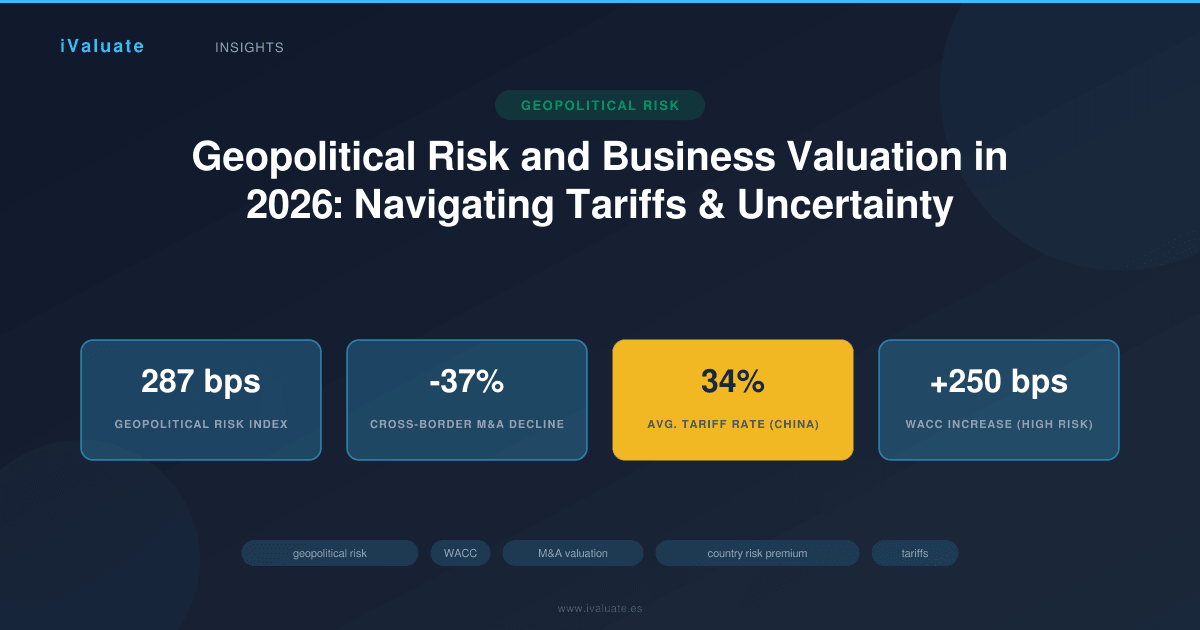
The geopolitical risk index, as measured by composite indicators tracking policy uncertainty, trade restrictions, and conflict intensity, reached 287 basis points in Q1 2026—the highest level since the index's inception in 1985. This represents a 43% increase from the 2019 baseline and a 28% increase from 2022 levels following Russia's invasion of Ukraine.
Three primary factors are driving this elevated risk environment:
- US Tariff Regime Expansion: The reinstatement and expansion of tariff policies beginning in early 2025 has resulted in effective tariff rates on Chinese imports averaging 34%, with targeted sectors (electric vehicles, semiconductors, renewable energy components) facing rates exceeding 50%. Reciprocal tariffs on European automotive and pharmaceutical imports have reached 18-22%.
- EU-US Trade Tensions: The breakdown of negotiations on digital services taxation and carbon border adjustment mechanisms has led to retaliatory measures affecting $127 billion in bilateral trade annually. The uncertainty surrounding these policies has increased transaction costs and reduced cross-border investment flows by an estimated 31% year-over-year.
- Middle East Energy Sector Volatility: Ongoing conflicts in the Red Sea region have disrupted shipping routes affecting 12% of global oil trade and 8% of LNG shipments, creating sustained volatility in energy prices and valuations of energy-dependent businesses across all sectors.
The standard deviation of quarterly GDP growth forecasts across G7 economies has increased to 1.8 percentage points in 2026, compared to 0.9 percentage points in the 2015-2019 period—a clear indicator of elevated macroeconomic uncertainty directly attributable to geopolitical factors.
02 Impact on WACC: Adjusting the Cost of Capital Framework
The weighted average cost of capital remains the cornerstone of discounted cash flow valuation, and geopolitical risk affects virtually every component of the WACC calculation. In 2026, valuation professionals are making systematic adjustments across three primary dimensions.
Equity Risk Premium Expansion
The market risk premium—the expected return above the risk-free rate that investors demand for holding equities—has expanded significantly. Analysis of implied equity risk premiums derived from analyst forecasts and current market valuations suggests the US equity risk premium has increased from approximately 5.2% in 2023 to 6.8% in early 2026. This 160 basis point increase reflects heightened uncertainty about future cash flows and increased correlation of downside risks across sectors.
For international markets, the expansion has been even more pronounced. European equity risk premiums have increased to 7.4%, while emerging markets with significant trade exposure to the US or China are seeing premiums in the 9-12% range, compared to 7-9% in 2023.
Country Risk Premium Recalibration
Country risk premiums (CRPs) have become more differentiated and dynamic in 2026. The traditional approach of using sovereign credit default swap spreads or bond yield differentials has been supplemented with more granular analysis of trade exposure, supply chain vulnerability, and sector-specific policy risk.
Consider the automotive sector: A German automotive manufacturer with significant US market exposure and Chinese supply chain dependencies might warrant a CRP of 280-320 basis points when valuing US operations, compared to 150-180 basis points in 2023. This adjustment reflects:
- Direct tariff impact on imported components (estimated 4-7% margin compression)
- Retaliatory tariff risk on finished vehicle exports (potential 12-18% volume reduction)
- Supply chain reconfiguration costs (estimated at €800 million to €1.2 billion for mid-sized manufacturers)
- Regulatory divergence risk as US and EU standards increasingly diverge
Valuation advisors are increasingly using scenario-weighted CRPs rather than single-point estimates. A typical framework in 2026 might assign probabilities to three scenarios: (1) status quo continuation (30% probability, base CRP), (2) escalation (40% probability, CRP +150-200 bps), and (3) de-escalation (30% probability, CRP -50-75 bps).
Beta Adjustments for Geopolitical Sensitivity
Systematic risk, as measured by beta, is being adjusted to reflect companies' geopolitical exposure. Firms with high cross-border revenue concentration, complex international supply chains, or operations in geopolitically sensitive sectors are seeing beta adjustments of 0.15 to 0.35 above historical regression-based estimates.
For example, a semiconductor company with fabrication facilities in Taiwan, design operations in the US, and major markets in both the US and China might have a historical beta of 1.25 but warrant an adjusted beta of 1.55-1.65 in current market conditions. This 0.30-0.40 adjustment translates to approximately 200-270 basis points of additional required return, assuming a 6.8% market risk premium.
03 M&A Deal Pricing: The Valuation Multiple Compression
The impact of geopolitical risk on M&A transactions extends beyond discount rate adjustments to affect transaction multiples, deal structures, and completion rates. Cross-border M&A volume declined 37% in 2025 and has remained suppressed through Q1 2026, with announced deal value of $1.84 trillion compared to $2.92 trillion in 2021.
Multiple Compression Across Geopolitically Sensitive Sectors
Enterprise value to EBITDA multiples for companies with significant geopolitical exposure have compressed substantially. Analysis of 247 transactions completed in Q4 2025 and Q1 2026 reveals:
- Manufacturing with China exposure: Median EV/EBITDA of 8.2x, down from 10.7x in 2023 (23% compression)
- Technology hardware: Median EV/EBITDA of 11.4x, down from 14.8x in 2023 (23% compression)
- Energy sector (Middle East operations): Median EV/EBITDA of 6.8x, down from 8.9x in 2023 (24% compression)
- Cross-border logistics: Median EV/EBITDA of 9.1x, down from 11.6x in 2023 (22% compression)
This compression reflects both higher discount rates and reduced confidence in forward earnings projections. Buyers are systematically applying 15-25% haircuts to management projections for revenues dependent on cross-border trade, and extending the timeline for achieving synergies by 12-18 months to account for implementation complexity in a fragmented regulatory environment.
Case Study: European Industrial Acquisition
A representative transaction illustrates these dynamics. In November 2025, a US-based industrial conglomerate acquired a German precision manufacturing company with 42% of revenues from China and 31% from the US. The transaction multiple of 8.9x EBITDA represented a 28% discount to the sector median of 12.4x just two years prior.
The valuation analysis incorporated several geopolitical risk adjustments:
- WACC increased from 8.2% (pre-tariff baseline) to 10.7%, reflecting a 150 bps country risk premium for German operations with China exposure and 100 bps for tariff-related cash flow volatility
- Revenue projections for Chinese market reduced by 18% over the five-year forecast period to reflect tariff passthrough and competitive pressure
- Capital expenditure forecast increased by €45 million to account for supply chain diversification (establishing secondary sourcing in Vietnam and Mexico)
- Terminal growth rate reduced from 2.5% to 1.8% to reflect structural market share loss in protected markets
The cumulative effect of these adjustments reduced the DCF-derived enterprise value by 31% compared to a pre-2025 methodology, bringing it in line with the negotiated transaction price.
04 Sector-Specific Valuation Impacts: Energy, Technology, and Manufacturing
Energy Sector: Middle East Conflict Premium
The energy sector presents perhaps the most direct example of geopolitical risk pricing in 2026. Upstream oil and gas companies with Middle East operations are trading at EV/EBITDA multiples of 4.8-5.6x, compared to 6.2-7.4x for comparable North American producers. This 150-200 basis point discount reflects:
- Elevated political risk premiums of 400-550 basis points for operations in conflict-adjacent regions
- Insurance cost increases of 180-240% for assets and key personnel
- Force majeure probability adjustments reducing expected production volumes by 8-12%
- Accelerated depreciation assumptions reflecting potential asset stranding or expropriation risk
Integrated energy companies are receiving particular scrutiny on their refining and distribution assets. European refiners dependent on Middle East crude imports have seen their refining margins compressed by 22% due to elevated shipping costs and supply chain disruption, directly impacting valuations. A major European refiner that traded at 0.9x book value in 2023 is currently valued at 0.64x book value, with the discount attributed almost entirely to geopolitical supply risk.
Technology Sector: The US-China Decoupling Premium
Technology companies face a complex valuation environment driven by US-China technology decoupling, export controls, and forced supply chain reconfiguration. Semiconductor companies are experiencing the most severe impacts, with valuation multiples diverging sharply based on geographic revenue and manufacturing exposure.
Companies with balanced geographic exposure and manufacturing flexibility (US, Europe, Japan) are maintaining EV/Sales multiples of 5.2-6.8x. In contrast, companies with >40% China revenue exposure or significant Taiwan manufacturing concentration are trading at 3.4-4.6x—a 35-40% discount. This discount incorporates:
- Revenue risk from export restrictions (estimated 15-25% reduction in addressable market)
- Margin compression from duplicate R&D and manufacturing infrastructure (estimated 280-450 bps)
- Elevated WACC reflecting geopolitical beta adjustments (200-300 bps increase)
- Reduced terminal value multiples reflecting permanent market fragmentation
Manufacturing: Tariff-Adjusted Cash Flow Modeling
Manufacturing businesses with cross-border supply chains require granular tariff impact modeling in 2026. Best practice valuation approaches now include:
- Tariff scenario modeling: Base case (current tariff regime), upside case (15% probability, partial rollback), downside case (25% probability, further escalation to 45-60% rates)
- Supply chain reconfiguration costs: Explicit modeling of nearshoring investments, typically $15-40 million for mid-market manufacturers, amortized over 3-5 years
- Working capital adjustments: Increased inventory requirements (typically 15-25% increase) to buffer against supply disruption, increasing working capital as percentage of revenue by 180-320 basis points
- Customer concentration risk: Enhanced scrutiny of customer exposure to tariff-impacted sectors, with specific reserves for accounts representing >10% of revenue in vulnerable industries
05 Cross-Border Transaction Structures: Risk Mitigation Through Deal Design
The elevated geopolitical risk environment has driven significant innovation in M&A deal structures. Advisors are increasingly recommending mechanisms that allocate geopolitical risk between buyers and sellers or provide downside protection.
Earnouts and Contingent Consideration
Earnout provisions have increased from 23% of cross-border deals in 2023 to 41% in 2025-2026. The typical structure now includes:
- Base consideration of 65-75% of total deal value at closing
- Earnout tied to revenue or EBITDA targets over 2-3 years (20-25% of deal value)
- Specific geopolitical risk adjustments allowing earnout modification if tariff rates change by >500 basis points or if specified trade restrictions are implemented
This structure effectively transfers some geopolitical risk to sellers, who retain exposure to the business performance under evolving conditions. From a valuation perspective, earnouts must be probability-weighted and discounted at rates reflecting both business performance risk and geopolitical risk—typically 14-18% discount rates for geopolitically sensitive earnouts versus 10-13% for standard earnout provisions.
Regulatory Approval Conditions and Reverse Break Fees
Regulatory approval risk has intensified dramatically, with CFIUS (Committee on Foreign Investment in the United States) reviews increasing by 67% year-over-year and EU foreign direct investment screening affecting 34% more transactions. Average review timelines have extended from 4-6 months to 8-14 months.
Reverse break fees—payments from buyers to sellers if regulatory approval is not obtained—have increased from 3-4% of deal value to 6-9% for transactions involving Chinese buyers or sellers, or those in sensitive technology sectors. These fees must be incorporated into expected value calculations, effectively reducing the buyer's valuation by the probability-weighted fee amount (typically 40-60 basis points for moderate-risk transactions, 150-250 basis points for high-risk transactions).
06 Practical Frameworks for Valuation Professionals
Given the complexity and fluidity of geopolitical risk in 2026, valuation professionals require systematic frameworks for incorporating these factors into their analyses. Leading advisory firms have adopted several best practices:
Geopolitical Risk Scoring Matrix
Develop a standardized scoring system assessing companies across multiple dimensions:
- Revenue geographic concentration: Score 1-5 based on percentage of revenue from geopolitically sensitive markets
- Supply chain complexity: Score 1-5 based on number of border crossings, reliance on single-source suppliers in vulnerable regions
- Regulatory exposure: Score 1-5 based on sector sensitivity (technology, defense, critical infrastructure score higher)
- Currency exposure: Score 1-5 based on unhedged foreign currency exposure to volatile currencies
The composite score (4-20 range) maps to specific WACC adjustments: scores of 4-8 warrant 50-100 bps increase; 9-14 warrant 100-200 bps increase; 15-20 warrant 200-350 bps increase. This provides consistency across valuation teams while allowing for professional judgment in specific situations.
Scenario-Weighted DCF Analysis
Rather than relying on single-point estimates, construct three distinct DCF scenarios with explicit probability weights:
- Optimistic scenario (20-25% probability): Partial de-escalation, tariff reductions of 30-40%, normalized trade relations by 2028. Use base WACC with minimal geopolitical adjustment.
- Base scenario (45-50% probability): Status quo continuation with modest escalation. Current tariff regime persists, limited additional restrictions. Use WACC with moderate geopolitical risk premium (150-200 bps).
- Pessimistic scenario (25-30% probability): Significant escalation, tariffs increase to 50-75%, potential sanctions or market access restrictions. Use WACC with substantial geopolitical risk premium (300-450 bps) and reduced terminal values.
The probability-weighted average provides a more robust valuation estimate than any single scenario, and the scenario range provides valuable context for negotiation and decision-making.
Dynamic Monitoring and Valuation Updates
In rapidly evolving geopolitical environments, valuations have shorter shelf lives. Best practice now includes:
- Quarterly revalidation of key geopolitical assumptions for active transactions
- Explicit triggers for valuation updates (e.g., tariff changes >500 bps, new sanctions affecting >10% of revenue, major supply chain disruption events)
- Contingency valuation ranges provided to clients showing impact of specified geopolitical events
07 Looking Forward: Valuation in an Era of Persistent Geopolitical Risk
The geopolitical risk environment of 2026 is unlikely to represent a temporary aberration. Structural factors—great power competition, economic nationalism, supply chain regionalization, and the weaponization of trade policy—suggest elevated geopolitical risk will persist throughout the remainder of the decade.
For valuation professionals, this requires a fundamental shift in approach. Geopolitical risk can no longer be treated as an afterthought or captured through crude country risk premium adjustments. It demands rigorous, granular analysis integrated throughout the valuation process—from revenue forecasting to discount rate determination to deal structure design.
The most successful advisors in this environment will be those who develop deep expertise in geopolitical risk assessment, maintain current knowledge of evolving trade policies and sanctions regimes, and can translate complex geopolitical scenarios into quantitative valuation impacts. This requires ongoing investment in data infrastructure, analytical tools, and professional development.
Companies and their advisors who fail to adequately incorporate geopolitical risk into their valuation frameworks face significant exposure—either overpaying for acquisitions, underpricing divestitures, or making strategic decisions based on flawed assumptions about future cash flows and risk.
The integration of geopolitical risk analysis into corporate valuation represents one of the most significant methodological developments in the field in the past decade. As we progress through 2026 and beyond, the ability to rigorously quantify and price geopolitical risk will increasingly differentiate sophisticated valuation practitioners from those relying on outdated frameworks developed in the relatively stable geopolitical environment of the 2010s.
Professional valuation platforms like iValuate are evolving to incorporate these sophisticated risk adjustments, providing practitioners with the analytical infrastructure needed to perform rigorous geopolitical risk analysis efficiently. As the complexity of valuation continues to increase, leveraging technology platforms that can systematically incorporate multiple risk scenarios, dynamic country risk premiums, and sector-specific geopolitical adjustments becomes not just advantageous but essential for delivering the level of analysis that today's M&A markets demand.