Table of Contents9 sections
Debtor-in-possession (DIP) financing represents one of the most consequential decisions in corporate restructuring, fundamentally altering the capital structure, creditor priorities, and ultimately the enterprise value of distressed companies. As bankruptcy filings among middle-market companies surged 37% in 2024-2025 amid persistent high interest rates and refinancing pressures, understanding how DIP financing impacts valuation has never been more critical for M&A advisors, private equity professionals, and corporate finance executives navigating Chapter 11-style proceedings.
The mechanics of DIP financing create a complex interplay between liquidity provision, creditor dilution, and value preservation that directly affects how practitioners calculate enterprise value in distressed scenarios. This article examines the technical framework governing DIP facilities, their structural impact on valuation methodologies, and the practical implications for stakeholders across the capital structure.
01 The DIP Financing Framework: Legal Foundations and Market Structure
Debtor-in-possession financing allows a company operating under Chapter 11 bankruptcy protection to obtain new capital to fund operations during reorganization. Unlike traditional secured lending, DIP facilities benefit from extraordinary protections under Section 364 of the U.S. Bankruptcy Code, creating a unique risk-return profile that fundamentally distinguishes these instruments from conventional corporate debt.
The legal framework establishes a hierarchy of DIP financing structures, each with progressively stronger creditor protections:
- Administrative expense priority — The baseline DIP claim receives priority over general unsecured claims as an administrative expense under Section 503(b)
- Super-priority administrative expense — Enhanced priority over all other administrative expenses under Section 364(c)(1)
- Secured claim with junior lien — Security interest in unencumbered assets under Section 364(c)(2) or junior lien on encumbered assets under Section 364(c)(3)
- Priming lien — Senior or equal lien on already-encumbered collateral under Section 364(d), subject to adequate protection for existing lienholders
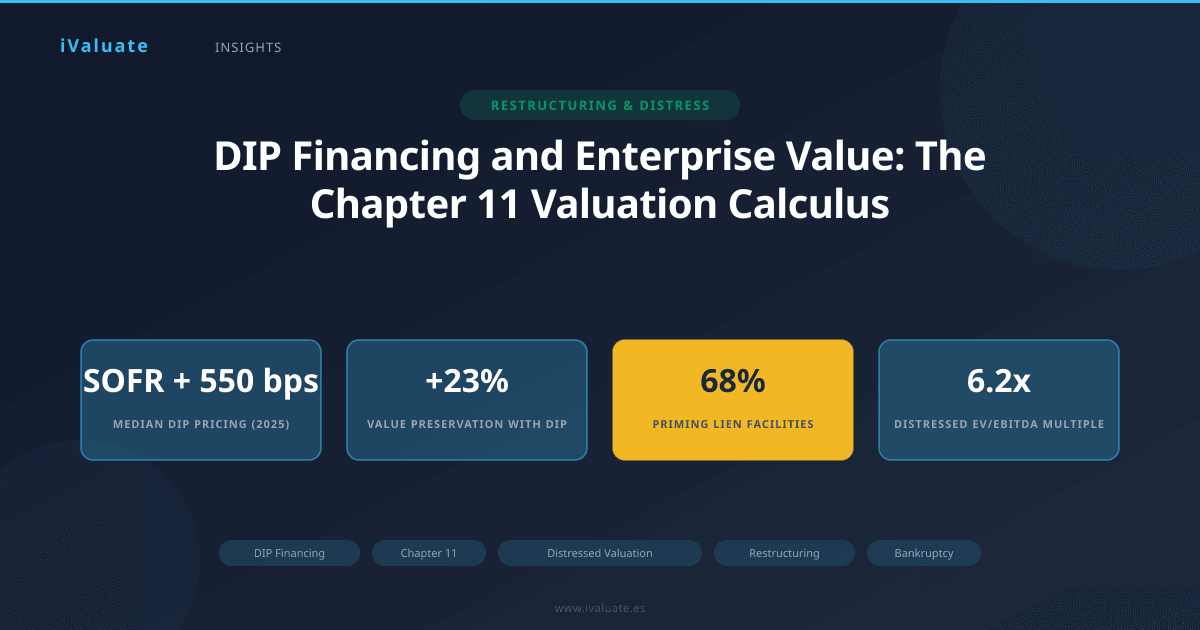
In the current market environment, approximately 68% of DIP facilities incorporate priming lien structures, reflecting lenders' insistence on maximum protection given elevated default risks. This represents a notable increase from the 52% observed during the 2020-2021 period, when abundant liquidity and lower distress rates created more borrower-friendly dynamics.
Adequate Protection: The Valuation Linchpin
The concept of adequate protection stands at the intersection of DIP financing and valuation. When a DIP lender seeks to prime existing secured creditors, the Bankruptcy Code requires that displaced lienholders receive adequate protection against diminution in the value of their collateral. This protection typically takes three forms:
- Periodic cash payments equivalent to the decrease in collateral value
- Additional or replacement liens on other property
- Other relief providing the "indubitable equivalent" of the creditor's interest
The adequate protection determination necessitates rigorous real-time valuation of collateral and ongoing business operations. Courts generally apply a "reasonable likelihood" standard rather than absolute certainty, but the valuation analysis must be defensible and grounded in established methodologies. This creates immediate valuation implications: the enterprise value calculation must account for the diminution in pre-petition secured creditor recoveries while recognizing the value-preserving function of DIP liquidity.
02 DIP Financing's Direct Impact on Enterprise Value Calculations
The introduction of DIP financing affects enterprise value through multiple transmission mechanisms, each requiring careful consideration in distressed valuation scenarios.
Capital Structure Reconfiguration
DIP facilities fundamentally restructure the claims waterfall. Consider a representative middle-market manufacturing company entering Chapter 11 in early 2025 with the following simplified capital structure:
Pre-DIP Capital Structure:
First Lien Term Loan: $150 million (secured by all assets)
Second Lien Notes: $75 million
Unsecured Notes: $50 million
Trade Claims: $25 million
Total Debt: $300 million
Upon securing a $40 million DIP facility with a priming lien, the effective priority structure transforms:
Post-DIP Priority Structure:
DIP Facility (priming): $40 million
First Lien Term Loan (primed): $150 million
Second Lien Notes: $75 million
Unsecured Notes: $50 million
Trade Claims: $25 million
Total Claims: $340 million
This reconfiguration creates immediate valuation consequences. If the enterprise value remains constant at $200 million (a simplifying assumption we'll challenge shortly), the first lien lenders' recovery rate drops from 100% to approximately 94% ($150M / $160M of senior claims), while junior creditors face proportionally greater dilution. The DIP facility effectively subordinates $40 million of previously senior debt.
The Liquidity Premium and Going-Concern Value Preservation
However, enterprise value rarely remains static following DIP financing. The critical question becomes: does the liquidity injection preserve sufficient going-concern value to offset the dilutive effect of super-priority claims?
Empirical research on Chapter 11 cases from 2022-2024 indicates that companies securing DIP financing within 45 days of filing preserve, on average, 23% more enterprise value compared to those experiencing delayed or inadequate DIP funding. This value preservation manifests through several channels:
- Operational continuity — Maintaining supplier relationships, fulfilling customer orders, and retaining key employees
- Asset value protection — Preventing fire-sale liquidation scenarios that typically realize 30-50% discounts to orderly liquidation values
- Strategic optionality — Creating runway for value-maximizing outcomes including competitive sale processes or operational restructuring
- Stakeholder confidence — Signaling viability to customers, suppliers, and employees, reducing destructive uncertainty
In our manufacturing example, assume the DIP facility enables the company to maintain operations and execute a value-maximizing sale process over nine months. Without DIP financing, the company would face immediate liquidation. The valuation impact becomes:
Scenario Analysis:
Liquidation Value (no DIP): $110 million
Going-Concern Value (with DIP): $200 million
Value Preservation: $90 million (82% increase)
Even after accounting for the $40 million DIP claim, total enterprise value available to pre-petition creditors increases from $110 million to $160 million—a 45% improvement. This illustrates why DIP financing, despite its dilutive mechanics, often enhances aggregate creditor recoveries.
03 Valuation Methodologies in DIP-Financed Restructurings
Practitioners must adapt traditional valuation approaches to account for the unique characteristics of DIP-financed Chapter 11 cases. The three primary methodologies—discounted cash flow (DCF), comparable company analysis, and precedent transaction analysis—each require specific adjustments.
Discounted Cash Flow Adjustments
DCF analysis in DIP scenarios must incorporate several bankruptcy-specific factors:
Cash Flow Projections: Reorganization cases typically utilize 13-week cash flow forecasts approved by the bankruptcy court, providing granular near-term visibility but requiring careful extrapolation for terminal value calculations. The projections must reflect realistic post-restructuring capital structures and operating improvements achievable during the bankruptcy process.
Discount Rate Selection: The weighted average cost of capital (WACC) calculation becomes problematic when the existing capital structure is impaired and undergoing restructuring. Practitioners typically employ one of three approaches:
- Using the DIP facility's cost of capital (typically 8-12% in the current market) as a proxy for the distressed company's cost of debt
- Constructing a hypothetical post-emergence capital structure and deriving WACC from comparable restructured companies
- Applying a higher discount rate (often 15-25%) to reflect execution risk and bankruptcy-specific uncertainties
In 2025, median DIP facility pricing stands at SOFR + 550 basis points with a 1.0% SOFR floor, translating to all-in rates of approximately 10.5%. This represents a 175 basis point increase from 2021 levels, reflecting both higher base rates and increased credit risk premiums.
Terminal Value Considerations: The terminal value calculation must assume a normalized, post-restructuring capital structure. This requires estimating the sustainable leverage ratio (typically 3.0-4.0x EBITDA for middle-market companies post-reorganization) and applying appropriate exit multiples based on the company's restructured profile.
Market-Based Valuation Approaches
Comparable company and precedent transaction analyses require careful selection of relevant benchmarks. For DIP-financed companies, practitioners should consider:
Distressed Comparables: Companies currently in or recently emerged from bankruptcy provide the most relevant multiples, though these populations are often limited. In 2024-2025, middle-market companies emerging from Chapter 11 traded at median EV/EBITDA multiples of 6.2x, representing a 35% discount to healthy industry peers trading at 9.5x.
Sector-Specific Adjustments: Certain industries demonstrate more resilient valuations through restructuring. Technology and healthcare companies preserved 78% of pre-distress multiples on average, while retail and energy companies retained only 52%, reflecting differences in asset tangibility and business model durability.
Transaction Precedents: Section 363 sales (asset sales in bankruptcy) and plan-based transactions provide relevant data points, though these often reflect distressed pricing. Median 363 sale multiples in 2024 averaged 5.8x EBITDA, with processes generating competitive bidding achieving 7.1x versus single-bidder scenarios at 4.9x.
04 The Priming Lien Controversy: Valuation Disputes and Adequate Protection
Priming lien DIP facilities generate the most contentious valuation disputes in Chapter 11 cases. Existing secured lenders vigorously contest priming when they believe their collateral coverage is insufficient to support additional senior debt.
Collateral Coverage Analysis
The adequate protection determination hinges on collateral valuation. Courts typically consider multiple valuation perspectives:
- Liquidation value — What assets would realize in an immediate, forced sale (typically 40-60% of book value for equipment, 70-85% for receivables)
- Orderly liquidation value — Realization over a reasonable marketing period (typically 60-75% of book value for equipment)
- Going-concern value — Value assuming continued operations (often 1.2-1.5x orderly liquidation value)
The choice of valuation standard profoundly impacts adequate protection findings. In a notable 2024 case involving a $280 million specialty chemicals manufacturer, the debtor's expert opined that equipment held a going-concern value of $165 million, supporting a $75 million priming DIP facility. The existing first lien lenders' expert countered with an orderly liquidation value of $98 million, arguing the priming would leave them dramatically undersecured.
The bankruptcy court ultimately approved a $50 million DIP facility, finding adequate protection through a combination of replacement liens on unencumbered intellectual property and a "carve-out" from the DIP lender's recovery to ensure the first lien lenders maintained their collateral position. This compromise illustrates the practical valuation negotiations that occur in contested DIP financings.
Equity Cushion Analysis
The "equity cushion" concept—the excess of collateral value over secured debt—provides a quantitative framework for adequate protection analysis. Lenders typically require a minimum 20-30% equity cushion to feel adequately protected, though this varies by asset class and industry.
Using our chemicals manufacturer example:
Equity Cushion Calculation:
Collateral Value (going-concern): $165 million
Existing First Lien: $120 million
Pre-DIP Equity Cushion: $45 million (37.5%)
Post-$75M DIP Facility:
Total Senior Debt: $195 million
Post-DIP Equity Cushion: -$30 million (-15.4%)
Post-$50M DIP Facility (as approved):
Total Senior Debt: $170 million
Post-DIP Equity Cushion: -$5 million (-2.9%)
Even the approved $50 million facility eliminated the equity cushion, requiring additional adequate protection measures. This demonstrates why priming lien DIP facilities almost universally require supplemental protection beyond mere collateral value assertions.
05 Strategic Considerations: DIP Financing as a Value Maximization Tool
Sophisticated restructuring professionals recognize that DIP financing serves strategic purposes beyond mere liquidity provision. The structure and terms of DIP facilities can shape reorganization outcomes and ultimate enterprise value realization.
DIP-to-Exit Financing
Increasingly, DIP facilities incorporate "DIP-to-exit" provisions, where the DIP lender commits to provide exit financing upon plan confirmation. These structures appeared in 41% of large DIP facilities (>$100 million) in 2024, up from 28% in 2022. DIP-to-exit arrangements provide several valuation benefits:
- Reducing execution risk by securing exit financing early in the process
- Eliminating the need for costly refinancing processes post-emergence
- Providing certainty that supports higher going-concern valuations
- Potentially offering more favorable exit financing terms than distressed companies could otherwise obtain
However, these structures also raise concerns about reduced competition for exit financing and potential overreach by DIP lenders. Courts scrutinize DIP-to-exit provisions to ensure they don't improperly constrain the debtor's strategic alternatives or depress enterprise value through monopolistic lending terms.
Milestones and Covenants: Operational Governance
DIP facilities typically impose stringent milestones and covenants that directly impact value preservation. Common provisions include:
- 13-week cash flow variance testing (typically allowing 10-15% negative variance)
- Plan filing deadlines (often 90-120 days from petition date)
- Sale process milestones if pursuing a 363 transaction
- Restrictions on asset sales, capital expenditures, and professional fee budgets
These governance mechanisms can enhance value by imposing discipline and preventing value-destructive delays. However, overly restrictive covenants may force suboptimal outcomes. The median DIP facility in 2024-2025 included 8-12 distinct milestones, with failure triggering events of default and potential conversion to Chapter 7 liquidation.
06 Case Study: Retail Restructuring in the Post-Pandemic Environment
A representative case illustrates these dynamics in practice. In late 2024, a regional department store chain with $450 million in revenue and 85 locations filed Chapter 11 following years of declining foot traffic and unsuccessful e-commerce pivots. The capital structure included:
- $180 million first lien term loan (secured by inventory, receivables, and real estate)
- $95 million second lien notes
- $60 million unsecured notes
- $40 million in trade and lease rejection claims
The company secured a $65 million DIP facility with a priming lien, structured as:
- $45 million new money
- $20 million roll-up of a portion of the first lien term loan (where existing lenders provide DIP financing in exchange for priming status on their claims)
The valuation analysis supporting the DIP facility revealed:
Enterprise Value Scenarios:
Immediate Liquidation: $195 million (primarily real estate and inventory)
Store Rationalization + Going Concern: $285 million (closing 35 underperforming locations)
Full Operational Restructuring: $340 million (optimistic scenario requiring 18-month runway)
The DIP facility enabled the store rationalization scenario, with the company ultimately confirming a plan around a going-concern sale to a private equity buyer at $295 million enterprise value. The recovery analysis demonstrated:
- DIP Facility: 100% recovery ($65 million)
- First Lien (primed portion): 100% recovery ($160 million remaining after $20M roll-up)
- Second Lien: 23% recovery ($22 million)
- Unsecured/Trade: 4% recovery ($4 million)
Without the DIP facility, immediate liquidation would have yielded:
- First Lien: 100% recovery ($180 million)
- Second Lien: 16% recovery ($15 million)
- Unsecured/Trade: 0% recovery
Despite the priming and dilution, the DIP facility enhanced aggregate creditor recoveries by $111 million (51% increase) while preserving 3,200 jobs at the 50 continuing locations. This case exemplifies how DIP financing, properly structured, can be genuinely value-accretive despite its dilutive mechanics.
07 Current Market Dynamics and Forward-Looking Considerations
The DIP financing market in 2025-2026 operates in a distinctly challenging environment. Several trends merit attention:
Pricing and Terms: DIP facilities have become more expensive and restrictive. Median pricing of SOFR + 550 bps represents a significant premium over pre-2022 levels, while original issue discounts (OIDs) averaging 2-3% have become standard. Commitment fees range from 50-100 basis points, and minimum liquidity covenants have tightened to 15-20% of facility size versus 10-12% historically.
Lender Concentration: The DIP market has consolidated, with the top 10 lenders accounting for 73% of facilities over $50 million in 2024. This concentration creates execution certainty but potentially reduces competitive tension on pricing. Traditional banks have retreated somewhat, with alternative credit funds and specialty finance companies filling the void.
Cross-Border Complexity: As companies operate increasingly global footprints, DIP financing must navigate multiple jurisdictions. Cross-border DIP facilities require careful coordination between U.S. Chapter 11 proceedings and foreign insolvency regimes, adding complexity to collateral packages and adequate protection analyses.
ESG Considerations: Environmental, social, and governance factors increasingly influence DIP financing decisions. Lenders scrutinize environmental liabilities that could impair collateral value, while some facilities incorporate sustainability-linked pricing or operational milestones. This trend will likely accelerate as stakeholders demand responsible restructuring practices.
08 Practical Implications for Valuation Professionals
For practitioners conducting enterprise valuations in DIP-financed restructurings, several key principles emerge:
Dynamic Valuation: Enterprise value in Chapter 11 is not static. Valuations must be updated regularly as the case progresses, DIP liquidity is deployed, and operational performance evolves. Initial filing valuations often prove overly pessimistic or optimistic as actual restructuring dynamics unfold.
Scenario Analysis: Given the inherent uncertainty in bankruptcy proceedings, robust scenario analysis is essential. Practitioners should model multiple outcomes (liquidation, going-concern sale, standalone reorganization) with probability-weighted valuations reflecting realistic case trajectories.
Stakeholder Perspective: Valuation conclusions may differ depending on the stakeholder perspective. DIP lenders focus on downside collateral protection, while equity holders (in solvent restructurings) emphasize upside going-concern value. Professionals must clearly articulate the purpose and perspective underlying their valuation work.
Professional Skepticism: Management projections in bankruptcy cases often reflect optimistic turnaround scenarios. Valuators should apply appropriate skepticism, stress-testing assumptions against historical performance, industry benchmarks, and realistic execution capabilities.
09 Conclusion: DIP Financing as a Value Fulcrum
Debtor-in-possession financing stands at the fulcrum of value creation and destruction in corporate restructurings. While the super-priority status and priming mechanics of DIP facilities create immediate dilution for existing creditors, the liquidity and operational runway they provide often preserve substantially greater enterprise value than would exist in their absence.
The valuation impact of DIP financing cannot be assessed in isolation from the broader restructuring context. Practitioners must evaluate the adequacy of DIP liquidity, the reasonableness of milestones and covenants, the credibility of business plans, and the realistic range of outcomes to determine whether a DIP facility enhances or impairs value.
As the restructuring landscape evolves through 2025-2026, with elevated interest rates, refinancing pressures, and sector-specific challenges creating continued distress, the sophistication required to analyze DIP-financed valuations will only increase. Professionals who master the technical intricacies of super-priority claims, adequate protection standards, and bankruptcy valuation methodologies will provide essential guidance to stakeholders navigating these complex situations.
For M&A advisors, private equity professionals, and corporate finance executives confronting these challenges, leveraging specialized analytical tools has become essential. Platforms like iValuate enable practitioners to model complex capital structures, perform scenario-based valuations, and analyze creditor recoveries with the rigor and precision that DIP-financed restructurings demand, helping professionals make informed decisions in high-stakes distressed situations.