Table of Contents10 sections
Debtor-in-possession (DIP) financing represents one of the most complex and consequential elements in restructuring valuations. As corporate distress levels remain elevated in 2025—with U.S. Chapter 11 filings up 32% year-over-year in the first quarter—understanding how DIP facilities impact enterprise value has become critical for valuation professionals, distressed investors, and corporate advisors navigating bankruptcy proceedings.
DIP financing serves as the lifeblood that keeps distressed companies operating during Chapter 11 reorganization. Yet this essential capital comes with structural features—super-priority status, priming liens, and stringent covenants—that fundamentally alter the enterprise's capital structure and materially affect valuation outcomes. The interplay between DIP facilities and enterprise value is neither straightforward nor static; it evolves throughout the bankruptcy process and varies significantly based on deal structure, collateral quality, and stakeholder dynamics.
01 The Mechanics of DIP Financing in Modern Restructurings
Debtor-in-possession financing allows a bankrupt company to borrow new capital while continuing operations under bankruptcy court protection. Unlike traditional lending, DIP facilities receive extraordinary legal protections under Section 364 of the U.S. Bankruptcy Code, designed to incentivize lenders to provide capital to distressed borrowers when conventional financing sources have evaporated.
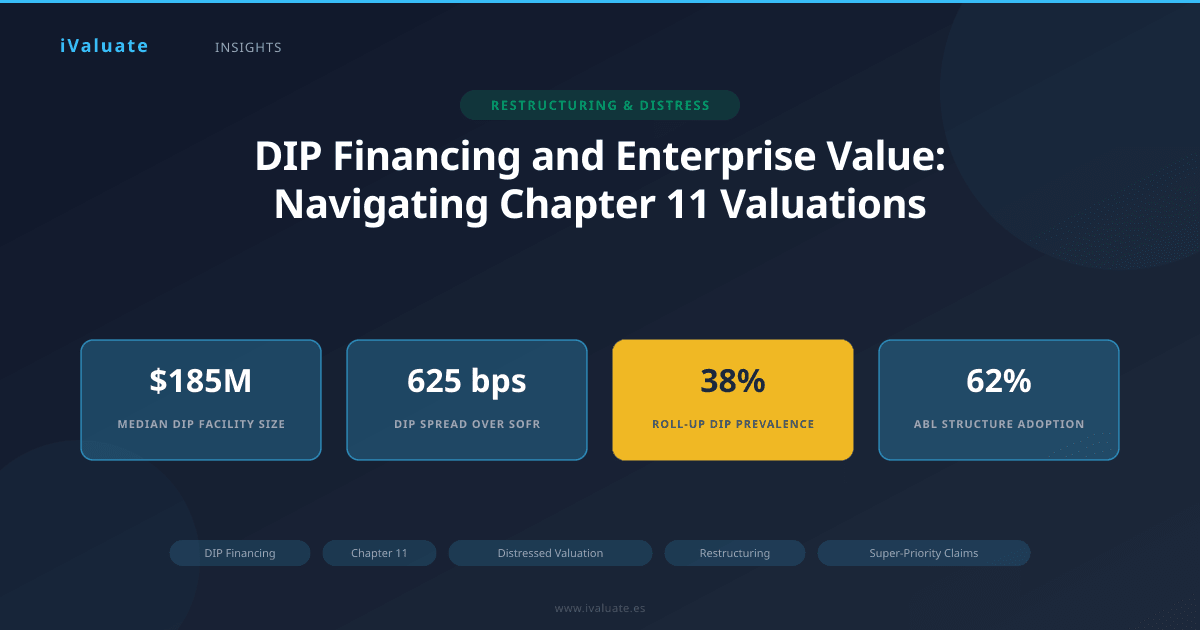
The typical DIP facility in 2025 ranges from $50 million to $500 million for middle-market companies, with mega-cap restructurings occasionally exceeding $2 billion. According to Debtwire data, the median DIP facility size increased to $185 million in 2024-2025, up from $142 million in 2021-2022, reflecting both inflation and the growing complexity of modern restructurings.
Super-Priority Administrative Expense Claims
DIP financing receives super-priority administrative expense status, meaning DIP lenders stand first in line for repayment—ahead of virtually all other administrative claims and pre-petition obligations. This positioning creates a critical valuation consideration: the DIP facility effectively becomes the most senior claim in the capital structure, subordinating all pre-existing debt.
From a valuation perspective, super-priority status means that when constructing a waterfall analysis to allocate enterprise value among creditor classes, the DIP facility must be satisfied in full before any distribution reaches pre-petition secured lenders, unsecured creditors, or equity holders. In a scenario where enterprise value equals $400 million and the DIP facility totals $150 million, only $250 million remains available for all other stakeholders—a material reduction in recoverable value for pre-petition creditors.
Priming Liens and Adequate Protection
Perhaps the most contentious aspect of DIP financing involves priming liens—situations where the DIP lender receives a security interest that ranks senior to existing secured creditors' liens on the same collateral. Courts authorize priming liens under Section 364(d) only when the debtor demonstrates that existing secured creditors are "adequately protected" against diminution in their collateral value.
Adequate protection typically takes three forms: periodic cash payments, replacement liens on other assets, or an equity cushion demonstrating that existing collateral value exceeds the secured claim even after priming. The valuation implications are profound. When a $100 million DIP facility primes a $300 million pre-petition first lien term loan secured by the same assets valued at $350 million, the pre-petition lender's effective collateral coverage drops from 1.17x to 0.83x ($250 million collateral value remaining after the DIP facility, divided by $300 million claim).
In practice, adequate protection battles have intensified in 2025 as asset values have compressed across certain sectors. Retail and commercial real estate bankruptcies have seen particularly contentious adequate protection disputes, with pre-petition lenders arguing that declining property values fail to provide sufficient cushion after DIP priming.
02 Valuation Impact: Enterprise Value Adjustments in DIP Scenarios
The introduction of DIP financing necessitates fundamental adjustments to traditional enterprise valuation methodologies. Valuation professionals must account for both the immediate capital structure changes and the ongoing operational and strategic constraints that DIP facilities impose.
Capital Structure Reconfiguration
DIP financing immediately reorders the capital stack. Consider a representative case from early 2025: a manufacturing company entered Chapter 11 with the following pre-petition capital structure:
- First Lien Term Loan: $250 million (secured by all assets)
- Second Lien Notes: $150 million
- Unsecured Notes: $200 million
- Trade Claims: $75 million
- Equity: Nominal value
The company secured a $125 million DIP facility with super-priority status and a priming lien on substantially all assets. From a valuation perspective, the effective capital structure became:
- DIP Facility: $125 million (super-priority, priming first lien)
- First Lien Term Loan: $250 million (now effectively primed)
- Second Lien Notes: $150 million
- Unsecured Notes: $200 million
- Trade Claims: $75 million
If enterprise value is determined to be $450 million through a combination of discounted cash flow analysis and comparable company methods, the waterfall allocation changes dramatically. The DIP facility consumes $125 million immediately, leaving $325 million for the first lien lenders—a 30% recovery shortfall against their $250 million claim before considering any value for junior creditors. This structural subordination materially affects how each creditor class values the enterprise and influences their negotiating positions in the plan confirmation process.
EBITDA and Cash Flow Adjustments
DIP facilities impose material ongoing costs that must be reflected in normalized EBITDA and free cash flow projections. The median DIP facility in 2025 carries an all-in interest rate of 9.5% to 12.5%—substantially higher than pre-petition secured debt, which typically ranged from 6% to 8% before default.
Beyond interest expense, DIP facilities typically include:
- Commitment fees: 2.0% to 3.5% of the facility size
- Unused line fees: 0.5% to 1.0% annually
- Exit fees: 1.0% to 2.0% upon facility termination
- Professional fee reimbursements for the DIP lender's advisors
For a $150 million DIP facility at 11% interest with a 2.5% commitment fee and 1.5% exit fee, the total cost over an 18-month bankruptcy period exceeds $30 million—capital that would otherwise contribute to enterprise value. Valuation models must incorporate these costs in both the reorganization period and, if the DIP rolls into exit financing, in the post-emergence capital structure.
Operational Constraints and Strategic Optionality
DIP facilities invariably include restrictive covenants that limit operational flexibility and strategic alternatives—factors that directly impact enterprise value through reduced growth optionality and constrained capital allocation. Common DIP covenants include:
- Minimum liquidity requirements (typically $25-50 million)
- Maximum capital expenditure limits
- Restrictions on asset sales without lender consent
- Limitations on new business lines or acquisitions
- Mandatory application of asset sale proceeds to DIP paydown
- Budget variance restrictions (often 10-15% monthly tolerance)
These constraints reduce enterprise value in several ways. Capital expenditure limitations may prevent value-enhancing investments, reducing terminal value assumptions in DCF models. Asset sale restrictions eliminate the option value of strategic divestitures that might unlock premium valuations. Budget variance requirements create operational rigidity that can prevent opportunistic market responses.
A 2024 analysis of 47 middle-market Chapter 11 cases found that companies operating under DIP facilities experienced revenue growth rates 3.2 percentage points lower than industry peers during the bankruptcy period, attributable primarily to constrained marketing spend and delayed product launches due to covenant restrictions. This growth differential must be reflected in valuation projections, typically reducing terminal value assumptions by 8-15% compared to unconstrained scenarios.
03 Roll-Up DIP Structures and Valuation Complexity
An increasingly common DIP structure involves "roll-up" provisions, where some or all pre-petition debt converts into the DIP facility, receiving super-priority status. Roll-up DIPs represented approximately 38% of all DIP facilities in 2024-2025, up from 27% in 2020-2021, according to restructuring advisory data.
Roll-up structures create unique valuation challenges. Consider a scenario where a company has $200 million in pre-petition first lien debt trading at 60 cents on the dollar (implying a $120 million market value). The pre-petition lenders agree to provide a $100 million DIP facility, with $75 million in new money and $125 million rolled up from existing debt. The total DIP facility is $200 million ($100 million new plus $100 million net roll-up after the $25 million new money applied to existing debt).
From a valuation perspective, this structure creates several analytical complications:
- The effective claim amount for the rolled-up lenders increases from $200 million to $200 million DIP plus $75 million remaining pre-petition debt
- The super-priority status of the rolled-up amount subordinates other creditors more severely than a pure new-money DIP
- The market value of the pre-petition debt ($120 million) may differ materially from the face value being rolled up ($125 million), creating potential valuation disputes
- Junior creditors may challenge the roll-up as an improper value transfer, introducing litigation risk that affects probability-weighted valuation outcomes
Roll-up DIPs have faced increased judicial scrutiny in 2025, with several courts requiring enhanced adequate protection for primed creditors and limiting roll-up amounts to demonstrable new value provided. Valuation professionals must assess the likelihood of roll-up approval and model alternative scenarios where courts reduce or eliminate roll-up provisions, materially affecting creditor recoveries.
04 Case Study: Retail Restructuring with Priming DIP
A representative case from late 2024 illustrates the valuation complexities of DIP financing. A specialty retail chain with 450 stores entered Chapter 11 with $600 million in pre-petition debt: $350 million first lien term loan secured by inventory, receivables, and intellectual property, and $250 million in unsecured notes. The company secured a $175 million DIP facility from a new lender group, with a priming lien on all assets.
The valuation advisory team performed a comprehensive enterprise value analysis using multiple methodologies:
Discounted Cash Flow Analysis: Based on a 13-week cash flow forecast and three-year business plan assuming 150 store closures, the DCF yielded an enterprise value range of $425 million to $510 million, with a midpoint of $465 million. The analysis assumed a 12% weighted average cost of capital, reflecting the elevated risk of a company in bankruptcy, and a terminal EBITDA multiple of 6.0x—a 25% discount to the 8.0x trading multiple of healthy specialty retail peers.
Comparable Company Analysis: Trading multiples of comparable specialty retailers averaged 7.2x EV/EBITDA for the forward twelve months. Applying a 30% distress discount yielded a 5.0x multiple. With projected normalized EBITDA of $95 million, this suggested an enterprise value of $475 million.
Precedent Transaction Analysis: Recent acquisitions of distressed specialty retailers in bankruptcy proceedings traded at 4.5x to 6.5x EBITDA, with a median of 5.3x. This methodology supported a $500 million enterprise value.
The valuation team concluded on a $475 million enterprise value, representing the midpoint of the range across methodologies. The waterfall allocation proceeded as follows:
- DIP Facility: $175 million (100% recovery)
- First Lien Term Loan: $300 million remaining enterprise value ÷ $350 million claim = 85.7% recovery
- Unsecured Notes: $0 recovery (out of the money)
The DIP facility's priming lien reduced the first lien lenders' recovery from a potential 100% (if the full $475 million enterprise value were available to them) to 85.7%, representing a $50 million value transfer. The first lien lenders challenged the adequate protection package, arguing that inventory values had declined 15% since the petition date due to clearance sales, eroding their collateral cushion.
The court ultimately approved the DIP facility but required monthly adequate protection payments of $1.2 million to the first lien lenders and granted them replacement liens on post-petition receivables. These additional protections increased the effective cost of the DIP facility and reduced available cash for operations, requiring a revised valuation that reduced enterprise value by approximately $12 million to account for the additional cash drag.
05 Market Dynamics and DIP Pricing in 2025-2026
The DIP financing market has evolved considerably over the past 24 months, with important implications for valuation professionals. Several trends are reshaping the landscape:
Increased Competition and Compressed Spreads
Despite elevated distress levels, DIP financing has become increasingly competitive. Traditional DIP lenders—including distressed debt funds, hedge funds, and specialty finance companies—face competition from private credit funds and opportunistic investors seeking higher-yielding assets. This competition has compressed DIP pricing from the peak levels of 2020-2021.
The median DIP spread over SOFR declined from 825 basis points in 2021 to approximately 625 basis points in early 2025, according to Debtwire data. For companies with strong asset coverage and clear reorganization paths, DIP facilities have priced as low as SOFR + 450 basis points—a remarkable compression that reflects abundant capital seeking distressed opportunities.
From a valuation perspective, lower DIP costs reduce the cash flow drag during bankruptcy and can support higher enterprise values. A 200-basis-point reduction in DIP pricing on a $200 million facility saves $4 million annually in interest expense—meaningful in the context of distressed companies often operating at breakeven or negative EBITDA.
Increased Use of Asset-Based Lending Structures
Approximately 62% of DIP facilities in 2024-2025 utilized asset-based lending (ABL) structures, up from 48% in 2019-2020. ABL DIPs provide borrowing bases tied to eligible inventory and receivables, offering more flexibility than traditional term loan structures but introducing additional complexity for valuation professionals.
ABL structures require detailed collateral valuations—typically performed by independent appraisal firms—to establish borrowing bases. These valuations use orderly liquidation value (OLV) or forced liquidation value (FLV) methodologies, which produce materially lower values than going-concern enterprise valuations. For inventory, OLV typically ranges from 50% to 70% of book value, while FLV may be 30% to 50%. For receivables, advance rates typically range from 75% to 85% of eligible balances.
The gap between collateral liquidation values and going-concern enterprise value creates important valuation considerations. If collateral OLV totals $250 million but going-concern enterprise value is $400 million, the $150 million difference represents the value of operational continuity, customer relationships, intellectual property, and other intangible assets. This "going concern premium" becomes critical in plan negotiations, as it represents value that would be destroyed in a liquidation scenario—value that should theoretically be shared among stakeholders to incentivize reorganization over liquidation.
06 Valuation Methodologies for DIP-Impacted Enterprises
Valuing companies operating under DIP financing requires modifications to standard valuation approaches. Several technical adjustments are essential for accuracy:
Adjusted Present Value (APV) Methodology
The adjusted present value approach proves particularly useful in DIP scenarios because it separately values the unlevered enterprise and the impact of financing decisions. The APV methodology values the company as if it were all-equity financed, then adds the present value of tax shields and subtracts the present value of financial distress costs.
For DIP situations, the financial distress costs include:
- Direct bankruptcy costs (legal and advisory fees, typically 3-7% of asset value)
- Indirect costs (lost sales, employee turnover, supplier relationship damage)
- DIP facility costs exceeding normal-course financing costs
- Operational constraints from DIP covenants
A comprehensive APV analysis for a company in Chapter 11 might show an unlevered enterprise value of $500 million, less $35 million in present value of distress costs, plus $8 million in tax shield value from the DIP facility, yielding a net enterprise value of $473 million. This approach makes explicit the value destruction from bankruptcy and the offsetting benefits of DIP financing, providing transparency for stakeholder negotiations.
Scenario Analysis and Probability Weighting
Given the uncertainty inherent in bankruptcy proceedings, rigorous scenario analysis becomes essential. Valuation professionals typically model three to five scenarios:
- Successful reorganization (40-50% probability): Company emerges from bankruptcy with rationalized operations and sustainable capital structure
- Going-concern sale (25-35% probability): Company is sold as a going concern to a strategic or financial buyer during the bankruptcy process
- Liquidation (15-25% probability): Company is unable to reorganize and assets are liquidated piecemeal
- Conversion to Chapter 7 (5-10% probability): Chapter 11 process fails and case converts to Chapter 7 liquidation
Each scenario produces different enterprise values and recovery outcomes for various creditor classes. The DIP facility typically receives 100% recovery in reorganization and going-concern sale scenarios but may face modest haircuts in liquidation scenarios if asset values prove insufficient. Pre-petition creditors face dramatically different outcomes across scenarios, with recoveries ranging from 80-100% in successful reorganization to 20-40% in liquidation.
Probability-weighted valuation aggregates these scenarios to produce an expected value. For the retail case discussed earlier, a probability-weighted analysis might show:
- Reorganization (45% probability): $475 million enterprise value
- Going-concern sale (30% probability): $510 million enterprise value
- Liquidation (20% probability): $285 million enterprise value
- Chapter 7 conversion (5% probability): $225 million enterprise value
The probability-weighted enterprise value equals $428 million—materially lower than the reorganization scenario alone and more accurately reflecting the range of potential outcomes.
07 Strategic Considerations: DIP Financing as a Control Mechanism
Beyond its immediate financial impact, DIP financing often serves as a mechanism for creditors to gain control over the bankruptcy process and ultimate enterprise value allocation. This strategic dimension has important valuation implications that extend beyond traditional financial analysis.
DIP-to-Exit Financing and Value Capture
Approximately 55% of DIP facilities in 2024-2025 included provisions to convert into exit financing upon plan confirmation, according to restructuring market data. These "DIP-to-exit" structures allow DIP lenders to maintain their super-priority position through emergence and often include equity upside through warrants or conversion features.
From a valuation perspective, DIP-to-exit structures create path dependency in enterprise value outcomes. If the DIP lenders control the exit financing, they effectively control the reorganization plan and can structure the emergence capital stack to favor their interests. This control premium should theoretically be reflected in the pricing of DIP facilities—lenders accepting lower current yields in exchange for strategic positioning—but in practice, DIP-to-exit facilities often command premium pricing, suggesting lenders capture both current yield and strategic value.
The valuation implications become apparent in plan negotiations. If the DIP lenders propose a reorganization plan that provides them with 70% of the post-emergence equity plus exit financing fees, they capture a disproportionate share of enterprise value relative to their capital contribution. Other stakeholders must assess whether this allocation reflects fair value or represents an extraction of control premium that should be shared more broadly.
Credit Bidding and Asset Acquisition Strategies
DIP lenders secured by substantially all assets possess the right to credit bid—using their debt claims as currency in asset sales—under Section 363 of the Bankruptcy Code. This right provides a powerful strategic advantage that affects enterprise value realization.
Consider a scenario where a DIP lender has a $150 million super-priority claim secured by all assets. If the company pursues a Section 363 sale, the DIP lender can credit bid up to $150 million, effectively acquiring the assets without deploying additional cash. Third-party bidders must offer cash exceeding the DIP lender's credit bid to prevail.
This dynamic can suppress asset sale values because third-party bidders recognize they face a strategic disadvantage against a credit-bidding DIP lender. Research on Section 363 sales in 2023-2024 found that transactions where DIP lenders possessed credit bidding rights achieved sale prices averaging 12% lower than comparable sales without credit-bidding secured creditors, controlling for asset quality and market conditions.
For valuation professionals, the presence of a credit-bidding DIP lender should inform market approach methodologies. Precedent transaction multiples from credit-bid sales may understate true market value and should be adjusted upward or supplemented with non-distressed transaction comparables.
08 Regulatory and Market Outlook: DIP Financing in 2025-2026
Several regulatory and market developments are reshaping DIP financing and its valuation implications as we move through 2025 and into 2026.
Increased Judicial Scrutiny of Priming Liens
Bankruptcy courts have demonstrated heightened skepticism toward aggressive priming lien structures, particularly when pre-petition lenders argue inadequate protection. Several high-profile cases in 2024 saw courts reduce requested DIP facility sizes or eliminate priming provisions, forcing debtors to seek alternative financing structures.
This judicial trend increases execution risk for DIP-dependent reorganization plans and may support higher valuation multiples for companies that can demonstrate viable paths to emergence without extensive priming. Conversely, companies requiring large priming DIPs face greater uncertainty and potentially lower probability-weighted enterprise values.
Private Credit Funds as DIP Providers
Private credit funds have emerged as significant DIP lenders, providing approximately 28% of DIP facilities in 2024-2025 compared to just 12% in 2020-2021. These funds often offer more flexible structures and faster execution than traditional distressed debt funds, but typically at premium pricing.
The entry of private credit has created a bifurcated DIP market: companies with strong asset coverage and clear reorganization paths access competitive pricing from multiple lender groups, while weaker credits face concentrated markets and elevated costs. This bifurcation affects valuation approaches—stronger credits warrant lower distress discounts and higher terminal multiples, while weaker credits require more conservative assumptions.
ESG Considerations in DIP Financing
An emerging trend in 2025 involves ESG-linked DIP facilities, where pricing or covenant terms adjust based on environmental or social metrics. While still rare—representing fewer than 5% of DIP facilities—these structures signal evolving stakeholder priorities that may affect enterprise value.
Companies demonstrating strong ESG performance or credible transition plans may access more favorable DIP terms, reducing bankruptcy costs and supporting higher enterprise values. Valuation professionals should consider ESG factors when assessing terminal multiples and long-term growth assumptions, particularly in industries facing regulatory or market pressure on sustainability issues.
09 Practical Implications for Valuation Professionals
For valuation professionals navigating DIP-impacted restructurings, several practical guidelines emerge from this analysis:
First, always construct detailed capital structure waterfalls that explicitly model DIP super-priority and priming effects. The waterfall should show enterprise value allocation across all creditor classes under multiple valuation scenarios, making transparent how DIP structures affect recoveries.
Second, adjust EBITDA and cash flow projections to reflect the full cost of DIP financing, including commitment fees, unused line fees, exit fees, and professional fee reimbursements. These costs are often material—2-4% of enterprise value annually—and must be incorporated in normalized earnings and free cash flow calculations.
Third, apply appropriate risk adjustments to discount rates and terminal multiples to reflect bankruptcy-specific risks. Companies operating under DIP facilities face elevated operational and strategic risks that warrant 200-400 basis points of additional cost of capital and 15-30% discounts to peer trading multiples.
Fourth, perform rigorous scenario analysis with probability weighting across reorganization, sale, and liquidation outcomes. Single-point enterprise value estimates provide false precision in bankruptcy contexts; probability-weighted ranges better reflect the true distribution of potential outcomes.
Fifth, consider strategic and control dynamics when assessing DIP structures. Roll-up provisions, DIP-to-exit features, and credit bidding rights create strategic optionality that affects value allocation beyond pure financial analysis.
Key Takeaway: DIP financing fundamentally restructures the capital stack and creates super-priority claims that subordinate all pre-existing obligations. Valuation professionals must model these structural changes explicitly, adjust cash flows for DIP costs, and apply probability-weighted scenario analysis to capture the range of potential outcomes in bankruptcy proceedings.
10 Conclusion: Navigating Complexity in Distressed Valuations
Debtor-in-possession financing represents a critical but complex element in restructuring valuations. The super-priority status, priming lien capabilities, and operational constraints inherent in DIP facilities materially affect enterprise value through multiple channels: capital structure reordering, increased financing costs, operational limitations, and strategic dynamics that influence value allocation among stakeholders.
As corporate distress levels remain elevated in 2025-2026, with continued pressure from elevated interest rates and sector-specific challenges in commercial real estate, retail, and certain technology segments, valuation professionals must develop sophisticated frameworks for analyzing DIP-impacted enterprises. The traditional valuation toolkit—DCF analysis, comparable company multiples, precedent transactions—remains relevant but requires material adjustments to account for bankruptcy-specific factors.
The most rigorous approach combines adjusted present value methodologies that explicitly quantify distress costs, probability-weighted scenario analysis that captures the range of potential outcomes, and detailed waterfall modeling that shows how DIP structures affect value allocation across the capital stack. These technical tools must be complemented by strategic analysis of control dynamics, credit bidding rights, and stakeholder incentives that influence ultimate value realization.
For corporate finance professionals, restructuring advisors, and investors navigating these complex situations, access to sophisticated analytical tools becomes essential. Platforms like iValuate provide the technical infrastructure to model complex capital structures, perform scenario analysis, and generate detailed valuation reports that meet the rigorous standards required in bankruptcy proceedings. As restructuring activity continues at elevated levels through 2025-2026, the ability to perform accurate, defensible valuations in DIP-impacted situations will remain a critical competency for finance professionals across the distressed landscape.
The intersection of DIP financing and enterprise valuation will continue to evolve as market conditions shift, judicial precedents develop, and new financing structures emerge. Staying current with these developments—and maintaining the technical capabilities to analyze their valuation implications—remains essential for professionals operating in the restructuring and distressed investment space.