Table of Contents9 sections
Debtor-in-possession (DIP) financing represents one of the most complex and consequential elements of corporate restructuring, fundamentally altering enterprise value calculations during Chapter 11 proceedings. As we navigate the elevated interest rate environment of 2025-2026, with the Federal Funds rate stabilizing between 4.25% and 4.75%, DIP financing has become both more expensive and more strategically critical for distressed companies seeking to preserve going-concern value.
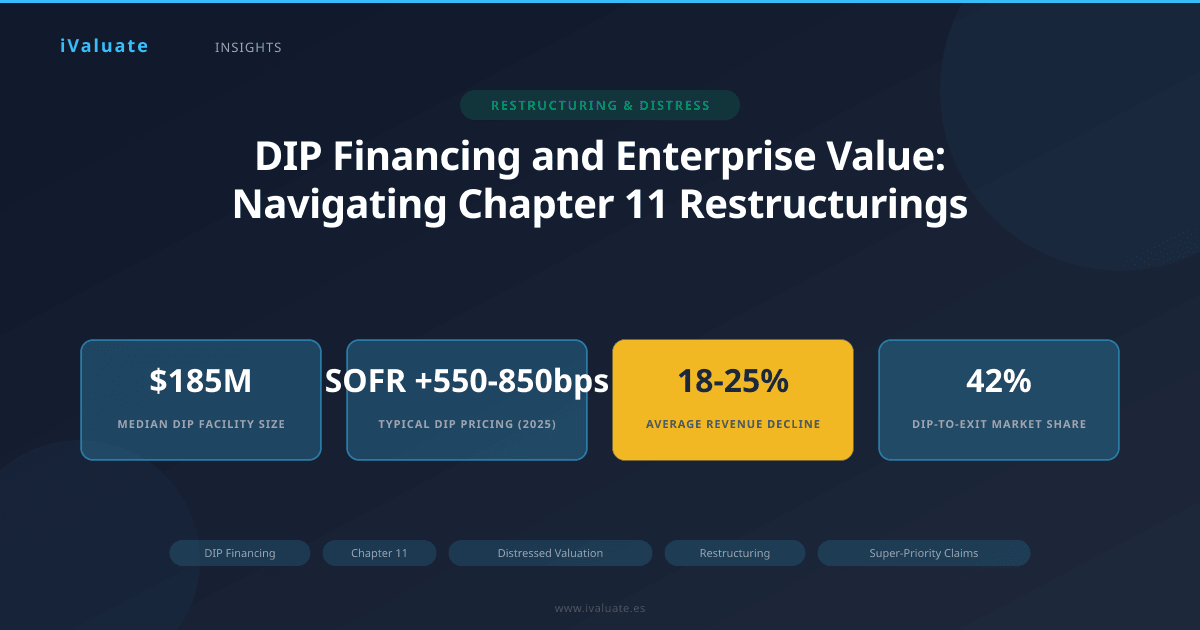
The DIP financing market has experienced significant evolution since the post-pandemic restructuring wave. In 2024-2025, the median DIP facility size reached $185 million, with pricing typically ranging from SOFR + 550 to 850 basis points—substantially higher than the SOFR + 350-500 basis points observed during the 2020-2021 period. This pricing pressure reflects not only higher base rates but also increased lender caution following several high-profile Chapter 11 failures where DIP lenders faced unexpected losses.
01 The Mechanics of DIP Financing and Capital Structure Priority
DIP financing occupies a unique position in the capital structure hierarchy, fundamentally disrupting the traditional waterfall of claims. Understanding this disruption is essential for accurate valuation work during restructuring proceedings.
When a company files for Chapter 11 protection, it typically lacks access to conventional financing sources. Trade creditors demand cash-on-delivery terms, existing credit facilities become unavailable, and operational cash flow is often insufficient to fund the restructuring process itself. DIP financing fills this critical liquidity gap, but at a price that extends far beyond the stated interest rate.
Super-Priority Administrative Claims
DIP loans are granted super-priority administrative expense status under Section 364(c)(1) of the U.S. Bankruptcy Code, placing them ahead of virtually all pre-petition claims. This means DIP lenders are repaid before pre-petition secured lenders, unsecured creditors, and equity holders. In practical terms, if a Chapter 11 case converts to Chapter 7 liquidation, DIP lenders stand first in line—after only the costs of administration and certain employee claims.
This super-priority status creates immediate valuation implications. The enterprise value available to pre-petition stakeholders is reduced by the full amount of the DIP facility plus accrued interest and fees. In a typical middle-market restructuring with a $50 million DIP facility at SOFR + 650 basis points (approximately 10.5% all-in rate in 2025), a 12-month Chapter 11 process adds $5.25 million in interest costs alone, before considering arrangement fees (typically 2-3%) and unused commitment fees (0.5-1.0% annually).
Priming Liens and Adequate Protection
Perhaps the most contentious aspect of DIP financing involves priming liens—situations where DIP lenders receive security interests that rank ahead of existing secured creditors. Section 364(d) of the Bankruptcy Code permits priming only when existing secured creditors receive "adequate protection" of their interests.
Adequate protection typically takes three forms: (1) periodic cash payments, (2) additional or replacement liens on other property, or (3) administrative expense claims. The valuation challenge lies in determining whether the adequate protection package truly compensates pre-petition secured lenders for the risk of subordination.
Consider a 2024 case involving a regional healthcare services provider. The company entered Chapter 11 with $120 million in pre-petition secured debt backed by a first lien on all assets, appraised at $145 million on a going-concern basis. The debtor sought $40 million in DIP financing with a priming lien. The pre-petition lenders argued that declining reimbursement rates and operational challenges would erode the collateral value by 15-20% during the restructuring, making the $25 million equity cushion insufficient adequate protection.
The court ultimately approved a $30 million DIP facility with a priming lien, requiring the debtor to provide the pre-petition lenders with replacement liens on post-petition accounts receivable and a monthly adequate protection payment of $200,000. This structure illustrates how DIP financing negotiations become intricate valuation exercises, requiring real-time assessment of collateral values, cash flow trajectories, and restructuring timelines.
02 Valuation Implications: Enterprise Value Under DIP Scenarios
DIP financing affects enterprise value through multiple channels, both direct and indirect. Sophisticated valuation professionals must account for each dimension to arrive at credible conclusions.
Direct Capital Structure Impact
The most straightforward impact is the addition of super-priority debt to the capital structure. Using a traditional enterprise value bridge:
- Enterprise Value (going concern)
- Less: DIP facility principal
- Less: DIP accrued interest and fees
- Less: Pre-petition secured debt
- Less: Pre-petition unsecured debt
- Equals: Equity value (typically zero in Chapter 11)
In practice, the analysis is more nuanced. The DIP facility size itself signals information about the company's liquidity needs and the expected duration of the restructuring. A $200 million DIP facility for a company with $80 million in annual EBITDA suggests either a protracted restructuring timeline or significant operational cash burn—both negative indicators for enterprise value.
Cost of Capital Adjustments
The presence of DIP financing fundamentally alters the weighted average cost of capital (WACC) calculation for the reorganized entity. Post-emergence capital structures typically reflect higher leverage and increased credit risk, even after debt reduction.
Data from 2024-2025 restructurings shows that companies emerging from Chapter 11 with DIP-to-exit financing (where DIP lenders roll into the post-emergence capital structure) typically carry weighted average costs of capital 300-500 basis points higher than pre-distress levels. For a company with $150 million in projected free cash flow, this WACC increase alone reduces enterprise value by approximately $750 million to $1.5 billion, assuming a perpetuity growth rate of 2-3%.
Operational Value Leakage
Beyond the financial mechanics, DIP financing periods often coincide with operational deterioration. Customer attrition, supplier relationship strain, and employee departures accelerate during Chapter 11, particularly in service businesses where relationships drive value.
A 2025 study of middle-market Chapter 11 cases found that companies experienced average revenue declines of 18-25% during the restructuring period, with professional services and consumer-facing businesses at the higher end of that range. This operational value leakage must be reflected in revised EBITDA projections and, consequently, enterprise value calculations.
Key Insight: The true cost of DIP financing extends far beyond stated interest rates. When accounting for operational disruption, customer attrition, and elevated post-emergence capital costs, the all-in impact on enterprise value typically ranges from 25-40% of the DIP facility size.
03 DIP Financing Structures and Their Valuation Consequences
Not all DIP facilities are created equal. The structure of DIP financing—including size, pricing, covenants, and milestones—carries distinct valuation implications.
Traditional DIP Loans vs. DIP-to-Exit Facilities
Traditional DIP loans are intended as bridge financing, to be repaid upon emergence from Chapter 11. DIP-to-exit facilities, by contrast, automatically convert into the post-emergence capital structure, providing continuity and reducing refinancing risk.
DIP-to-exit structures have gained significant market share, accounting for approximately 42% of large-cap DIP facilities in 2024-2025, up from 28% in 2020-2021. These structures typically command pricing premiums of 50-100 basis points but offer debtors greater certainty around post-emergence financing.
From a valuation perspective, DIP-to-exit facilities reduce execution risk but may lock the reorganized company into suboptimal capital structures. A company that emerges with a DIP-to-exit facility priced at SOFR + 750 basis points may find itself at a competitive disadvantage if credit markets improve post-emergence, as refinancing options may be limited by prepayment penalties and make-whole provisions.
Roll-Up Provisions and Lender Influence
Many DIP facilities include "roll-up" provisions, allowing pre-petition lenders to provide DIP financing and effectively convert their pre-petition claims into super-priority DIP claims. While roll-ups can facilitate faster DIP approval, they concentrate power in the hands of existing lenders and may not maximize value for the broader creditor body.
In a notable 2024 retail restructuring, pre-petition lenders provided a $75 million DIP facility with a $50 million roll-up of their existing $180 million pre-petition debt. This structure gave the DIP lenders $125 million in super-priority claims and effective control over the restructuring process. Junior creditors challenged the roll-up as an improper value transfer, arguing that the DIP lenders were using their leverage to improve their position at the expense of other stakeholders.
The court approved the roll-up but required enhanced disclosure and an independent valuation of the collateral package. The valuation revealed that the roll-up effectively transferred approximately $18 million in value from unsecured creditors to the DIP lenders—a finding that influenced the ultimate plan of reorganization and recovery rates.
Milestone-Based DIP Facilities
Increasingly, DIP facilities incorporate milestone provisions that tie funding availability to the debtor's achievement of specific operational or restructuring targets. These might include:
- Filing a plan of reorganization within 90 days
- Achieving minimum monthly EBITDA thresholds
- Completing asset sales by specified dates
- Obtaining creditor support agreements
Milestone-based structures align incentives between debtors and DIP lenders but introduce additional uncertainty into valuation analyses. If a debtor fails to meet milestones, DIP funding may be curtailed, potentially forcing conversion to Chapter 7 liquidation. Valuation models must incorporate probability-weighted scenarios reflecting both successful restructuring and premature liquidation outcomes.
04 Market Dynamics and Pricing Trends in 2025-2026
The DIP financing market has evolved considerably in response to macroeconomic conditions and lender experience from recent restructuring cycles.
Pricing and Terms
As of early 2025, DIP pricing exhibits significant dispersion based on company size, industry, and perceived restructuring complexity:
- Large-cap DIP facilities (>$500 million): SOFR + 450-650 basis points
- Middle-market DIP facilities ($50-500 million): SOFR + 600-850 basis points
- Small-cap DIP facilities (<$50 million): SOFR + 800-1,200 basis points
Arrangement fees have also increased, now typically ranging from 2.5-4.0% of committed amounts, compared to 1.5-2.5% during the low-rate environment of 2020-2021. These fees represent immediate value transfer from the estate to DIP lenders and must be incorporated into enterprise value calculations.
Lender Composition and Competition
The DIP lending market has become increasingly concentrated among specialized credit funds and opportunistic investors. Traditional banks, which historically dominated DIP lending, now account for only 35-40% of DIP facilities, down from 55-60% a decade ago.
This shift toward non-bank lenders has implications for pricing, terms, and restructuring dynamics. Credit funds typically demand higher returns and more aggressive terms, including shorter timelines, tighter milestones, and more extensive lender consent rights. These provisions constrain debtor flexibility and can accelerate value deterioration if restructuring negotiations stall.
05 Valuation Methodologies in DIP Contexts
Valuing companies operating under DIP financing requires modifications to standard valuation approaches.
Discounted Cash Flow Considerations
DCF models for companies in Chapter 11 must incorporate several DIP-specific adjustments:
Projection Period Bifurcation: Separate the in-Chapter 11 period (typically 6-18 months) from the post-emergence period. In-Chapter 11 projections should reflect operational constraints, customer attrition, and DIP covenant restrictions. Post-emergence projections should incorporate stabilization assumptions and normalized working capital requirements.
Discount Rate Adjustments: The appropriate discount rate during the DIP period is subject to debate. Some practitioners use the DIP facility rate as a proxy for the cost of capital during restructuring, while others employ a higher rate reflecting execution risk. Post-emergence discount rates should reflect the reorganized capital structure and elevated business risk.
Terminal Value Considerations: Terminal value calculations must account for the company's post-emergence competitive position, which may be permanently impaired by the Chapter 11 process. Exit multiples for recently reorganized companies typically trade at 15-25% discounts to industry peers, reflecting stigma and operational disruption.
Market Approach Complications
Comparable company analysis becomes challenging in DIP contexts. Pure-play comparables are rarely in Chapter 11 simultaneously, making direct multiple comparisons problematic. Practitioners often employ a hybrid approach:
- Identify comparable companies and calculate standard multiples (EV/Revenue, EV/EBITDA)
- Apply distress discounts of 20-35% to reflect Chapter 11 status
- Adjust for DIP financing burden and post-emergence capital structure
- Triangulate with precedent restructuring transactions in similar industries
Precedent transaction analysis should focus on recent Chapter 11 cases with similar DIP structures, recovery rates, and industry characteristics. In 2024-2025, median enterprise value recovery rates for secured creditors in middle-market Chapter 11 cases ranged from 65-80%, while unsecured creditors recovered 15-30% on average.
Asset-Based Valuation as a Floor
In DIP scenarios, liquidation value analysis takes on heightened importance as it establishes the floor value for stakeholder recoveries. Orderly liquidation values (OLV) typically range from 40-60% of going-concern value for operating companies, though this varies dramatically by industry and asset composition.
For the adequate protection analysis discussed earlier, precise OLV calculations are essential. Appraisers must consider forced-sale discounts, liquidation costs (typically 8-15% of gross proceeds), and the time value of money during an extended liquidation process.
06 Case Study: Multi-Location Restaurant Chain Restructuring
A practical example illustrates how DIP financing reshapes valuation analysis. In mid-2024, a restaurant chain operating 185 locations across the Southeast filed for Chapter 11 protection with $240 million in pre-petition secured debt and $85 million in unsecured obligations.
The company secured a $60 million DIP facility with the following terms:
- Pricing: SOFR + 725 basis points (approximately 11.5% all-in)
- Term: 12 months
- Arrangement fee: 3.0% ($1.8 million)
- Priming lien on all assets
- Milestones: Plan filing within 120 days, minimum monthly EBITDA of $4.5 million
Pre-petition, the company was valued at approximately $320 million enterprise value (6.5x normalized EBITDA of $49 million). The valuation analysis during Chapter 11 required substantial adjustments:
In-Chapter 11 Period (12 months):
- Projected EBITDA decline to $38 million (22% reduction) due to location closures and same-store sales decline
- DIP interest and fees: $8.7 million
- Professional fees (legal, financial advisors): $12 million
- Adequate protection payments to pre-petition lenders: $2.4 million
Post-Emergence Projections:
- Stabilized EBITDA: $42 million (reflecting permanent closure of 35 underperforming locations)
- Post-emergence capital structure: $180 million in secured debt (combination of DIP-to-exit facility and pre-petition lender recovery)
- Elevated WACC: 12.5% (vs. 9.0% pre-distress)
The revised enterprise value calculation yielded approximately $245 million, representing a 23% decline from pre-petition levels. After deducting the $60 million DIP facility and $180 million in post-emergence secured debt, the analysis supported a recovery of approximately 6-12% for unsecured creditors—ultimately reflected in the confirmed plan of reorganization.
Valuation Reality: In this case, the DIP facility's direct cost ($8.7 million in interest and fees) represented only a fraction of the total enterprise value impact. Operational deterioration, elevated post-emergence capital costs, and permanent business model changes drove the majority of value destruction.
07 Strategic Considerations for Stakeholders
Different stakeholders approach DIP financing with distinct objectives and valuation perspectives.
For Debtors and Management
Management teams must balance the immediate need for liquidity against the long-term cost of DIP financing. Accepting overly restrictive DIP terms—aggressive milestones, extensive lender consent rights, or punitive pricing—can constrain restructuring flexibility and destroy value.
Best practices include: (1) initiating DIP discussions early, ideally pre-petition, to maximize negotiating leverage; (2) running competitive processes with multiple potential DIP lenders when feasible; and (3) carefully modeling the impact of various DIP structures on post-emergence enterprise value and stakeholder recoveries.
For Pre-Petition Secured Lenders
Existing secured lenders face a critical decision: provide DIP financing themselves (potentially with a roll-up) or allow a third party to prime their liens. Providing DIP financing offers control and the opportunity to improve position, but requires committing additional capital to a distressed situation.
The adequate protection analysis is paramount. Lenders must conduct rigorous collateral valuations, considering both going-concern and liquidation scenarios, and negotiate for adequate protection packages that truly compensate for priming risk. In the current environment, many secured lenders demand monthly adequate protection payments of 0.5-1.0% of their outstanding balance, plus replacement liens on unencumbered assets.
For Unsecured Creditors and Equity
Junior stakeholders typically have limited influence over DIP financing but must scrutinize proposed facilities for value transfers and inappropriate terms. Creditors' committees should retain independent financial advisors to assess whether DIP terms are market-standard and whether adequate protection packages are sufficient.
In cases where DIP terms appear excessive or designed to benefit insiders, unsecured creditors can object to DIP approval or seek to condition approval on enhanced disclosure and independent valuation. While courts generally defer to debtor business judgment on DIP financing, egregious terms or conflicts of interest can warrant judicial intervention.
08 Regulatory and Market Evolution
The DIP financing landscape continues to evolve in response to regulatory developments and market innovation.
Bankruptcy Code Amendments and Case Law
Recent case law has clarified certain aspects of DIP financing, particularly around adequate protection and priming liens. The 2024 Third Circuit decision in In re: Advanced Manufacturing Solutions established a more rigorous standard for adequate protection, requiring debtors to demonstrate with "reasonable certainty" that collateral values would not decline below pre-petition secured debt levels during the Chapter 11 process.
This heightened standard has made priming liens more difficult to obtain and has increased the leverage of pre-petition secured lenders in DIP negotiations. Valuation professionals must now provide more detailed collateral appraisals and sensitivity analyses to support adequate protection findings.
ESG Considerations in DIP Financing
An emerging trend in 2025-2026 involves the incorporation of environmental, social, and governance (ESG) considerations into DIP facilities. Several high-profile energy and manufacturing restructurings have included DIP covenants requiring the debtor to meet emissions reduction targets or implement enhanced worker safety protocols.
While ESG-linked DIP facilities remain a small minority of the market (approximately 8% of facilities in 2024-2025), they represent a growing intersection of restructuring finance and sustainability. These provisions can affect enterprise value by constraining operational flexibility or requiring capital expenditures that might otherwise be deferred during Chapter 11.
09 Looking Forward: DIP Financing in an Evolving Credit Environment
As we progress through 2025 and into 2026, several trends are likely to shape the DIP financing market and its valuation implications.
First, the elevated interest rate environment appears likely to persist, with the Federal Reserve maintaining restrictive monetary policy to ensure inflation remains anchored near the 2% target. This suggests continued high DIP pricing and increased restructuring activity as companies face refinancing challenges on debt incurred during the 2020-2021 low-rate period.
Second, the growing concentration of DIP lending among non-bank credit funds is likely to continue, bringing more aggressive terms and shorter restructuring timelines. This evolution may accelerate the trend toward pre-packaged and pre-negotiated Chapter 11 cases, where DIP financing terms are negotiated pre-petition as part of a comprehensive restructuring support agreement.
Third, technological innovation is beginning to impact DIP financing and valuation processes. Real-time cash flow monitoring, AI-powered covenant compliance tracking, and blockchain-based collateral registries are emerging tools that may reduce information asymmetries and enable more efficient DIP structures.
For valuation professionals, these trends underscore the importance of maintaining current market knowledge and adapting methodologies to reflect evolving DIP structures. The intersection of restructuring finance and enterprise valuation will remain a critical competency as companies navigate the challenging credit environment of the mid-2020s.
In this complex landscape, sophisticated analytical tools have become essential for professionals managing restructuring valuations. Platforms like iValuate enable practitioners to model multiple DIP scenarios, stress-test assumptions, and generate comprehensive valuation analyses that meet the rigorous standards required in Chapter 11 proceedings. As DIP structures grow more complex and stakeholder scrutiny intensifies, the ability to perform rapid, defensible valuation work has never been more critical to successful restructuring outcomes.