Table of Contents9 sections
The convergence of Internet of Things (IoT) sensors, artificial intelligence, and real-time data analytics has given rise to one of the most transformative technologies in industrial asset management: digital twins. As we move through 2025, these virtual replicas of physical assets are fundamentally reshaping how valuation professionals assess everything from manufacturing facilities to power generation infrastructure, creating new paradigms for determining fair market value and investment returns.
A digital twin is a dynamic, virtual representation of a physical asset, system, or process that is continuously updated with real-time data from sensors, operational systems, and external sources. Unlike static CAD models or traditional asset registers, digital twins simulate actual performance, predict future states, and enable scenario analysis that was previously impossible. For valuation professionals, this technology represents a quantum leap in the precision and defensibility of asset valuations, particularly for complex industrial operations where traditional approaches have long struggled with uncertainty.
01 The Digital Twin Revolution in Asset Valuation
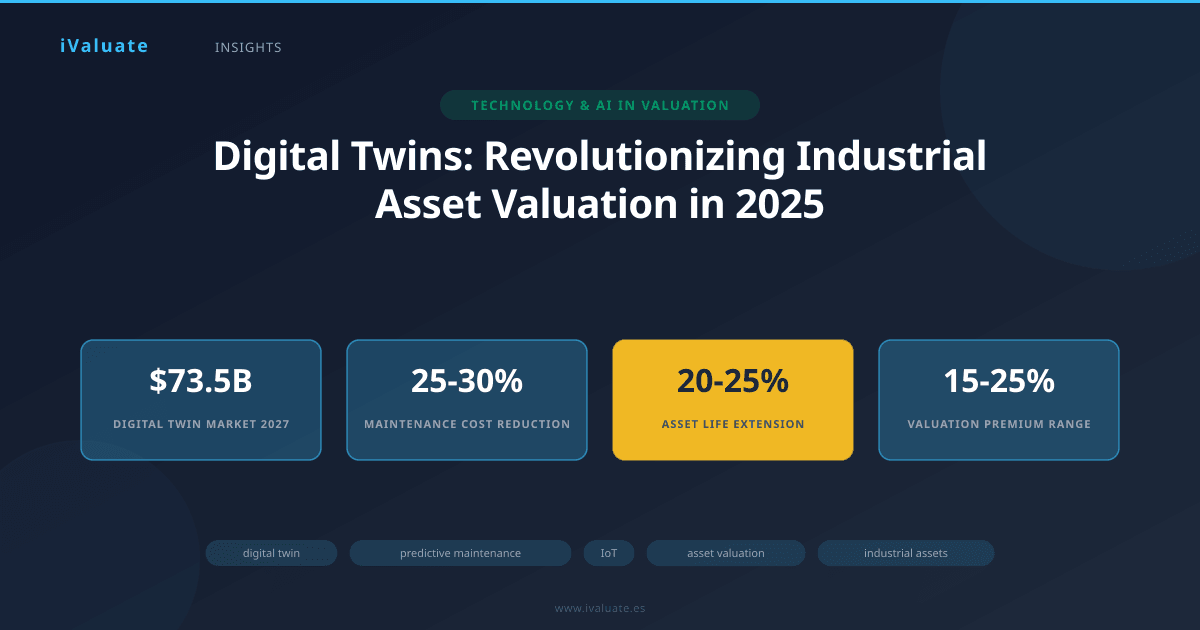
The global digital twin market has experienced explosive growth, reaching $16.4 billion in 2024 and projected to exceed $73.5 billion by 2027, according to recent market intelligence. This expansion reflects widespread adoption across manufacturing, energy, transportation, and infrastructure sectors—precisely the domains where asset valuation has historically been most challenging and subjective.
Traditional industrial asset valuation has relied heavily on depreciation schedules, comparable transactions, and discounted cash flow models built on historical performance data and industry averages. These approaches, while foundational, suffer from significant limitations: they cannot account for asset-specific condition variations, fail to capture the value of operational optimization, and struggle to quantify the impact of maintenance practices on remaining useful life.
Digital twins address these shortcomings by providing unprecedented visibility into asset health, performance efficiency, and degradation patterns. When a manufacturing facility deploys thousands of IoT sensors across production lines, HVAC systems, and structural components, the resulting data stream enables valuators to move from generalized depreciation curves to asset-specific condition assessments with confidence intervals previously unattainable.
Real-Time Condition Assessment and Fair Market Value
Consider a conventional approach to valuing a 15-year-old industrial compressor system. Traditional methodology would apply a standard depreciation schedule—perhaps straight-line over 25 years—resulting in a book value of 40% of replacement cost. However, this approach ignores critical variables: actual operating hours, maintenance quality, load factors, environmental conditions, and component-specific wear patterns.
With a digital twin implementation, valuators access granular data on vibration signatures, bearing temperatures, lubricant contamination levels, and efficiency metrics. Machine learning algorithms trained on thousands of similar assets can predict remaining useful life with 85-92% accuracy, according to 2025 industry studies. If the digital twin reveals that despite its age, the compressor operates at 94% of original efficiency due to superior maintenance practices and favorable operating conditions, the fair market value calculation shifts dramatically—potentially justifying a 30-40% premium over book value.
This precision matters enormously in M&A transactions, insurance valuations, and financial reporting. A mid-market manufacturing acquisition completed in Q2 2025 illustrates this impact: the buyer's due diligence team utilized the target company's digital twin infrastructure to revalue production assets, discovering that actual remaining useful life exceeded depreciation schedules by an average of 6.2 years. This finding reduced the required capital expenditure forecast by $18 million over five years, directly impacting the transaction multiple and purchase price negotiation.
02 Predictive Maintenance and the Value Creation Multiplier
Perhaps the most significant valuation impact of digital twins stems from their enablement of predictive maintenance strategies. Traditional time-based or reactive maintenance approaches create substantial value uncertainty: assets may be replaced prematurely (destroying residual value) or operated to failure (risking catastrophic losses and production interruptions).
Predictive maintenance, powered by digital twin analytics, optimizes the maintenance-replacement decision by forecasting component failures with sufficient lead time to plan interventions during scheduled downtime. The financial implications are substantial. Industry data from 2024-2025 indicates that organizations implementing digital twin-enabled predictive maintenance achieve:
- 25-30% reduction in maintenance costs compared to time-based schedules
- 35-45% decrease in unplanned downtime
- 20-25% extension of asset useful life through optimized intervention timing
- 15-20% improvement in overall equipment effectiveness (OEE)
From a valuation perspective, these operational improvements translate directly into higher cash flow generation and lower capital intensity—both of which drive enterprise value. When applying income-based valuation approaches, the ability to demonstrate sustainable, data-driven operational efficiency creates a compelling case for reduced risk premiums and higher terminal value multiples.
Quantifying the Predictive Maintenance Premium
Sophisticated buyers and investors now explicitly factor digital twin capabilities into their valuation models. In the industrial equipment leasing sector, assets equipped with comprehensive digital twin monitoring command lease rate premiums of 8-12% compared to equivalent assets without such systems. This premium reflects reduced lessor risk, higher residual value confidence, and demonstrated lower total cost of ownership for lessees.
For valuation professionals, quantifying this premium requires integrating digital twin data into traditional methodologies. The discounted cash flow approach benefits most directly: predictive maintenance capabilities reduce the volatility of future cash flows (lowering the discount rate by 50-150 basis points in typical scenarios) while simultaneously increasing expected cash flows through reduced downtime and maintenance optimization. The combined effect can increase enterprise value by 15-25% for asset-intensive businesses, all else equal.
A European wind farm operator provides a compelling case study. Following digital twin implementation across its 240-turbine portfolio in 2023-2024, the company documented a 31% reduction in major component failures and a 4.2% increase in fleet-wide capacity factor. When the operator pursued refinancing in early 2025, independent valuators incorporated these performance improvements into their asset appraisals, resulting in a 19% increase in appraised value compared to pre-digital twin assessments. This higher valuation enabled more favorable debt terms and reduced the weighted average cost of capital by 75 basis points.
03 Asset Lifecycle Management and Residual Value Optimization
Digital twins fundamentally alter the economics of asset lifecycle management by providing continuous visibility into degradation patterns and enabling data-driven decisions about refurbishment, repurposing, or retirement. This capability has profound implications for residual value estimation—one of the most challenging and subjective aspects of asset valuation.
Traditional residual value estimates rely on industry averages, age-based depreciation curves, and comparable asset sales. These approaches work reasonably well for standardized assets with liquid secondary markets but struggle with specialized industrial equipment, where condition variation and technological obsolescence create wide valuation ranges.
Digital twin technology enables a shift from statistical estimation to individualized assessment. By tracking actual wear patterns, usage intensity, and maintenance history, valuators can project remaining useful life and residual value with unprecedented precision. This capability is particularly valuable for assets with high capital costs and long service lives, where residual value represents a significant component of total lifecycle economics.
The Secondary Market Transformation
The impact extends beyond individual asset valuations to transform secondary markets for industrial equipment. Traditionally, used equipment markets suffer from severe information asymmetry: sellers know far more about asset condition and maintenance history than buyers, creating a "lemons problem" that depresses prices and reduces market liquidity.
Digital twins with transferable maintenance and performance histories are changing this dynamic. When a manufacturing facility sells a five-year-old CNC machining center with a complete digital twin record showing actual operating hours, maintenance interventions, precision measurements, and performance metrics, buyers can assess condition with confidence approaching that of new equipment. This transparency reduces buyer risk premiums and increases realized sale prices.
Market data from 2025 indicates that industrial assets sold with comprehensive digital twin documentation realize sale prices 12-18% higher than comparable assets without such records. This premium reflects both reduced information asymmetry and the ongoing value of the digital twin system itself for the new owner. Forward-thinking valuation professionals now explicitly account for digital twin infrastructure as an intangible asset that enhances the value of associated physical assets.
04 IoT Infrastructure and the Technology Value Component
The IoT sensor networks, edge computing infrastructure, and cloud analytics platforms that enable digital twins represent significant capital investments—typically $50,000 to $500,000 for a mid-sized manufacturing facility, depending on asset complexity and monitoring requirements. These technology investments create a valuation question: should IoT infrastructure be valued separately from the physical assets it monitors, or does it represent an integral component of a unified asset system?
Best practice in 2025 has converged on a hybrid approach. The physical IoT hardware (sensors, gateways, networking equipment) is typically valued using cost or market approaches, with depreciation schedules reflecting the 5-7 year useful life common for industrial technology. However, the data generated by these systems and the analytical models trained on that data represent intangible assets with potentially longer useful lives and different value drivers.
The proprietary algorithms, machine learning models, and historical datasets that power digital twin analytics can constitute significant competitive advantages. When a company has accumulated three years of high-frequency operational data and developed predictive models calibrated to its specific equipment and operating conditions, this intellectual property has demonstrable value. Valuation approaches for these intangible assets typically employ relief-from-royalty or multi-period excess earnings methods, with indicated values ranging from 5-15% of the associated physical asset base for mature implementations.
Integration with Enterprise Systems
The value of digital twin infrastructure increases substantially when integrated with enterprise resource planning (ERP), computerized maintenance management systems (CMMS), and financial planning platforms. This integration enables automated decision-making, optimized capital allocation, and real-time financial impact analysis of operational changes.
A North American chemical manufacturer's experience illustrates this integration value. After connecting its digital twin platform to SAP S/4HANA and implementing automated maintenance work order generation based on predictive analytics, the company reduced maintenance planning labor by 40% while improving maintenance timing precision. The resulting operational improvements increased EBITDA margins by 2.3 percentage points. When the company underwent a fairness opinion valuation for a potential going-private transaction in late 2024, the valuation firm explicitly modeled these technology-enabled margin improvements as sustainable, incorporating them into perpetuity cash flows rather than treating them as one-time benefits. This treatment added approximately $47 million to the enterprise valuation.
05 Sector-Specific Applications and Valuation Implications
Digital twin adoption and valuation impact vary significantly across industrial sectors, reflecting differences in asset intensity, operational complexity, and regulatory environments.
Energy and Utilities
The power generation sector has emerged as a digital twin leader, with 68% of major utilities implementing some form of digital twin technology by mid-2025. For valuation purposes, the impact is most pronounced in renewable energy assets, where performance variability and O&M costs significantly affect project economics.
Solar photovoltaic installations with digital twin monitoring demonstrate 3-5% higher energy yields compared to facilities relying on traditional monitoring, primarily through early detection of panel degradation, soiling impacts, and inverter inefficiencies. In project finance valuations, this performance improvement translates to higher P50 energy production forecasts and tighter P90/P10 ranges, reducing project risk and supporting higher debt leverage. Recent solar project acquisitions have shown valuation multiples (EV/MW) approximately 0.8-1.2x higher for assets with comprehensive digital twin implementations.
Manufacturing and Industrial
Discrete manufacturing facilities face unique valuation challenges due to the interdependence of production assets and the difficulty of isolating individual asset contributions to enterprise value. Digital twins address this by enabling asset-level profitability analysis and identifying bottlenecks that constrain overall facility output.
A automotive components manufacturer implemented digital twins across its stamping, welding, and assembly operations in 2024, enabling real-time OEE tracking and predictive maintenance. The resulting 11% improvement in overall throughput and 23% reduction in quality defects increased facility EBITDA by $8.2 million annually. When the parent company pursued a carve-out sale of this facility in Q1 2025, buyers explicitly valued the digital twin infrastructure and associated performance improvements, with the winning bid reflecting a 2.1x higher EBITDA multiple than comparable facilities without such systems.
Transportation and Logistics
Fleet operators have rapidly adopted digital twin technology for vehicles, aircraft, and rail assets. The valuation implications are particularly significant for leasing companies and asset-backed securities, where residual value risk represents a primary concern.
Commercial aircraft lessors now routinely require digital twin monitoring as a lease condition for new-generation aircraft. The resulting maintenance data enables more accurate residual value forecasting and supports higher advance rates in ABS transactions. Market data indicates that aircraft ABS backed by digitally-monitored fleets achieve pricing approximately 25-35 basis points tighter than comparable transactions without such monitoring, reflecting reduced investor uncertainty about asset condition and residual values.
06 Valuation Methodology Evolution and Best Practices
The integration of digital twin data into formal valuation practice requires methodological evolution across all three traditional approaches: cost, market, and income.
Cost Approach Refinements
The cost approach traditionally estimates value based on replacement cost less depreciation. Digital twins enable a shift from age-based depreciation to condition-based depreciation, using actual wear measurements and remaining useful life predictions rather than generalized schedules.
Best practice now involves reconciling book depreciation with digital twin-indicated condition. When significant divergence exists—for example, when a 10-year-old asset shows condition metrics consistent with a 6-year-old asset due to superior maintenance—valuators adjust depreciation calculations accordingly. This adjustment typically involves calculating effective age based on condition metrics rather than chronological age, then applying standard depreciation curves to the effective age.
Market Approach Enhancement
Digital twin data enhances the market approach by enabling more precise comparability adjustments. When comparable sales data is available, valuators can adjust for differences in asset condition, maintenance history, and remaining useful life using quantitative metrics rather than subjective estimates.
The emergence of digital twin-enabled secondary markets is also improving market data availability. Several industrial equipment marketplaces now require sellers to provide digital twin data summaries, creating a growing database of transactions with detailed condition information. This data enables more robust regression analysis and valuation models that explicitly incorporate condition metrics as value drivers.
Income Approach Transformation
The income approach benefits most substantially from digital twin integration. Predictive maintenance capabilities, operational efficiency improvements, and reduced downtime risk all flow through to cash flow projections and risk assessment.
Leading valuation practices now incorporate digital twin-enabled operational improvements into base case projections rather than treating them as upside scenarios. This reflects the demonstrated sustainability of these improvements and the competitive necessity of such systems in many industries. Discount rate adjustments typically range from 50-150 basis points lower for assets with mature digital twin implementations, reflecting reduced operational risk and cash flow volatility.
Key Takeaway: Digital twin technology is not merely an operational tool—it represents a fundamental shift in how industrial assets are understood, managed, and valued. Valuation professionals who fail to incorporate digital twin data into their analyses risk material misstatement of asset values and competitive disadvantage in an increasingly data-driven market.
07 Challenges and Limitations
Despite the transformative potential, digital twin adoption in valuation practice faces several challenges that professionals must navigate carefully.
Data Quality and Validation
Digital twin outputs are only as reliable as the underlying data. Sensor calibration issues, data transmission failures, and algorithmic biases can produce misleading results. Valuation professionals must develop competence in assessing digital twin data quality and understanding the limitations of predictive models.
Best practice involves requesting sensor calibration records, data validation procedures, and model accuracy metrics. When digital twin predictions have been validated against actual outcomes over multiple years, confidence in the data increases substantially. Conversely, newly implemented systems without validation history warrant more conservative treatment in valuation models.
Standardization and Comparability
The lack of standardized digital twin implementations creates comparability challenges. Different sensor configurations, data collection frequencies, and analytical approaches can produce varying condition assessments for similar assets. This heterogeneity complicates the development of industry benchmarks and valuation multiples.
Professional organizations including the International Valuation Standards Council (IVSC) and the American Society of Appraisers (ASA) are developing guidance on incorporating digital twin data into valuation practice. As of 2025, these efforts remain in early stages, and valuation professionals must exercise significant judgment in determining appropriate methodologies.
Cybersecurity and Data Integrity
Digital twin systems represent potential cybersecurity vulnerabilities, and the integrity of valuation-critical data depends on robust information security practices. High-profile incidents in 2024-2025, including ransomware attacks on industrial control systems, have highlighted these risks.
Valuation professionals should assess cybersecurity controls as part of digital twin data validation. Assets with compromised or potentially manipulated digital twin data may warrant risk premium adjustments or reliance on traditional valuation approaches until data integrity can be established.
08 The Future of Asset Valuation: AI-Enhanced Digital Twins
Looking forward, the integration of advanced artificial intelligence with digital twin technology promises further valuation methodology evolution. Generative AI models are beginning to enable scenario simulation and sensitivity analysis at scales previously impossible, allowing valuators to model thousands of potential future states and their probability distributions.
By 2026, we expect to see AI-powered digital twins that can automatically generate valuation-relevant reports, including condition assessments, remaining useful life projections, and maintenance cost forecasts formatted specifically for valuation purposes. These capabilities will reduce the time and cost of industrial asset valuations while improving consistency and defensibility.
The convergence of digital twins with blockchain technology also holds promise for creating immutable asset history records that follow assets through ownership transfers, further reducing information asymmetry in secondary markets and supporting more efficient price discovery.
09 Conclusion: Embracing the Digital Transformation of Valuation
Digital twin technology represents a paradigm shift in industrial asset valuation, moving the profession from estimation based on averages and comparables to precision assessment based on actual asset-specific data. The valuation premiums associated with digital twin-enabled assets—ranging from 15-25% for enterprise valuations to 12-18% for individual asset sales—reflect genuine economic value creation through reduced risk, improved operational efficiency, and optimized lifecycle management.
For valuation professionals, the imperative is clear: developing competence in digital twin data interpretation and integration into valuation models is no longer optional. As digital twin adoption approaches ubiquity in asset-intensive industries, valuators who cannot effectively incorporate this data into their analyses will find themselves at a significant competitive disadvantage.
The technical complexity of this evolution should not be underestimated. Valuation professionals must develop new skills spanning IoT technology, data analytics, and predictive modeling while maintaining the fundamental principles of valuation theory. Collaboration with data scientists, engineers, and operations specialists becomes essential for credible valuations of digitally-enabled assets.
Professional platforms like iValuate are evolving to support this transformation, incorporating digital twin data integration capabilities and providing valuation professionals with the tools needed to efficiently analyze IoT-enabled assets. As the profession continues to adapt to this digital revolution, such platforms will play an increasingly important role in maintaining valuation quality and consistency while managing the growing complexity of data-driven asset assessment.
The future of industrial asset valuation is inextricably linked to digital twin technology. Those who embrace this transformation, develop the necessary competencies, and integrate digital twin insights into rigorous valuation frameworks will lead the profession forward. Those who resist will find themselves increasingly marginalized in a market that demands precision, transparency, and data-driven decision-making. The choice facing valuation professionals in 2025 is not whether to adopt digital twin methodologies, but how quickly and effectively they can integrate these powerful tools into their practice.