Table of Contents8 sections
In March 2025, a mid-market SaaS company's acquisition fell through during final due diligence when the buyer's cybersecurity assessment revealed inadequate data protection controls. The deal, valued at $340 million, was ultimately renegotiated at a 22% discount—a $75 million haircut driven entirely by quantified cyber risk exposure. This scenario is no longer exceptional; it represents the new reality where cybersecurity risk directly and measurably impacts enterprise value.
For valuation professionals, the challenge is clear: cyber risk must transition from a qualitative concern buried in due diligence reports to a quantified factor in discounted cash flow models, comparable company analyses, and transaction negotiations. Yet most valuation practitioners lack a structured framework for translating technical vulnerabilities into financial impact. This article provides that framework.
01 The Enterprise Value Impact of Cyber Risk
Cybersecurity risk affects enterprise value through multiple transmission mechanisms, each requiring distinct quantification approaches. The most direct impact comes from potential breach costs, but sophisticated valuators must also account for operational disruption, regulatory penalties, customer attrition, and the ongoing cost of remediation and insurance.
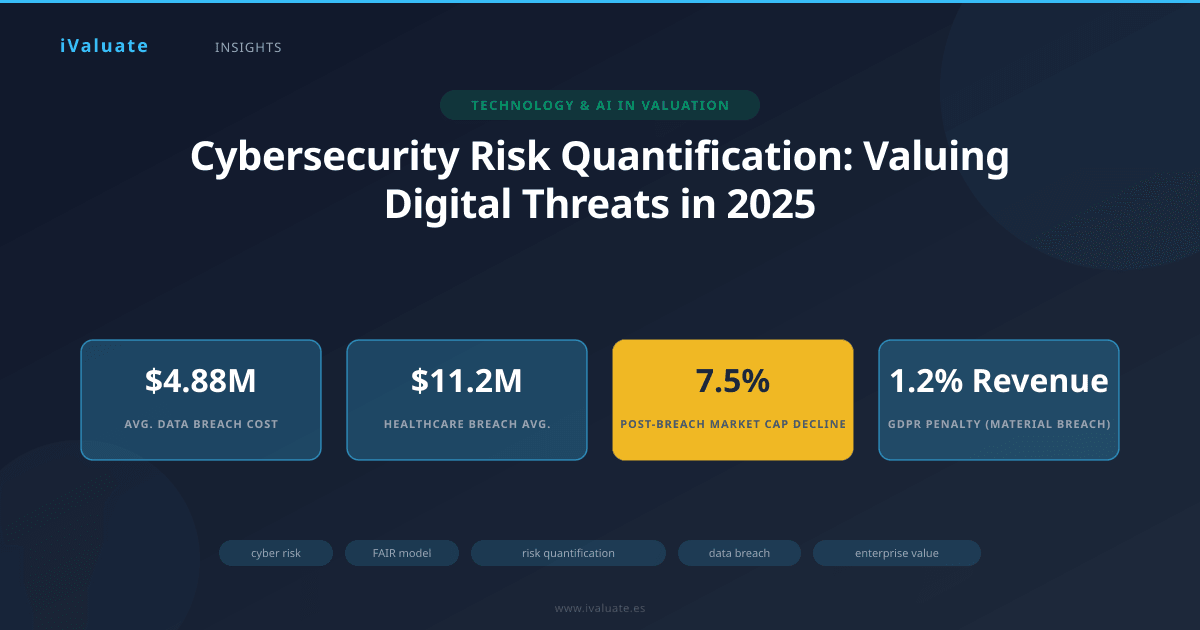
According to IBM's 2025 Cost of a Data Breach Report, the global average cost of a data breach reached $4.88 million, up 12% from 2023. However, this figure masks substantial variation by industry, company size, and breach characteristics. Healthcare breaches averaged $11.2 million, while financial services breaches cost $6.3 million on average. For companies with revenues below $50 million, a material breach often represents 15-25% of annual revenue—a potentially existential event.
The valuation impact extends beyond direct breach costs. Research from Comparitech analyzing 40 publicly traded companies post-breach found an average market capitalization decline of 7.5% in the six months following disclosure, with recovery taking an average of 46 days. More concerning for valuation purposes: companies experiencing breaches saw their revenue growth rates decline by an average of 3.2 percentage points in the subsequent fiscal year, directly impacting terminal value calculations.
Quantifying Probability and Impact
The fundamental challenge in cyber risk quantification is that we're dealing with low-probability, high-impact events with limited actuarial data. Unlike operational risks with decades of loss history, cyber risk evolves rapidly as attack vectors and defensive technologies change. This makes traditional probability distributions unreliable.
The Factor Analysis of Information Risk (FAIR) model, developed by Jack Jones and now maintained by the FAIR Institute, provides the most rigorous framework for cyber risk quantification in valuation contexts. FAIR decomposes risk into two primary components: Loss Event Frequency (LEF) and Loss Magnitude (LM), with Risk = LEF × LM expressed as a probability distribution rather than a point estimate.
Loss Event Frequency is further decomposed into:
- Threat Event Frequency (TEF): How often a threat actor acts against the asset
- Vulnerability (Vuln): The probability that a threat event results in loss
- LEF = TEF × Vuln
Loss Magnitude considers:
- Primary Loss: Direct costs of the event (response, notification, legal, regulatory)
- Secondary Loss: Indirect costs (customer churn, competitive disadvantage, increased insurance premiums)
For valuation purposes, this framework allows us to generate a loss exceedance curve—showing the probability of losses exceeding various thresholds—which can be integrated into scenario analysis and risk-adjusted valuation models.
02 Implementing FAIR in Valuation Practice
The FAIR model's strength lies in its structured decomposition of risk factors, but implementation requires careful calibration using both internal and external data sources. Here's how sophisticated valuation teams are applying FAIR in 2025:
Step 1: Asset and Threat Identification
Begin by cataloging information assets material to enterprise value. For a typical technology company, this includes customer databases, intellectual property repositories, financial systems, and operational technology controlling product delivery. Each asset requires separate analysis, as threat profiles vary dramatically.
For a B2B SaaS company we analyzed in Q4 2024, the customer database represented the highest-value target. The database contained 47,000 enterprise customer records with payment information, usage patterns, and integration details. Loss or exposure of this asset would trigger notification requirements under GDPR, CCPA, and sector-specific regulations, while also providing competitors with strategic intelligence.
Step 2: Threat Event Frequency Estimation
TEF estimation combines industry benchmarks with company-specific factors. The 2025 Verizon Data Breach Investigations Report indicates that companies in the software sector face an average of 2,100 attempted intrusions annually, with 3.8% resulting in some level of unauthorized access. However, these figures require adjustment based on:
- Company size and visibility (larger companies face 4-7x more targeted attacks)
- Geographic footprint (operations in high-risk jurisdictions increase TEF by 40-60%)
- Previous breach history (prior victims face 2.3x higher subsequent attack rates)
- Industry attractiveness to threat actors
For the SaaS company mentioned above, we estimated TEF at 85 credible threat events annually (attacks sophisticated enough to potentially succeed), based on their security operations center logs, threat intelligence feeds, and industry benchmarking.
Step 3: Vulnerability Assessment
Vulnerability represents the probability that a threat event overcomes existing controls. This requires technical assessment of:
- Network architecture and segmentation
- Access controls and authentication mechanisms
- Patch management and vulnerability remediation processes
- Employee security awareness and phishing susceptibility
- Third-party vendor security posture
Quantifying vulnerability is inherently subjective, but can be grounded in frameworks like the NIST Cybersecurity Framework maturity levels or CIS Controls implementation scores. Companies at NIST Tier 3 (Repeatable) typically show vulnerability rates of 2-5% for sophisticated attacks, while Tier 2 (Risk Informed) organizations may face 8-15% vulnerability rates.
Our SaaS company scored as Tier 2.5, with particular weaknesses in third-party vendor management and legacy system patching. We estimated vulnerability at 6.5% for the customer database asset, yielding LEF = 85 × 0.065 = 5.5 expected loss events over a five-year valuation horizon, or approximately one material incident every 11 months.
Step 4: Loss Magnitude Quantification
Loss magnitude requires detailed financial modeling of breach scenarios. Primary losses include:
Immediate Response Costs:
- Forensic investigation: $250-$850 per compromised record for complex breaches
- Legal counsel: $400-$900 per hour, typically 500-2,000 hours for material breaches
- Notification costs: $5-$15 per affected individual (mail, call center, credit monitoring)
- Regulatory response: 800-3,000 hours of internal time plus external counsel
Regulatory Penalties: Under GDPR, fines can reach €20 million or 4% of global annual revenue, whichever is higher. In practice, 2024-2025 enforcement showed average fines of 1.2% of revenue for material breaches involving inadequate security controls. CCPA penalties of $7,500 per intentional violation create additional exposure for companies serving California customers.
Secondary Losses: These often exceed primary costs but are harder to quantify:
- Customer churn: Studies show 15-30% of affected customers reduce spending or switch providers within 12 months
- Revenue growth impact: New customer acquisition costs increase 25-40% post-breach as sales cycles lengthen
- Valuation multiple compression: Public company analysis shows EV/Revenue multiples declining 0.8-1.5 turns post-breach
- Insurance premium increases: Cyber insurance renewals typically see 40-120% premium increases following a claim
For our SaaS company with $180 million in annual recurring revenue, we modeled three breach scenarios:
Scenario Analysis Results:
Minor Breach (5,000 records): $8.2M total cost (4.6% of ARR)
Moderate Breach (25,000 records): $31.7M total cost (17.6% of ARR)
Severe Breach (all 47,000 records): $67.4M total cost (37.4% of ARR)
Probability-weighted expected loss: $12.3M over five-year horizon
03 Integrating Cyber Risk into Valuation Models
Once quantified, cyber risk must be incorporated into valuation models through one of three approaches, depending on the materiality and the valuation context.
Approach 1: Direct Cash Flow Adjustment
For ongoing operational cyber costs (security tools, personnel, insurance), these flow through as operating expenses in the DCF model. The more sophisticated adjustment involves incorporating expected breach costs as a recurring expense item.
Using our SaaS company example, the probability-weighted expected annual loss of $2.46 million ($12.3M ÷ 5 years) can be added to operating expenses, reducing EBITDA by that amount. At a 10x EV/EBITDA multiple, this translates to a $24.6 million reduction in enterprise value—a 7.2% impact on the original $340 million valuation.
Approach 2: Scenario-Weighted Valuation
For material cyber risks with binary outcomes (breach occurs or doesn't), scenario analysis provides more transparency. Develop three valuations:
- Base case (no breach): Standard DCF assuming current operations
- Breach scenario: DCF incorporating breach costs, customer churn, and growth rate impacts
- Probability-weighted: Combine scenarios using LEF-derived probabilities
This approach proves particularly valuable in M&A contexts, where buyers can see the risk-adjusted valuation alongside the clean scenario, facilitating negotiation around risk allocation through indemnities, escrows, or price adjustments.
Approach 3: Risk-Adjusted Discount Rate
Some practitioners argue for incorporating cyber risk into the discount rate through a risk premium. While theoretically sound, this approach lacks precision—a 50-basis-point increase in WACC might reflect cyber risk, but provides no transparency into the underlying assumptions and makes sensitivity analysis difficult.
We generally recommend against this approach except in cases where cyber risk is diffuse and non-quantifiable, preferring the explicit cash flow adjustments that allow stakeholders to understand and debate the assumptions.
04 Industry-Specific Considerations
Cyber risk quantification requires industry-specific calibration, as threat profiles, regulatory environments, and customer expectations vary dramatically.
Healthcare and Life Sciences
Healthcare organizations face the highest breach costs due to HIPAA penalties, medical record sensitivity, and patient safety implications. A 2025 analysis of hospital system breaches showed average costs of $10.9 million, with 43% of costs attributed to lost business and reputation damage. For valuation purposes, healthcare companies require:
- Higher vulnerability assumptions due to legacy medical device integration
- Longer customer churn impact periods (patient relationships span decades)
- Explicit modeling of OCR enforcement actions (averaging $2.3M for material breaches)
Financial Services
Banks and fintech companies face sophisticated, persistent threats from nation-state actors and organized crime. While direct breach costs average $6.3 million, the regulatory scrutiny and potential for systemic impact create tail risks that must be explicitly modeled. The 2024 Capital One settlement of $190 million for a 2019 breach demonstrates the long-tail liability exposure.
Financial services valuations should incorporate:
- Regulatory capital requirements for operational risk (Basel III framework)
- Explicit modeling of consent orders and business restrictions
- Reputational impact on deposit funding costs and customer acquisition
Technology and SaaS
Software companies face unique risks around intellectual property theft and supply chain attacks. The 2024 SolarWinds settlement of $26 million, while modest relative to company size, created a precedent for software vendor liability that affects all technology company valuations.
Key considerations include:
- Source code theft impact on competitive positioning
- Customer contract termination rights post-breach
- Potential liability for downstream customer impacts
05 Real-World Application: Private Equity Due Diligence
In Q1 2025, a middle-market private equity firm engaged our team to assess cyber risk for a potential platform acquisition in the healthcare IT sector. The target company, with $95 million in revenue and $22 million in EBITDA, had received a letter of intent at 11.5x EBITDA, implying a $253 million enterprise value.
Our FAIR-based analysis revealed:
- The company operated at NIST Tier 1.5 (Ad Hoc), significantly below industry standard
- Customer data for 340,000 patients resided in poorly segmented cloud infrastructure
- No cyber insurance coverage above $5 million (inadequate for modeled scenarios)
- Third-party vendor management was essentially non-existent, with 47 vendors having database access
Our quantified risk assessment projected a 32% probability of a material breach within three years, with expected losses of $18.7 million (probability-weighted). This translated to a $38 million reduction in enterprise value using direct cash flow adjustment, or a 15% valuation haircut.
The PE firm used this analysis to:
- Renegotiate the purchase price to 9.8x EBITDA ($215.6 million), a $37.4 million reduction
- Require the seller to obtain $15 million in tail cyber insurance coverage
- Establish a $5 million escrow for cyber-related claims
- Develop a 100-day security improvement plan with $4.2 million in budgeted remediation costs
The deal closed in April 2025, and the portfolio company has since achieved NIST Tier 2.5 status, with updated risk quantification showing expected losses reduced to $6.3 million—validating the investment in security improvements.
06 Emerging Trends in Cyber Risk Valuation
As we move through 2025 and into 2026, several trends are reshaping how valuation professionals approach cyber risk quantification.
AI-Driven Threat Landscape
Generative AI has dramatically lowered the barrier to entry for cyber attacks. Phishing campaigns now achieve 3.2x higher success rates using AI-generated content that passes traditional detection. Simultaneously, AI-powered defense tools have improved threat detection by 40-60%. The net effect: higher threat event frequency but potentially lower vulnerability for well-defended organizations. Valuation models must account for this bifurcation—companies investing in AI-powered security see improving risk profiles, while those relying on legacy controls face accelerating risk.
Cyber Insurance Market Dynamics
The cyber insurance market has matured significantly, with 2025 seeing the first decline in premium rates (down 8% year-over-year) after three years of increases. More importantly, insurers now provide detailed risk assessments that can inform FAIR model inputs. Forward-thinking valuation teams are incorporating insurance underwriting data into their vulnerability assessments, as insurers have superior loss data and actuarial models.
Regulatory Standardization
The SEC's 2023 cybersecurity disclosure rules have created standardized reporting for public companies, generating a growing dataset for benchmarking. By mid-2025, we have 18 months of Form 8-K incident disclosures, allowing for more robust industry-specific TEF estimation. The EU's Digital Operational Resilience Act (DORA), fully effective in January 2025, creates similar transparency for financial services firms operating in Europe.
Quantum Computing Threat
While still years away from practical implementation, quantum computing's potential to break current encryption standards is beginning to appear in long-term valuation models. Companies with data requiring 20+ year confidentiality (healthcare records, financial data, trade secrets) face a "harvest now, decrypt later" threat that sophisticated buyers are beginning to quantify in acquisition models. This represents a novel form of long-tail cyber risk that will require new quantification approaches.
07 Best Practices for Valuation Professionals
Based on our experience implementing cyber risk quantification across 40+ valuation engagements in 2024-2025, we recommend the following best practices:
1. Engage Technical Expertise Early: Cyber risk quantification requires collaboration between valuation professionals and cybersecurity experts. Bring in qualified assessors during preliminary due diligence, not as an afterthought.
2. Use Ranges, Not Point Estimates: Cyber risk is inherently uncertain. Present findings as probability distributions and scenario ranges rather than single numbers. Monte Carlo simulation of FAIR model inputs provides valuable insight into tail risks.
3. Benchmark Rigorously: Leverage industry-specific data from sources like Advisen's cyber loss database, the Privacy Rights Clearinghouse breach database, and industry-specific ISACs (Information Sharing and Analysis Centers). Generic benchmarks mask critical variation.
4. Document Assumptions Transparently: Cyber risk quantification involves numerous subjective judgments. Document each assumption, its source, and the rationale for any adjustments. This transparency proves essential when defending valuations to boards, investors, or in litigation.
5. Update Regularly: Cyber risk profiles change rapidly. A risk assessment from 12 months ago may be materially outdated. For portfolio companies, implement quarterly risk quantification updates using streamlined FAIR assessments.
6. Consider Risk Mitigation Costs: When cyber risk drives a valuation discount, model the cost to remediate the identified weaknesses. Often, $2-5 million in security improvements can eliminate $15-30 million in risk-adjusted valuation impact—a compelling investment case.
08 Looking Forward: The Professionalization of Cyber Risk Valuation
Cyber risk quantification is transitioning from a niche specialty to a core competency for valuation professionals. As of 2025, major accounting firms have established dedicated cyber risk valuation practices, and the AICPA has released preliminary guidance on incorporating cyber risk into business valuations. The International Valuation Standards Council is developing specific guidance expected in 2026.
This professionalization brings both opportunities and obligations. Valuation professionals who develop cyber risk quantification capabilities will differentiate themselves in competitive M&A processes and provide superior counsel to clients. Conversely, those who continue treating cyber risk as a qualitative afterthought will find their valuations increasingly challenged by sophisticated counterparties armed with quantified risk assessments.
The tools and methodologies exist today to rigorously quantify cyber risk's impact on enterprise value. The FAIR model provides a structured framework, industry benchmarks offer calibration data, and case studies demonstrate real-world application. What's required now is the professional will to implement these approaches systematically.
For corporate development teams, private equity firms, and advisory practices looking to implement rigorous cyber risk quantification, platforms like iValuate are incorporating these frameworks into their valuation workflows, allowing professionals to systematically assess cyber risk alongside traditional valuation factors. As the field matures, the integration of cyber risk quantification into standard valuation practice will become not just best practice, but expected practice.
The $75 million valuation adjustment that opened this article represents the future of M&A and corporate valuation—a future where cyber risk is quantified with the same rigor as market risk, operational risk, and financial risk. Valuation professionals who master these techniques today will be the trusted advisors of tomorrow, capable of navigating the increasingly complex intersection of technology risk and enterprise value.