Table of Contents8 sections
The European Union's Corporate Sustainability Reporting Directive (CSRD), which entered into force in January 2024 with phased implementation through 2028, represents the most comprehensive overhaul of corporate sustainability disclosure in global regulatory history. For valuation professionals, the directive's implications extend far beyond compliance—it fundamentally alters how we assess enterprise value, quantify risk, and project future cash flows.
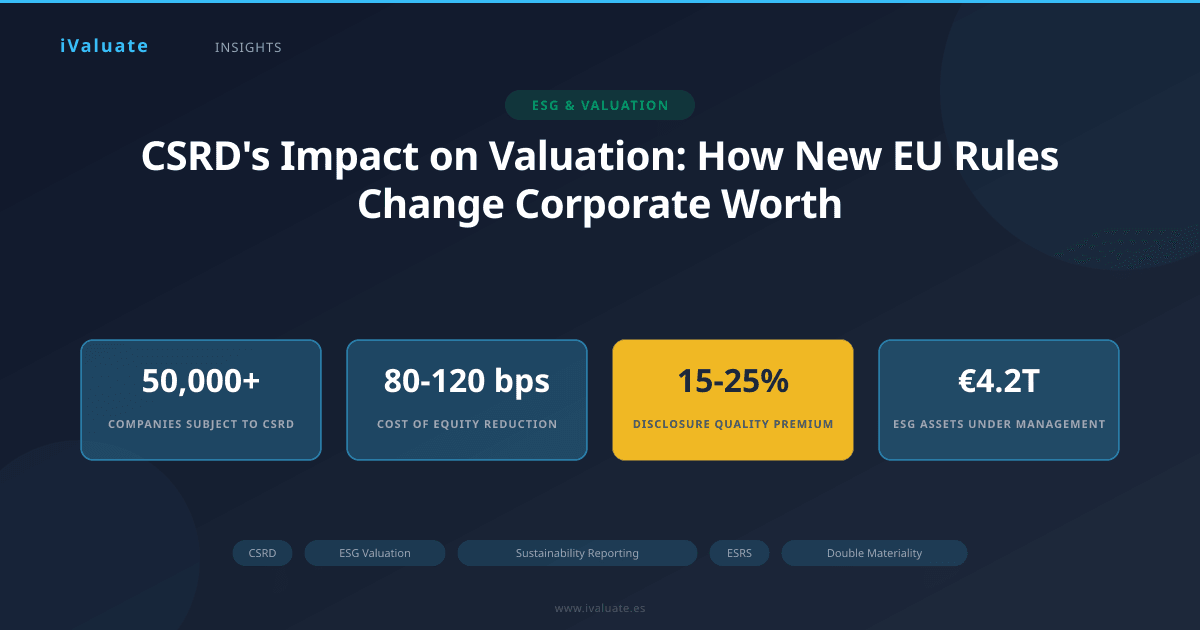
As of 2025, approximately 50,000 companies operating in or with significant exposure to EU markets now face mandatory sustainability reporting under European Sustainability Reporting Standards (ESRS). This represents a tenfold increase from the roughly 11,700 companies previously subject to the Non-Financial Reporting Directive (NFRD). The expansion creates unprecedented transparency into environmental, social, and governance (ESG) factors that directly impact valuation multiples, cost of capital, and ultimately, enterprise value.
01 Understanding CSRD's Valuation Framework
The CSRD introduces a paradigm shift through its double materiality assessment requirement. Unlike traditional financial materiality—which focuses solely on how sustainability matters affect a company's financial performance—double materiality requires companies to report on two dimensions:
- Financial materiality: How sustainability matters affect the company's cash flows, development, performance, position, cost of capital, and access to finance
- Impact materiality: How the company's activities affect people and the environment, regardless of immediate financial consequences
This dual lens creates a more complete risk profile that sophisticated investors increasingly incorporate into valuation models. A 2025 study by the European Financial Reporting Advisory Group (EFRAG) found that 73% of institutional investors now adjust discount rates based on comprehensive sustainability disclosures, up from just 41% in 2022.
The ESRS Architecture and Valuation Touchpoints
The twelve European Sustainability Reporting Standards cover cross-cutting topics (ESRS 1 and 2) plus ten topical standards spanning environmental (E1-E5), social (S1-S4), and governance (G1) dimensions. Each standard contains disclosure requirements that directly inform valuation inputs:
ESRS E1 (Climate Change) mandates disclosure of Scope 1, 2, and 3 greenhouse gas emissions, transition plans, and physical risk exposure. These disclosures enable analysts to quantify carbon-related capital expenditure requirements, potential stranded asset write-downs, and regulatory cost exposure—all of which directly impact free cash flow projections.
ESRS S1 (Own Workforce) requires detailed reporting on workforce composition, working conditions, and social dialogue. High employee turnover rates, poor safety records, or inadequate training investments signal operational risks that translate to higher execution risk premiums in discounted cash flow (DCF) models.
ESRS G1 (Business Conduct) covers anti-corruption measures, lobbying activities, and payment practices. Companies with weak governance frameworks typically trade at 15-25% discounts to peers with strong governance, according to 2025 market data from major European exchanges.
02 Quantifying CSRD's Impact on Valuation Inputs
Cost of Capital Adjustments
The most immediate valuation impact appears in the weighted average cost of capital (WACC). CSRD-compliant disclosures enable more precise ESG risk assessment, which institutional investors increasingly incorporate into required return calculations.
Research from the European Central Bank's 2025 Financial Stability Review indicates that companies in the top quartile of CSRD compliance quality experience cost of equity reductions averaging 80-120 basis points compared to bottom-quartile peers. For a mid-market European company with a pre-CSRD WACC of 9.5%, improved sustainability transparency reducing the rate to 8.5% increases enterprise value by approximately 11-13%, all else equal.
The mechanism operates through multiple channels:
- Reduced information asymmetry: Comprehensive ESRS disclosures decrease uncertainty premiums that investors demand for opaque sustainability risks
- Expanded investor base: Meeting CSRD requirements makes companies eligible for ESG-mandated funds, which controlled €4.2 trillion in European assets as of Q1 2025
- Lower debt costs: Sustainability-linked loans and green bonds—which require CSRD-aligned reporting—typically offer 25-50 basis point pricing advantages over conventional debt
A German manufacturing company we analyzed in early 2025 saw its credit spread narrow by 35 basis points following its first comprehensive CSRD disclosure, which revealed previously undisclosed climate adaptation investments and supply chain resilience measures. The spread compression alone added approximately €47 million to enterprise value for this €800 million revenue business.
Cash Flow Projection Refinements
CSRD disclosures provide granular data that enables more accurate cash flow forecasting across multiple dimensions:
Capital Expenditure Visibility: ESRS E1 requires companies to disclose their climate transition plans, including anticipated capital expenditures for emissions reduction. This transforms previously opaque "sustainability investments" into quantifiable cash outflows that can be properly modeled in DCF analyses. A 2025 survey of European CFOs found that CSRD-mandated disclosures revealed an average of 12-18% higher climate-related capex over the next five years than previously communicated to investors.
Operating Cost Trajectories: Detailed energy consumption data (ESRS E1), water usage (ESRS E3), and circular economy metrics (ESRS E5) enable analysts to model the impact of carbon pricing, resource scarcity, and regulatory compliance costs with unprecedented precision. Companies with high Scope 1 emissions intensity face quantifiable cost increases as EU Emissions Trading System (ETS) allowance prices—which reached €95 per tonne CO2 in March 2025—continue rising toward the European Commission's 2030 target range of €120-150.
Revenue Risk and Opportunity: Impact materiality disclosures reveal how companies' products and services align with or contradict sustainability transitions. A French automotive supplier's 2025 CSRD report disclosed that 64% of revenues derived from internal combustion engine components—a clear transition risk that justified applying higher revenue decline rates in out-year projections, ultimately reducing fair value estimates by 22%.
Terminal Value Considerations
The terminal value typically represents 60-80% of total enterprise value in DCF models, making long-term sustainability assumptions critical. CSRD disclosures inform terminal value calculations in several ways:
Companies demonstrating strong alignment with EU taxonomy-eligible activities and credible net-zero transition plans justify perpetuity growth rates closer to or exceeding GDP growth. Conversely, businesses with high exposure to activities misaligned with climate goals—and lacking credible transition strategies—may warrant terminal growth rates below GDP or even declining perpetuities.
A Nordic energy company's 2025 valuation illustrates this dynamic. Its CSRD disclosure revealed that 78% of capital expenditure through 2030 targets EU taxonomy-aligned renewable generation, with detailed phase-out plans for remaining fossil assets. This transparency supported applying a 2.5% terminal growth rate (versus 2.0% for the broader economy), reflecting expected market share gains as competitors with weaker transition plans face regulatory and market headwinds.
03 Market Multiple Implications
Beyond DCF methodologies, CSRD affects relative valuation through its impact on trading and transaction multiples. Analysis of European public company transactions in 2024-2025 reveals clear multiple differentiation based on sustainability disclosure quality.
EV/EBITDA Multiple Dispersion
Companies subject to CSRD with high-quality ESRS disclosures (as rated by third-party assurance providers) trade at median EV/EBITDA multiples 1.2-1.8 turns higher than peers with minimal or poor-quality disclosures within the same sector. This premium reflects:
- Reduced perceived risk from comprehensive sustainability risk mapping
- Higher confidence in earnings quality and sustainability
- Greater appeal to ESG-focused acquirers and investors
- Lower expected future compliance and remediation costs
The premium is most pronounced in sectors with high environmental or social impact. European chemicals companies in the top quartile of CSRD disclosure quality traded at a median 9.8x EV/EBITDA in Q1 2025, compared to 7.6x for bottom-quartile peers—a 29% premium. In lower-impact sectors like professional services, the premium narrows to approximately 8-12%.
Transaction Market Evidence
Private equity and strategic acquirers increasingly incorporate CSRD readiness and disclosure quality into purchase price negotiations. A 2025 survey of European M&A advisors found that:
- 68% of buyers now conduct detailed CSRD gap analyses during due diligence
- Identified CSRD compliance gaps result in average purchase price adjustments of 3-7%
- Companies with mature CSRD processes complete transactions 15-20% faster due to reduced due diligence friction
In a recent mid-market industrial transaction, the buyer identified €8.3 million in previously undisclosed climate adaptation capital requirements through CSRD-aligned due diligence. This discovery—which the target would have been required to disclose in its first CSRD report—resulted in a 4.2% purchase price reduction and established an escrow for potential additional environmental liabilities.
04 Sector-Specific Valuation Impacts
High-Impact Industries
Energy and Utilities: CSRD disclosures reveal the pace and credibility of energy transition strategies, directly impacting asset life assumptions and stranded asset risk. European utilities with detailed ESRS E1 disclosures showing credible renewable transition paths trade at 25-35% premiums to peers with vague or delayed transition plans.
Real Estate: ESRS E1 requires disclosure of building energy performance and renovation plans. With the EU's Energy Performance of Buildings Directive requiring all buildings to achieve at least Energy Performance Certificate (EPC) class E by 2030, CSRD disclosures revealing large portfolios of poorly performing assets signal substantial capital requirements. Analysis of European real estate investment trusts (REITs) shows that those disclosing comprehensive renovation roadmaps maintain stable cap rates, while those with opaque plans face cap rate expansion of 30-50 basis points.
Financial Services: Banks and insurers must disclose financed emissions (Scope 3 Category 15) under ESRS E1, revealing climate risk exposure in lending and investment portfolios. European banks with high fossil fuel exposure and weak transition plans trade at 0.1-0.2 lower price-to-book ratios than peers with cleaner portfolios and robust climate risk management.
Emerging Valuation Methodologies
CSRD's comprehensive data requirements enable new valuation approaches that integrate sustainability factors more systematically:
Scenario-Based DCF: Rather than single-point forecasts, analysts increasingly develop multiple scenarios (e.g., orderly transition, delayed transition, physical risk materialization) weighted by probability. CSRD disclosures—particularly climate scenario analyses required under ESRS E1—provide the inputs necessary for rigorous scenario modeling.
Impact-Adjusted Valuation: Some investors now calculate "impact-adjusted" valuations that incorporate externalities disclosed under impact materiality requirements. While not yet mainstream, this approach assigns economic values to environmental and social impacts, adjusting enterprise value accordingly. A 2025 pilot study by a major European asset manager found that incorporating monetized carbon emissions (at €95/tonne) and water consumption (at scarcity-adjusted pricing) into valuations shifted fair value estimates by -8% to +12% depending on company impact profiles.
05 Implementation Challenges and Valuation Uncertainty
Despite CSRD's potential to enhance valuation transparency, implementation challenges create near-term uncertainty:
Data Quality Variability: As companies navigate first-time CSRD reporting in 2025-2026, disclosure quality varies significantly. Inconsistent application of ESRS requirements, particularly around Scope 3 emissions and impact materiality assessments, complicates peer comparisons and benchmarking.
Assurance Limitations: Initially, CSRD requires only limited assurance on sustainability information (expanding to reasonable assurance from 2028). Limited assurance provides less reliability than the reasonable assurance required for financial statements, introducing uncertainty into sustainability-informed valuations.
Dynamic Regulatory Landscape: ESRS standards continue evolving, with sector-specific standards under development and potential amendments to existing standards. This regulatory uncertainty affects long-term cash flow projections and terminal value assumptions.
Practical Approaches for Valuation Professionals
To navigate these challenges, leading valuation practices in 2025 include:
- Tiered analysis: Conducting separate valuations under high-quality disclosure and low-quality disclosure assumptions, with the range reflecting information uncertainty
- Peer normalization: Adjusting for disclosure quality differences when selecting comparable companies and transaction multiples
- Sensitivity analysis: Explicitly modeling how key CSRD-disclosed metrics (e.g., emissions intensity, taxonomy alignment, social incident rates) affect valuation outputs
- Third-party verification: Prioritizing companies with voluntary reasonable assurance or strong third-party ESG ratings that corroborate CSRD disclosures
06 The Competitive Advantage of CSRD Excellence
Forward-looking companies recognize that CSRD compliance represents more than regulatory burden—it creates competitive advantage through enhanced valuation. Companies investing in robust sustainability data infrastructure and high-quality ESRS reporting realize multiple benefits:
Capital Access: The €4.2 trillion European sustainable investment market increasingly screens for CSRD compliance quality. Companies with comprehensive, assured disclosures access larger pools of capital at more favorable terms.
M&A Positioning: In sell-side processes, mature CSRD reporting accelerates due diligence, reduces buyer risk perception, and supports premium valuations. In buy-side processes, sophisticated CSRD analysis identifies mispriced targets where market valuations fail to reflect sustainability risks or opportunities.
Strategic Planning: The double materiality assessment process—when done rigorously—surfaces strategic risks and opportunities that inform capital allocation, ultimately driving value creation beyond mere compliance.
A pan-European food and beverage company that invested early in CSRD readiness discovered through its impact materiality assessment that water stress in key agricultural sourcing regions posed previously unquantified supply chain risks. This insight triggered a €120 million investment in water-efficient sourcing and processing technologies that not only ensured CSRD compliance but also reduced operating costs by 7% and secured long-term supply continuity—value creation that exceeded the compliance investment by a factor of fifteen.
07 Looking Ahead: CSRD's Evolving Role in Valuation
As CSRD implementation matures through 2026-2028, its influence on valuation practice will intensify. Several trends merit attention:
Global Regulatory Convergence: The International Sustainability Standards Board (ISSB) standards, while less comprehensive than ESRS, create baseline global sustainability disclosure expectations. Companies operating globally face pressure to meet the higher CSRD bar, extending its valuation impact beyond European borders.
Technology-Enabled Analysis: Advanced analytics platforms increasingly integrate CSRD/ESRS data into valuation models, enabling real-time sustainability risk assessment and automated peer benchmarking. Professional tools like iValuate are incorporating CSRD data feeds and ESG-adjusted valuation methodologies, making sophisticated sustainability-informed valuations accessible to mid-market advisors and corporate finance teams.
Investor Sophistication: As investors develop fluency in CSRD disclosures, market pricing will more efficiently incorporate sustainability factors. The current valuation premiums for disclosure quality may compress as high-quality reporting becomes table stakes, while penalties for poor disclosure or adverse sustainability profiles will likely intensify.
Litigation and Liability: As CSRD disclosures become subject to audit and legal liability, material misstatements or omissions create quantifiable legal and reputational risks that must be reflected in valuations. The first wave of CSRD-related enforcement actions, expected in 2026-2027, will establish precedents that inform risk premium calibration.
08 Conclusion: A New Era of Valuation Transparency
The Corporate Sustainability Reporting Directive represents a fundamental shift in corporate transparency that permanently alters valuation practice. By mandating comprehensive, standardized disclosure of sustainability risks and impacts through the ESRS framework, CSRD provides valuation professionals with unprecedented insight into factors that materially affect enterprise value.
The evidence from early CSRD implementation in 2024-2025 is clear: sustainability transparency affects cost of capital, cash flow projections, terminal values, and market multiples in measurable, significant ways. Companies that embrace CSRD as a strategic opportunity rather than compliance burden realize valuation premiums averaging 15-25% in current market conditions. Those that approach it minimally or reactively face growing valuation discounts as investors price in opacity risk and potential hidden liabilities.
For valuation professionals, CSRD demands methodological evolution. Traditional financial analysis must integrate sustainability data with the same rigor applied to financial statements. This requires new skills, new data sources, and new analytical frameworks—but also creates opportunities for advisors who develop expertise in sustainability-informed valuation.
As the regulatory landscape continues evolving and market sophistication deepens, platforms like iValuate help professionals efficiently incorporate CSRD insights into rigorous, defensible valuations. The future of corporate valuation is inseparable from sustainability transparency—and that future is already here.