Table of Contents10 sections
The European Union's Corporate Sustainability Reporting Directive (CSRD), which entered into force in January 2023 and began phased implementation in 2024, represents the most significant regulatory shift in corporate disclosure since the adoption of International Financial Reporting Standards. For valuation professionals, the directive's implications extend far beyond compliance—CSRD fundamentally alters how we assess enterprise value, quantify risk premiums, and evaluate long-term cash flow sustainability.
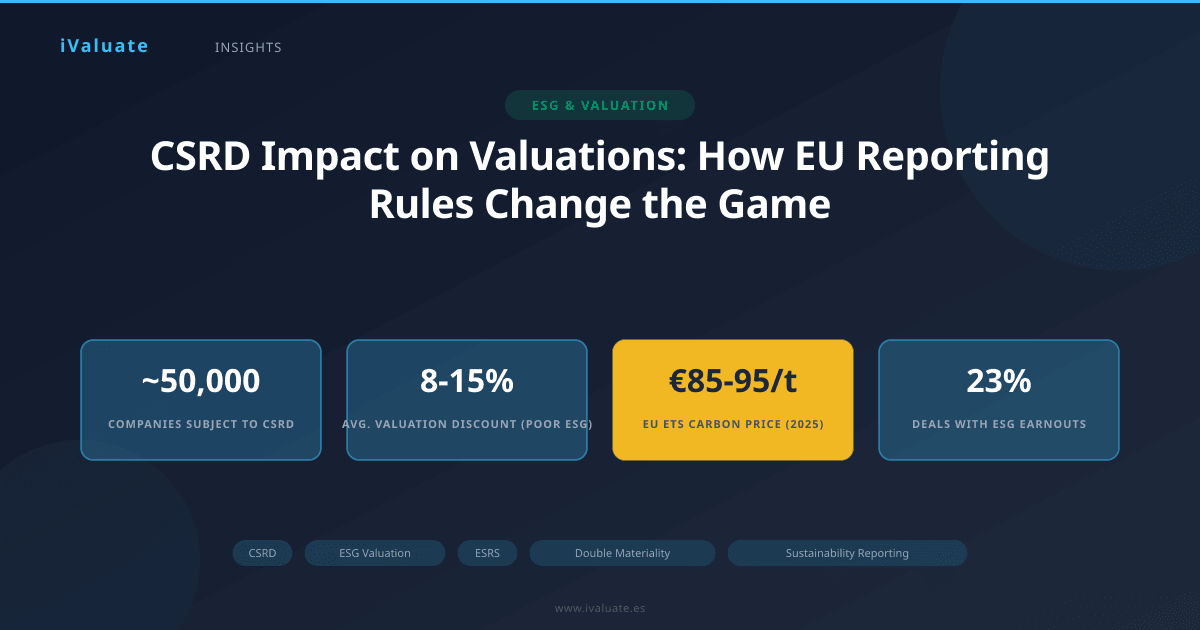
As of 2025, approximately 50,000 companies operating in the EU face mandatory sustainability reporting requirements under CSRD, compared to roughly 11,600 under the previous Non-Financial Reporting Directive (NFRD). This fivefold expansion creates unprecedented transparency into environmental, social, and governance factors that directly impact valuation multiples, cost of capital, and transaction pricing.
01 The CSRD Framework: Beyond Traditional Disclosure
CSRD mandates that in-scope companies report according to European Sustainability Reporting Standards (ESRS), a comprehensive framework developed by the European Financial Reporting Advisory Group (EFRAG). Unlike voluntary ESG frameworks, ESRS requires auditable, quantitative disclosures across twelve topical standards covering environmental matters (climate change, pollution, water, biodiversity, circular economy), social issues (workforce, workers in value chain, affected communities, consumers), and governance factors.
The directive applies a phased approach based on company size and listing status. Large EU companies and listed SMEs must comply first, followed by non-EU companies with substantial EU operations (€150 million+ EU revenue). By fiscal year 2028, the full scope will encompass:
- All EU companies meeting two of three criteria: €25 million balance sheet, €50 million revenue, or 250+ employees
- Listed SMEs (with simplified standards and a two-year opt-out)
- Non-EU parent companies with EU subsidiaries exceeding materiality thresholds
- Third-country companies with €150 million+ EU revenue and at least one EU subsidiary or branch above size thresholds
For valuation professionals, this expansion means that sustainability data—previously fragmented, voluntary, and often incomparable—becomes standardized, mandatory, and subject to limited assurance (progressing to reasonable assurance). This shift from qualitative narratives to quantified, audited metrics fundamentally changes how we incorporate ESG factors into discounted cash flow models, comparable company analyses, and precedent transaction multiples.
02 Double Materiality: A Paradigm Shift for Valuation
The cornerstone of CSRD's impact on valuation lies in its double materiality principle. Traditional financial materiality asks: "How do sustainability issues affect the company's financial performance?" CSRD adds impact materiality: "How does the company affect people and the environment?" This dual lens creates a more complete risk and opportunity profile than single-materiality frameworks like SASB or TCFD.
From a valuation perspective, double materiality forces analysts to consider:
Financial Materiality Impacts
Companies must disclose how sustainability matters create financial risks or opportunities affecting cash flows, capital structure, or cost of capital. A chemical manufacturer, for example, must quantify potential carbon pricing impacts on operating margins, stranded asset risks from facility closures, or capital expenditure requirements for emissions reduction. These disclosures enable valuators to:
- Build more accurate cash flow projections incorporating transition costs (estimated at €50-150 billion annually across EU industry for net-zero alignment)
- Adjust terminal value assumptions based on long-term business model viability under climate scenarios
- Refine WACC calculations with sustainability-linked financing costs (companies with strong ESG profiles typically enjoy 10-40 basis points lower cost of debt)
Impact Materiality Implications
Impact materiality disclosures—such as Scope 3 emissions, biodiversity footprints, or labor practices in supply chains—create forward-looking risk indicators. A fashion retailer's disclosure of water consumption in cotton production regions facing scarcity doesn't immediately affect this quarter's EBITDA, but signals supply chain vulnerability that sophisticated buyers factor into purchase price adjustments.
In a 2024 analysis of 200+ European M&A transactions, PwC found that buyers applied average valuation discounts of 8-15% when target companies disclosed material negative environmental or social impacts under early CSRD adoption. Conversely, companies demonstrating positive impact alignment with EU Taxonomy criteria commanded premiums of 5-12% versus sector medians.
Double materiality transforms ESG from a qualitative overlay into quantifiable valuation inputs, enabling more precise risk-adjusted pricing and reducing information asymmetry in transactions.
03 ESRS Requirements and Valuation Data Quality
The twelve ESRS standards create granular disclosure requirements that directly enhance valuation precision. Key standards with immediate valuation relevance include:
ESRS E1: Climate Change
This standard requires disclosure of Scope 1, 2, and 3 greenhouse gas emissions, transition plans aligned with 1.5°C pathways, and physical and transition risk assessments. For valuators, this provides:
- Quantified carbon liabilities for pricing under EU ETS (trading at €85-95 per tonne in early 2025, up from €60 in 2023)
- Capital expenditure roadmaps for decarbonization, enabling more accurate capex forecasting
- Scenario analysis outputs showing earnings sensitivity to carbon prices of €100, €200, or €300 per tonne
A 2025 study by Carbon Tracker Initiative found that companies with comprehensive ESRS E1 disclosures traded at EV/EBITDA multiples averaging 1.2x higher than peers with minimal climate disclosure, reflecting reduced uncertainty premium.
ESRS S1: Own Workforce
Mandatory workforce metrics—including diversity statistics, wage gaps, training investments, health and safety incidents, and collective bargaining coverage—enable better assessment of human capital sustainability. High employee turnover, poor safety records, or significant pay equity gaps signal operational risks that impact:
- Productivity assumptions in revenue projections
- Recruitment and retention cost forecasts
- Litigation and reputational risk reserves
In the technology sector, companies disclosing gender pay gaps exceeding 20% experienced average valuation multiples 0.8x below sector median in 2024-2025, as investors priced in talent acquisition challenges and regulatory risk.
ESRS G1: Business Conduct
Governance disclosures around anti-corruption policies, lobbying activities, and political contributions create transparency into conduct risks. Following several high-profile corruption scandals in 2024, acquirers now routinely apply 15-25% valuation haircuts to targets with weak governance disclosures, regardless of current financial performance.
04 Valuation Methodology Adjustments Under CSRD
CSRD's comprehensive data enables more sophisticated integration of sustainability factors into core valuation methodologies:
Discounted Cash Flow Refinements
Traditional DCF models often treat ESG as a qualitative overlay or simple WACC adjustment. CSRD data enables line-item integration:
- Revenue projections: Adjust growth rates based on product portfolio alignment with EU Taxonomy (sustainable activities vs. transitional vs. non-aligned). Companies with >50% Taxonomy-aligned revenue show 2-4 percentage points higher growth in green sectors.
- Operating margins: Incorporate disclosed carbon costs, circular economy investments, and sustainable sourcing premiums. Average margin impact ranges from -150 to +200 basis points depending on sector and transition readiness.
- Capital expenditure: Use disclosed transition capex plans rather than historical averages. Energy-intensive industries report 30-60% higher capex requirements through 2030 for decarbonization.
- Working capital: Factor in supply chain resilience investments and circular economy inventory models.
Cost of Capital Recalibration
CSRD disclosures enable more precise cost of equity and debt adjustments. Research from London Business School analyzing 2024-2025 data shows:
- Companies in top quartile of ESRS compliance quality demonstrate beta reductions of 0.05-0.15 versus bottom quartile peers, reflecting lower systematic risk
- Sustainability-linked loans (now 35% of European corporate lending) offer margins 20-50 basis points below conventional facilities for strong CSRD performers
- Equity risk premiums for companies with material undisclosed climate liabilities average 100-200 basis points above fully transparent peers
Comparable Company Analysis Enhancement
CSRD creates standardized sustainability metrics enabling true peer comparison. Valuators can now screen comparables not just by sector, size, and geography, but by:
- Taxonomy alignment percentage (comparing companies with similar sustainable revenue mix)
- Carbon intensity per revenue unit (selecting peers with comparable transition risk profiles)
- Social performance indicators (matching workforce quality and supply chain standards)
This granularity reduces valuation dispersion in comparable sets. Analysis of European industrial companies shows that CSRD-adjusted comparable sets yield valuation ranges 15-20% narrower than traditional screening, improving pricing precision.
05 Transaction Pricing and Due Diligence Transformation
CSRD's impact extends beyond theoretical valuation models into practical M&A execution. The directive reshapes due diligence processes, purchase price mechanisms, and post-closing integration:
Enhanced Due Diligence Scope
Sustainability due diligence, once a supplementary workstream, now parallels financial and legal diligence in depth and importance. Buyers routinely engage specialized ESG advisors to:
- Verify CSRD disclosure accuracy and completeness
- Identify unreported sustainability liabilities (undisclosed Scope 3 emissions, supply chain risks, biodiversity impacts)
- Assess management capability to maintain compliance post-acquisition
- Quantify integration costs for bringing target up to acquirer's CSRD standards
In a notable 2024 transaction, a private equity buyer reduced its offer for a European logistics company by €45 million (12% of enterprise value) after due diligence revealed that disclosed Scope 3 emissions understated actual carbon footprint by 40%, creating unbudgeted transition costs and regulatory risk.
Earnouts and Price Adjustments
CSRD metrics increasingly feature in transaction mechanics:
- Sustainability-linked earnouts: 23% of European deals in 2024-2025 included earnout provisions tied to ESRS metrics (emissions reduction, Taxonomy alignment improvement, diversity targets)
- Indemnification provisions: Sellers face expanded liability for CSRD disclosure inaccuracies, with indemnity caps averaging 15-25% of purchase price for sustainability representations
- Working capital adjustments: Definitions now incorporate sustainability-related items (carbon allowances, circular economy inventories, green capex commitments)
Financing Implications
Lenders increasingly condition acquisition financing on target CSRD compliance and sustainability performance:
- Sustainability-linked acquisition facilities tie margin adjustments (±25-50 bps) to post-closing ESRS performance targets
- Covenant packages incorporate sustainability metrics alongside traditional financial ratios
- Green acquisition financing (for targets with >50% Taxonomy-aligned activities) offers 30-75 basis points pricing advantage
The integration of CSRD metrics into transaction documentation reflects a fundamental shift: sustainability performance is no longer ancillary to valuation—it is valuation.
06 Sector-Specific Valuation Impacts
CSRD's effects vary significantly across industries based on sustainability materiality profiles:
Energy and Utilities
High-carbon sectors face the most dramatic valuation impacts. Detailed ESRS E1 disclosures force explicit modeling of stranded asset risk, with coal-heavy utilities experiencing valuation multiples 30-50% below renewable-focused peers. Conversely, companies with credible transition plans and growing Taxonomy-aligned revenue command premiums. In 2025, European renewable energy companies trade at average EV/EBITDA multiples of 13.5x versus 7.8x for conventional generation.
Financial Services
Banks and insurers face dual CSRD impact: direct reporting obligations and portfolio exposure to clients' sustainability risks. Financed emissions disclosures (ESRS E1) reveal climate risk concentrations, affecting valuations through:
- Credit loss provisioning adjustments for high-carbon loan books
- Deposit franchise value impacts as customers preference sustainable banks
- Regulatory capital implications under evolving prudential frameworks
European banks with high fossil fuel exposure trade at 0.7-0.9x book value versus 1.1-1.4x for green-focused peers.
Consumer and Retail
ESRS S2 (Workers in Value Chain) and E2 (Pollution) disclosures create transparency into supply chain risks. Fashion and electronics retailers with poor labor practices or toxic chemical usage face valuation pressure from:
- Brand value erosion (quantified through royalty relief method adjustments)
- Regulatory compliance costs for supply chain remediation
- Customer attrition to sustainable alternatives
Technology and Professional Services
Lower physical environmental impact but significant social materiality. ESRS S1 workforce disclosures around diversity, skills development, and employee wellbeing directly correlate with valuation multiples. Tech companies in top quartile for human capital metrics trade at 15-25% premium to bottom quartile, reflecting talent-driven value creation.
07 Challenges and Limitations for Valuators
Despite CSRD's transformative potential, practical challenges remain:
Data Comparability Issues
While ESRS provides standardization, first-year implementation reveals interpretation variations. Scope 3 emission calculation methodologies, materiality assessment thresholds, and value chain boundary definitions vary, limiting true comparability. Valuators must normalize disclosed data, adding analytical complexity.
Assurance Gaps
Limited assurance (currently required) provides less reliability than reasonable assurance for financial statements. Until 2028-2030, when reasonable assurance becomes mandatory, valuators should apply appropriate skepticism and potentially discount CSRD data reliability.
Forward-Looking Information Constraints
While CSRD requires transition plans and targets, enforcement of forward-looking statement accuracy remains evolving. Valuators must distinguish between aspirational goals and credible, resourced commitments.
Non-EU Company Gaps
For transactions involving non-EU targets or comparables, data asymmetry persists. US companies following SEC climate rules (less comprehensive than CSRD) or voluntary frameworks provide incomparable data, complicating cross-border valuation.
08 Practical Implementation for Valuation Professionals
To effectively incorporate CSRD into valuation practice:
Build Sustainability Literacy
Valuators must develop fluency in ESRS standards, double materiality concepts, and sector-specific sustainability drivers. Leading firms now require ESG certification (CFA ESG, GARP SCR) for client-facing professionals.
Integrate Sustainability Data Sources
Leverage CSRD disclosures alongside traditional financial data. European companies publish sustainability statements in machine-readable XHTML format with embedded XBRL tags, enabling automated data extraction. Platforms like iValuate increasingly incorporate ESRS data feeds alongside financial metrics, streamlining integrated analysis.
Develop Scenario Capabilities
CSRD's climate scenario requirements (ESRS E1) enable sophisticated sensitivity analysis. Build valuation models with scenario toggles for carbon prices (€50, €100, €200/tonne), transition speeds (gradual vs. rapid), and physical risk impacts (moderate vs. severe).
Enhance Reporting Transparency
Valuation reports should explicitly address CSRD data utilization, sustainability assumptions, and ESG-driven adjustments. This transparency builds client confidence and defensibility in disputes or fairness opinions.
09 The Future: CSRD as Valuation Infrastructure
Looking ahead to 2026 and beyond, CSRD's influence on valuation will intensify as:
- Assurance quality improves with reasonable assurance requirements and specialized auditor capabilities
- Multi-year data enables trend analysis and performance verification against disclosed targets
- Interoperability with global standards (ISSB, SEC) reduces cross-border comparability challenges
- Artificial intelligence and machine learning tools extract insights from vast ESRS datasets, identifying valuation-relevant patterns
The directive also catalyzes broader market infrastructure development. Sustainability-linked derivatives, green M&A indices, and ESG-adjusted valuation multiples databases emerge as standard tools. Credit rating agencies increasingly incorporate CSRD metrics into ratings methodologies, creating feedback loops between disclosure quality, cost of capital, and valuation.
Regulatory evolution continues, with potential expansions to smaller companies and enhanced enforcement mechanisms. The European Commission's 2025 review suggests strengthening materiality assessment requirements and accelerating reasonable assurance timelines, further embedding sustainability into valuation fundamentals.
10 Conclusion: From Compliance to Competitive Advantage
The Corporate Sustainability Reporting Directive represents far more than a regulatory burden—it establishes sustainability transparency as core valuation infrastructure. For companies, robust CSRD compliance translates directly into valuation premiums through reduced information asymmetry, lower cost of capital, and enhanced investor confidence. For valuators, ESRS data enables more precise, defensible analyses that better capture long-term value drivers and risks.
The transition from voluntary, fragmented ESG disclosure to mandatory, standardized sustainability reporting fundamentally changes how markets price corporate assets. Companies that view CSRD as mere compliance miss the strategic opportunity to demonstrate sustainability-driven value creation. Those that embrace comprehensive, high-quality disclosure—supported by genuine operational improvements—position themselves for valuation advantages in an increasingly sustainability-conscious capital market.
As the volume and quality of CSRD data accumulates through 2025-2026 and beyond, valuation methodologies will continue evolving to fully integrate this information. Professional valuators must adapt their approaches, enhance their sustainability expertise, and leverage analytical tools that seamlessly combine financial and non-financial data. Platforms like iValuate help professionals navigate this complexity, providing integrated frameworks that incorporate CSRD metrics alongside traditional valuation inputs, enabling more comprehensive and forward-looking analyses.
The message is clear: in the post-CSRD landscape, sustainability transparency isn't optional—it's fundamental to credible, defensible valuation. Companies and advisors who recognize this reality early will capture competitive advantages in transactions, financing, and strategic positioning. Those who lag risk valuation discounts, deal complications, and missed opportunities in a market that increasingly prices sustainability as systematically as it prices earnings.