Table of Contents7 sections
Cross-border mergers and acquisitions in Europe have entered a new phase of complexity and opportunity in 2025-2026. After a challenging 2022-2023 period marked by geopolitical uncertainty, rising interest rates, and regulatory tightening, European cross-border deal activity has rebounded with notable vigor. However, the landscape has fundamentally shifted: acquirers now navigate a more intricate web of foreign investment screening mechanisms, antitrust reviews, and sector-specific regulations while simultaneously confronting elevated valuation expectations from target shareholders.
This article examines the current state of cross-border M&A activity across Europe, analyzing deal flow trends, valuation premiums being paid, the regulatory hurdles that increasingly define transaction timelines, and the strategic implications for corporate acquirers, private equity sponsors, and their advisors.
01 The Current State of European Cross-Border Deal Flow
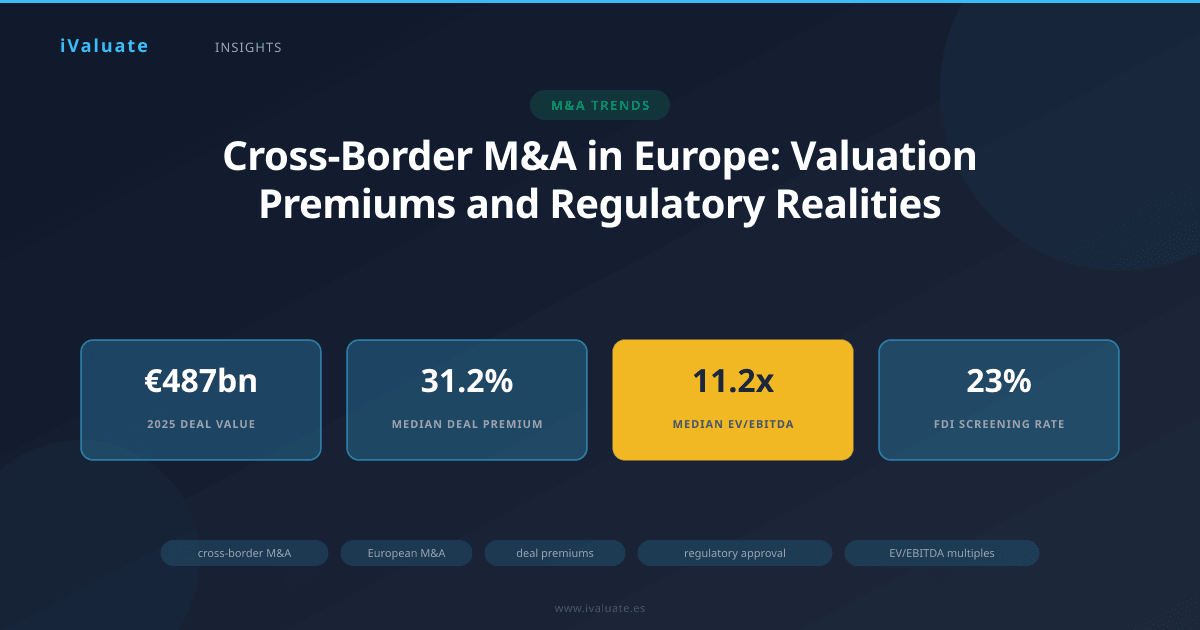
European cross-border M&A activity reached approximately €487 billion across 2,341 transactions in 2025, representing an 18% increase in value from 2024 levels. This resurgence follows two years of subdued activity, during which deal values had contracted by nearly 35% from the 2021 peak of €612 billion. The recovery has been uneven across sectors and geographies, with technology, healthcare, and renewable energy leading transaction volumes while traditional industrials and consumer discretionary sectors lag.
Intra-European deals—transactions between European entities across different jurisdictions—constitute roughly 62% of total cross-border activity by value, with the remaining 38% representing acquisitions by non-European buyers (primarily North American and, increasingly, Middle Eastern investors) or European companies acquiring assets outside the continent. The United Kingdom, despite Brexit-related complexities, remains the most active target market, accounting for 23% of cross-border deal value, followed by Germany (19%), France (14%), and the Netherlands (11%).
Several structural factors are driving this renewed activity:
- Currency dynamics: The euro's relative weakness against the US dollar (trading in the 1.08-1.12 range throughout 2025) has made European assets more attractive to dollar-denominated buyers, particularly US private equity firms and corporates with strong balance sheets.
- Valuation gaps: European public market valuations continue to trade at a discount to US comparables—the STOXX Europe 600 trades at approximately 12.8x forward earnings versus 19.3x for the S&P 500—creating arbitrage opportunities for strategic acquirers.
- Digital transformation imperatives: European companies are aggressively pursuing technology capabilities through M&A, with cross-border technology acquisitions up 34% year-over-year as traditional industrials seek to digitalize operations.
- Energy transition acceleration: The EU's intensified commitment to carbon neutrality by 2050 has catalyzed significant cross-border investment in renewable energy infrastructure, battery technology, and green hydrogen capabilities.
02 Valuation Premiums and Deal Multiples: What Acquirers Are Paying
One of the most significant developments in the current cross-border M&A environment is the persistent elevation of acquisition premiums despite broader market volatility. Analysis of 347 publicly announced cross-border transactions in Europe during 2025 reveals that acquirers paid a median premium of 31.2% over the target's undisturbed share price (measured one day prior to initial rumors or formal announcement). This represents a notable increase from the 26.8% median observed in 2023 and approaches the elevated premium levels last seen in 2021.
The premium structure varies significantly by sector and deal rationale:
- Technology and software: Median premiums of 38-42%, driven by scarcity of high-quality assets and strategic imperative to acquire capabilities quickly
- Healthcare and life sciences: Premiums of 32-36%, reflecting pipeline value and regulatory approval risks
- Industrials and manufacturing: More moderate premiums of 24-28%, with higher premiums paid for businesses with strong ESG credentials or advanced automation capabilities
- Financial services: Premiums of 22-26%, constrained by regulatory capital requirements and integration complexity
From an EV/EBITDA perspective, cross-border transactions in Europe are commanding median multiples of 11.2x for the twelve months ending March 2026, compared to 9.8x for domestic transactions. This 140 basis point premium reflects several factors: cross-border acquirers tend to target higher-quality assets with stronger market positions, international buyers often possess superior cost of capital, and strategic synergies (revenue enhancement, geographic expansion, technology transfer) justify higher valuations.
Breaking down EV/EBITDA multiples by transaction size reveals interesting patterns:
- Megadeals (>€5 billion): Median 10.4x, as larger transactions face greater regulatory scrutiny and integration risk
- Large-cap (€1-5 billion): Median 11.8x, the most competitive segment with multiple bidders common
- Mid-market (€250m-€1 billion): Median 12.1x, benefiting from private equity competition and strategic scarcity
- Lower mid-market (<€250 million): Median 9.7x, with wider dispersion based on growth profile and market position
The valuation premium for cross-border deals reflects not just the target's standalone value, but the acquirer's ability to extract synergies, navigate regulatory complexity, and integrate across jurisdictional boundaries—capabilities that command a price in today's market.
Case Study: Technology Sector Premium Dynamics
Consider the acquisition of a Northern European enterprise software company by a US technology conglomerate in Q3 2025. The target, with €180 million in revenue and €42 million in EBITDA, was acquired for €720 million—representing an EV/EBITDA multiple of 17.1x and a 44% premium to the undisturbed share price. The acquirer justified this valuation based on: (1) revenue synergies from cross-selling into the acquirer's installed base, (2) cost synergies from consolidating R&D functions, and (3) strategic value of the target's AI-powered analytics capabilities. The transaction required regulatory approvals from five jurisdictions and took 11 months to close, yet the acquirer maintained its valuation throughout the process—illustrating the premium strategic buyers will pay for scarce, high-quality technology assets.
03 The Regulatory Gauntlet: Navigating Europe's Approval Landscape
Perhaps no factor has more profoundly reshaped cross-border M&A in Europe than the dramatic expansion and intensification of regulatory review mechanisms over the past three years. What was once primarily an antitrust exercise has evolved into a multi-layered approval process encompassing competition policy, foreign investment screening, sector-specific regulations, and increasingly, national security considerations.
Foreign Direct Investment Screening: The New Frontline
The EU's Foreign Direct Investment (FDI) Screening Regulation, which became fully operational in 2020, has matured into a formidable barrier for certain categories of cross-border transactions. As of 2026, all 27 EU member states have established national FDI screening mechanisms, up from just 14 in 2020. These mechanisms grant governments broad authority to review and potentially block transactions that threaten security, public order, or critical infrastructure.
The scope of "critical" sectors subject to enhanced scrutiny has expanded dramatically:
- Energy infrastructure and renewable energy assets
- Telecommunications networks and 5G/6G technology
- Semiconductor design and manufacturing
- Artificial intelligence and quantum computing
- Space and satellite technology
- Dual-use technologies with civilian and military applications
- Healthcare infrastructure and pharmaceutical manufacturing
- Food security and agricultural technology
In 2025, approximately 23% of cross-border transactions involving non-EU acquirers triggered FDI screening in at least one member state, up from 11% in 2022. The average review period for transactions subject to FDI screening has extended to 4.7 months, with some cases requiring 8-12 months when remedies or mitigation measures are negotiated.
Acquirers from certain jurisdictions face heightened scrutiny. While the EU framework is ostensibly jurisdiction-neutral, practical application reveals that transactions involving Chinese, Russian, and increasingly Middle Eastern buyers receive more intensive review. In 2025, 67% of Chinese acquisitions of European assets above €50 million underwent FDI screening, compared to 31% for US acquirers and 18% for UK acquirers.
Antitrust Review: Evolving Standards and Longer Timelines
The European Commission's Directorate-General for Competition (DG COMP) continues to apply rigorous antitrust analysis to cross-border mergers, with several notable developments in 2025-2026:
Market definition evolution: The Commission has adopted narrower market definitions in digital and technology sectors, making it easier to establish dominance concerns. A transaction that might have cleared in 2020 based on broad market definitions now faces deeper investigation as the Commission focuses on specific product categories and customer segments.
Vertical merger scrutiny: Following several high-profile interventions, the Commission has intensified review of vertical mergers (combinations of companies at different stages of the supply chain). Theories of harm now routinely examine potential foreclosure effects, even in cases where horizontal overlaps are minimal.
Remedies packages: The Commission has become more demanding in remedy negotiations, frequently requiring structural divestitures rather than accepting behavioral commitments. In 2025, 42% of conditionally approved Phase II transactions required divestiture of business units, compared to 28% in 2022.
The statistics are sobering: Phase II investigations (the more intensive review process) were initiated in 3.8% of notified transactions in 2025, up from 2.9% in 2023. The average Phase II investigation now takes 9.2 months from notification to final decision, with complex cases extending beyond 12 months when parties submit remedy proposals.
Sector-Specific Regulations: Banking, Insurance, and Telecoms
Certain sectors face additional layers of regulatory approval beyond general antitrust and FDI screening. Cross-border banking transactions require approval from both home and host country prudential regulators, with the European Central Bank (ECB) playing a central role for eurozone institutions. The ECB's assessment encompasses not just competition concerns but also prudential soundness, governance structures, and the acquirer's ability to provide adequate capital and liquidity support.
In telecommunications, national regulatory authorities retain significant power to review transactions affecting network infrastructure, spectrum holdings, and service provision. A cross-border telecom merger may require approvals from a dozen or more regulatory bodies, each with distinct timelines and substantive requirements.
The regulatory approval process has become a critical value driver in cross-border M&A. Sophisticated acquirers now model regulatory risk as explicitly as they model financial returns, building approval timelines, remedy costs, and termination probabilities into their valuation frameworks.
04 Strategic Implications and Deal Structuring Considerations
The confluence of elevated valuations and intensified regulatory scrutiny has forced material changes in how cross-border transactions are structured, negotiated, and executed.
Reverse Termination Fees and Regulatory Risk Allocation
Reverse termination fees (RTFs)—payments from acquirer to target if the deal fails to receive regulatory approval—have become standard in European cross-border M&A. In 2025, 73% of public company acquisitions above €500 million included RTF provisions, with fees typically ranging from 3.5% to 6.5% of transaction value. These fees compensate target shareholders for the opportunity cost and disruption of a failed transaction while incentivizing acquirers to pursue approvals diligently.
The negotiation of regulatory covenants has become increasingly sophisticated. Acquirers and targets now extensively negotiate:
- The extent of "efforts" obligations (reasonable efforts vs. best efforts vs. hell-or-high-water commitments)
- Limitations on acceptable remedies (e.g., divestitures capped at X% of target revenues)
- Allocation of remedy costs between acquirer and target
- Process obligations for regulatory filings and information sharing
- Termination rights if approvals are not obtained within specified timeframes
Pre-Signing Regulatory Engagement
Leading practitioners now routinely engage with key regulatory authorities before signing definitive agreements. This pre-notification dialogue serves multiple purposes: identifying potential concerns early, gauging the likely review intensity, and establishing relationships with case teams. While informal and non-binding, these conversations can significantly inform deal structure and valuation.
Some acquirers have adopted a "regulatory-first" approach, making signing conditional on receiving preliminary regulatory feedback or even formal approval. While this extends the pre-signing period, it reduces execution risk and can support tighter valuation certainty.
Carve-Out Strategies and Remedy Planning
Sophisticated buyers now develop detailed remedy scenarios during due diligence, identifying business units or assets that could be divested to satisfy regulatory concerns while preserving core deal value. This "remedy-ready" approach accelerates the approval process and demonstrates credible commitment to regulators.
In several 2025 transactions, acquirers pre-identified divestiture buyers and negotiated conditional sale agreements that could be activated if required by regulators. This proactive approach reduced uncertainty and shortened Phase II timelines by an average of 2.3 months compared to transactions where remedy packages were developed reactively.
05 Geographic Hotspots and Sector Trends
The Nordics: Europe's Cross-Border M&A Engine
The Nordic region (Sweden, Denmark, Norway, Finland) has emerged as a particularly active cross-border M&A market, punching well above its weight relative to GDP. Nordic companies' strong positions in technology, life sciences, and clean energy have attracted significant international interest. In 2025, Nordic targets represented 16% of European cross-border deal value despite accounting for only 6% of EU GDP.
Nordic transactions typically command premium valuations—median EV/EBITDA of 12.4x versus 11.2x for broader Europe—reflecting high-quality corporate governance, strong innovation cultures, and attractive growth profiles. Regulatory approval processes in Nordic countries are generally more streamlined than in larger EU economies, with FDI screening focused narrowly on genuine security concerns rather than economic protectionism.
Central and Eastern Europe: The Value Play
Central and Eastern European (CEE) markets present a contrasting dynamic. Cross-border acquisitions in Poland, Czech Republic, Romania, and Hungary typically trade at EV/EBITDA multiples of 8.2-9.6x, reflecting perceived higher political risk, less developed capital markets, and integration complexity. However, these markets offer compelling growth opportunities, particularly in manufacturing, logistics, and business process outsourcing.
Western European and North American acquirers view CEE as a nearshoring destination, acquiring manufacturing and service delivery capabilities that can serve broader European markets at competitive cost structures. This strategic rationale has driven a 27% increase in CEE-focused cross-border M&A in 2025.
Renewable Energy: The Mega-Trend
Cross-border M&A in European renewable energy and clean technology reached €94 billion in 2025, representing 19% of total cross-border deal value—up from just 11% in 2022. This surge reflects the intersection of multiple drivers: aggressive decarbonization targets, energy security concerns following geopolitical disruptions, and massive capital deployment from infrastructure funds and sovereign wealth funds.
Renewable energy transactions present unique valuation challenges. Traditional EBITDA-based multiples are less relevant for project-based businesses; instead, acquirers focus on metrics like enterprise value per megawatt of capacity, levelized cost of energy, and power purchase agreement coverage ratios. Cross-border renewable deals in 2025 traded at median values of €1.2-1.8 million per MW for operational wind assets and €0.9-1.4 million per MW for solar, with significant variation based on geography, offtake agreements, and remaining asset life.
06 The Private Equity Dimension
Private equity firms have been particularly active in European cross-border M&A, accounting for approximately 31% of deal value in 2025. Several factors explain this prominence:
Dry powder deployment pressure: European-focused PE funds are sitting on approximately €287 billion in uncommitted capital, creating intense pressure to deploy at scale. Cross-border acquisitions allow funds to access larger platforms and more attractive assets than purely domestic strategies.
Buy-and-build strategies: PE firms are executing aggressive buy-and-build strategies, using portfolio companies as platforms for cross-border acquisitions. A typical playbook involves acquiring a market leader in one country, then consolidating fragmented markets in adjacent geographies through bolt-on acquisitions. This approach has been particularly effective in business services, healthcare services, and specialty manufacturing.
Valuation arbitrage: PE firms with global mandates can exploit valuation differences across European markets, acquiring assets in lower-multiple markets (Southern and Eastern Europe) and selling to strategic buyers or through IPOs in higher-multiple markets (UK, Germany, Nordics).
However, PE cross-border transactions face unique regulatory challenges. Competition authorities increasingly scrutinize serial acquisitions by PE-backed platforms, concerned about market concentration and reduced competition. In 2025, the European Commission opened in-depth investigations into three PE-backed buy-and-build strategies, examining whether sequential acquisitions that individually fell below notification thresholds collectively raised competition concerns.
07 Looking Ahead: The 2026 Outlook and Strategic Considerations
As we progress through 2026, several trends will likely shape European cross-border M&A activity:
Continued regulatory evolution: The EU is developing new regulations around artificial intelligence, digital markets, and critical raw materials that will create additional approval requirements for certain transactions. Acquirers should anticipate longer, more complex approval processes and build corresponding contingencies into deal structures.
Valuation normalization: While premiums remain elevated, there are early signs of moderation as sellers adjust expectations to reflect higher cost of capital and integration complexity. The median deal premium may compress toward 26-28% by late 2026, particularly in sectors where strategic rationales are less compelling.
Geopolitical fragmentation: Ongoing geopolitical tensions may further complicate cross-border M&A, particularly for transactions involving parties from jurisdictions subject to sanctions or heightened scrutiny. Acquirers will need sophisticated geopolitical risk assessment capabilities and contingency planning for rapidly evolving political landscapes.
Technology and sustainability convergence: The intersection of digital transformation and sustainability will drive significant cross-border M&A activity. Companies that combine technology capabilities with strong ESG credentials will command premium valuations as acquirers seek to address both imperatives simultaneously.
For corporate development teams, private equity professionals, and M&A advisors, success in this environment requires rigorous analytical capabilities, deep regulatory expertise, and sophisticated deal structuring skills. The ability to accurately value cross-border opportunities—incorporating not just financial projections but also regulatory risk, integration complexity, and synergy realization timelines—has become a critical competitive advantage.
Professional valuation platforms like iValuate have become essential tools for practitioners navigating this complexity, enabling rapid scenario analysis, comparable company benchmarking across jurisdictions, and sensitivity testing around key value drivers. As cross-border M&A continues to evolve, the firms and professionals who combine strategic vision with analytical rigor will be best positioned to identify, execute, and create value from these increasingly complex transactions.
In an environment where regulatory approval can take longer than due diligence and valuation premiums reflect both financial and strategic considerations, the ability to model complexity and quantify uncertainty is no longer optional—it's the foundation of successful cross-border M&A.