Table of Contents8 sections
In the high-stakes arena of corporate restructuring, few mechanisms carry as much weight—or generate as much controversy—as the cramdown provision. When a debtor's reorganization plan fails to achieve unanimous creditor approval, bankruptcy courts possess the authority to impose that plan on dissenting classes, provided specific statutory requirements are met. At the heart of these contested proceedings lies valuation: the court must determine what the restructured enterprise is worth, how value should be distributed among stakeholders, and whether the proposed plan meets rigorous legal standards.
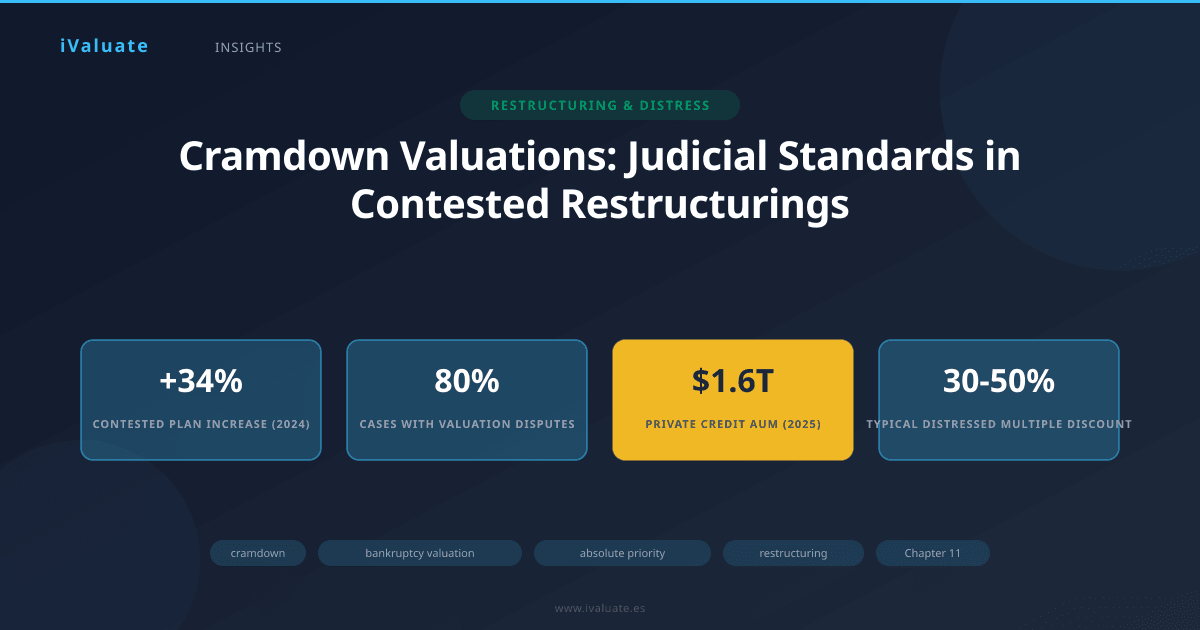
As we navigate the elevated interest rate environment of 2025-2026, cramdown valuations have taken on renewed significance. With the Federal Reserve maintaining benchmark rates in the 4.5-5.0% range and credit spreads widening across leveraged sectors, more companies face balance sheet stress that cannot be resolved through consensual out-of-court agreements. Recent data from the American Bankruptcy Institute indicates that contested plan confirmations increased 34% in 2024 compared to the prior year, with valuation disputes central to nearly 80% of these cases.
01 The Cramdown Framework: Legal Foundation and Economic Reality
The term "cramdown" derives from the bankruptcy court's power to "cram down" a reorganization plan over the objections of one or more impaired classes of creditors or equity holders. Section 1129(b) of the U.S. Bankruptcy Code establishes the framework, requiring that any plan imposed over dissent must be "fair and equitable" and "not discriminate unfairly" against dissenting classes.
These seemingly simple phrases conceal extraordinary complexity. The "fair and equitable" standard encompasses three distinct tests that vary depending on the nature of the dissenting class:
- For secured creditors: The plan must provide the creditor with property having a present value equal to the allowed amount of the claim, or the creditor must retain its lien and receive deferred cash payments totaling at least the allowed secured claim
- For unsecured creditors: The absolute priority rule applies—no junior class may receive or retain any property unless the dissenting class receives full compensation
- For equity holders: Similar absolute priority principles govern, though equity typically receives nothing unless all senior claims are satisfied in full
The valuation challenge emerges immediately: determining "present value" and "full compensation" requires the court to value both the reorganized entity and the specific rights being distributed or retained under the plan. This is not an academic exercise—billions of dollars in recoveries hinge on whether a court accepts a debtor's valuation of $500 million versus a creditor committee's assertion that the enterprise is worth $800 million.
02 The Absolute Priority Rule: Valuation's Most Consequential Application
The absolute priority rule represents one of bankruptcy law's foundational principles: creditors must be paid in full before equity holders receive any distribution. In cramdown proceedings involving unsecured creditor objections, this rule becomes the central battleground, and valuation determines the outcome.
Consider a representative case from 2024: a specialty chemicals manufacturer filed for Chapter 11 with $600 million in secured debt, $400 million in unsecured claims, and equity that had been trading at pennies before the filing. The debtor's plan proposed giving unsecured creditors 60% recovery through a combination of cash and new debt, while existing equity holders would retain 15% of the reorganized company in exchange for contributing $50 million in new capital.
The unsecured creditors' committee objected strenuously, arguing that if the reorganized company was truly worth enough to justify giving equity holders 15%, then unsecured creditors were entitled to 100% recovery before equity received anything. The valuation battle centered on enterprise value: the debtor's investment banker testified to a range of $750-850 million, while the committee's expert asserted $950 million to $1.1 billion.
The court ultimately sided closer to the committee's valuation, finding enterprise value of $925 million. After satisfying the secured debt and administrative claims, this left approximately $250 million in value available for unsecured creditors—representing only 62.5% recovery on their $400 million in claims. The court ruled that equity could not retain any value under the absolute priority rule unless unsecured creditors received full payment. The plan was denied confirmation, forcing the debtor back to the negotiating table.
This case illustrates why valuation precision matters enormously in cramdown proceedings. A $100 million difference in enterprise value determination can mean the difference between equity retaining meaningful ownership or being completely wiped out. For unsecured creditors, it determines whether they recover 60 cents or 90 cents on the dollar.
The New Value Exception: A Narrow Path Around Absolute Priority
The new value exception, recognized in some circuits, provides a limited pathway for equity holders to retain ownership despite not fully satisfying senior claims. Under this doctrine, existing equity may contribute new capital in exchange for ownership in the reorganized entity, provided the contribution is:
- New value in money or money's worth
- Reasonably equivalent to the equity interest received
- Necessary for successful reorganization
- Made available to all potential investors through a market test or auction
Valuation becomes doubly critical here: the court must determine both the enterprise value (to assess whether senior claims are impaired) and the fair value of the equity being distributed (to evaluate whether the new capital contribution is reasonably equivalent). In the current market environment, with private equity firms sitting on record levels of dry powder—estimated at $2.8 trillion globally as of Q1 2025—courts increasingly require robust market testing to validate that existing equity's proposed contribution represents true fair value.
03 The Best Interest Test: Protecting Dissenting Individual Creditors
Even when a class of creditors votes to accept a plan, individual dissenters within that class receive protection through the "best interest of creditors" test under Section 1129(a)(7). This provision requires that each dissenting creditor receive at least as much under the plan as they would receive in a Chapter 7 liquidation.
The best interest test necessitates a liquidation valuation analysis—typically the most conservative valuation approach and one that often yields significantly lower values than going-concern analyses. The valuation professional must estimate:
- Forced-sale values for tangible assets (inventory, equipment, real estate)
- Realizable value of accounts receivable (often 70-85% of book value)
- Recovery on contracts and intellectual property in a liquidation scenario
- Administrative costs of liquidation (trustee fees, legal expenses, asset disposition costs)
In practice, liquidation values typically range from 30% to 60% of going-concern value, though this varies dramatically by industry. A technology company with primarily intangible assets might see liquidation values at 20% of going-concern value, while a real estate holding company might achieve 80% or more.
Recent case law has emphasized that liquidation analysis must reflect current market conditions, not historical precedent. In a 2024 Delaware bankruptcy court decision involving a logistics company, the court rejected the debtor's liquidation analysis that relied on pre-pandemic equipment values. The judge noted that the used truck and trailer market had fundamentally shifted, with values declining 25-30% due to oversupply and reduced freight demand. This required a fresh appraisal and ultimately increased the minimum distribution required to satisfy the best interest test.
04 Feasibility: The Forward-Looking Valuation Challenge
Section 1129(a)(11) requires that plan confirmation is "not likely to be followed by the liquidation, or the need for further financial reorganization." This feasibility requirement forces courts to make prospective judgments about the reorganized debtor's ability to perform under the plan—a fundamentally forward-looking valuation exercise.
Feasibility analysis typically involves:
- Detailed financial projections (typically 5-7 years)
- Sensitivity analysis testing various operating scenarios
- Debt service coverage ratio analysis
- Liquidity and working capital modeling
- Assessment of competitive position and market dynamics
The current macroeconomic environment makes feasibility analysis particularly challenging. With inflation moderating but still above the Federal Reserve's 2% target, interest rates elevated, and recession probabilities fluctuating, courts scrutinize projection assumptions with heightened skepticism. A plan that appeared feasible with 3% revenue growth assumptions may fail the feasibility test if the court finds those projections unrealistic given sector-specific headwinds.
In a notable 2025 retail restructuring, the debtor's plan projected 4-6% same-store sales growth based on planned merchandising improvements and store remodels. The court heard testimony from industry analysts indicating that the broader specialty retail sector was experiencing negative same-store sales growth, with consumer spending shifting toward experiences and away from goods. The court found the projections "aspirational rather than realistic" and denied confirmation, citing feasibility concerns. The debtor was forced to revise projections downward, which in turn reduced the enterprise valuation and necessitated greater concessions to creditors.
The Discount Rate Dilemma in Feasibility Analysis
One of the most contentious technical issues in cramdown valuations involves selecting appropriate discount rates for the reorganized entity. The debtor naturally argues for lower discount rates (producing higher valuations), while objecting creditors advocate for higher rates reflecting risk.
In the 2025-2026 environment, this debate has intensified. Risk-free rates (10-year Treasury yields) have stabilized around 4.2-4.5%, but appropriate equity risk premiums and company-specific risk adjustments remain hotly contested. Courts have generally adopted a middle-ground approach, using weighted average cost of capital (WACC) calculations that reflect:
- The reorganized entity's projected capital structure (not the pre-petition structure)
- Market-based cost of debt reflecting the company's post-reorganization credit profile
- Equity risk premiums in the 6-8% range for middle-market companies
- Company-specific risk adjustments of 2-5% for execution risk, market position, and management quality
A representative WACC for a reorganized middle-market company in 2025 might fall in the 10-13% range, compared to 8-11% in the low-rate environment of 2020-2021. This seemingly modest increase has profound valuation implications—a company with projected free cash flows of $50 million annually in perpetuity would be valued at $500 million using a 10% discount rate, but only $385 million using a 13% rate. That $115 million difference often determines whether a plan can be confirmed over creditor objections.
05 Valuation Methodologies in Cramdown Proceedings
Courts generally expect valuation experts to employ multiple methodologies and triangulate to a reasonable value conclusion. The three primary approaches—income, market, and asset-based—each carry different weight depending on the debtor's circumstances.
Discounted Cash Flow Analysis: The Dominant Approach
The income approach, typically implemented through discounted cash flow (DCF) analysis, receives the greatest weight in most cramdown proceedings. This reflects the going-concern premise underlying Chapter 11—the company will continue operating and generating cash flows. The DCF methodology involves:
- Projecting unlevered free cash flows for a discrete period (typically 5-7 years)
- Estimating terminal value using either a perpetuity growth method or exit multiple
- Discounting all cash flows to present value using WACC
- Adjusting for excess assets, non-operating items, and debt-like obligations
Courts scrutinize every assumption. Revenue growth rates must be supported by market analysis, customer contracts, and industry trends. EBITDA margins must reflect realistic operating improvements, not wishful thinking. Capital expenditure requirements must align with the business plan. Terminal growth rates—often the single most influential assumption—must be conservative and defensible.
In a 2024 manufacturing case, the debtor's DCF used a 3.5% terminal growth rate, arguing it reflected long-term GDP growth plus modest inflation. The creditors' expert countered that the specific industry had experienced structural decline, with volumes decreasing 1-2% annually for the past decade. The court adopted a 1.5% terminal growth rate, reducing enterprise value by approximately 18% and fundamentally altering the distribution waterfall.
Market Multiples: Anchoring to Observable Transactions
The market approach provides an important reality check on DCF valuations. Courts favor comparable company analysis and precedent transaction analysis because they reflect actual market prices rather than theoretical projections.
However, finding truly comparable companies or transactions presents challenges, particularly for distressed businesses. A company in bankruptcy typically trades at a discount to healthy peers, but quantifying that discount requires judgment. Recent market data suggests distressed company multiples trade 30-50% below healthy peer medians, though this varies by sector and specific circumstances.
As of early 2025, middle-market enterprise value to EBITDA multiples have compressed from 2021-2022 peaks, with median multiples in the 8-10x range for quality businesses, down from 11-13x during the SPAC boom. Distressed companies achieving successful reorganizations typically see exit multiples in the 5-7x range, reflecting both operational challenges and capital structure risk.
Asset-Based Approaches: The Floor Value
While less commonly determinative in going-concern cramdown valuations, asset-based approaches establish a floor value and inform liquidation analysis for the best interest test. This approach involves valuing individual assets and liabilities on the balance sheet, adjusted to fair market value.
For asset-intensive businesses—real estate companies, equipment lessors, natural resource firms—the asset approach may carry significant weight. For service businesses or companies with primarily intangible value, it serves mainly to establish the liquidation alternative.
06 Recent Trends and Emerging Issues
Several developments in the 2024-2025 restructuring cycle warrant attention from valuation professionals and restructuring advisors.
Increased Judicial Scrutiny of Management Projections
Courts have grown increasingly skeptical of debtor-prepared projections, particularly when those projections show dramatic improvement from pre-petition performance. Multiple recent decisions have noted that companies rarely "restructure their way to prosperity" and that projections must reflect realistic operational capabilities, not aspirational targets.
This skepticism has led to greater reliance on independent financial advisors and more extensive cross-examination of projection assumptions. Creditors' committees routinely retain their own valuation experts, and courts increasingly appoint independent examiners or fee examiners when valuation disputes appear intractable.
The Rise of Valuation Litigation and Expert Battles
As stakes have increased, so has the sophistication and intensity of valuation disputes. It is now common for major Chapter 11 cases to feature multiple expert witnesses, extensive discovery into projection methodologies, and detailed Daubert challenges to expert qualifications and methodologies.
Expert witness fees in contested cramdown proceedings can easily exceed $500,000 to $1 million per side, with total professional fees in major cases reaching tens of millions of dollars. This reality has created pressure for alternative dispute resolution mechanisms, including court-appointed neutral valuation experts or structured settlement negotiations.
Private Credit and Non-Traditional Capital Structures
The explosive growth of private credit—with an estimated $1.6 trillion in assets under management globally as of 2025—has complicated cramdown valuations. Private credit facilities often feature complex payment-in-kind provisions, multiple debt tranches with varying seniority, and embedded equity features that blur traditional distinctions between debt and equity.
Valuing these hybrid instruments requires sophisticated option pricing models and careful analysis of contractual terms. Courts have struggled with how to classify certain private credit instruments for purposes of absolute priority analysis, with some instruments receiving treatment as debt for some purposes and equity for others.
07 Practical Implications for Restructuring Professionals
For CFOs, restructuring advisors, and creditor representatives navigating cramdown proceedings, several practical lessons emerge from recent case law and market practice:
Start with realistic projections. Aggressive projections may seem advantageous initially but create credibility problems that undermine the entire case. Courts have long memories for failed projections, and judges frequently reference prior cases where similar optimism proved unfounded.
Invest in robust valuation analysis early. Waiting until plan confirmation to develop detailed valuation support is a recipe for delays and unfavorable outcomes. Sophisticated parties develop comprehensive valuation analyses during the plan negotiation phase, allowing them to identify areas of agreement and focus disputes on genuine disagreements rather than analytical gaps.
Consider market testing mechanisms. When valuation disputes appear intractable, structured auction processes or rights offerings can provide market-based validation that courts find persuasive. A well-designed auction that produces no higher bids than the plan valuation provides powerful evidence supporting confirmation.
Document assumptions thoroughly. Every material assumption in a valuation analysis should be supported by specific evidence—market studies, customer contracts, industry reports, management interviews, or historical performance. Generic assertions about "industry growth" or "operational improvements" will not withstand cross-examination.
Key Takeaway: In cramdown proceedings, valuation is not merely a technical exercise—it is the central determinant of how billions of dollars in value are allocated among competing stakeholders. Courts demand rigorous, well-supported analyses that reflect current market realities and realistic operational expectations.
08 Looking Ahead: Valuation in an Uncertain Environment
As we progress through 2025 and into 2026, several macroeconomic and market factors will continue shaping cramdown valuations. The persistence of elevated interest rates, even as inflation moderates, means that discount rates will remain higher than the 2010-2021 period, compressing valuations across the board. Geopolitical uncertainty, supply chain reconfiguration, and technological disruption add layers of complexity to projection development and risk assessment.
The restructuring pipeline remains robust, with particular stress visible in commercial real estate, certain retail segments, and companies that over-levered during the low-rate environment. Each of these situations will require careful, context-specific valuation analysis that accounts for sector dynamics, competitive positioning, and realistic operational capabilities.
For professionals navigating these complex proceedings, the combination of legal standards, financial analysis, and practical judgment required in cramdown valuations represents one of the most intellectually demanding aspects of restructuring work. Success requires not only technical valuation expertise but also deep understanding of bankruptcy law, negotiation dynamics, and the practical realities of operating distressed businesses.
Modern valuation platforms have emerged to support this work, allowing professionals to develop sophisticated financial models, perform sensitivity analyses, and generate court-ready valuation reports more efficiently than traditional spreadsheet-based approaches. Tools like iValuate enable restructuring teams to quickly test multiple scenarios, compare methodologies, and produce defensible valuation analyses that can withstand judicial scrutiny—critical capabilities when billions of dollars and stakeholder recoveries hang in the balance.
Ultimately, cramdown valuations represent the intersection of law, finance, and business judgment. As courts continue refining standards and market conditions evolve, the professionals who combine technical rigor with practical wisdom will be best positioned to navigate these high-stakes proceedings and achieve optimal outcomes for their clients.