Table of Contents12 sections
Valuing companies in emerging markets presents one of the most challenging aspects of corporate finance: how to accurately quantify and incorporate country-specific risks into discount rates. While developed market valuations can rely on relatively stable assumptions about political stability, currency convertibility, and regulatory frameworks, emerging market valuations require sophisticated adjustments to reflect heightened sovereign risk, political uncertainty, and macroeconomic volatility.
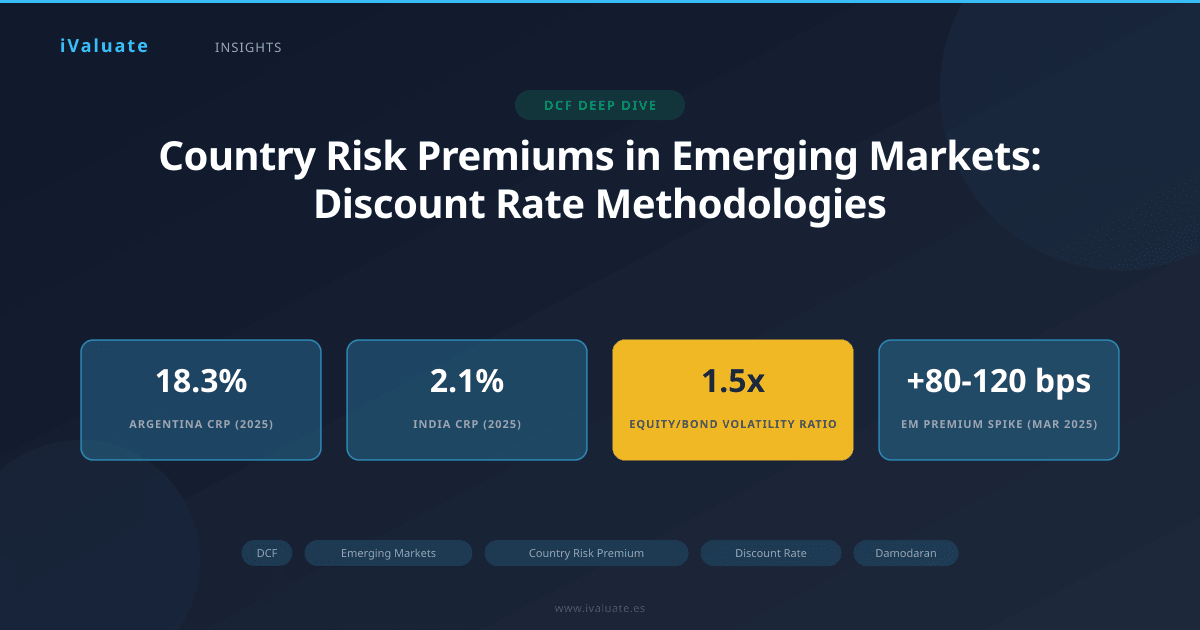
As of early 2025, the dispersion in country risk premiums across emerging markets has widened significantly. While India's premium hovers around 2.1%, Argentina's exceeds 18%, and Turkey's stands at approximately 7.8%. These differentials have profound implications for valuation outcomes—a company generating identical cash flows could theoretically be worth 40-60% less when domiciled in a high-risk jurisdiction versus a lower-risk emerging economy.
This article examines the rigorous methodologies professionals employ to adjust discount rates for country risk, explores the theoretical underpinnings and practical limitations of each approach, and provides guidance on selecting appropriate frameworks for different valuation contexts.
01 The Theoretical Foundation: Why Country Risk Matters
Country risk premium (CRP) represents the additional return investors demand for exposure to risks specific to a particular nation that cannot be diversified away in a global portfolio. Unlike company-specific risks, which can theoretically be eliminated through diversification, country risks—including expropriation, currency controls, sovereign default, political instability, and regulatory unpredictability—affect all assets within a jurisdiction simultaneously.
The academic debate around country risk centers on whether these risks are systematic (non-diversifiable) or unsystematic (diversifiable). Traditional finance theory suggests that globally diversified investors should not demand compensation for country-specific risks they can diversify away. However, empirical evidence consistently shows that emerging market equities trade at discounts that cannot be explained by fundamental factors alone, suggesting markets do price in a country risk premium.
Several factors explain this apparent contradiction. First, many investors face constraints on international diversification due to regulatory restrictions, home bias, or investment mandates. Second, country risks often correlate with global systematic factors—emerging markets tend to suffer disproportionately during global downturns. Third, the costs of financial distress in emerging markets can be substantially higher due to weaker legal frameworks and less developed restructuring mechanisms.
02 The Sovereign Spread Method: Building on Government Debt
The most widely adopted approach for estimating country risk premiums builds upon sovereign credit spreads—the additional yield investors demand to hold a country's government bonds over risk-free benchmarks. This methodology, extensively developed and refined by Aswath Damodaran of NYU Stern, provides a market-based, observable starting point for country risk assessment.
Core Methodology
The sovereign spread method begins with the yield differential between a country's U.S. dollar-denominated sovereign bonds and comparable-maturity U.S. Treasury securities. For example, as of January 2025, Brazil's 10-year dollar bonds yield approximately 6.8%, compared to 4.2% for 10-year U.S. Treasuries, implying a sovereign spread of 260 basis points.
However, this spread reflects default risk on bonds, not equity risk. To convert this to an equity risk premium, practitioners apply a volatility adjustment based on the relative volatility of equity versus bond markets:
Country Risk Premium = Sovereign Spread × (σequity / σbond)
Where σ represents the standard deviation of returns. Historically, equity market volatility exceeds bond market volatility by a factor of 1.3 to 1.8 in emerging markets, though this ratio varies by country and time period. Using a conservative multiplier of 1.5, Brazil's equity country risk premium would be approximately 390 basis points (2.60% × 1.5).
Practical Implementation Considerations
Several technical decisions significantly impact the resulting premium. First, practitioners must select appropriate sovereign bonds—ideally liquid, dollar-denominated issues with maturities matching the valuation horizon (typically 10 years). Local currency bonds introduce currency risk that conflates with sovereign risk, making interpretation more complex.
Second, the equity-to-bond volatility ratio requires careful estimation. Some practitioners use historical volatility ratios, while others employ implied volatilities from options markets where available. The ratio itself varies across market cycles—during the 2025 market turbulence, this ratio spiked to over 2.0 for several Latin American markets as equity volatility surged while bond markets remained relatively stable.
Third, for countries without liquid dollar-denominated sovereign debt, practitioners often use synthetic spreads based on sovereign credit ratings. Rating agencies publish default spread tables mapping credit ratings to typical spreads. For instance, a Ba2/BB rated sovereign might correspond to a 350-basis-point spread in current market conditions.
A critical insight: The sovereign spread method assumes that equity investors face the same country risks as bondholders, scaled by relative volatility. This assumption holds reasonably well for risks like expropriation, currency controls, and sovereign default, but may understate risks specific to equity holders, such as discriminatory taxation or regulatory changes targeting specific sectors.
03 The Damodaran Country Risk Premium Database
Aswath Damodaran maintains the most comprehensive and widely-referenced database of country risk premiums, updated annually and available publicly. As of January 2025, his database covers 186 countries, providing both total equity risk premiums and country-specific premiums.
Damodaran's methodology synthesizes multiple data sources. For countries with liquid sovereign debt markets, he uses market-based spreads. For others, he relies on credit default swap (CDS) spreads or synthetic spreads derived from sovereign ratings. He then applies country-specific equity volatility adjustments rather than a uniform multiplier.
The 2025 database reveals several notable patterns. Mature emerging markets like South Korea (0.9%), Taiwan (1.1%), and Chile (1.4%) carry premiums only marginally above developed markets. Large emerging economies show moderate premiums: China (2.3%), India (2.1%), and Mexico (2.8%). High-risk markets command substantial premiums: Venezuela (24.5%), Lebanon (19.2%), and Argentina (18.3%).
Practitioners should note that these premiums fluctuate with market conditions. During the March 2025 emerging market selloff triggered by unexpected Federal Reserve hawkishness, average emerging market premiums spiked by 80-120 basis points before partially recovering. This volatility underscores the importance of using current data and considering whether observed spreads reflect temporary dislocations or fundamental reassessments of risk.
04 Alternative Methodologies: Strengths and Limitations
The Equity Risk Premium Survey Approach
Some practitioners prefer direct estimation through surveys of institutional investors or analysis of equity market returns. This approach asks: what additional return do equity investors actually demand for emerging market exposure?
Academic studies examining realized returns in emerging markets suggest country risk premiums ranging from 3% to 8% above developed markets, varying by region and time period. However, this backward-looking approach suffers from survivorship bias—countries that experienced the worst outcomes (hyperinflation, expropriation, market closures) often disappear from datasets, understating true risk.
Forward-looking surveys, such as those conducted by major investment banks, provide current market expectations but introduce subjectivity and potential anchoring biases. The January 2025 Goldman Sachs emerging market survey indicated average expected excess returns of 4.2% over developed markets, broadly consistent with sovereign spread-based estimates.
The Relative Standard Deviation Method
An alternative approach scales the U.S. equity risk premium by the ratio of emerging market to U.S. equity volatility:
CRP = U.S. ERP × [(σEM / σUS) - 1]
If U.S. equity volatility is 18% and Brazilian equity volatility is 32%, this method would suggest a country risk premium of 78% of the U.S. equity risk premium. Assuming a 5.5% U.S. premium, Brazil's CRP would be approximately 4.3%.
This approach has intuitive appeal but faces criticism for potentially double-counting risk. If higher volatility already reflects country-specific risks, using it to calculate an additional premium may overstate required returns. Additionally, volatility ratios can be unstable, particularly during crisis periods when correlations shift.
The Political Risk Rating Approach
Organizations like the PRS Group, Economist Intelligence Unit, and World Bank publish political risk indices scoring countries on factors including government stability, corruption, law and order, and bureaucratic quality. Some practitioners map these scores to country risk premiums through regression analysis or expert judgment.
For example, a practitioner might establish that countries in the top quartile of political risk scores warrant a 1-2% premium, while bottom quartile countries justify 8-12% premiums. This approach offers granularity and incorporates qualitative factors difficult to capture in market spreads, but introduces subjectivity in the mapping from scores to premiums.
The 2025 World Bank Governance Indicators show interesting divergences from market-based premiums. Vietnam scores poorly on political risk indices but enjoys relatively low market-based premiums (2.4%), suggesting investors focus more on economic stability and growth prospects than political freedoms. Conversely, South Africa scores reasonably well on governance but faces elevated premiums (4.1%) due to fiscal concerns and infrastructure challenges.
05 Sector and Company-Specific Adjustments
A sophisticated approach recognizes that country risk exposure varies across sectors and companies. A domestic retailer faces full country risk exposure—its revenues, costs, and asset values all depend on local economic conditions. Conversely, a mining company exporting commodities to global markets faces different risk profiles.
The Lambda Approach
Damodaran introduced the lambda (λ) coefficient to adjust country risk premiums for company-specific exposure:
Company CRP = λ × Country CRP
Where λ ranges from 0 (no country risk exposure) to 1 (full exposure). Determining λ requires judgment based on:
- Revenue geography: Companies deriving revenues primarily from exports to developed markets warrant lower λ values (0.3-0.5)
- Operating leverage: Companies with significant local fixed costs face higher exposure (λ = 0.8-1.0)
- Asset tangibility: Companies with easily relocatable assets or intellectual property may face lower expropriation risk (λ = 0.5-0.7)
- Government relationship: State-owned enterprises or companies in strategic sectors may face heightened political risk (λ = 1.0-1.2)
Consider a Brazilian aircraft manufacturer with 85% of revenues from exports, minimal local debt, and operations that could theoretically relocate. A practitioner might assign λ = 0.4, reducing the effective country risk premium from 3.9% to 1.6%. Conversely, a Turkish bank with purely domestic operations and significant sovereign bond holdings might warrant λ = 1.2, increasing the effective premium from 7.8% to 9.4%.
Case Study: Valuing an Indian Technology Services Firm
An Indian IT services company with 75% of revenues from North American clients, 15% from Europe, and 10% domestic presents an interesting case. While domiciled in India (CRP ≈ 2.1%), its primary risks relate to client relationships, competition, and technology disruption rather than Indian political or economic instability.
A rigorous analysis might conclude:
- Revenue risk: Largely independent of India-specific factors (λrevenue = 0.2)
- Operating cost risk: Significant exposure to Indian wage inflation and rupee volatility (λcost = 0.7)
- Regulatory risk: Moderate exposure to Indian tax policy and data localization requirements (λregulatory = 0.5)
- Repatriation risk: Minimal given strong foreign exchange reserves and current account position (λrepatriation = 0.3)
Weighting these factors by their impact on value, the practitioner might conclude λ = 0.4, implying an effective country risk premium of 0.84% rather than the full 2.1%. This adjustment can materially impact valuation—for a company with a base discount rate of 9%, the difference between 9.84% and 11.1% translates to approximately 11% higher valuation.
06 Currency Considerations and the Consistency Principle
A critical but often mishandled aspect of emerging market valuation involves maintaining consistency between cash flow currency and discount rate. The fundamental principle: cash flows and discount rates must be denominated in the same currency.
Local Currency Valuation
When projecting cash flows in local currency, the discount rate should reflect local currency required returns. This requires adding expected inflation differential to the base discount rate:
rlocal = rUSD + E(inflationlocal) - E(inflationUSD)
For a Brazilian company valued in reais, if the USD-based discount rate is 12% (including country risk premium), Brazilian inflation expectations are 4.5%, and U.S. inflation expectations are 2.3%, the real-denominated discount rate would be approximately 14.2%.
This approach offers advantages when local currency cash flows are more predictable or when exchange rate forecasting introduces excessive uncertainty. However, it requires careful inflation forecasting and can produce misleading results if inflation expectations change materially during the valuation period.
Dollar Valuation with Exchange Rate Forecasts
Alternatively, practitioners can project local currency cash flows, convert them to dollars using forecasted exchange rates, and discount at dollar-based rates. This approach makes currency assumptions explicit but introduces exchange rate forecasting risk.
The two approaches should theoretically yield identical results if exchange rates move according to purchasing power parity. In practice, exchange rates deviate substantially from PPP predictions, particularly over short to medium horizons. The Argentine peso, for instance, depreciated 95% against the dollar from 2018 to 2024, far exceeding inflation differentials.
Best practice: Perform valuations using both approaches and investigate significant discrepancies. Material differences often reveal inconsistent assumptions about inflation, exchange rates, or real growth rates that require reconciliation.
07 Temporal Dynamics: When Country Risk Premiums Change
Country risk premiums are not static. Political transitions, fiscal crises, commodity price shocks, and changes in global risk appetite all drive premium fluctuations. Sophisticated practitioners consider whether current premiums reflect temporary dislocations or fundamental shifts.
The 2025 market environment illustrates this challenge. Several emerging markets experienced premium compression in late 2024 as global growth stabilized and commodity prices strengthened. However, the March 2025 Federal Reserve surprise triggered sharp widening. For valuations conducted during this period, practitioners faced difficult judgments about whether 350-basis-point spreads for certain credits reflected fair long-term premiums or temporary market stress.
Terminal value calculations present particular challenges. Should the terminal period discount rate reflect current elevated premiums or normalize to historical averages? A company valued at the peak of a crisis using temporarily elevated discount rates may appear significantly undervalued once spreads normalize.
One approach involves scenario analysis with multiple premium assumptions. A base case might use current market-implied premiums, while alternative scenarios explore normalized premiums based on historical averages or fundamental country risk assessments. This provides a valuation range acknowledging premium uncertainty rather than false precision from a single point estimate.
08 Regulatory and Tax Considerations
Country risk manifests not only through macroeconomic instability but also through regulatory unpredictability and discriminatory taxation. These factors may warrant additional adjustments beyond standard country risk premiums.
Consider the 2024-2025 experience in several emerging markets. Indonesia implemented unexpected nickel export restrictions, stranding investments in processing facilities. India introduced retroactive tax assessments on certain technology transactions. Turkey imposed mandatory local partnership requirements in specific sectors. These regulatory risks disproportionately affect certain industries and may not be fully captured in sovereign spreads.
For companies in regulated industries (telecommunications, banking, utilities) or those dependent on government contracts or concessions, practitioners should consider supplemental risk adjustments. This might involve increasing the lambda coefficient, adding a regulatory risk premium (50-200 basis points depending on sector and country), or incorporating explicit regulatory change scenarios in cash flow projections.
09 Integration with Other Valuation Adjustments
Country risk premiums represent just one component of emerging market valuation adjustments. Practitioners must also consider:
- Illiquidity discounts: Many emerging market companies trade in less liquid markets, warranting 5-15% discounts for minority stakes
- Corporate governance adjustments: Weaker shareholder protections and higher agency costs may justify additional discounts of 10-25%
- Size premiums: Smaller companies in emerging markets face disproportionate challenges accessing capital and weathering downturns
- Control premiums: Conversely, controlling stakes may command premiums of 20-40% given the ability to influence governance and strategic decisions
The challenge lies in avoiding double-counting. If country risk premiums already reflect governance concerns and illiquidity, applying separate adjustments overstates risk. Best practice involves clearly documenting which risks each adjustment addresses and ensuring comprehensive but non-overlapping coverage.
10 Practical Workflow for Emerging Market Valuations
Based on two decades of emerging market valuation experience, I recommend the following systematic approach:
- Establish the base discount rate: Begin with the risk-free rate (typically 10-year U.S. Treasury yield, currently 4.2%) and add the U.S. equity risk premium (5.0-5.5% based on current market conditions)
- Determine country risk premium: Use current sovereign spreads adjusted for equity volatility, cross-referenced against Damodaran's database and recent CDS spreads. For major emerging markets, this data is readily available; for frontier markets, synthetic spreads based on ratings may be necessary
- Assess company-specific exposure: Calculate lambda based on revenue geography, operating leverage, asset mobility, and sector-specific political risks. Document the rationale for the chosen coefficient
- Add company-specific risk premium: Incorporate beta (typically 0.8-1.4 for emerging market companies) and any size or liquidity premiums not captured in country risk
- Verify currency consistency: Ensure cash flow currency matches discount rate currency, adjusting for inflation differentials if necessary
- Perform sensitivity analysis: Test valuation sensitivity to ±100-200 basis point changes in country risk premium and ±0.2 changes in lambda
- Cross-check with market multiples: Compare implied valuation multiples with comparable companies in similar and different risk jurisdictions to identify potential inconsistencies
11 The Role of Technology in Country Risk Assessment
Modern valuation platforms increasingly incorporate real-time country risk data, automating much of the premium calculation and adjustment process. Tools like iValuate integrate current sovereign spreads, CDS data, and equity volatility metrics, allowing practitioners to generate current country risk premiums instantly rather than manually compiling data from multiple sources.
These platforms also facilitate scenario analysis, enabling rapid recalculation of valuations under different country risk assumptions. For firms conducting regular valuations across multiple emerging markets, this automation ensures consistency, reduces manual errors, and allows professionals to focus on judgment-intensive aspects like lambda determination and qualitative risk assessment rather than data gathering.
12 Looking Forward: Country Risk in 2025-2026
Several trends will likely shape country risk premiums over the coming 18-24 months. First, the divergence between emerging markets will likely persist and potentially widen. Countries with strong fiscal positions, diversified economies, and stable institutions (Poland, South Korea, Chile) may see premiums compress toward developed market levels. Conversely, countries facing fiscal stress, political instability, or commodity dependence (Argentina, Turkey, Nigeria) may experience sustained elevated premiums.
Second, climate transition risks are increasingly influencing country risk assessments. Emerging markets heavily dependent on fossil fuel exports face long-term structural challenges that may not yet be fully reflected in current premiums. Conversely, countries positioned to benefit from critical mineral production or renewable energy deployment may see risk reassessments in the opposite direction.
Third, geopolitical fragmentation and supply chain restructuring continue reshaping country risk profiles. Countries perceived as reliable partners in "friend-shoring" strategies (Vietnam, Mexico, India) may enjoy risk premium compression despite governance challenges, while those caught in geopolitical crosscurrents face heightened uncertainty.
For valuation professionals, these dynamics underscore the importance of dynamic, forward-looking country risk assessment rather than mechanical application of historical premiums. The most rigorous valuations will combine quantitative market-based measures with qualitative assessment of country-specific trajectories and company-specific exposure factors.
As emerging markets continue to represent an increasing share of global economic activity and investment opportunities, mastering these country risk premium methodologies becomes not merely a technical skill but a fundamental competency for corporate finance professionals. Whether you're valuing acquisition targets, assessing investment opportunities, or conducting portfolio company valuations, the frameworks outlined here provide the foundation for defensible, market-consistent discount rate estimation in complex cross-border contexts. Platforms like iValuate help professionals apply these sophisticated methodologies efficiently, ensuring valuations reflect both theoretical rigor and current market realities.