Table of Contents10 sections
When a buyer acquires a controlling interest in a company, they typically pay significantly more per share than the current trading price for publicly traded firms, or more than the proportionate value of a minority stake in private companies. This additional payment—the control premium—reflects the tangible economic value of control rights: the ability to direct strategy, appoint management, declare dividends, approve acquisitions, and ultimately determine the company's destiny.
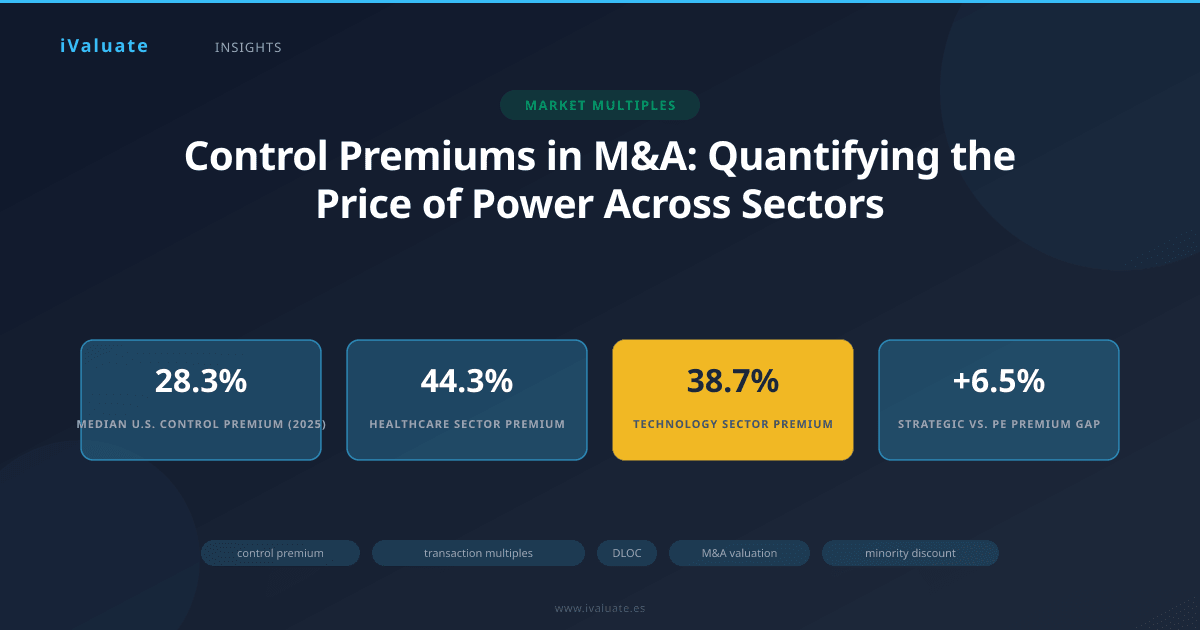
In 2025-2026, control premiums have remained stubbornly persistent despite increased regulatory scrutiny and market volatility. Recent data from FactSet and S&P Capital IQ indicates median control premiums of 28.3% for U.S. public company acquisitions in 2025, measured as the percentage difference between the offer price and the target's stock price one day prior to announcement. However, this headline figure masks substantial variation across industries, deal structures, and market conditions.
For valuation professionals, accurately quantifying control premiums is not merely an academic exercise—it directly impacts fairness opinions, purchase price allocations, financial reporting under ASC 805 and IFRS 3, tax planning, and litigation support. The inverse concept, the discount for lack of control (DLOC), is equally critical when valuing minority interests in private companies or estimating the fair value of non-controlling stakes for financial reporting purposes.
01 The Economic Foundation of Control Premiums
Control premiums exist because control shareholders can extract value that minority shareholders cannot. These value-creation opportunities fall into several categories:
- Strategic redirection: The ability to pivot business models, enter or exit markets, and reallocate capital to higher-return opportunities
- Operational improvements: Implementing cost reductions, efficiency gains, and performance management systems that existing management may resist
- Synergy realization: Capturing revenue synergies through cross-selling, market expansion, or cost synergies through economies of scale and elimination of redundancies
- Financial restructuring: Optimizing capital structure, dividend policy, and tax strategies
- Asset redeployment: Selling underperforming divisions, monetizing non-core assets, or pursuing sale-leaseback transactions
- Governance changes: Eliminating conflicts of interest, related-party transactions, or excessive compensation that may benefit insiders at the expense of enterprise value
The magnitude of the control premium in any specific transaction reflects the buyer's assessment of these value-creation opportunities, competitive dynamics in the auction process, and the target's existing operational efficiency. A well-run company operating at peak efficiency will command a lower control premium than a mismanaged firm with obvious improvement opportunities.
02 Measuring Control Premiums: Methodologies and Data Sources
Valuation professionals employ several approaches to quantify control premiums, each with distinct advantages and limitations:
Transaction-Based Analysis
The most direct method examines actual M&A transactions, comparing the acquisition price to the target's unaffected market price (for public companies) or to minority interest transactions in the same company (for private firms). The calculation is straightforward:
Control Premium = [(Transaction Price per Share - Unaffected Price per Share) / Unaffected Price per Share] × 100
The critical question is determining the "unaffected" price—the market price before any takeover speculation. Industry practice typically uses the closing price one day, one week, or four weeks prior to the announcement, depending on whether rumors preceded the formal announcement. In 2025, with social media and algorithmic trading accelerating information dissemination, the one-day prior price has become the most reliable benchmark.
Major data providers track these premiums systematically. According to Mergermarket data for 2025, median premiums measured one day prior to announcement were:
- All U.S. transactions: 28.3%
- All European transactions: 31.7%
- All Asia-Pacific transactions: 24.1%
These geographic variations reflect differences in corporate governance structures, minority shareholder protections, and market liquidity.
Restricted Stock Studies
An alternative approach examines transactions in restricted (non-marketable) shares of publicly traded companies. The difference between the restricted stock price and the freely traded stock price reflects the combined effect of lack of marketability and lack of control. While this method provides market-based evidence, disentangling the control component from the marketability component requires additional assumptions and analysis.
Pre-IPO Studies
Comparing pre-IPO transaction prices to the eventual IPO price offers another data point, though this method conflates multiple factors including market timing, growth trajectories, and the marketability discount that disappears at IPO.
03 Sector-Specific Control Premium Patterns
Control premiums vary dramatically across industries, reflecting sector-specific value creation opportunities, regulatory constraints, and competitive dynamics. Analysis of 2024-2025 transaction data reveals clear patterns:
Technology and Software (Median Premium: 35-45%)
Technology companies consistently command among the highest control premiums. In 2025, software acquisitions averaged 38.7% premiums, driven by several factors. Technology firms often have significant unrealized value in intellectual property, customer relationships, and data assets that acquirers can monetize more effectively. Strategic buyers can integrate acquired technologies into broader platforms, cross-sell to existing customer bases, and eliminate duplicate R&D spending.
A representative 2025 example: when a major cloud infrastructure provider acquired a mid-sized cybersecurity firm, the 42% premium reflected not just the target's standalone value but the acquirer's ability to embed the security technology across its entire product suite, potentially reaching 100x more customers than the target could access independently.
Healthcare and Pharmaceuticals (Median Premium: 40-50%)
Healthcare transactions, particularly in pharmaceuticals and biotechnology, often exhibit the highest control premiums. The 2025 median of 44.3% for healthcare deals reflects the binary nature of drug development, where controlling shareholders can make critical decisions about clinical trial designs, regulatory strategies, and partnership structures that dramatically affect value.
Pharmaceutical acquirers pay substantial premiums to gain control over promising drug pipelines, redirect development priorities, and leverage their superior regulatory expertise and commercial infrastructure. A notable 2025 transaction saw a large pharma company pay a 51% premium for a biotech firm with three Phase II assets, valuing control rights that would allow acceleration of the most promising candidate while potentially shelving or out-licensing the others.
Financial Services (Median Premium: 25-32%)
Banks and financial institutions typically trade at lower control premiums, averaging 27.8% in 2025. Heavily regulated financial institutions offer fewer opportunities for dramatic operational overhauls, and regulatory approval processes constrain aggressive post-acquisition changes. However, premiums increase substantially when acquirers can achieve significant cost synergies through branch consolidation, technology platform integration, and back-office elimination.
Regional bank consolidation in 2025 demonstrated this pattern, with premiums ranging from 22% for straightforward market expansion deals to 35% for transactions where substantial branch overlap enabled aggressive cost reduction.
Industrial and Manufacturing (Median Premium: 22-30%)
Industrial companies averaged 26.4% premiums in 2025, reflecting moderate opportunities for operational improvement and synergy realization. Manufacturing businesses with significant capital investments and established processes offer less dramatic transformation potential than asset-light technology firms, but strategic buyers can still capture value through supply chain optimization, capacity rationalization, and procurement synergies.
Consumer and Retail (Median Premium: 30-38%)
Consumer-facing businesses commanded 33.2% median premiums in 2025, with significant variation based on brand strength and digital maturity. Traditional retailers with underutilized digital capabilities attracted higher premiums from acquirers who could accelerate e-commerce transformation. Conversely, digitally native brands with limited physical presence attracted premiums from traditional retailers seeking to enhance their omnichannel capabilities.
Energy and Utilities (Median Premium: 18-25%)
Regulated utilities and energy infrastructure assets traded at the lowest premiums in 2025, averaging just 21.3%. Rate-regulated utilities offer limited opportunities for operational improvements beyond regulatory-approved returns, constraining control value. However, premiums increased for renewable energy assets where controlling shareholders could optimize tax equity structures, accelerate development pipelines, and capture economies of scale in operations and maintenance.
04 The Discount for Lack of Control (DLOC): The Mirror Image
When valuing minority interests, appraisers apply a discount for lack of control to reflect the absence of control rights. The mathematical relationship between control premiums and DLOC is not simply inverse due to the base effect:
DLOC = [Control Premium / (1 + Control Premium)] × 100
For example, a 30% control premium translates to a 23.1% DLOC, not 30%. This distinction matters significantly in valuation contexts.
In private company valuations, determining the appropriate DLOC requires careful analysis of several factors:
- Shareholder agreement provisions: Tag-along rights, drag-along rights, and put options can significantly reduce the economic impact of minority status
- Board representation: Minority shareholders with board seats exercise more influence than those without
- Protective provisions: Veto rights over major decisions (acquisitions, financings, asset sales) reduce the control premium attributable to majority shareholders
- Distribution policies: Established dividend policies or mandatory distributions reduce the controlling shareholder's ability to trap cash flow
- Exit mechanisms: Redemption rights, put options, or contractual exit timelines reduce the minority discount
In 2025-2026, courts and tax authorities have increasingly scrutinized mechanical application of industry-average DLOCs without adequate consideration of company-specific factors. The Tax Court's recent emphasis on actual shareholder agreements and governance structures has elevated the importance of detailed legal analysis in determining appropriate discounts.
05 Control Premiums in Different Transaction Structures
The structure of an acquisition significantly affects the observed control premium:
Tender Offers vs. Negotiated Mergers
Hostile tender offers typically exhibit higher premiums (averaging 32.1% in 2025) than negotiated mergers (26.8%), reflecting the need to overcome target resistance and the absence of due diligence-driven price reductions. However, hostile deals also face higher failure rates, and announced premiums may not reflect ultimate transaction prices after negotiation.
Strategic vs. Financial Buyers
Strategic acquirers paid median premiums of 31.2% in 2025, compared to 24.7% for financial sponsor acquisitions. Strategic buyers can justify higher premiums through synergy realization, while private equity firms rely primarily on operational improvements and financial engineering. However, competitive auction processes often force financial buyers to pay strategic-level premiums to win contested deals.
Cash vs. Stock Consideration
All-cash transactions averaged 29.8% premiums in 2025, compared to 26.3% for stock deals and 28.1% for mixed consideration. Cash deals provide certainty of value and immediate liquidity, justifying higher premiums. Stock deals expose target shareholders to acquirer execution risk and market volatility, reducing the effective premium.
06 Market Conditions and Control Premium Cyclicality
Control premiums exhibit cyclical patterns tied to broader M&A market conditions. During the 2021-2022 M&A boom, median premiums compressed to 23-25% as abundant capital and aggressive competition pushed valuations higher, leaving less room for premiums above already-elevated trading prices. The 2023-2024 market correction and subsequent 2025 recovery saw premiums expand back to historical norms of 28-30%.
Several factors drive this cyclicality:
- Market valuation levels: When public market multiples are elevated, premiums compress as trading prices already reflect optimistic assumptions
- Financing availability: Abundant debt financing enables higher premiums; tight credit markets constrain them
- Competitive intensity: Multiple bidders drive premiums higher; single-bidder processes result in lower premiums
- Shareholder activism: Active shareholders demanding premium prices can push premiums higher but may also deter potential acquirers
In 2025-2026, rising interest rates have moderated premiums somewhat from 2021 peaks, but strong strategic buyer activity and robust corporate balance sheets have prevented significant compression. Private equity firms, facing pressure to deploy record amounts of dry powder, have maintained competitive premium levels despite higher financing costs.
07 Regulatory and Litigation Considerations
Control premiums play critical roles in several regulatory and legal contexts:
Fairness Opinions and Appraisal Rights
Investment banks issuing fairness opinions must carefully consider control premiums when comparing transaction prices to public market trading prices. Delaware courts, in particular, have scrutinized fairness opinions that fail to adequately address whether observed premiums are consistent with market norms for comparable transactions.
In appraisal proceedings, where dissenting shareholders seek judicial determination of fair value, the treatment of control premiums remains contentious. Delaware courts have generally held that fair value should reflect the company's value as a going concern but exclude any value arising from the merger itself, creating complex questions about how to treat synergies and control premiums.
Tax Valuations
For estate and gift tax purposes, the IRS carefully examines control premiums and minority discounts. Recent regulatory efforts to limit valuation discounts for family-controlled entities have heightened scrutiny of DLOC applications. Appraisers must provide detailed support for applied discounts, including analysis of actual shareholder agreements, empirical studies, and company-specific factors.
Financial Reporting
Under ASC 820 (Fair Value Measurement), companies must consider whether control premiums are appropriate when measuring fair value of investments. For equity investments measured at fair value, the unit of account determination—whether valuing individual shares or a controlling block—affects whether control premiums apply. Recent SEC comment letters have emphasized the need for clear disclosure of valuation assumptions regarding control premiums.
08 Practical Application: A Framework for Analysis
When analyzing control premiums for a specific valuation assignment, professionals should follow a structured approach:
Step 1: Gather Relevant Transaction Data
Compile control premium data for comparable transactions, focusing on same-industry deals of similar size completed within the past 2-3 years. Adjust for market condition differences if using older data.
Step 2: Analyze Company-Specific Factors
Assess the target company's specific characteristics that might justify premiums above or below industry medians: operational efficiency, management quality, strategic positioning, and available synergies.
Step 3: Consider Transaction Structure
Evaluate how the specific transaction structure (auction vs. negotiated, strategic vs. financial buyer, cash vs. stock) affects the expected premium.
Step 4: Adjust for Market Conditions
Consider current market conditions, financing availability, and competitive dynamics that might cause current premiums to differ from historical averages.
Step 5: Document and Support Conclusions
Provide detailed documentation of the analysis, including specific comparable transactions, adjustment rationale, and sensitivity analysis showing how conclusions change with different assumptions.
Key Takeaway: Control premiums are not one-size-fits-all. A technology company with significant unrealized synergies might justify a 40%+ premium, while a well-run utility might warrant only 20%. The valuation professional's role is to analyze the specific facts and circumstances, not simply apply industry averages.
09 Emerging Trends and Future Outlook
Several trends are reshaping control premium dynamics in 2025-2026:
ESG and Stakeholder Governance
The rise of stakeholder capitalism and ESG considerations is creating new dimensions of control value. Acquirers increasingly pay premiums to gain control over sustainability strategies, supply chain practices, and social impact initiatives. Companies with poor ESG profiles but significant improvement potential may command higher control premiums from acquirers who can implement rapid ESG transformations.
Technology Integration Opportunities
Digital transformation continues to drive elevated control premiums in traditional industries. Acquirers pay substantial premiums to gain control over companies where they can implement advanced analytics, artificial intelligence, and automation—capabilities the target might lack resources or expertise to deploy independently. In 2025, several industrial acquisitions exceeded 35% premiums specifically due to identified technology integration opportunities.
Geopolitical Considerations
Supply chain resilience and geopolitical risk management have become significant control value drivers. Acquirers pay premiums to gain control over supply chains, manufacturing footprints, and market access in strategic geographies. Cross-border premiums have become more variable, with some transactions commanding premiums above 40% when they solve critical supply chain or market access challenges.
Regulatory Scrutiny
Increased antitrust enforcement in the U.S. and Europe is affecting control premiums in two ways. First, regulatory risk is depressing premiums in highly concentrated industries where approval is uncertain. Second, in approved deals, premiums may be higher as acquirers compensate target shareholders for extended regulatory review periods and associated uncertainty.
10 Conclusion: The Enduring Value of Control
Control premiums remain a fundamental feature of M&A markets, reflecting the economic reality that controlling shareholders can create and capture value that minority investors cannot. While the magnitude varies significantly across sectors, transaction structures, and market conditions, the persistence of 25-40% median premiums across market cycles demonstrates that control rights have substantial, quantifiable value.
For valuation professionals, accurately quantifying control premiums requires rigorous analysis of comparable transactions, deep understanding of industry-specific value drivers, and careful consideration of company-specific factors. The stakes are high—in fairness opinions, tax valuations, financial reporting, and litigation contexts, errors in control premium analysis can result in material misvaluations and significant financial consequences.
As markets evolve and new value creation opportunities emerge, control premiums will continue to adapt. The rise of ESG considerations, digital transformation imperatives, and geopolitical complexities are creating new dimensions of control value that weren't contemplated in traditional frameworks. Valuation professionals must stay current with these developments while maintaining rigorous analytical standards.
Modern valuation platforms like iValuate help professionals efficiently analyze transaction multiples, benchmark control premiums against industry databases, and document their analytical conclusions with the rigor that regulators, courts, and clients demand. In an environment where valuation scrutiny continues to intensify, having robust analytical tools and comprehensive market data is not merely convenient—it's essential for delivering defensible, credible valuation opinions that withstand professional and legal review.