Table of Contents8 sections
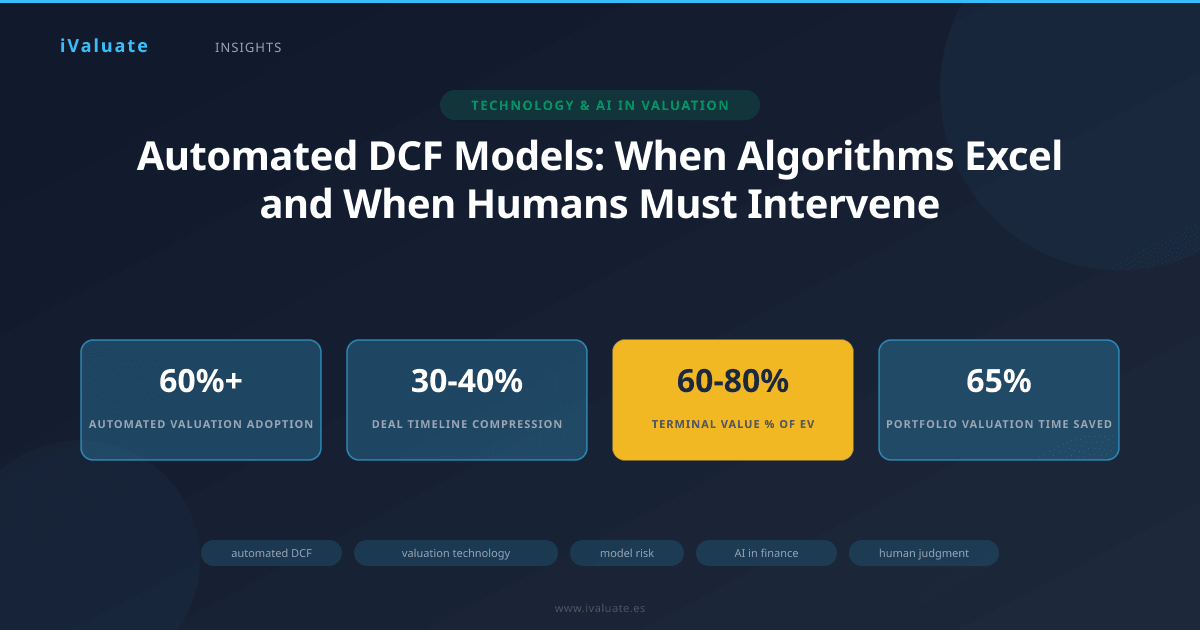
The discounted cash flow model has long been the cornerstone of corporate valuation, yet its implementation has undergone a dramatic transformation. As of early 2025, automated DCF platforms process over 60% of preliminary valuations in middle-market transactions, a figure that has doubled since 2020. This acceleration reflects both technological advancement and market necessity—deal timelines have compressed by 30-40% over the past five years, forcing professionals to embrace automation.
Yet this efficiency comes with a paradox. While automated DCF models can execute complex calculations flawlessly and process vast datasets instantaneously, they remain fundamentally dependent on the quality of inputs and assumptions that only experienced professionals can properly calibrate. Understanding when to trust automation and when to override it has become a critical competency for valuation professionals navigating the 2025-2026 market environment.
01 The Current State of Automated DCF Technology
Modern automated DCF platforms have evolved far beyond simple spreadsheet templates. Today's systems integrate real-time market data, apply machine learning to revenue forecasting, and automatically adjust discount rates based on current market conditions. Leading platforms now incorporate:
- Dynamic WACC calculations that update daily based on risk-free rates, equity risk premiums, and sector-specific betas
- Automated comparable company screening using natural language processing to identify truly comparable businesses
- Revenue forecasting algorithms trained on thousands of historical company trajectories
- Sensitivity analysis engines that can run 10,000+ scenario permutations in seconds
- Integration with financial data providers for automatic population of historical financials
The sophistication is impressive. A mid-market software company valuation that might have required 15-20 hours of analyst time in 2020 can now generate a preliminary DCF output in under 30 minutes using platforms like iValuate and similar tools. The model will pull five years of historical data, project cash flows, calculate terminal value, and produce a detailed sensitivity table—all with minimal human intervention.
A 2024 study by the American Society of Appraisers found that automated DCF models achieved valuations within 8-12% of expert-prepared models for stable, mature businesses with predictable cash flows. However, that accuracy deteriorated to 25-40% variance for high-growth, early-stage, or cyclical businesses.
02 Where Automation Excels: The Sweet Spot
Automated DCF models perform exceptionally well under specific conditions. Understanding these scenarios allows professionals to deploy automation strategically, reserving human judgment for situations where it adds the most value.
Mature, Stable Businesses with Established Track Records
Consider a regional manufacturing company with 15 years of operating history, consistent 4-6% annual revenue growth, stable EBITDA margins around 18%, and predictable capital expenditure patterns. For such businesses, automated models excel because:
- Historical patterns provide reliable forecasting anchors
- Industry comparables are abundant and genuinely comparable
- Working capital movements follow predictable seasonal patterns
- Capital structure decisions align with industry norms
- Terminal growth rates can be confidently pegged to GDP or industry growth
In these situations, the primary value-driver isn't creative forecasting—it's execution speed and consistency. An automated platform can produce a defensible valuation range in a fraction of the time, allowing professionals to focus on transaction structuring, negotiation strategy, or client communication.
Portfolio Monitoring and Preliminary Screening
Private equity firms managing 20-50 portfolio companies have embraced automation for quarterly valuation updates. Rather than having analysts rebuild DCF models each quarter, automated systems ingest updated financials, refresh market data, and flag significant valuation changes. This creates a surveillance system that highlights which portfolio companies require deeper human analysis.
One middle-market PE firm we studied reduced portfolio valuation time by 65% after implementing automated DCF monitoring in 2024, while simultaneously improving the frequency and consistency of their valuations. The key insight: automation handles the routine updates, freeing senior professionals to investigate anomalies and inflection points.
Initial Valuation Ranges for Deal Screening
When evaluating 50+ acquisition targets in a buy-and-build strategy, automated DCF models provide rapid initial screening. A corporate development team can quickly establish preliminary valuation ranges, identify outliers, and prioritize which opportunities warrant detailed analysis. The goal isn't precision—it's efficient capital allocation of analytical resources.
03 The Critical Limitations: When Human Judgment Becomes Indispensable
Despite impressive capabilities, automated DCF models encounter fundamental limitations rooted in the nature of valuation itself. These aren't temporary technological constraints—they reflect the irreducible role of judgment in financial analysis.
Assumption Quality: The Garbage In, Garbage Out Problem
Every DCF model, automated or manual, rests on a foundation of assumptions about future performance. The mathematical precision of discounting cash flows can create a false sense of certainty that masks assumption risk. Automated systems typically default to:
- Extrapolating historical growth rates with statistical smoothing
- Applying industry-average margins and returns on capital
- Using published beta coefficients without adjustment for company-specific factors
- Selecting terminal growth rates based on GDP or inflation forecasts
- Calculating WACC using current market conditions without forward-looking adjustments
These defaults work reasonably well for stable businesses but fail catastrophically when circumstances deviate from historical patterns. Consider three scenarios from 2024-2025 transactions:
Case 1: The SaaS Pivot — A traditional enterprise software company with 15 years of perpetual license revenue began transitioning to a subscription model in 2023. Historical revenue growth of 8-10% annually masked a fundamental business model transformation. An automated DCF, anchored to historical patterns, projected continued modest growth and stable margins. Reality: the transition temporarily depressed revenue by 20% while dramatically improving customer lifetime value and retention. A human analyst recognized that historical patterns were irrelevant; the valuation required modeling the transition curve, customer cohort behavior, and the emerging SaaS economics. The automated model undervalued the business by approximately 35%.
Case 2: The Cyclical Trap — A specialty chemicals manufacturer serving the construction industry showed strong performance through 2023, with revenue growth of 15% and expanding margins. An automated model projected continued growth, applying a modest normalization factor. However, an experienced analyst recognized leading indicators of a construction cycle downturn—rising interest rates, declining building permits, and inventory accumulation. By incorporating cyclical adjustments and stress-testing downside scenarios, the human-adjusted valuation came in 28% below the automated output. Within nine months, the company's performance deteriorated exactly as the experienced analyst anticipated.
Case 3: The Regulatory Inflection — A healthcare services company operated profitably under existing reimbursement structures. Automated models projected steady cash flows based on historical patterns. However, pending regulatory changes threatened to reduce reimbursement rates by 12-15% within 18 months. The automated system, lacking the ability to interpret regulatory developments and assess implementation probability, missed this material risk entirely. Human judgment was required to model multiple regulatory scenarios and probability-weight the outcomes.
Model risk in automated DCF systems doesn't primarily stem from calculation errors—it emerges from the inability of algorithms to recognize when historical patterns have become unreliable guides to future performance.
The Discount Rate Dilemma
Calculating an appropriate discount rate requires layering multiple judgments: risk-free rate selection, equity risk premium estimation, beta calculation and adjustment, size premium application, and company-specific risk assessment. While automated systems can pull current risk-free rates and published betas, they struggle with nuanced adjustments.
In the current 2025-2026 environment, discount rate determination has become particularly challenging. The risk-free rate has stabilized around 4.2-4.5% after the volatility of 2022-2024, but equity risk premiums remain elevated due to geopolitical uncertainty and concerns about AI-driven economic disruption. Published betas for many sectors reflect pre-AI-transformation business models, potentially understating or overstating true systematic risk.
Consider a mid-market logistics company. The automated system applies a published beta of 1.15, reflecting historical correlation with market returns. However, the company has recently invested heavily in AI-powered route optimization and autonomous vehicle technology. Does this increase risk (execution uncertainty, technology adoption challenges) or decrease it (competitive positioning, efficiency gains)? The answer requires understanding the company's specific implementation, management capabilities, and competitive dynamics—judgments that resist automation.
Similarly, size premiums—the additional return required for investing in smaller, less liquid companies—vary significantly based on actual liquidity constraints, not just market capitalization. An automated system might apply a standard 3-4% size premium based on market cap, but the appropriate adjustment depends on ownership structure, shareholder agreements, market depth for similar assets, and transaction-specific factors.
Terminal Value: The Assumption That Drives 60-80% of Value
In most DCF models, terminal value represents 60-80% of total enterprise value, yet it rests entirely on assumptions about perpetual growth rates and exit multiples. Automated systems typically default to conservative approaches: GDP growth rates, inflation rates, or industry-average multiples.
These defaults provide consistency but may dramatically misvalue businesses at inflection points. A company investing heavily in market share expansion might show depressed near-term margins while building sustainable competitive advantages that justify above-GDP perpetual growth. Conversely, a business riding a temporary wave of demand might appear to justify optimistic terminal assumptions when reversion to mean is more appropriate.
The terminal value challenge intensifies for technology-enabled businesses. Should a traditional retailer that has successfully implemented e-commerce and AI-powered inventory management receive a terminal multiple reflecting traditional retail (6-8x EBITDA) or technology-enhanced retail (10-14x EBITDA)? The answer depends on sustainable competitive advantage, replicability by competitors, and long-term margin structure—all requiring human judgment.
04 The Hybrid Approach: Combining Automation with Expert Oversight
The most sophisticated valuation practices in 2025-2026 don't choose between automation and human judgment—they strategically combine both. This hybrid approach recognizes that automation and expertise serve complementary functions.
The Three-Layer Framework
Leading valuation practices have adopted a three-layer approach:
Layer 1: Automated Foundation — Use automated platforms to establish the baseline model structure, populate historical data, calculate standard metrics, and generate preliminary outputs. This layer handles the mechanical aspects: data gathering, calculation accuracy, formatting consistency, and basic sensitivity analysis. Time savings: 60-70% compared to manual model building.
Layer 2: Expert Adjustment — Senior professionals review automated outputs specifically focusing on assumption quality. Key questions include: Are historical patterns reliable predictors? Do current market conditions require discount rate adjustments? Are there business model changes, competitive dynamics, or regulatory developments that invalidate default assumptions? This layer applies judgment to the most value-sensitive inputs.
Layer 3: Scenario Analysis and Validation — Use automation to rapidly model multiple scenarios based on expert-defined parameters. Rather than running a single DCF with best-guess assumptions, professionals define bull, base, and bear scenarios with specific assumption sets, then use automated tools to execute the calculations and generate probability-weighted valuations. This approach acknowledges uncertainty while leveraging computational power.
Practical Implementation: The Assumption Override Protocol
Several leading advisory firms have implemented formal protocols for when to override automated assumptions. Common triggers include:
- Revenue volatility exceeding 15% annually over the past three years
- Significant M&A activity, divestitures, or business model changes in the past 24 months
- Operating margins diverging from industry averages by more than 500 basis points
- Pending regulatory changes affecting more than 10% of revenue
- Customer concentration exceeding 25% with any single customer
- Technology disruption threats or opportunities in the core business model
- Capital structure significantly different from industry norms
When any trigger activates, the automated output becomes a starting point rather than a conclusion. The professional must document specific adjustments and the reasoning behind them.
05 Model Risk Management in Automated DCF Systems
As automated DCF models become more prevalent, model risk management has emerged as a critical discipline. Model risk—the potential for adverse consequences from decisions based on incorrect or misused model outputs—can be particularly insidious with automated systems because the sophistication of the platform can create unwarranted confidence.
Common Sources of Model Risk
Data Quality Issues: Automated systems ingest data from multiple sources, but data errors, inconsistencies, or misclassifications can propagate through the entire model. A misclassified extraordinary expense that gets projected forward, or a one-time revenue spike treated as recurring, can materially distort valuations.
Assumption Anchoring: Default assumptions in automated systems can create anchoring bias, where users insufficiently adjust from the automated starting point. Studies show that even experienced professionals anchor to initial values, adjusting less than they would if building models from scratch.
Black Box Opacity: Some automated platforms use proprietary algorithms for forecasting or risk adjustment. When users don't fully understand how outputs are generated, they can't effectively evaluate whether the methodology suits the specific situation.
Version Control and Auditability: Automated systems that continuously update with new market data can make it difficult to recreate historical valuations or understand what assumptions drove specific outputs. This creates challenges for audit trails and regulatory compliance.
Mitigation Strategies
Professional-grade automated DCF platforms now incorporate several risk mitigation features:
- Transparent assumption logs that document every input and its source
- Mandatory user review and sign-off on key assumptions before finalizing valuations
- Automated reasonableness checks that flag outlier assumptions or results
- Version control systems that preserve historical models and assumptions
- Sensitivity dashboards that highlight which assumptions most impact valuation
- Benchmarking against comparable transactions and market multiples
However, technology alone cannot eliminate model risk. Effective governance requires human oversight, including peer review of significant valuations, regular calibration of automated outputs against manual models, and post-transaction analysis to identify systematic biases.
06 The Future Evolution: AI-Enhanced Judgment, Not AI Replacement
Looking toward 2026 and beyond, the trajectory of automated DCF technology points toward AI-enhanced judgment rather than AI replacement of human expertise. Emerging capabilities include:
Natural Language Processing for Qualitative Factor Integration: Next-generation systems can analyze management discussion and analysis sections, earnings call transcripts, and industry reports to identify qualitative factors that should inform assumptions. Rather than replacing human judgment, these tools surface relevant information that professionals might otherwise miss.
Anomaly Detection and Explanation: Machine learning models trained on thousands of valuations can identify when a specific company's metrics deviate from expected patterns and flag these anomalies for human review. The system might note: "This company's projected margin expansion exceeds 95% of comparable situations—verify competitive advantage sustainability."
Assumption Recommendation with Confidence Intervals: Rather than providing point estimates, advanced systems can offer assumption ranges with confidence levels based on historical accuracy. For example: "Based on 500 comparable situations, revenue CAGR of 8-12% has 70% confidence; 5-15% has 90% confidence." This helps professionals understand assumption uncertainty.
Continuous Learning from Transaction Outcomes: As automated systems track how projected cash flows compare to actual performance, they can identify systematic biases and improve forecasting accuracy. However, this learning must be carefully governed to avoid overfitting to recent market conditions.
07 Practical Guidance for Valuation Professionals
For CFOs, M&A advisors, and valuation professionals navigating the automated DCF landscape in 2025-2026, several practical principles emerge:
Use automation for speed and consistency, not as a substitute for thinking. Automated DCF models excel at executing calculations rapidly and consistently, but they cannot replace the judgment required to assess assumption quality. Treat automated outputs as sophisticated first drafts that require expert review.
Invest time in assumption validation, not model mechanics. The efficiency gains from automation should be redirected toward deeper analysis of key assumptions. Spend less time building spreadsheets and more time understanding business models, competitive dynamics, and industry trends.
Maintain modeling skills even while using automation. Understanding how DCF models work—the mathematical relationships, the sensitivity to key inputs, the common pitfalls—remains essential even when software handles execution. Professionals who lose touch with model mechanics become unable to effectively evaluate automated outputs.
Document assumption rationale explicitly. When overriding automated assumptions, document the specific reasoning. This creates an audit trail, facilitates peer review, and builds institutional knowledge about when standard approaches require adjustment.
Calibrate regularly against market transactions. Periodically compare automated DCF outputs to actual transaction multiples and outcomes. Systematic divergence may indicate that default assumptions need recalibration for current market conditions.
Recognize the limits of precision. A DCF model that calculates value to eight decimal places creates false precision. The inherent uncertainty in assumption-dependent models means that valuation ranges, scenario analysis, and sensitivity testing provide more useful information than point estimates.
08 Conclusion: The Irreducible Role of Human Judgment
The rise of automated DCF models represents genuine progress in valuation practice. The ability to rapidly generate sophisticated analyses, process vast datasets, and execute complex calculations has democratized access to professional-grade valuation tools and accelerated transaction timelines. These efficiency gains are real and valuable.
However, the fundamental nature of valuation—projecting uncertain future cash flows and determining appropriate risk-adjusted discount rates—ensures that human judgment remains irreplaceable. Algorithms can process historical patterns with superhuman speed and consistency, but they cannot assess whether those patterns will persist. They can calculate discount rates with mathematical precision, but they cannot evaluate company-specific risks that don't appear in historical data. They can generate terminal values, but they cannot judge whether a business has sustainable competitive advantages.
The most effective approach combines the complementary strengths of automation and expertise. Automated platforms like iValuate handle the mechanical aspects of model building, data population, and calculation execution, freeing professionals to focus on the judgment-intensive aspects: assumption quality, scenario definition, and risk assessment. This hybrid approach delivers both efficiency and rigor.
As we progress through 2025-2026, the competitive advantage in valuation will increasingly belong to professionals who master this hybrid approach—those who leverage automation for speed and consistency while applying seasoned judgment to the assumptions that drive value. The technology will continue to evolve, but the need for human expertise in navigating uncertainty, interpreting context, and exercising judgment will remain constant. The question isn't whether to use automated DCF models, but how to use them wisely.