Table of Contents10 sections
The due diligence landscape has undergone a fundamental transformation over the past five years. While traditional financial statement analysis and management interviews remain essential, sophisticated investors and advisors now routinely incorporate alternative data sources—satellite imagery, web-scraped information, and social media sentiment—to validate assumptions, identify risks, and refine valuation models. In 2025-2026, these techniques have moved from experimental to mainstream, particularly in private equity, venture capital, and strategic M&A contexts.
The imperative is clear: companies can manipulate quarterly earnings presentations, but they cannot easily fake parking lot traffic, online customer complaints, or supply chain disruptions visible from space. Alternative data provides an independent verification layer that enhances accuracy and reduces information asymmetry between buyers and sellers.
01 The Evolution of Alternative Data in Valuation
Alternative data encompasses any information not found in traditional financial statements, regulatory filings, or company-provided materials. The category has exploded in sophistication and accessibility since 2020, driven by three converging trends: exponentially cheaper data storage, advances in machine learning for pattern recognition, and the proliferation of digital footprints across every aspect of commercial activity.
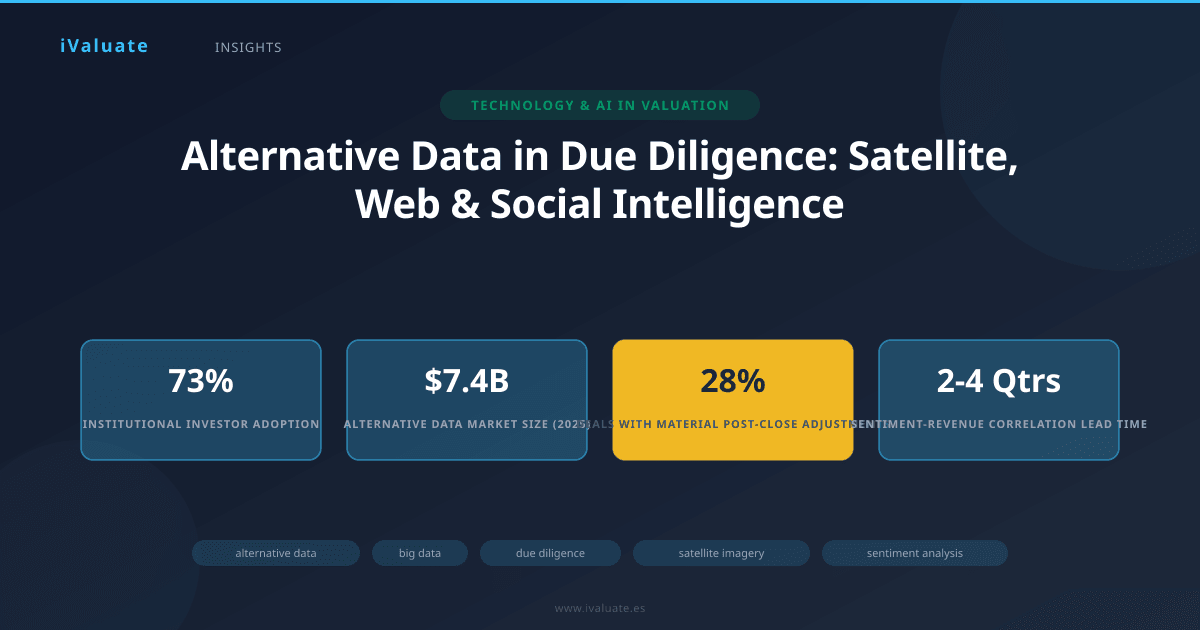
According to recent industry surveys, approximately 73% of institutional investors now incorporate at least one form of alternative data into their investment process, up from 42% in 2020. The alternative data industry itself has grown to an estimated $7.4 billion market in 2025, with projections reaching $137 billion by 2030 as adoption accelerates among mid-market firms and corporate development teams.
Why Traditional Due Diligence Falls Short
Traditional due diligence relies heavily on backward-looking financial statements, management representations, and industry reports that may be months old by the time they're published. This creates several critical blind spots:
- Temporal lag: Financial statements reflect historical performance, often 30-90 days old, while business conditions evolve daily
- Presentation bias: Management teams naturally emphasize positive developments and downplay challenges
- Limited operational visibility: Financial metrics aggregate thousands of transactions but reveal little about underlying operational health
- Competitive intelligence gaps: Traditional sources provide minimal real-time insight into competitive positioning or market share shifts
A 2024 study of 340 middle-market acquisitions found that 28% of deals experienced material post-closing adjustments related to revenue or EBITDA misstatements that could have been identified through alternative data verification. The median adjustment was $4.7 million, representing approximately 8% of transaction value.
02 Satellite Imagery: Eyes in the Sky for Operational Verification
Satellite imagery has emerged as perhaps the most powerful alternative data source for validating operational assumptions in due diligence. Commercial satellite providers now offer sub-meter resolution imagery updated daily or even hourly for critical locations, enabling analysts to track physical activity with remarkable precision.
Retail and Consumer Applications
For retail businesses, parking lot analysis has become standard practice in sophisticated due diligence processes. By analyzing vehicle counts across store locations over time, analysts can:
- Verify management claims about foot traffic trends
- Identify seasonal patterns and their magnitude
- Detect early warning signs of declining customer interest
- Compare performance across locations and against competitors
In a notable 2024 case, a private equity firm evaluating a regional restaurant chain used satellite imagery to count vehicles in parking lots across 47 locations over six months. The analysis revealed that management's claimed 12% same-store sales growth was inconsistent with a 6% decline in parking lot traffic. Further investigation uncovered aggressive revenue recognition practices that had inflated reported performance. The firm reduced its offer by 23% and negotiated enhanced representations and warranties.
Industrial and Manufacturing Insights
For manufacturing and distribution businesses, satellite imagery provides visibility into inventory levels, production activity, and supply chain health. Analysts examine:
- Yard inventory levels at manufacturing facilities
- Shipping container volumes at distribution centers
- Construction activity indicating capacity expansion or contraction
- Environmental compliance issues such as waste discharge or emissions
A 2025 analysis of an automotive parts manufacturer revealed significant inventory accumulation visible in satellite imagery—finished goods stacking up in outdoor storage areas—contradicting management assertions of strong demand and healthy working capital. The imagery prompted deeper investigation into customer order cancellations and ultimately led to a 15% valuation reduction and restructured earnout provisions.
Agricultural and Commodity Sector Applications
In agriculture, forestry, and natural resource sectors, satellite imagery with multispectral and synthetic aperture radar capabilities enables assessment of:
- Crop health and yield estimates through vegetation indices
- Timber inventory and forest management practices
- Mining activity levels and ore stockpile volumes
- Water resource availability and irrigation effectiveness
The technology has become sufficiently sophisticated that analysts can estimate production volumes within 5-8% accuracy for many agricultural operations, providing independent verification of management projections.
03 Web Scraping: Digital Footprints as Performance Indicators
Web scraping—the automated extraction of data from websites—has evolved into a sophisticated discipline that provides real-time insights into customer behavior, pricing dynamics, competitive positioning, and operational performance.
E-commerce and Digital Business Intelligence
For businesses with significant online presence, web scraping enables continuous monitoring of:
- Product pricing and promotional activity
- Inventory availability and stock-out frequency
- Product assortment breadth and new SKU introduction rates
- Customer review volumes, ratings, and sentiment trends
- Search ranking positions for key terms
- Website traffic estimates and engagement metrics
A mid-market private equity firm evaluating a direct-to-consumer brand in early 2025 deployed web scraping across the target's website and major e-commerce platforms. The analysis revealed that 23% of the company's top-selling SKUs had experienced stock-outs lasting more than seven days in the previous quarter—a significant operational red flag not disclosed in management presentations. The finding prompted investigation into supply chain vulnerabilities and working capital requirements, ultimately leading to a $3.2 million adjustment in working capital assumptions.
Competitive Intelligence and Market Share Analysis
Web scraping enables sophisticated competitive analysis that would be impossible through traditional methods:
- Tracking competitor pricing strategies and promotional calendars
- Monitoring new product launches and feature additions
- Analyzing job posting volumes as a proxy for growth investment
- Assessing marketing spend through digital advertising presence
- Estimating relative market share through search visibility and review volumes
In technology sector due diligence, scraping GitHub repositories, Stack Overflow discussions, and developer forums provides insight into product adoption, technical debt, and competitive positioning that financial statements cannot reveal. A 2024 analysis of a B2B SaaS company found that declining GitHub star counts and reduced developer community engagement preceded a material slowdown in new customer acquisition by approximately four months—providing early warning that traditional metrics missed.
Pricing and Revenue Verification
For businesses with transparent online pricing, web scraping enables independent revenue estimation by combining:
- Published pricing across product lines
- Estimated transaction volumes from various proxies
- Promotional discount frequency and depth
- Product mix shifts over time
These bottom-up revenue estimates serve as a reality check on management projections. Discrepancies of more than 10-15% warrant investigation and often reveal optimistic assumptions or accounting irregularities.
04 Social Media and Sentiment Analysis: The Voice of the Customer
Social media platforms have become vast repositories of unfiltered customer opinion, employee sentiment, and market perception. Natural language processing and sentiment analysis tools now enable systematic extraction of insights from millions of social media posts, reviews, and comments.
Customer Sentiment as a Leading Indicator
Customer sentiment analysis examines reviews, social media mentions, and online discussions to assess:
- Overall brand perception and trajectory
- Product quality issues and complaint patterns
- Customer service effectiveness
- Competitive positioning in customer minds
- Emerging reputational risks
Research demonstrates that shifts in social media sentiment typically lead changes in financial performance by 2-4 quarters. A 2024 study analyzing 180 consumer brands found that a 10-point decline in net sentiment score (positive minus negative mentions) correlated with a 3.2% reduction in revenue growth over the subsequent six months, controlling for other factors.
In a 2025 retail acquisition, sentiment analysis of 47,000 customer reviews and social media mentions revealed a troubling pattern: while overall ratings remained strong at 4.2 stars, negative reviews increasingly focused on product quality deterioration following a manufacturing relocation 18 months earlier. The sentiment analysis prompted physical product testing that confirmed quality issues, leading to a $6.8 million adjustment for anticipated returns and warranty claims.
Employee Sentiment and Cultural Due Diligence
Platforms like Glassdoor, Indeed, and Blind provide unprecedented visibility into employee sentiment, cultural issues, and organizational health. Sophisticated analysis examines:
- Overall employee satisfaction trends
- Leadership approval ratings and trajectory
- Specific complaints about compensation, culture, or management
- Turnover indicators such as farewell posts on LinkedIn
- Diversity and inclusion perceptions
Employee sentiment has proven particularly valuable in identifying cultural integration risks in M&A. A 2024 analysis found that acquisitions where target company employee sentiment declined by more than 15 points in the six months pre-closing experienced 2.3x higher key employee turnover in the first year post-closing, directly impacting synergy realization.
Crisis Detection and Reputational Risk
Social listening tools can identify emerging crises before they appear in traditional media or financial results. Sudden spikes in negative mentions, particularly around specific themes (product safety, data breaches, executive misconduct), provide early warning of potential value destruction.
In one notable case, social media monitoring detected a surge in complaints about a food manufacturer's products causing illness three weeks before the issue appeared in regulatory filings or mainstream media. The private equity firm conducting due diligence immediately paused the process, avoiding a transaction that would have closed just days before a major product recall that destroyed 40% of the company's enterprise value.
05 Integration into Valuation Models: From Data to Decisions
The true value of alternative data emerges not from collection but from systematic integration into valuation frameworks. Leading practitioners have developed sophisticated approaches to translate alternative data insights into quantitative adjustments.
Revenue and Growth Rate Adjustments
Alternative data most directly impacts revenue projections and growth assumptions:
- Satellite parking lot trends: Declining traffic typically translates to 0.6-0.8x revenue impact (e.g., 10% traffic decline suggests 6-8% revenue decline)
- Web traffic and engagement: Changes in unique visitors or session duration correlate 0.4-0.6x with revenue for digital businesses
- Social sentiment shifts: Major sentiment deterioration (>20 points) suggests 2-5% revenue headwinds over subsequent quarters
- Competitive web presence: Loss of search ranking or review volume share indicates 3-7% market share erosion
These relationships vary by industry and business model, requiring calibration against historical data. However, they provide quantitative frameworks for adjusting management projections based on alternative data signals.
Risk Premium and Discount Rate Implications
Alternative data also informs cost of capital assumptions by revealing operational, competitive, or reputational risks not apparent in financial statements:
- Significant inventory accumulation (satellite imagery) may warrant 50-100 basis point increase in WACC due to working capital risk
- Deteriorating employee sentiment suggesting retention challenges may add 25-75 basis points for execution risk
- Emerging product quality issues in social media may require 50-150 basis point premium for reputational risk
A comprehensive 2025 framework developed by a leading valuation advisory firm incorporates alternative data risk factors into a structured discount rate adjustment matrix, with typical impacts ranging from 25 to 200 basis points depending on severity and business model sensitivity.
Scenario Analysis and Probability Weighting
Perhaps most powerfully, alternative data enables more sophisticated scenario modeling. Rather than relying solely on management's base case, analysts can construct independent scenarios based on alternative data signals:
- Base case: Management projections adjusted for systematic optimism (typically 10-15% haircut)
- Alternative data case: Projections derived from satellite, web, and social data trends
- Downside case: Incorporating risks identified through alternative data analysis
These scenarios receive probability weights based on the strength and consistency of alternative data signals. When alternative data strongly contradicts management assertions, probability weighting shifts significantly toward more conservative scenarios.
06 Practical Implementation: Building Alternative Data Capabilities
Implementing alternative data analysis requires thoughtful approach to vendor selection, internal capability building, and process integration.
Vendor Landscape and Selection
The alternative data vendor ecosystem has matured significantly, with specialized providers for each data category:
- Satellite imagery: Orbital Insight, RS Metrics, Spaceknow (pricing typically $15,000-$75,000 per analysis depending on scope)
- Web scraping and analytics: Similarweb, Apptopia, Sensor Tower ($25,000-$150,000 annual subscriptions for professional tiers)
- Sentiment analysis: Brandwatch, Sprinklr, Talkwalker ($30,000-$200,000 annually depending on volume)
- Integrated platforms: Thinknum, YipitData, 1010data (custom pricing based on data sets and user count)
Vendor selection should consider data quality, update frequency, historical depth, API accessibility, and analytical tools provided. Many firms adopt a hybrid approach: subscriptions to core platforms supplemented by project-based engagements for specialized analyses.
Building Internal Expertise
Effective alternative data utilization requires cross-functional expertise:
- Data scientists: For scraping, processing, and statistical analysis
- Industry specialists: To interpret signals within business context
- Valuation professionals: To translate insights into quantitative adjustments
- Legal/compliance: To ensure data acquisition and use complies with regulations
Leading private equity firms and advisory practices have established dedicated alternative data teams of 3-8 professionals supporting deal teams. Mid-market firms increasingly partner with specialized consultancies or fractional resources rather than building full in-house capabilities.
Process Integration and Quality Control
Alternative data analysis should be integrated into standard due diligence workflows rather than treated as an afterthought:
- Week 1-2: Initial alternative data scans to identify red flags or areas requiring deeper investigation
- Week 3-4: Detailed analysis of priority areas, with findings informing management interview questions
- Week 5-6: Reconciliation of alternative data insights with traditional due diligence findings
- Week 7-8: Integration into valuation models and investment committee materials
Quality control requires triangulation across multiple data sources and validation against known benchmarks. No single alternative data signal should drive major valuation adjustments without corroboration from traditional due diligence or other alternative sources.
07 Legal, Ethical, and Regulatory Considerations
The alternative data revolution has outpaced regulatory frameworks, creating gray areas that require careful navigation.
Data Privacy and Compliance
Web scraping and social media analysis must comply with:
- Website terms of service and robots.txt protocols
- GDPR and CCPA requirements for personal data handling
- Computer Fraud and Abuse Act restrictions on unauthorized access
- Platform-specific API terms and rate limits
Leading practitioners maintain strict protocols: scraping only publicly available information, respecting technical and legal access restrictions, anonymizing personal data, and maintaining audit trails of data sources and methodologies.
Material Non-Public Information Concerns
Alternative data analysis occasionally uncovers information that may constitute material non-public information (MNPI), particularly in public company contexts. Firms have established protocols:
- Legal review of potentially material findings before use
- Information barriers between alternative data teams and trading desks
- Documentation of data sources and public availability
- Consultation with securities counsel on edge cases
The SEC has provided limited guidance, generally indicating that information derived from publicly available sources through legal means does not constitute MNPI, but each situation requires fact-specific analysis.
Ethical Considerations
Beyond legal compliance, ethical questions arise around surveillance capitalism and privacy expectations. Best practices include:
- Focusing on aggregate patterns rather than individual tracking
- Avoiding analysis of sensitive personal information
- Transparency with counterparties about alternative data use
- Respecting reasonable privacy expectations even where legally permissible
Industry standards continue to evolve, with professional organizations developing frameworks for responsible alternative data use in financial analysis.
08 Case Study: Multi-Source Alternative Data in Action
A comprehensive example illustrates the power of integrated alternative data analysis. In mid-2025, a private equity firm evaluated a specialty retailer with 230 locations across the southeastern United States. Management projected 8% same-store sales growth and EBITDA margin expansion from 12.5% to 14.2% over three years, supporting a 9.2x EBITDA valuation.
The firm deployed comprehensive alternative data analysis:
Satellite imagery analysis of 45 representative locations over 12 months revealed parking lot traffic declining 4% year-over-year, contradicting management's growth narrative. Seasonal patterns showed particular weakness in Q4 2024, the critical holiday period.
Web scraping of the company's e-commerce platform and major marketplaces showed inventory availability declining from 94% to 87% over six months, with stock-outs concentrated in top-selling SKUs. Promotional frequency increased 35%, with average discount depth rising from 22% to 31%, suggesting margin pressure.
Sentiment analysis of 12,400 customer reviews and social media mentions revealed net sentiment declining from +42 to +28 over 12 months. Negative reviews increasingly cited product quality issues (up 67%) and customer service problems (up 43%). Employee reviews on Glassdoor showed satisfaction declining from 3.8 to 3.2 stars, with specific complaints about understaffing and compensation.
The integrated analysis suggested:
- Revenue growth likely 2-4% rather than 8%, based on traffic trends and competitive dynamics
- Margin expansion unlikely given promotional intensity and operational challenges
- Execution risk elevated due to employee satisfaction issues
- Working capital requirements higher than projected due to inventory management problems
The firm revised its valuation to 7.1x EBITDA (23% reduction) and restructured the deal with 30% of consideration in earnouts tied to verified performance metrics. Post-closing performance validated the alternative data analysis: actual same-store sales growth was 2.8% in year one, with EBITDA margins declining to 11.9% due to promotional pressure and wage increases needed to address retention issues.
09 The Future: AI, Real-Time Data, and Predictive Analytics
Alternative data capabilities continue to evolve rapidly. Several trends will shape the next phase:
Artificial Intelligence and Pattern Recognition
Machine learning models increasingly identify subtle patterns across massive datasets that human analysts would miss. Computer vision algorithms analyze satellite imagery at scale, detecting changes in parking lot configurations, building expansions, or inventory patterns across thousands of locations simultaneously. Natural language processing extracts nuanced sentiment and topic trends from millions of social media posts, identifying emerging issues before they become obvious.
Real-Time Integration
Alternative data is moving from periodic analysis to continuous monitoring. Leading firms now maintain dashboards tracking key alternative data metrics for portfolio companies and acquisition targets, enabling rapid response to emerging trends. By 2026, real-time alternative data feeds are becoming standard components of investment monitoring systems.
Predictive Modeling
The frontier involves using alternative data to build predictive models of business performance. Early research demonstrates that machine learning models incorporating satellite, web, and social data can predict quarterly revenue within 3-5% accuracy for many business models—often more accurately than management guidance. These capabilities will increasingly enable forward-looking valuation approaches grounded in real-time operational data rather than historical financials.
10 Conclusion: Alternative Data as Competitive Imperative
Alternative data has transitioned from experimental technique to essential component of sophisticated due diligence and valuation. The information asymmetry advantages it provides—independent verification of management claims, early warning of operational issues, real-time competitive intelligence—have become too significant to ignore in competitive transaction environments.
Firms that have invested in alternative data capabilities consistently achieve better acquisition outcomes: more accurate valuations, fewer post-closing surprises, and enhanced negotiating positions. The performance gap between alternative data adopters and traditional practitioners continues to widen as data sources proliferate and analytical techniques advance.
However, alternative data is not a replacement for traditional due diligence but rather a powerful complement. The most effective approach combines rigorous financial analysis, operational due diligence, and management assessment with systematic alternative data verification. Each methodology addresses different aspects of investment risk and opportunity.
For valuation professionals, corporate development teams, and investment advisors, the imperative is clear: develop alternative data capabilities now or risk systematic disadvantage in deal execution and portfolio management. The learning curve is significant, requiring new skills, vendor relationships, and analytical frameworks. But the competitive advantage—and risk mitigation—justify the investment.
As the alternative data ecosystem continues to mature, platforms like iValuate are increasingly integrating these capabilities into comprehensive valuation workflows, enabling professionals to leverage satellite imagery, web analytics, and sentiment data alongside traditional financial modeling. The future of valuation lies in this synthesis: combining time-tested methodologies with cutting-edge data sources to achieve unprecedented accuracy and insight. Those who master this integration will define best practice for the next generation of corporate valuation and due diligence.