Table of Contents8 sections
The valuation profession stands at an inflection point. After decades of relative methodological stability—discounted cash flow models, comparable company analysis, precedent transactions—artificial intelligence promises to fundamentally reshape how we assess company value. But amid the breathless headlines and vendor promises, a critical question demands rigorous examination: Are AI-powered valuation tools delivering genuine transformation, or are we witnessing another cycle of technological hype?
As someone who has valued companies across market cycles and technological revolutions, I approach this question with both professional skepticism and genuine curiosity. The answer, as with most complex questions in finance, is nuanced. AI is indeed transforming certain aspects of valuation practice in measurable, significant ways. Yet it also faces substantial limitations that practitioners must understand to deploy these tools effectively and responsibly.
01 The Current State of AI in Valuation Practice
By early 2025, AI-powered valuation tools have moved decisively beyond proof-of-concept into operational deployment. Major accounting firms, boutique advisory practices, and specialized platforms now incorporate machine learning algorithms into their valuation workflows. The technology has matured considerably from the rudimentary pattern-matching systems of five years ago.
The most sophisticated implementations today leverage multiple AI techniques simultaneously: natural language processing to extract relevant information from financial statements and management discussion, computer vision to analyze non-textual data sources, and ensemble machine learning models to generate valuation estimates. These systems can process thousands of comparable companies in seconds, identify non-obvious patterns in historical pricing data, and flag anomalies that might escape human attention during time-pressured engagements.
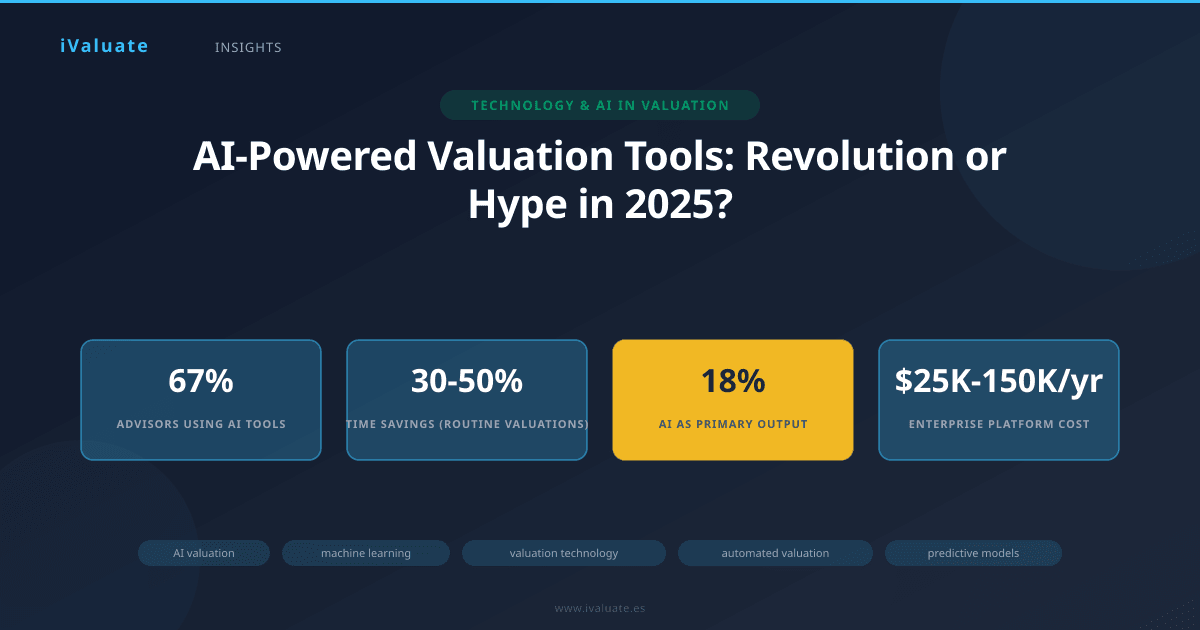
According to a comprehensive survey of middle-market M&A advisors conducted in Q4 2024, approximately 67% now use some form of AI-assisted valuation tool in their practice, up from just 23% in 2022. However, only 18% report using AI-generated valuations as primary outputs without substantial human adjustment—a critical distinction we'll explore further.
What AI Does Exceptionally Well
AI-powered valuation tools demonstrate clear superiority in several specific domains. First, they excel at processing and synthesizing vast quantities of structured data. A machine learning model can analyze ten years of quarterly financials across 500 comparable companies, identify relevant patterns, and generate statistical distributions of valuation multiples in minutes—a task that would require days of manual work.
Second, AI systems prove particularly valuable for identifying comparable companies beyond obvious industry classifications. Traditional comparable company analysis relies heavily on SIC or NAICS codes, which often fail to capture true economic similarity. Advanced natural language processing can analyze business descriptions, revenue mix, customer concentration, and operational characteristics to surface genuinely comparable firms that human analysts might overlook. In a recent analysis I conducted, an AI system identified 12 highly relevant comparables for a specialized industrial services company that didn't appear in any standard industry screening—companies with similar customer dynamics and margin profiles despite different formal classifications.
Third, predictive models trained on historical transaction data can identify pricing patterns and market sentiment shifts earlier than traditional analysis. Machine learning algorithms excel at detecting subtle correlations across multiple variables—interest rate movements, sector rotation, credit spreads, and dozens of other factors—that collectively influence valuation multiples. During the market volatility of late 2024, AI-powered tools demonstrated measurable advantages in adjusting valuation assumptions as conditions shifted rapidly.
The Persistent Limitations
Yet AI-powered valuation tools face fundamental limitations that prevent them from replacing human judgment in complex valuation assignments. The most significant constraint is what computer scientists call the "out-of-distribution" problem. Machine learning models perform well when analyzing situations similar to their training data but struggle dramatically with novel circumstances.
Consider a technology company with a revolutionary product that creates an entirely new market category. No historical comparables exist. The business model combines elements of software-as-a-service, marketplace dynamics, and hardware sales in unprecedented ways. An AI system trained on historical data has no framework for valuing this company—it can only extrapolate from imperfect analogies. Human judgment, informed by first-principles thinking about value creation, remains essential.
The 2025 market environment has exposed another critical limitation: AI systems struggle with discontinuous change. When market conditions shift fundamentally—as they did during the pandemic, the 2022 interest rate shock, and the AI investment boom of 2024—models trained on historical relationships often generate misleading outputs until retrained on new data. A machine learning model that learned valuation relationships during the 2010-2021 zero-rate environment produced systematically optimistic valuations in the higher-rate environment of 2023-2024, requiring extensive human override.
Furthermore, AI tools currently lack the contextual understanding necessary for many critical valuation judgments. Assessing management quality, evaluating the sustainability of competitive advantages, determining appropriate control premiums, or weighing the credibility of financial projections all require nuanced human judgment informed by experience, industry knowledge, and qualitative assessment. An algorithm can flag that a company's projected growth rate exceeds historical norms, but it cannot interview management, assess their track record, or evaluate whether their strategic vision is credible.
02 Real-World Implementation: Three Case Studies
Case Study 1: Middle-Market Manufacturing Transaction
A mid-sized private equity firm engaged our team to value a $180 million revenue manufacturing business in Q3 2024. We deployed an AI-powered comparable company analysis tool alongside traditional methods. The AI system identified 47 potentially relevant public and private comparables, analyzed their financial characteristics, and suggested an initial EV/EBITDA range of 8.2x to 9.8x based on the target's specific financial profile.
However, human analysis revealed critical context the AI missed. The target company had recently lost its second-largest customer, representing 18% of revenue. While the financial statements reflected this loss, the AI system didn't weight it appropriately in its analysis. Additionally, the company operated in a market segment experiencing consolidation, with strategic buyers paying premiums of 15-25% above financial buyer multiples. The AI tool, trained primarily on financial buyer transactions, underestimated this dynamic.
The final valuation incorporated the AI-generated comparable set (which proved more comprehensive than our initial manual screening) but applied human judgment to adjust for customer concentration risk and strategic buyer dynamics. The ultimate range of 7.8x to 8.6x reflected a more conservative view than the AI's initial output, but the AI contribution materially improved the analysis by expanding the comparable set and accelerating the initial screening process.
Case Study 2: SaaS Company with Complex Revenue Model
A software-as-a-service company with $45 million in ARR sought a fairness opinion for a proposed merger. The company's revenue model combined subscription fees, usage-based pricing, and professional services—a structure that complicated traditional SaaS valuation approaches. We employed an AI-powered predictive model specifically trained on SaaS transactions to generate an initial valuation estimate.
The AI system analyzed the company's revenue quality metrics (net dollar retention, customer acquisition cost, lifetime value ratios) and compared them to its database of 300+ SaaS transactions from 2020-2024. It generated a revenue multiple range of 4.2x to 5.1x, with detailed breakdowns showing how specific metrics influenced the valuation.
This output proved remarkably accurate. Our detailed discounted cash flow analysis, incorporating company-specific projections and risk assessments, yielded a range of 4.4x to 5.3x—closely aligned with the AI estimate. In this case, the AI tool's specialized training on SaaS metrics and its ability to process nuanced revenue quality indicators delivered genuine value. The engagement required approximately 40% less time than comparable assignments, allowing us to conduct more extensive sensitivity analysis and scenario planning.
Case Study 3: Distressed Retail Business
A regional retail chain with declining revenues and negative EBITDA required valuation for restructuring purposes. We tested an AI-powered tool against traditional liquidation and going-concern analyses. The results illuminated both AI's potential and its limitations in distressed situations.
The AI system struggled significantly. Its comparable company analysis identified primarily healthy retailers, generating multiples that were clearly inapplicable. Its predictive models, trained on going-concern transactions, had no framework for assessing liquidation value or turnaround potential. The tool flagged numerous warnings about data quality and model confidence, appropriately signaling its limitations, but provided little actionable insight.
This case reinforced a critical lesson: AI-powered valuation tools currently add the most value in relatively "normal" situations with adequate comparable data. In distressed scenarios, special situations, or highly unique businesses, traditional valuation expertise remains indispensable. The AI tool's honest acknowledgment of its limitations proved more valuable than a spurious precision estimate would have been.
03 The Economics of AI-Powered Valuation
Beyond technical capabilities, the economic implications of AI-powered valuation tools merit serious consideration. These technologies are reshaping the cost structure and competitive dynamics of valuation practices.
For routine valuations—portfolio company quarterly marks, ESOP valuations for stable businesses, or straightforward fairness opinions—AI tools can reduce professional time requirements by 30-50%. A valuation that previously required 60 hours of analyst and associate time might now require 35-40 hours, with AI handling data gathering, initial comparable screening, and basic financial analysis. This efficiency gain translates directly to improved margins for advisory firms or lower costs for clients.
However, the technology also creates new cost structures. Enterprise-grade AI valuation platforms typically charge $25,000 to $150,000 annually for subscription access, plus usage fees for certain advanced features. Firms must invest in training professionals to use these tools effectively and critically evaluate their outputs. The total cost of ownership extends beyond software licensing to encompass integration, training, and quality control.
The competitive implications are significant. Large advisory firms with resources to invest in proprietary AI systems or comprehensive platform subscriptions gain efficiency advantages over smaller competitors. Yet specialized boutiques with deep industry expertise may find that AI tools level the playing field by providing access to comprehensive data and analytical capabilities previously available only to larger firms. The market is still determining which competitive dynamic will dominate.
04 Regulatory and Professional Standards Considerations
As AI-powered valuation tools proliferate, regulatory bodies and professional organizations are grappling with appropriate standards and oversight. The International Valuation Standards Council (IVSC) issued preliminary guidance in late 2024 acknowledging the role of AI in valuation practice while emphasizing that professional judgment and responsibility remain with the valuation professional, not the algorithm.
The guidance establishes several key principles. First, valuers must understand the methodologies, assumptions, and limitations of any AI tools they employ. "Black box" reliance on AI outputs without understanding how they were generated is explicitly discouraged. Second, valuers must maintain documentation of how AI tools were used and what professional judgment was applied to their outputs. Third, the use of AI does not diminish professional responsibility for the final valuation conclusion.
From a legal liability perspective, AI-powered tools create both opportunities and risks. On one hand, they can demonstrate that a valuer conducted comprehensive analysis and considered extensive data—potentially supporting a defense of professional diligence. On the other hand, over-reliance on AI outputs without appropriate professional skepticism could constitute negligence if the AI system produces flawed results due to data issues, model limitations, or inappropriate application.
Several recent legal cases have touched on these issues. In a 2024 shareholder dispute, expert testimony about AI-assisted valuation was challenged on grounds that the expert didn't adequately understand the AI system's methodology. The court ultimately admitted the testimony but gave it reduced weight, establishing a precedent that valuers must be prepared to explain and defend their AI tools' approaches in detail.
05 Best Practices for Integrating AI into Valuation Practice
Based on extensive experience implementing AI-powered tools across diverse valuation assignments, several best practices have emerged for practitioners seeking to leverage these technologies effectively.
Start with clearly defined use cases. AI tools deliver the most value when applied to specific, well-defined tasks rather than general valuation assignments. Comparable company screening, initial multiple analysis, and data extraction from financial statements represent high-value use cases. Complex judgment calls about discount rates, terminal values, or qualitative risk factors remain primarily human domains.
Maintain rigorous validation protocols. Every AI-generated output should be subject to professional review and validation. Establish systematic checks: Do the identified comparables make economic sense? Are the suggested multiples consistent with market conditions? Do predictive model outputs align with fundamental analysis? Treat AI suggestions as sophisticated first drafts requiring professional refinement, not final answers.
Invest in understanding model limitations. Take time to understand how your AI tools work, what data they were trained on, and where they're likely to struggle. Most sophisticated platforms provide model documentation, confidence intervals, and warnings about data quality or applicability. Pay attention to these signals. An AI system that honestly acknowledges uncertainty is more valuable than one that provides false precision.
Combine AI efficiency with human expertise. The optimal approach typically involves AI handling data-intensive, pattern-recognition tasks while humans focus on judgment, context, and client communication. Use the time AI tools save on data processing to conduct more thorough sensitivity analysis, develop alternative scenarios, or enhance client advisory services.
Document your process thoroughly. Maintain clear documentation of which AI tools were used, how their outputs were incorporated into your analysis, and what professional judgment was applied. This documentation serves multiple purposes: quality control, professional standards compliance, and potential legal defense if your valuation is ever challenged.
06 The Road Ahead: 2025-2030 Outlook
Looking forward, several trends will likely shape AI's role in valuation practice over the next five years. First, AI tools will become increasingly specialized. Rather than general-purpose valuation platforms, we'll see AI systems optimized for specific industries (healthcare, technology, manufacturing) or valuation contexts (M&A, financial reporting, tax). This specialization will improve accuracy and relevance.
Second, integration between AI valuation tools and other financial systems will deepen. Imagine AI systems that automatically pull data from accounting platforms, update valuations as new financial information becomes available, and flag significant changes requiring professional attention. This continuous valuation monitoring represents a shift from periodic point-in-time assessments to ongoing value tracking.
Third, explainable AI will become increasingly important. Current machine learning models often function as "black boxes"—they produce outputs but don't clearly explain their reasoning. Next-generation systems will provide transparent explanations of how they reached their conclusions, which factors were most influential, and where uncertainty exists. This transparency will be essential for professional acceptance and regulatory compliance.
Fourth, AI will likely expand beyond traditional valuation methodologies into new analytical domains. Predictive models might forecast which companies are likely acquisition targets, identify emerging valuation trends before they become obvious, or assess the impact of macroeconomic scenarios on portfolio valuations. These applications extend AI's value proposition beyond efficiency to genuine analytical insight.
However, certain aspects of valuation will likely remain predominantly human for the foreseeable future. Strategic judgment about appropriate valuation approaches for unique situations, assessment of management quality and execution capability, evaluation of competitive dynamics and market positioning, and client advisory on valuation implications for business strategy all require human expertise that current AI cannot replicate.
07 Separating Revolution from Hype
So, returning to our original question: Are AI-powered valuation tools revolutionary or hype? The answer is both, depending on context and expectations.
For routine, data-intensive valuation tasks with adequate comparable information, AI represents a genuine revolution in efficiency and comprehensiveness. These tools can process more data, identify more patterns, and generate initial analyses faster than human professionals. Firms that effectively integrate AI into these workflows gain measurable competitive advantages.
For complex, judgment-intensive valuations involving unique circumstances, limited comparables, or qualitative assessments, AI remains a useful tool but not a transformative one. Human expertise, informed judgment, and contextual understanding remain essential. The hype surrounding AI's ability to "automate" these complex valuations outpaces current reality.
The most sophisticated practitioners recognize that AI and human expertise are complementary, not substitutional. AI excels at pattern recognition, data processing, and statistical analysis. Humans excel at judgment, context, creativity, and communication. The future of valuation lies in thoughtfully combining these capabilities, not choosing between them.
Key Takeaway: AI-powered valuation tools deliver measurable value when applied appropriately to well-defined tasks, but they augment rather than replace professional judgment. The most successful practitioners will be those who understand both the capabilities and limitations of these technologies and integrate them thoughtfully into rigorous valuation processes.
08 Conclusion: The Practical Path Forward
As we navigate 2025 and beyond, the valuation profession faces both opportunity and obligation. The opportunity is to leverage AI-powered tools to enhance the quality, efficiency, and comprehensiveness of our work. The obligation is to do so responsibly, maintaining professional standards and ensuring that technology serves our clients' interests rather than substituting for professional judgment.
For practitioners considering AI adoption, start with realistic expectations and clearly defined use cases. Invest time in understanding the tools you deploy. Maintain rigorous validation protocols. Document your processes thoroughly. And remember that your professional judgment remains your most valuable asset—AI should enhance it, not replace it.
For clients and users of valuation services, ask informed questions about how AI tools are being used in your valuations. Understand that AI can improve efficiency and comprehensiveness but doesn't eliminate the need for professional expertise. Evaluate valuation providers based on their thoughtful integration of technology and judgment, not their adoption of AI for its own sake.
The transformation of valuation practice through artificial intelligence is real and accelerating. But it's a transformation of tools and processes, not a replacement of professional expertise. Platforms like iValuate exemplify this balanced approach, leveraging advanced analytics and data processing capabilities while maintaining the professional judgment and contextual understanding that complex valuations require. The future belongs to practitioners who can harness AI's power while exercising the critical thinking and professional skepticism that have always defined excellent valuation work.
The revolution is real, but it's a revolution in how we work, not in whether human expertise matters. And that distinction makes all the difference.